On this page
-
Text (6)
-
CoMMBBdAivj THE LEAPEB 703
-

COMMERCIAL. _ : -A-
-
money on deposit to lend, is now so univ...
-
REDUCTION IN THE RATE OF DISCOUNT. On Th...
-
MONEY MARKET & STOCK EXCHANGE
-
Cily, Friday-15veiling-. In the money ma...
Note: This text has been automatically extracted via Optical Character Recognition (OCR) software. The text has not been manually corrected and should not be relied on to be an accurate representation of the item.
-
-
Transcript
-
Note: This text has been automatically extracted via Optical Character Recognition (OCR) software. The text has not been manually corrected and should not be relied on to be an accurate representation of the item.
Additionally, when viewing full transcripts, extracted text may not be in the same order as the original document.
27th Foot, And Paymaster Sewell Dth R»™ ...
to obtain intelligence of M . Adolphe Schlagentweit ^ a German , ' and . a protege of Prince Albert , than of Connolly , Stoddart , or Wyburd . This has excited some indignation in India . A rich , yellow . shell marble at Agra has been brought into notice by Mr . : Gubbins . The carriage nuisance in Calcutta is likely to be amended , for with the growth of English enterprise , it is proposed to establish a Calcutta Suburban and Mofussil Omnibus'and'Carriage Company ( Limited ) .
Commbbdaivj The Leapeb 703
CoMMBBdAivj THE LEAPEB 703
Commercial. _ : -A-
COMMERCIAL . _ : -A-
Money On Deposit To Lend, Is Now So Univ...
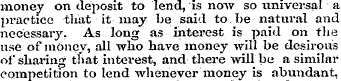
money on deposit to lend , is now so universal a practice that it may be said to . be natural and necessary . As long as interest is paid on the use of money , all who have money will be desirous of sharing that interest , and there will be a similar competition to lend whenever ' money is abundant , lind a similar withdrawal from loans whenever apprehensions are entertained that money will be wanted ,, whether joint-stock or other banks be employed as convenient instruments for using the money . It could be easily shown , were it now necessary , that joint-stock bunks , with large deposits , can make more of money than individuals , and that it is really advantageous to them and- to the community , that joint-stock banks and other institutions like them should exist ; We must
CHARGE AGAINST THE JOINT-STOCK BANKS . IT is said that the " action of the deposit-receiving joint-stock banks is of a character to aggravate the incipient mischief" in the money market at . a time of pressure . These " monied establishments " are accused of precipitating the late crash in the Stock Exchange by rigorously calling in loans on all descriptions of securities , 'while they are now in a peculiarly difficult position , overloaded with money , for which they have to pay interest , and cannot find safe customers . That banks should receive
disposed to increase it , did he remai'k that it is one of the means by which a territorial aristocracy is subverted by a monied aristocracy , instead of . a healthy democracy . Old wrong is continued by a new , more subtle , " and more rapacious wrong . But the effects of legislation are generally different from the intentions of the legislature , and we therefore cannot' be surprised that the Parliament , without intending it , as it is much against the interests of its most influential members , should have contributed very much to the tendency of money to accumulate in masses . Let those who now declaim against joint-stock
banks remember that they arc exclusively the offspring of modern legislation . Not that associations for the purposes of banking are essentially injurious . They have to a great extent existed almost as long as banking itself . The Bank of England is a joint-stock bank . All the Scotch banks of importance are joint-stock bank ? . Such associations are natural and . necessary , and they have long existed in England in the form of private banks , though they were restricted in the number of their ° partners , and hampered in their operations by the legal monopoly conferred on the Bank of England . After the great revolutionary war had driven all commercial transactions athwart thsir usual channels—after the Bank Suspension Act-had dcranrre'd the whole . monetary system , and
tumbled all credit from its just foundation , some of the resulting disorders manifested themselves in our private banks . Of course , the Bank of England was sustained by legislation , and the whole power of the community guarded it from suffering . The calamity fell on the private banks ' ' on the community which sheltered the Bank of England from harm . Then , soon after the peace of 1815 , when hasty , illtimed , incongruous , and even scandalous legislation—such as corn laws—was the ordinary product of Tory and ¦ -aristocratic brains , before observation had found in commercial restrictions the pauses of ' the vast disorders which prevailed between 1815 and 1830 , an alarmed and ignorant public , led by journalists unacquainted with the lavs of social science , and a Parliament more eager to ant than to learn—for if it learned it would
the same kind of panic- —particularly if it had no good foundation—as " the returning abundance of money may make us suspect , would have been felt by them all . We believe it would not . a false opinion or sentiment is liable to correction , in proportion as great numbers are affected by it , and . therefore we say ; that ' the best correction of money . panics , is to diffuse the _ resources of the money market amongst many individuals , exposing all to unrestricted competition , which will keep them all vigilant and all honest .
Abstain from much action ^ - ran private banks , and a law was hastily passed to promote the establishment of joint-stock" banks . . They did not grow naturally iii their present forms , like private banks with numerous partners—which would have become joint-stock banks , had not the Legislature unwisely forbidden them , and very foolishly thought it could substitute something better—but were born of an net of the Legislature . On private banks , at the same time , several restrictions were laid . Now complaints are made that the joint-stuck
banks , which only act vigorously on the lavs of competition—the supply of capital and the demand for it—are the sources of considerable disorder in the money market . We believe that ofhite their action has not tended to keep it steady . They have taken the character of an impelling power , while they should h-. ive been a guide—have been rather sails than the rudder , and have stimulated'the gambling and tho enterprise they should have checked . For this , however , the joint-stock banks are far less to be blamed than the law which ,
in spite of experience ' , not only maintains tho monopoly of tho 'Bank of England , but hns done all it could to put down private banks , destroy their credit , and so prevent the healthy competition winch is as necessary in the capital or money market as in tho corn market . Tho Lpgirflnturo never effects any good—never effects ought but mischief when it makes regulations for trade , and therefore it should , us quickly as is consistent with safbtv—for it cannot oven do away with its noxious regulations without inflicting injury on aoi . no onerepeal all the laws now iu existence interfering with banking .
Tho lato destruction of members of the Stock Exchange began with a panic , which was itsolf the ooiifiequenoe of a general speculation for a rise . By help of money borrowed from tho joint-stock banks and other bodies , Consols had boon forced up , or kept above their fair market , value . Whatovor might hnvo boon tho cause of tho panic it was ( Lilly shared by tho Bank of England , which raised its rate of discount 2 per . cent ., in ton days and by the joint-stock banks , which hastened to draw in then loans on stock , with what threatened to bean insufficient margin . Now it is not to bo supposed , if tho largo resources of thoso bodies had been dispersed through ton times ns many private banker ** , that
therefore consider the aggravation they are said to cause of the evils of fluctuations in the money markets , as one of the sandbanks or rocks in the social ocean , warning us that we have taken an erroneous course . We cannot condemn taking interest on money ; we cannot condemn competition to make the best use of it ; we oarinot condemn joint-stock banks which answer these pur- ' poses ; we have rather to find out from the wreck how we have gone out of oiu * course . At New York , where the commercial community suffered from sudden expansions and contractions of the money market , and where both borrowers and lenders were jrreat sufferers , it was
proposed in the early part of last year to place an artificial limit , by the joint action of all the bunks , both on thi' rate * at which money should be taken in on deposit and at which it should be employed to discount . But . this project , after receiving the ;• auction of nearly all the banks of that city , came to nothing , because all would not agree to it . In truth , to prevent competition in borrowing and lending money is impossible . Usury laws in England and in the United States , though agreeable to the popular sentiment , have failed to accomplish this object . We can entertain no rational hope oi settling such matters by positive regulations . Wo must trust to competition for settling them , and wo must remove all obstacles to the perfectly free
pluy of its laws . One obvious source of mischief is the heaping up of money or credit in great masses , which places the control of the whole in the hands of a i . 'omj > aratively few individuals . Money , or credit , i * another name , for power , and the m , ore it is diffused , so that each individual shall have a
reasonable share , tho greater its benefits . Heaped ui ) , like manure , it generates rank and weedy disorder ; spreads equally over tho field it fertilies every part . Modern legislation on this subject has generally tended to collect money in few hands , and much of the late and present disorder in tho market is probably the result of this legislation . As money makes money , it has naturally a great tondonoy to this form ; and ns the c ondition so fervently prayed for by tho prophet , neither " poverty nor . riches" is alike favourable to individual virtue and social welfare , this tendency ought , on no account , to bo incrca ' sOl by legislation . Nor would the refloating legislator bo
Reduction In The Rate Of Discount. On Th...
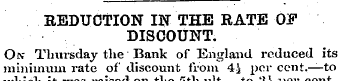
REDUCTION IN THE RATE OF DISCOUNT . On Thursday the Bank of England reduced its minimum rate of discount from 4 J per cent . —to which it was raised on the 5 th ult . —to 3 i per cent . The abundance of money in the market , and the previous reduction of the rate by private bill discounters , fully justify the step . At the same time , these facts show that the Bank , vast as are its resources , does not really determine the rate of discount in the market , though it affects to do so . If there were any error in its conduct , it was in raising the rate so suddenly , on the 5 th ult ., aii additional . 1 " per cent . ; but it was then influenced by the sudden diminution of its resources , and the actual condition of the money market . All the dealers in money , whether borrowers or lenders , were frightened , and the Bank shared the general contagion . Whether the " present reduction , -which is justified by the circumstances of the moment , will continue , will depend on the fact of war absorbing loss of the resources of the world at its commencement than it throws enterprise into inactivity . It compels the suspension of much peaceful'industry , and so limits the demand for capital . At the same time Capital is required to carry on war . In the end , as it impedes reproduction , it will press , mbre and more on the comparatively diminished' resources of . society , and enhance the value . of capital . We anticipate , therefore , that the present reduction , though now justified by circumstances , will not be lasting . '
Money Market & Stock Exchange
MONEY MARKET & STOCK EXCHANGE
Cily, Friday-15veiling-. In The Money Ma...
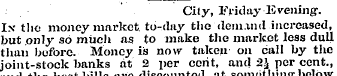
Cily , Friday-15 veiling-. In the money market to-day the demand increased , hut only so much as to make the market less dull than before . Money is now taken on call by the joint-stock banks at 2 per cent , and 2 J per cent ., jind the best bills arc discounted at something below the Bank rate . The little increase in the demand did not alter the character of the market , which continues easy , and tit present there arc no indications of an adverse change . We have referred above to tho reduction by the Bank of England ofjhe rate of discount , and the accounts published below will show hi the increase of its resources tho ronsons for its conduct . The markets of the Stock Exchange , which have exhibited through tho week a rapid tendency upwards—Consols even rising on . Wednesday to an unwarranted height—have been dull to-day . They Avont backwards yesterday , and to-day opened at yesterday ' s prices—Consols 0 M . { to J , — -but notwithstanding tho prices from Paris lo-dny fame firm and improved Consols , and tho other funds receded . This was attributed to parties who had speculated for the rise having realised , and to political causes . More weight was attributed to tho urtiolo . of tho Auqaburah Gazette , published in tho Times , than it Ucs ' orves . It can only be considered as expressing tho wishes of tho heated and silly princes of Germany , not tho sentiments of tho people . The latter want political improvement at homo rather than war abroad . Tho fonnur would gladly excite an anti-revolutionary cry to scotiro thoir own powor . Woino weight was usorlboa to the presumed instability of our own ministry , and tho uncertainty whotber tlu-lr opponents uro in a condition to oflur to tho country tho guarantees of a strong government in room ot tlio one they aim at destroying . ThvBoaa ¦ . ««»« duoul groat ( fulness on tho Stock Market t < -d y , and Consols wore done after tho close at Ou'J to ) .., Llie price at present is probably somewhat ufllelod by property remitted from abroad , to bo placed hero In security , and Is , conse quently , quite as high us it is U 1 prus s ° i . i hft « announced a loan for about £ 2 , 500 ' , 000 , but as it will bo negotiated in Germany , it will not uftlot our market . Wo understand that tho failures in . Gonnimy continue , and that some of tho oldest houses in Auasmrg-li and other places aro mentioned as having
-
-
Citation
-
Leader (1850-1860), June 4, 1859, page 19, in the Nineteenth-Century Serials Edition (2008; 2018) ncse.ac.uk/periodicals/l/issues/cld_04061859/page/19/
-