
On this page
-
Text (2)
-

No. 411, February 6, 1858. j THE LE1DEB....
-
BANKRUPTCY REFORM. Having dealt with the...
Note: This text has been automatically extracted via Optical Character Recognition (OCR) software. The text has not been manually corrected and should not be relied on to be an accurate representation of the item.
-
-
Transcript
-
Note: This text has been automatically extracted via Optical Character Recognition (OCR) software. The text has not been manually corrected and should not be relied on to be an accurate representation of the item.
Additionally, when viewing full transcripts, extracted text may not be in the same order as the original document.
H. M. Opposition. All Humbugs Are Unwhol...
supernumeraries of E . T . Smith ' s theatre are the Senate of Venice , the Knights of Rhodes , or the 'Peers of England pillars of the State . ' They are as much ' dummies' as if they were paid hy the lessee PaIiMerston , and marshalled by the stage-manager Hatter . They are , in fact , paid by a certain amount of consideration ; they are honorary supernumeraries , glad enough to do the duties for the sake of the distinction , and for a free admission to the amateur theatre of St . James ' s . \ oo . ardiner to the traditions of the stagre
play-acting of the place , the Opposition consists of the Tories ; but there are no Tories , or only stick a beggarly array of them as Falstait would scarcely have led through Coventry . If there are any genuine Tories , persons ready to swear by ' Church and King , ' they consist of men like Mr . BESTTnsroK , and some few other persons of no weight in the House ; whose only weight , in fact , is seen in their speeches . One of the genuine Tories died lately in Mr . Stafford , another in Lord "WiNCHEiiSEA ; but the breed is almost as
much extinct as the cock-of-the-woods . The most showy section of so-called Tories is represented by Lord Derby ; but they are entirely spurious . Lord Derb y himself was a "Whig , an author of Reform Bills ; he went into Opposition as a Tory only because he was thwarted personally , and was too proud to associate with shopkeepers brought into Parliament by the Reform Bill . As he grew older he grew grander in his ideas of the quasi-royal position due to ' the house of Derby , ' and he has become a Tory principally through superciliousness of character , an Oppositionist chiefly through reckless insubordination . But without discipline to be
a follower , he has no head to be a leader ., He has no faith in Tory principles , he does not care to keep up appearances , he deceives no man ; and his heir apparent , a devotee of * useful knowledge and practical art , ' already "belongs to the Germanized Whig party which considers itself to be for evermore in possession of office and its approaches . The most like a living Tory at the present day is Mr . Disraeli , who is as much like a living Tory as Mr . Charles Kean is like Uiciiabi > III . He plays his part admirably , and ' Lord , how he keeps his countenance ! ' But nil his notions are obsolete . He is a political Ruskik , who would introduce ' the Stones of Venice' into the debate of the week . He is
perpetually for reviving Kunnymede , only he moves an amendment on the proceedings of that memorable field , and would omit Magna Charta . Hia aim is to lead the House of Commons with ' ideas '— -things about which liis following know so little that they agreed to support him in office , to try how 'ideas ' would work in the management of English administration . The best raau of the mixed jnob which is not admitted to the north side of the House , and is therefore contented to take his place on the" south side , is Sir John Pakingxon , the leading advocate of popular education ; a man more liberal than most on
the Liberal side of the House , but for some punctilio refusing to > leave the sign of the Church and Crown . So that he forfeits his position in a Liberal Cabinet ; but being above hie company , he could not muBter a Tory Cabinet after his own improved fashion . As to __ tho half-dozen ^ gentlemen called r Peelifces , ' tlToy differ from oaoli other even more than they differ from ovory party in Parliament . All these persons form a large band of supernumeraries that fill the benches on . their side of the House , and they delude the public into "the belief that there is an Opposition . As they ore there they must do something , if only to keep up appearances ; but the difficulty ia to find a function for them . They
ought to be able to oppose the Reform Bill , but they are almost as ready to accept one which will extend a county franchise as Mr . Cobdest is one to extend the borough franchise ; and they are perhaps less opposed to the Government Bill than Mr . John Bright declares himself to be . They can , of course , oppose the Indian Government Bill , just because it is a Ministerial "bill . It is their
business to object ; but as Ministers are not likely to propose anything for which there is absolutely no demand in the market , and as the Tories do not wish to run' against the market , they have the greatest difficulty in learning how to object without offending their possible customers . Their great object of the day is to get into office if possible , but as they are not really an Opposition they cannot establish their claim to be ' sent for ;' and should Lord PaIiMERstost , by any mischance , vacate the seat at the head of the Treasury bench , somebody lower down on his side of the House would be ' sent for , ' instead of the leader on the opposite side .
The principal reasons why there is no Opposition lie with the Ministers and with the country . There is no exposition because there is no position . The Cabinet Ministers at present in office are carrying on Her Majesty ' s administration , and are bringing in the bills which are demanded by public importunity ; but they are giving expression to no positive opinions of their own , are maintaining no principles distinct from those of the men against them , are sustaining no struggle for the rights from which the people
are debarred ; they are not even vindicating the independence of our country against the atrocious demands of a foreign despot . But if Ministers personate no great public principle , champion no great public measure , they may justly say that they are no worse than other Liberals , for there is no man speaking out his mind . Lord Campbell , like Charles James Fox and other jurists of past generaions—like jurists of our own day—has declared that resident burgesses have a right to vote in the election of a member of
Parliament ; that the } ' have that right at common law , which is only suspended by our so-called reform statutes . But we look in vain for the man Avho stands out to claim that existing right of the British people . There is compromise in office , and therefore there is compromise in opposition , compromise in the independent party below the gangway . Any statesman who could take heart of grace and embody the just claims of the people to a recognition of their existing rights , that man would again call our Opposition into being , and would establish the right of himself and his friends to be ' sent for' on tho next occasion .
No. 411, February 6, 1858. J The Le1deb....
No . 411 , February 6 , 1858 . j THE LE 1 DEB . 135
Bankruptcy Reform. Having Dealt With The...
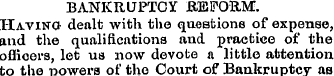
BANKRUPTCY REFORM . Having dealt with the questions of expense , and the qualifications and practice of the officers , let us now devote a little attention to the powers of tlio Court of Bankruptcy as a legal tribunal . In the first place it has no power to enforce payment of disputed claims . It may issue circulars to debtors of estates winding up under its jurisdiction , it may even go the length of summoning a debfcou to show cause
wh y he does not j ) i \ y ; but if he has a colourable pretext rieadyln the sTTape " of a defence ( which he always has , as a matter of course ) , the expense , trouble , and risk of suing for the claim in tho ordinary couuty or superior courta are then thrown , upon the Official Awsignoe . A prudent officer , in such a position , will naturally consult his own interest in preference to that of the creditors , and refuse to riBk the small assets , which , untouched , will just pay hia
commission and the © otivfc expenses , in standing the issue of a trial , even to recover property that he kflowB has been dishonestly removed out of the reaeh of the estate . Nearly every debtor who comes , or is brought to that court , shorws in his ' balance sheet ' the disposal of property , varying from onefourth to three-fourths of his whole assets , under the convenient heading of ' creditors holding security . ' Whether proper consideration has been given , whether the conveyance has been legally made , and the hold
over the property can be maintained , or whether there has been nothing more than a fictitious transfer between the bankrupt and an accommodating and interested relative , for the purpose of securing capital to begin trade with again , can only be ascertained by a tardy and expensive trial against men who have taken the precaution to secure the sinews of war out of the pockets of the ill-used creditors . The court has a check upon this kind of dealing in that part of the statute providing the punishment for what is called a ' fraudulent preference ; ' but the offence is so difficult to define , and so much
more difficult to prove , that out of a hundred such gross cases not one is dealt with as it deserves to be . "When the judicial wrath does descend , it punishes the bankrupt by a suspension of certificate , but it has no power to benefit the estate and increase the dividend . The fraudulent creditor , with his illegally and unjustly acquired property , walks out of the court untouched , before the eyes of the Official Assignee , who , having an establishment to keep up , and a family to maintain , very properly declines the risk of attacking a man in such an entrenched position .
Again with regard to compromises of claims . If the law and practice on this point in the Bankruptcy Court were more clearly defined , and the trade and official assignees had the power of acting as they would undoubtedly act if they were mercantile men managing their own affairs , it would be of immense benefit to the trading community . Upon the break-up of a corporation like the British Bank , it ia not alone the shareholders who become timid or dishonest , it is the numerous large and small debtors of the bank ,
who begin to look into their affairs and judge whether it will not be profitable or necessary to declare a suspension . It is then that the clumsy and ineffective machinery of the Court especially manifests itself . The Official Assignee has no power to arrange or compromise ; the matter is placed unreservedly in the hands of the solicitor to the fiat , whose interests centre in costs , and whole troops of insolvent petitioners are created clay after day , with assets barely sufficient to cover tlie heavy expenses .
Another serious defect is the fact that , with all the lavish expenditure of the court , the Trade Assignee , usually the principal or most active creditor , is left entirely without compensation for time , knowledge , and trouble expended for the benefit of the estate . The law certainly gives him considerable powers , but it forgets to provide any inducements for him to put those powers in action . The experience that he must possess of the bankrupt ' s trading and concha
duct , naturo and value of his stock , - TracFer ^ nnrb ^ iraera ^^^ hood of his accounts , one would think warbh purchasing at somo cost for tho benefit ot a body of creditors . But the law , in its wisdom , has thought otherwise , and the result ia an official scram bio for assets without any real checking power , and a routine signature given as a matter of course at a thing called an ' audit . ' Tho necessity for proving debts m a place
-
-
Citation
-
Leader (1850-1860), Feb. 6, 1858, page 15, in the Nineteenth-Century Serials Edition (2008; 2018) ncse.ac.uk/periodicals/l/issues/cld_06021858/page/15/
-