On this page
- Departments (1)
-
Text (5)
-

j^g t H E I* E A D E R. [No. 411, FjLB&i...
-

" . . . 2"^*+^ 4-, , . i'lUrJlIUXJ. «
-
>• Critics are not the legislators, but ...
-
We have lately received some papers whic...
-

Bluchivood this month opens with n seaso...
Note: This text has been automatically extracted via Optical Character Recognition (OCR) software. The text has not been manually corrected and should not be relied on to be an accurate representation of the item.
-
-
Transcript
-
Note: This text has been automatically extracted via Optical Character Recognition (OCR) software. The text has not been manually corrected and should not be relied on to be an accurate representation of the item.
Additionally, when viewing full transcripts, extracted text may not be in the same order as the original document.
J^G T H E I* E A D E R. [No. 411, Fjlb&I...
j ^ g t H E I * E A D E R . [ No . 411 , FjLB & iUAitr 6 / I 808 .
" . . . 2"^*+^ 4-, , . I'Lurjliuxj. «
Citeratact ——
>• Critics Are Not The Legislators, But ...
>• Critics are not the legislators , but the judges ana potice of literature . 'They do not makelaws—they interpret and try to enforce tJaem . —Edinburgh Jietneta . a »
We Have Lately Received Some Papers Whic...
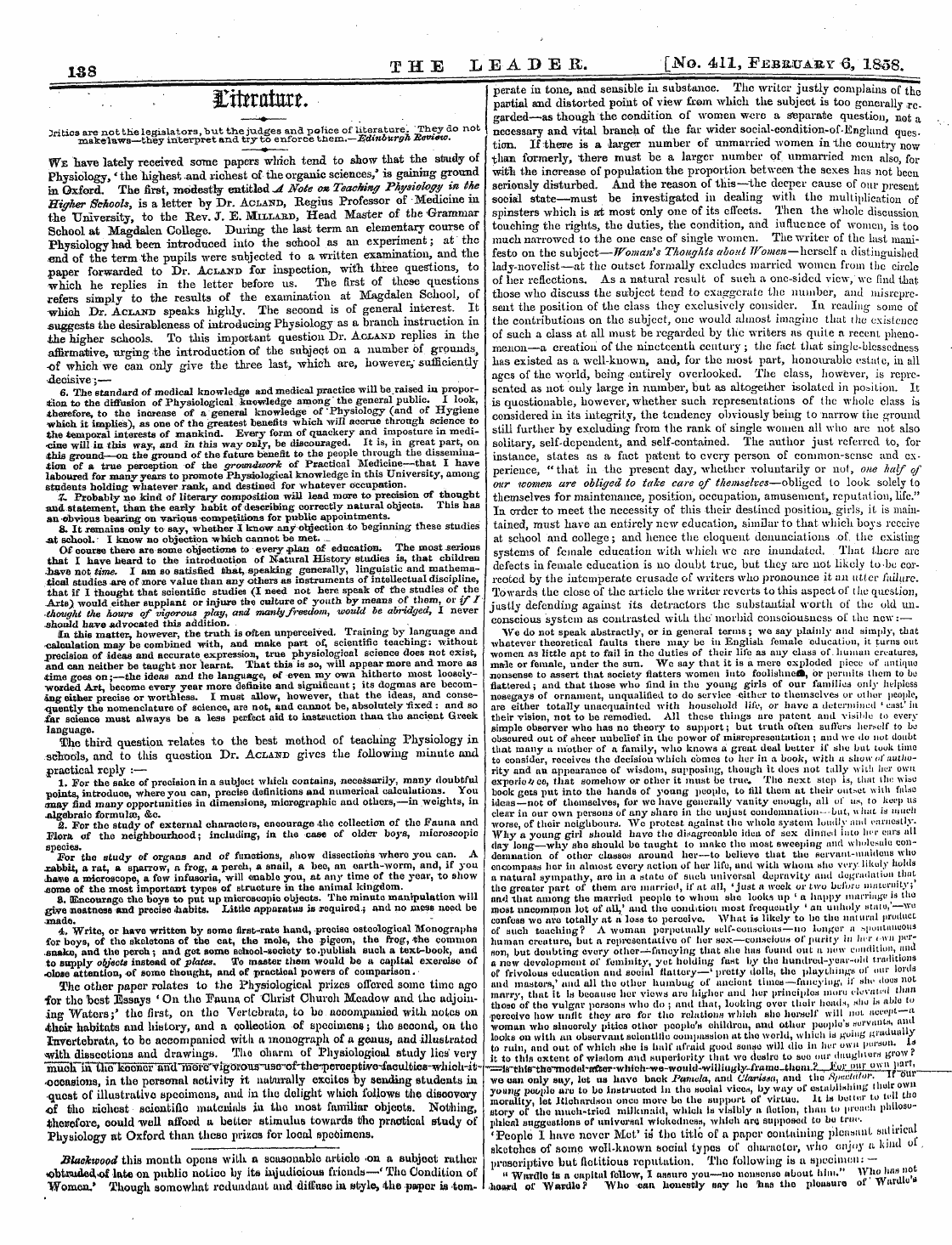
We have lately received some papers which tend to show that the study ot Physiology , ' the highest and richest of the organic sciences / is gaining ground in Oxford . The first , modestly entitled , /* Note on Teaching Physiology in the Higher Schools , is a letter by Dr . Aclaud , Regius Professor of Medicine in the " University , to the Rev . J . E . Miixabd , Head Master of the Grammar of
School at Magdalen College . During the last term an elementary course Physiology had been introduced into the school as an experiment ; at the end of the term the pupils were subjected to a written examination , and the paper forwarded to Dr . Acland for inspection , with three questions , to which he replies in the letter hefore us . The Brst of these questions refers simply to the results of tlie examination at Magdalen School , of which Dr . Aciand speaks highly . The second is of general interest . It suggests the desirableness of introducing Physiology as a branch instruction in the higher schools . To this important question Dr . Agland replies in the affirmative , ttrging the introduction of the subject on a number of grounds , -of which we can only give the three last , which are , however , " sufficiently
• decisive ;—6 . The standard of medical knowledge and medical practice will be . raised in proportion to the diffusion of Ph ysiological knowledge among the general public . I look , therefore , to the increase of a general knowledge of "Physiology ( and of Hygiene which it implies ) , as one of the greatest benefits -which will accrue through science to the temporal interests of mankind . Every form of quackery and imposture in mediae will in tbds way , and in this way only , be discouraged . It is , in great part , on this ground— -on the ground of the future benefit to the people through the dissemination of a true perception of the groundwork of Practical Medicine : —that I have laboured for many years to promote Physiological knowledge in this University , among students holding whatever rank , and destined for whatever occupation . . 7- Probably no kind of lit erary composition will lead more to precision of thought and statement , than the early habit of describing correctly natural objects . This has an obvious bearing on various ^ competitions for public appointments . 8 . It remains only to say , whether I know any objection to beginning these studies -At school . I know no objection which cannot be met . _ most serious
Of course there are some objections to every . plan of education . The that I have heard to the introduction of Natural History studies is , that children ii & ve not time . I am so satisfied that , speaking generally , linguistic and mathematical studies are of more value than any others as instruments of intellectual discipline , that if I thought that scientific studies ( I need not here speak of the studies of the Arts ) would either supplant or injure the culture of youth by means of them , or if I ¦ thought the hours of vigorous play , and manly freedom , would be abridged , I never ¦ should have advocated this addition . In this matter , however , the truth is often unperceived . Training by language and calculation may be combined with , and . make part of , scientific teaching : without precision of ideas and accurate expression , true physiological science does not exist , and can neither be taught nor learnt . That this is so , will appear more and more as time goes on;—the ideas and the language , of even my own hitherto most looselyworded Art , become every year more definite and significant ; its dogmas are becoming either precise or worthless . I must allow , however , that the ideas , and consequently the nomenclature of science , are not , and cannot be , absolutely -fixed : and so iar science must always be a lesa perfect aid to instruction than the ancient Greek
language . The third question relates to the beat method of teaching Physiology in schools , and to this question Dr . Acland gives the following minute and practical reply : — 1 . For the sake of prooiaion in a subject which contains , necessarily , many doubtful points , introduce , where you can , precise definitions and numerical calculations . You may find many opportunities in dimensions , inicrographic and others , —in weights , in -algobraio formulae , & c . 2 . For the study of external characters , encourage the collection of the 1 'auna and Flora of the neighbourhood ; including , in the caae of older boys , microscopic species . . J ? or the study of organs and of functions , show dissections where you can . A . rabbit , a rat , a Bparrow , a frog , a perch , a snail , a bee , an earth-worm , and , if you < have a microscope , a few infusoria , will enable you , at any time of the year , to show . some of the most important types of structure in the animal kingdom .
8 . [ Encourage the boya to put up microacopio objects . The minute manipulation will give ( neatness and precise 'habits . Little apparatus is required ; and no mess need be made . . 4 . Write , or have written by some flrst-rate hand , precise osteologioal Monographs for boyB , of the skeletons of the cat , tlie mole , the pigeon , the frog , the common snako , and the perch-, and got some Bohool-aociety to . publish such a toxt-book , and to supply objects instead of plates . To master them would be a capital exercise of -oloae attention , of some thought , and of practical powers of comparison . The other paper relates to the Physiological prizes offered some time ago for the best Essays ' On the Fauna of Christ Churoh Moadow and the
adjoining Waters ; ' the first , on tho Vericbrata , to bo accompanied with notes on their habitats and history , and a collection of specimens ; the scoond , on tho Iuvertebratn , to bo accompanied witli a monograph of a genus , and illustrated with dissections and drawings . Tho oh arm of Physiological study lies' very T nlu < flriiir £ ll ^ occasions , in the poroonal activity it nut / UTally exoitos by sending students in quest of illustrative spcoimons , and in the delight which follows tho discovery of tho richest aoiontiuo materials in . tho most familiar objects . Nothing , tfievefore , could well afford a better stimulus towards iiho practical study of Physiology at Oxford than theso prizes for local specimens .
Bluchivood This Month Opens With N Seaso...
Bluchivood this month opens with n seasonable artiolo on a subject rather * obtdrauLed ,. of late on public notioo by its injudicious frionda—' Tho Condition ot Women , * Though somewhat redundant and tUtt ' uso itt Htyle , ( the pwpor is
tomperate in tone , and sensible in substance . The writer justly complains of the partial and distorted point of view from which the subject is too generally regarded—as though the condition of women were a separate question , not a necessary and vital branch of the far wider social-condition-of-England ques - tion . If there is a larger number of unmarried wo men in the country now than formerly , there must be a larger number of unmarried men also , for with the increase of population the proportion between the sexes has not been seriously disturbed . And the reason of this—the deeper cause of our present social state—must be investigated in dealing with the multiplication of spinsters which is at most only one of its effects . Then the whole discussion touching the rights , the duties , the condition , and influence of women , is too much narrowed to the one case of single women . The writer of the last manifesto on the subject—Woman's Thoughts about Women—herself a distinguished
lady-novelist—at the outset formally excludes married women from the circle of her reflections . As a natural result of such a onc-sided view , we find that those who discuss the subject tend to exaggerate the number , and misrepresent the position of the class they exclusively consider . In reading ; some of the contributions on the subject , one would almost imagine that the existence of such a class at all must be regarded by the writers as quite a recent phenomenon—a creation of the nineteenth century ; the Tact that single-blessedness has existed as a well-known , and , for the most part , honourable estate , in all ages of the world , being entirely overlooked . The class , however , is represented as not only large in number , but as altogether isolated in position . It is questionable , however , whether such representations of the whole class is considered in its integrity , tlie tendency obviously being to narrow the ground still further bv excluding from the rank of single women all who are not also
solitary , self-dependent , and self-contained . The author just referred to , for instance , states as a fact patent to every person of conimoa-scnsc and experience , " that in the present day , whether voluntarily or not , one hal f of our icometi are obliged to tulce care of themselves—obliged to look solely to themselves for maintenance , position , occupation , amusement , reputation , life . " In order to meet the necessity of this their destined position , girls , it is maintained , must have an entirely new education , similar to that which boys receive at school and college ; and hence the eloquent denunciations of . the existing systems of female education with whieh we arc inundated . That there are defects in female education is no doubt true , but they arc not likely to be corrected by the intemperate crusade of writers wko pronounce it an utter failure . Towards the close of the article the writer reverts to this aspect of the question , justly defending against its detractors the substantial worth of tlie old unconscious system as contrasted with the morbid consciousness of the new : —
We do not speak abstractly , or in general terms ; we say plainly and simply , that whatever theoretical faults there may be in English female education , it turns out ¦ women as little apt to fail in the duties of their life as any class of- human creatures , ma-le or female , under the sun . We say that it is a mere exploded piece of antique nonsense to assert that society natters women into foolishnett , or permits them to be nattered ; and that those who find in tho young girls of our families only helpless nosegays of ornament , unqiialified to do service cither to themselves or other people , are either totally unacquainted with household life , or have a determined ' cast' in their vision , not to be remedied . All these things are patent and visible to every simple observer who has no theory to support ; but truth often sutlers herself to be obscured out of sheer unbelief in the power of misrepresentation ; and we do not doubt that many a mother of a family , who knows a great deal better if she ljut took time to consider , receives the decision which cornea to her in a book , with a show « t'
authority and an appearance of wisdom , supposing , though it does not tally wiih her own experience , that somehow or other it must be true , Tho next step is , that tin ; wise book gets put into the hands of young people , to iill them at their outset with tiilse ideas—not of themselves , for we have generally vanity enough , all of us , to keep us clear in our own persons of any aharp in the unjust condoinnatiuu— -but , wlmt is much worse , of their neighbours . Wo protest against the whole system loudly and earnestly . Why a young girl should have the disagreeable idea of sex dinned into h < r ears ull day long—why she should be taught to make tho most sweeping and wholesale condemnation of " other classes around hoi" —to believe that tho Bcrvant-innidons who encompass her in almost every action of her life , anil with whom she wry . likely holds a natural sympathy , are in a stnto of such universal depravity and degradation Unit the greater part of them arc married , if at all , 'just a woek or two bcl ' ure maternity ; and that among tho married people to whom sho looks up ' a happy inarrinjfi ! is tho
j moat uncommon lot of all / and the condition most frequently ' an unholy state , —we confess wo are totally at a loss to perceive . What is likely to bo tho natural product of such teaching ? A woman perpetually Bell-conscious—no longer a spontaneous human creature , but a representative of her box—conscious of purity in ln-r < nn person , but doubting every other—fancying that she has found out a now condition , mm a now development of feminity , yet holding funt by tho hundrou-yoar- « ht traditions of frivolous education and social flattery— ' pretty dolls , the playthings ol' mn- lows ( ind masters , ' uud all tho othor humbug of uuciont times—fancying , ii * she tlous not mnrry , that it is because her views uro hiyhor und her principles mom i luvali-d than thoac of tho vulgar persons who do ; and that , looking over their head * , hIio i * aulojo porcoivo how un / lt they aro for tho rotations which fiho horaclf will not neci' / it a Murvantsaim
woman who sincerely pitioa othor people ' children , and othor people's , looks on with an observant aoiontiuo compassion at tho world , whieh is tfuiug HiaUuuliy to ruin , nnd out of whieh she is half afraid good sonso will ilio in hur own pursua . l * it to this extent of wisdom and superiority that wo deslro to seo our daughters grow r l ' ^ B ^ liirtho ' mo-dttH ^ er wlifoh ^^ ¦ wo can only say , lot ub have back Pqntvla , and Clarism , and tho Simulator , jr ou young people uru to bo instructed in tho sooial vieon , by way of establishing " ,. ° , morality , let Richardson onco more bo tho support of virtue . It is bettor to tu m story ol" tho nmoh-triod milkmaid , which is visibly a notion , than to proiie . h philosophical suggestions of universal wickedness , which are . supposed to bo true . _ 'People 1 have never Met' is tho title of a paper containing plonsanl siihnciu sketches of some woll-known sociul types of ohuruolor , who enjoy u ki » " ul prnsoriptivo but fictitious reputation . Tho following is u specimen : — " Wrordlo iB a capital follow , I unsure you—no nouMonso ubout him . " WJ'ol ""* » ° _ liojwru of Wardlo ? Who can honently my ho lias tho ploaburo of Wanuo »
-
-
Citation
-
Leader (1850-1860), Feb. 6, 1858, page 18, in the Nineteenth-Century Serials Edition (2008; 2018) ncse.ac.uk/periodicals/l/issues/cld_06021858/page/18/
-