On this page
-
Text (2)
-
![Nov. 10, 1860] The Saturday Analyst and ...](/static/media/periodicals/101-CLD-1860-11-10-001-SINGLE/Ar01101S.png)
Nov. 10, 1860] The Saturday Analyst and ...
-

MISCELLANEOUS WORKS. Hemiwksnu the Post-...
Note: This text has been automatically extracted via Optical Character Recognition (OCR) software. The text has not been manually corrected and should not be relied on to be an accurate representation of the item.
-
-
Transcript
-
Note: This text has been automatically extracted via Optical Character Recognition (OCR) software. The text has not been manually corrected and should not be relied on to be an accurate representation of the item.
Additionally, when viewing full transcripts, extracted text may not be in the same order as the original document.
Foreign Cdrukspo^Dexck. ¦ ' . ' ¦ Skkc'l...
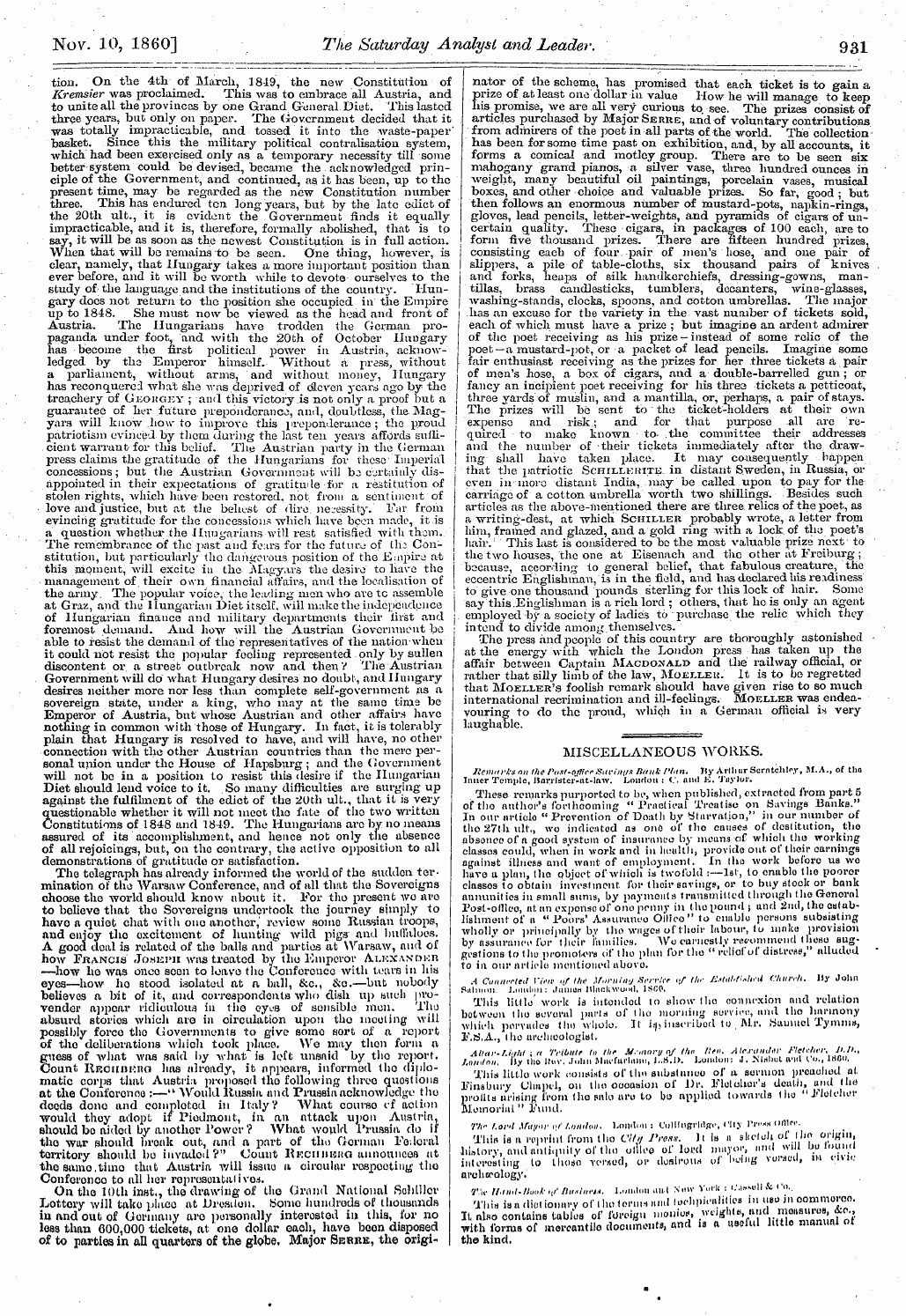
tion . On the 4 th of March , 18-19 , the new Constitution of Kremsier was proclaimed . This was to embrace all Austria , and to unite all the provinces by one Grand General Diet . This lasted three years , but only on paper . The Government decided that it was totally impracticable , and tossed , it into the waste-paper ' basket . Since this the military political centralisation system , which had been exercised only as a temporary necessity till some better system could be devised , became the acknowledged principle of the Government , and continued , as . it has been , up to the present time , may be regarded as the new Constitution number three . This has endured ten long years , but by the late edict of the 20 th ult ., it is evident the Government finds it equally impracticable , and it is , therefore , formally abolished , that is to say , it will be as soon as the newest Constitution is in full action . When that will be remains to be seen . One thing , however , is clear , namely , that Hungary takes a more important position than ever before , and it will be worth while to devote ourselves to the study of the language and the institutions of the country . Hungary does not return to the position she occupied in the Empire up to 1848 . She must now be viewed as the head and front of Austria . The Hungarians have trodden the German propaganda under foot , and with the 20 th of October Hungary has become the first political j > ower in Austria , acknowledged by the Emperor himself . Without a press , -without a parliament , without arms , and without , money , Hungary has reconquered what she was . deprived of eleven years ago by the treachery of Geokgey ; and this victory is not only a proof but a guarantee of her future preponderance , and , doubtless , the Magyars will know how to improve this preponderance ; the proud patriotism evinced , by them during the last ten years affords sufficient warrant for this belief . The Austrian party in the ( iermau press claims the gratitude of the Hungarians for these Imperial concessions ; but the Austrian Government will bo certainl y dis- i appointed in their expectations of gratitude-for a restitution of stolen rights , which have been restored , not from a sentiment of love and justice , but at the behest of dire , necessity . ' Far from evincing gratitude ' 'for the concessions which have been made , it is a question whether the . Hungarians will rest satisfied with thorn . The remembrance of the ' -past and fears for the future of tli 3 Constitution , but'particularly tlic dangerous position of the Empire at j this ¦ moment , will excite in the Magyars the desire to have the management of their own financial affairs , and the localisation of the army . The popular voice , the leading men who ave tc assemble at Graz , and the Hungarian Diet itself , will make the independence Of Hungarian finance and military departments their first and j foremost demand . And how will the Austrian Government be j able to resist the demand of the representatives of the nation when J it could not resist the popular feeling represented . only by sullen j discontent or a street outbreak now and then ? The Austrian Government will do what- Hungary desire 3 no doubt , and Hungary desires neither more nor less than complete self-government as a sovereign state , under a king , who may at the same tiros be Emperor of Austria , but whose Austrian and other affairs have nothing in common with those of Hungary . In fact , it is tolerably plain that Hungary is resolved to have , and will have , no other connection with the other Austrian countries than the mere personal union under the House of Hapsburg ; and the Government will not bo in a position to resist this desire if the Hungarian Diet should lend voice to it . So many difficulties are surging up against the fulfilment of the edict of the 20 th ult ., that it is very questionable whether it will Hot meet tho fate of the two written Constitutions of 1848 and 1849 . The Hungarians aro by no means assured of its accomplishment , and hence not only the absence of all rejoicings , but , on the contx'ary , the active opposition to all demonstrations of gratitude or satisfaction . The telegraph has already informed the world of the suddon , termination of tho Warsaw Conference , and of all that the Sovereigns choose tho world should know about it . For tho present wo are to believe that tho Sovereigns undertook the journey simply to have ft quiet chat with one another , ' review some Russian troops , and enjoy the excitement of hunting wild pigs and bullaloes . A good deal is related of the balls and parties at Warsaw , and of how Fkancis Jomki'ii was treated by tho Emperor Alkxandku —how ho was onco seen to leave the Conforouco with tears in his eyes—how ho stood isolated at a ball , & c , & c . —but nobody believes a bit of it , and correspondents w 1 k > dish up bul-Ii provendor appoar ridiculous in tho oyos of sonsiblu men . The absurd stories which aro in circulation upon tho mooting will possibly forco tho Governments to give somo sort of a report of tho deliberations whioh took place . We may then form a guess of what was said by what is left unsnid by tho report . Count RisdiinKita has already , it appears , informed tho di p lomatic corps that Austria proposed tho following throe questions at the Conforonoo : — " Would Russia and Prussia acknowledge tho doeds done and coinplotod in Italy ? What course cf aolion would they adopt it Piedmont , in an attack upon Austria , should bo aided by another rower ? What would Prussia do if tho wur should break out , and a part of the- Gorman Federal territory should bo iuvadod ? " Count RKCiiiucita announces at tho same . time that Austria will issue a oiroulnr impootiny ; tho Conforonco to all her representative * . On tho 10 th inst ., the drawing of tho Grand National Soli 11 lor Lottery will tako placo at Dresden . Some hundreds of thouuimds ill and out of Germany are personally interested iu this , for no less than 600 , 000 tickets , at one dollar each , have been disposed of to parties in all quarters of the globe . Major Shrek , the origi-*
| ! nator of the scheme , has promised that each ticket is to gain a prize of at least one dollar in value How he will manage to keep his promise , we are all very curious to see . The prizes consist of articles purchased by Major Serre , arid of voluntary contributions , from admirers of the poet in all parts of the world . The collection has been for some time past on exhibition , and , by all accounts , it forms a comical and motley group . There are to be seen six mahogany grand pianos , a silver vase , three hundred ounces in weight , many beautiful oil pain tings , porcelain vases , musical boxes , and other choice and valuable prizes . So far , good ; but then follows an enormous number of mustard-pots , napkin-rings , gloves , lead pencils , letter-weights , and pyramids of cigars of uncertain quality . These cigars , in packages of 100 each , are to form five thousand prizes . There are fifteen hundred prizes , consisting each of four pair of men ' s ' hose , and one pair of slippers , a pile of table-cloths , six thousand pairs of knives . and forks , heaps of silk handkerchiefs , dressing-gowns , mantillas , brass candlesticks , tumblers , decanters , wine-glasses , washing-stands , clocks , spoons , and cotton umbrellas . The major I has an excuse for the variety in the vast number of tickets sold , each of which must have a prize ; but imagine an ardent admirer of tho poet receiving as his prize — instead of some relic of the poet—a mustard-pot , or a packet of lead pencils . Imagine some fair enthusiast receiving as the prizes for her three tickets a pair of men ' s hose , a box of cigars , and a double-barrelled gun ; or fancy an incipient poet receiving for his three tickets a petticoat , three yards of muslin , and a mantilla , or , perhaps , a pair of stays . The prizes will be sent to the ticket-holders at their own j expense and risk . ; and for that purpose all are re-I quired to make known to- the committee their addresses I and the number of their tickets immediately after the . drawf ing sliall have taken place . It may consequently ¦ ¦ happen that the patriotic Schillkrite . in distant Sweden , in Russia , or even in more distant India , may be called upon to pay for the carriage of a cotton umbrella worth two shillings . Besides such articles as the above-mentioned there are three relics of the poet , as a writing-dest , at which Schiller probably wrote , a letter from him , framed and glazed , and a gold ring with a lock of the poet ' s hair . This last is considered to be the most valuable prize next to the two houses , the one at Eisenach and the other at Freiburg ; because , according to general belief , that fabulous creature , the eccentric Englishman , is in the field , and has declared his readiness to give one thousand pounds sterling for this lock of hair . Somo say this . Englishman is a rich lord ; others , that he is only an agent employed by a society of ladies to purchase the relic which they intone ! to divide among . themselves . The press and people of this country are thoroughly astonished - at the energy with which the London press has taken up the affair between Captain Macdo . nald and the railway official , or rather that silly limb of the law , Moezxeu . It is to bo regretted that Moeller ' s foolish remark should have given rise to so much international recrimination and ill-feelings . Moeller was endeavouring to do the proud , Avhich in a German official is very laughable .
Nov. 10, 1860] The Saturday Analyst And ...
Nov . 10 , 1860 ] The Saturday Analyst and Leader . 931
Miscellaneous Works. Hemiwksnu The Post-...
MISCELLANEOUS WORKS . Hemiwksnu the Post-qftii-o Saeinun fi « i > k / 'fun . T » y Arthur Serntchlcy , M . A ., of tho Inner Temple , JJarrister-nt-law . London ! ( . ' . nntl K . Tiiylor . These remarks purportod to be , when published , extracted from part 5 of tho author ' s forthcoming " Practical Treatise on Savings ] 3 anks . " In our urticlo " Prevention of Doalh by Starvation , " in our number of tho 27 th ult ., wo 'indicated as one of tho causes ! of destitution , the absence of a good system of insurance by means of which the working classes could , when in work oncl iu health , provide out of their earnings against illness and want of employment . In Iho work boforo us wo huve a plan , tho object of which is twofold : —1 st , to enablo tho poorer classes to obtain investment for their savings , or to buy stock or bank annunitics in email sums , by payments transmitted through the General Post-ofnco , ntun expense ) of one penny in the pound ; and 2 nd , the establishment of u " Poors' Assurance Olliea" to enable persona subsisting wholly or principally by tho wnges of their labour , to ninlco provision by assurance for their i ' uimlies . AVo earnestly rwommend these suggestions to the promoters of I he plan for the " relief of distress , " alluded to in our article mentioned above . .-1 Coniicrteil View <\ f the . tforniinj -Service of the EM \ tf > ti * hcil Church . Ny John Salmon . J . iniilnii : Jii ' iiiom Illuckwunri , l . SfiQ . This littlo work is intended lo show the oonncxion mid relation between the uuvorul purl a of ( ho morning Hurvioo , and tho harmony which pervades tho wholo , It is . , inscribed to , Mr . Samuel Tymms , 1 \ S , A ., the urclucologist . AlKtr-f . ii / ht i a Tribute Id the Memory n / tho / leu . AlrritiiUtir Fletcher , J > . /> ,, loii ' lnn . ijy tho Iti-v . John Mm-fufliiim , J .. S . 1 ) . Londons . 1 . MrthuUi'id ( . '<> ., ltfflti . Tin ' s littlo work c . oiiswtd of tlm substunuo of u . sormon proaolioii nl . ITinBbury ( Jlmpil , on tho occasion of Dr . IHoloUor ' d death , und tin ) prolita urising i ' rom tho snlo tiro to bo applied towards tho " Jflolchor Memorial " i ' uud . 7 ' fir- f . onl . m < i /» r »/ / . otiihw . Knndun : C ' olllnffrldpv , cll . v Pivxn oilhv . This is a ronrint from tho Cifu Pnita . It is n skeloli of llio origin , history , amlimliimilY of tho olll .-o of lord mayor , and will bo lounil interesting to llioso vc < r « ecl , or duairou * vt l > eintf versoil , m vivu : arch ecology . T . ' iv U-niil' / hokifi ' . / liiilin-i / i . l . iiiuUm tin I N «» v Vurk ' - '•""> o 11 & (' "' . This is a dictionary of Iho term * and loolipifnUNoa in mw In oommoroo . It , also contains tables of foreign iMonio * . weight * , mid " |«« BUiro 8 , A . o ., irith forme of mercantile documents , and > s « useful little manual oi the kind , ¦
-
-
Citation
-
Leader (1850-1860), Nov. 10, 1860, page 11, in the Nineteenth-Century Serials Edition (2008; 2018) ncse.ac.uk/periodicals/l/issues/cld_10111860/page/11/
-