On this page
-
Text (2)
-
![May 11, 1850.] ®t>£ 3LtVL*tX+ 159](/static/media/periodicals/101-CLD-1850-05-11-001-SINGLE/Ar01502S_ZgQVcax.png)
May 11, 1850.] ®t>£ 3LtVL*tX+ 159
-

PHILIP BAILEY'S ANGEL WOULD. Tho 4ngel W...
Note: This text has been automatically extracted via Optical Character Recognition (OCR) software. The text has not been manually corrected and should not be relied on to be an accurate representation of the item.
-
-
Transcript
-
Note: This text has been automatically extracted via Optical Character Recognition (OCR) software. The text has not been manually corrected and should not be relied on to be an accurate representation of the item.
Additionally, when viewing full transcripts, extracted text may not be in the same order as the original document.
Merivalk's Roman Empire. A Uisiory Of Th...
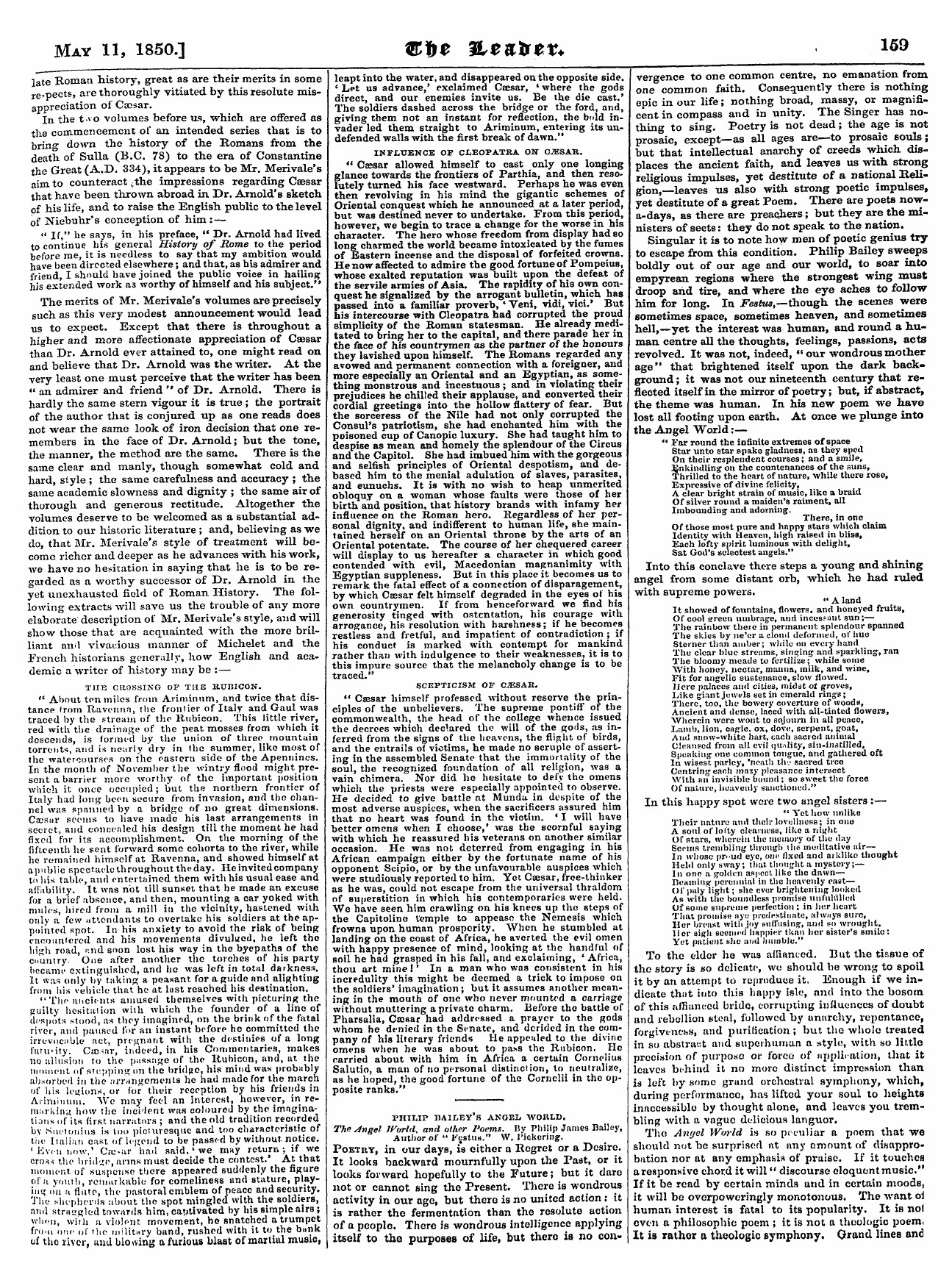
late Roman history , great as are their merits in some re-pects , are thoroughly vitiated by this resolute misappreciation of Caesar . In the t-vo volumes before us , which are offered as the commencement of an intended series that is to bring down the history of the Romans from the death of Sulla ( B . C . 78 ) to the era of Constantine the Great ( A . D . 334 ) , it appears to be Mr . Merivale ' s aim to counteract >; the impressions regarding Csesar that have been thrown abroad in . Dr . Arnold's sketch of his life , and to raise the English public to the level of Niebuhr ' s conception of him : —
" If , " he says , in his preface , " Dr . Arnold had lived to continue his general History of Rome to the period before me , it is needless to say that my ambition would have been directed elsewhere ; and that , as his admirer and friend , I should have joined the public voice in hailing his extended work as worthy of himself and his subject . " The merits of Mr . Merivale's volumes are precisely such as this very modest announcement would lead us to expect . Except that there is throughout a higher and more affectionate appreciation of Caesar than Dr . Arnold ever attained to , one might read on and believe that Dr . Arnold was the writer . At the
very least one must perceive that the writer has been " an admirer and friend " of Dr . Arnold . There is hardly the same stern vigour it is true ; the portrait of the author that is conjured up as one reads does not wear the same look of iron decision that one remembers in the face of Dr . Arnold ; but the tone , the manner , the method are the same . There is the same clear and manly , though somewhat cold and hard , style ; the same carefulness and accuracy ; the same academic slowness and dignity ; the same air of thorough and generous rectitude . Altogether the volumes deserve to be welcomed as a substantial
addition to our historic literature ; and , believing as we do , that Mr . Merivale ' s style of treatment will become richer and deeper as he advances with his work , we have no hesitation in saying that he is to be regarded as a worthy successor of Dr . Arnold in the yet unexhausted field of Roman History . The following extracts will save us the trouble of any more elaborate description of Mr . Merivale ' s style , and will show those that are acquainted with the more brilliant ami vivacious manner of Michelet and the French historians generally , how English and academic a writer of history may be : —
THE CROSSING OF THE KUBICON . " About ton miles from Arirninum , and twice that distance from Ravenna , the frontier of Italy and Gaul was traced by the stream of the Rubicon . This little river , red with the drainage of the peat mosses from which it descends , is formed by the union of three mountain torrents , and is nearly dry in the summer , like most of the watercourses on the eastern side of the Apennines . In the month of November the wintry flood might present a barrier more worthy of the important position which it once occupied ; but the northern frontier of Italy had long been secure from invasion , and the channel was spanned by a bridge of no great dimensions . Caesar sccMiis to have made his last arrangements in secret , and concealed his design till the moment he had
fixed for its accomplishment . On the morning of the fifteenth he sent forward some cohorts to the river , while he . remained himself at Ravenna , and showed himself at apublic spectacle throughout the day . He invited company to his table , and entertained them with his usual ease and affability . It was not till sunset that he made an excuse for a brief absence , and then , mounting a car yoked with mules , hired from a mill in the vicinity , hastened with only a few attendants to overtake his soldiers at the appointed spot . In his anxiety to avoid the risk of being encountered and his movements divulged , he left the high road , und soon lost his way in the byepaths of the country . One after another the torches of his party became extinguished , and he was left in total darkness . It was only by taking a peasant , for a guide and alighting from his vehicle that he at last reached his destination .
"The ancients amused themselves with picturing the guilty hesitation wiih which the founder of a line of despots stood , as they imagined , on the brink of the fatal river , and paused for an instant before he committed the irrevocable act , pregnant with the destinies of a long futiuity . Ca ) -ar , indeed , in his Commentaries , makes no allusion to the passage of the Rubicon , and , at the moment of stepping on the bridge , his mind was probably absorbed in the jirrangements he had made for the march of his legions , or for their reception by his friends in Ariniinuni . We nmy feel an interest , however , in remarking how the inci'lent was coloured by the imaginations of its first narrators : and the old tradition recorded
by Suetonius is loo picturesque and too characteristic of the Italian cast , of legend to be passed by without notice . ' Kvcu now , ' Ca > ar had said , we may return ; if we cross the bridge , arms must decide the contest . ' At that moment of suspense tbere appeared suddenly the figure of ; t youth , remarkable for comeliness and stature , playing on a flute , the pastoral emblem of peace and security . The shepherds about the spot mingled with the soldiers , ami struggled towards him , captivated by his simple airs ; when , with a violrnt movement , he snatched a trumpet from one of the military band , rushed with it to the bunk of the river , and blowing a furious blast of martial music ,
leapt into the water , and disappeared on the opposite side . 4 Let us advance , ' exclaimed Caesar , * where the gods direct , and our enemies invite us . Be the die cast . ' The soldiers dashed across the bridge or the ford , and , giving them not an instant for reflection , the bold invader led them straight to Ariminum , entering its undefended walls with the first break of dawn . " INFLUENCE OP CLEOPATRA ON CJES & R . " Caesar allowed himself to cast only one longing glance towards the frontiers of Parthia , and then resolutely turned his face westward . Perhaps he was even then revolving in his mind the gigantic schemes of Oriental conquest which he announced at a later period , but was destined never to undertake . From this period , however , we begin to trace a change for the worse in his character . The hero whose freedom from display had so long charmed the world became intoxicated by the fumes of Eastern incense and the disposal of forfeited crowns . He now affected to admire the good fortune of Pompeius , whose exalted reputation was built upon the defeat of
the servile armies of Asia . The rapidity of his own conquest he signalized by the arrogant bulletin , which has passed into a familiar proverb , * Veni , vidi , vici . ' But his intercourse with Cleopatra had corrupted the proud simplicity of the Roman statesman . He already meditated to bring her to the capital , and there parade her in the face of his countrymen as the partner of the honours they lavished upon himself . The Romans regarded any avowed and permanent connection with a foreigner , and more especially an Oriental and an Egyptian , as something monstrous and incestuous ; and in violating their prejudices he chilled their applause , and converted their cordial greetings into the hollow flattery of fear . But
the sorceress of the Nile had not only corrupted the Consul ' s patriotism , she had enchanted him with the poisoned cup of Canopic luxury . She had taught him to despise as mean and homely the splendour of the Circus and the Capitol . She had imbued him with the gorgeous and selfish principles of Oriental despotism , and debased him to the menial adulation of slaves , parasites , and eunuchs . It is with no wish to heap unmerited obloquy on a woman whose faults were those of her birth and position , that history brands with infamy her influence on the Roman hero . Regardless of her personal dignity , and indifferent to human life , she maintained herself on an Oriental throne by the arts of an
Oriental potentate . The course of her chequered career will display to us hereafter a character in which good contended with evil , Macedonian magnanimity with Egyptian suppleness . But in this place it becomes us to remark the fatal effect of a connection of disparagement , by which Caesar felt himself degraded in the eyes of his own countrymen . If from henceforward we find his generosity tinged with ostentation , his courage with arrogance , his resolution with harshness ; if he becomes restless and fretful , and impatient of contradiction ; if his conduct is marked with contempt for mankind rather than with indulgence to their weaknesses , it is to this impure source that the melancholy change is to be traced . "
SCEPTICISM OF CJESAB . " Caesar himself professed without reserve the principles of the unbelievers . The supreme pontiff of the commonwealth , the head of the college whence issued the decrees which declared the will of the gods , as inferred from the signs of the heavens , the flight of birds , and the entrails of victims , he made no scruple of asserting in the assembled Senate that the immortality of the soul , the recognized foundation of all religion , was a vain chimera . Nor did he hesitate to defy the omens which the priests were especially appointed to observe . He decided to give battle at Munda in despite of the most adverse auspices , when the sacrificers assured him
that no heart was found in the victim . ' I will have better omens when I choose , ' was the scornful saying with which he reassured his veterans on another similar occasion . He was not deterred from engaging in his African campaign either by the fortunate name of his opponent Scipio , or by the unfavourable auspices which were studiously reported to him . Yet Caesar , free-thinker as he was , could not escape from the universal thraldom of superstition in which his contemporaries were held . We have seen him crawling on his knees up the steps of the Capitoline temple to appease the Nemesis which frowns upon human prosperity . When he stumbled at landing on the coast of Africa , he averted the evil omen with happy presence of mind , looking at the handful of
soil he had grasped in his fall , and exclaiming , ' Africa , thou art mine ! ' In a man who was consistent in his incredulity this might be deemed a trick to impose on the soldiers' imagination ; but it assumes another meaning in the mouth of one who never mounted a carriage without muttering a private charm . Before the battle of Pharsalia , Caesar had addressed a prayer to the gods whom he denied in the Senate , and derided in the company of his literary friends He appealed to the divine omens when he was about to pass the Rubicon . He carried about with him in Africa a certain Cornelius Salutio , a man of no personal distinction , to neutralize , as he hoped , the good fortune of the Cornclii in the opposite ranks . "
May 11, 1850.] ®T>£ 3ltvl*Tx+ 159
May 11 , 1850 . ] ® t > £ 3 LtVL * tX + 159
Philip Bailey's Angel Would. Tho 4ngel W...
PHILIP BAILEY ' S ANGEL WOULD . Tho 4 ngel World , and other Poems . I 5 y Philip James Bailey , Author of " r ' estus . " W . 1 'ickcring . Poetry , in our days , is either a Regret or a Desire . It looks backward mournfully upon the Past , or it looks forward hopefully to the Future ; but it dare not or cannot sing the Present . There is wondrous activity in our age , but there is no united action : it is rather the fermentation than the resolute uction of a people . There is wondrous intelligence applying itself to tho purposes of life , but there is no
convergence to one common centre , no emanation from one common faith . Consequently there is nothing epic in our life ; nothing broad , massy , or magnificent in compass and in unity . The Singer has nothing to sing . Poetry is not dead ; the age is not prosaic , except—as all ages are—to prosaic souls ; but that intellectual anarchy of creeds which displaces the ancient faith , and leaves us with strong religious impulses , yet destitute of a national Religion , —leaves us also with strong poetic impulses , yet destitute of a great Poem . There are poets nowa-days , as there are preachers ; but they are the ministers of sects : they do not speak to the nation .
Singular it is to note how men of poetic genius try to escape from this condition . Philip Bailey sweeps boldly out of our age and our world , to soar into empyrean regions where the strongest wing must droop and tire , and where the eye aches to follow him for long . In Festus , —though the scenes were sometimes space , sometimes heaven , and sometimes hell , —yet the interest was human , and round a human centre all the thoughts , feelings , passions , acts revolved . It was not , indeed , " our wondrous mother age" that brightened itself upon the dark background ; it was not our nineteenth century that reflected itself in the mirror of poetry ; but , if abstract , the theme was human . In his new poem we have lost all footing upon earth . At once we plunge into the Angel World : — " Far round the infinite extremes of space Star unto star spake gladness , as they sped On their resplendent courses ; and a smiJe , Enkindling' on the countenances of the suns , Thrilled to the heart of nature , while there rose , Expressive of divine felicity , A clear bright strain of music , like a braid Of silver round a maiden ' s raiment , all Imbounding and adorning . There , in one Of those most pure and happy stars which claim Identity with Heaven , high raised in bliss , Each lofty spirit luminous with delight , Sat God ' s selectest angels . " Into this conclave there steps a young and shining angel from some distant orb , which he had ruled with supreme powers . "Aland It showed of fountains , flowers , and honeyed fruits , Of cool srreen umbrage , and incessant sun ;—The rainbow there in permanent splendour spanned The skies by ne ' er a cloud deformed , of hue Sterner than amber ; while on every hand The clear blue streams , sink ing- and sparkling-, ran The bloomy meads to fertilize ; while some With honey , nectar , manna , milk , and wine . Fit for angelic sustenance , slow flowed . Uere palaces and cities , midst ot groves , Ivike giant jewels set in emerald rings ; There , too , the bowery coverture of woods , Ancient and dense , laced with all-tinted flowers , Wherein were wont to sojourn in all peace , Lamb , lion , eagle , ox , dove , serpent , goat , And snow-white hart , each sacred animal Cleansed from all evil qu-ility , sin-instilled , Speaking one common tongue , and gathered oft In wisest parley , ' noalh tin ? sacred tree Centring 1 each mazy pleasanco intersect With an invisible bound ; so sweet the force Of nature , heavenly sanctioned . " In this happy spot were two angel sisters : — " Yet how unlike Their nature and their loveliness ; in one A soul of lofty clearness , like a night Of stars , wherein the memory of the day Serins trembling through the meditative air—In whose pri-ud eye , one fixed and arklikc thought Held only sway ; that thought a mystery;—In one a golden aspect like the dawn—Beaming perennial in the heavenly oast—Oi" paly light ; she ever brightening looked As with the boundless promise unfulfilled Of some supreme perfection ; in her heart That promise nye predestinate , always sure , Her breast with joy gufrusing-, and t-o wrought . Her sigh seemed happier tkan her sister ' s smile : Yet patient she and Jmioble . " To the elder he was affianced . But the tissue of the story is so delicate , we should be wrong to spoil it by an attempt to reproduce it . Enough if we indicate thsit into this happy isle , and into the bosom of this affianced bride , corrupting influences of doubt and rebellion steal , followed by anarchy , repentance , forgiveness , and purification ; but the whole treated in so abstract and superhuman a stylo , with so little precision of purpose or force of application , that it leaves behind it no more distinct impression than is left by some grund orchestral symphony , which , during performance , has lifted your soul to heights inaccessible by thought alone , and leaves you trembling with a vague delicious languor .
Tho Ant / el World is so peculiar a poem that we should not be surprised nt any omount of disapprobation nor at any emphasis of praise . If it touches a responsive chord it will" discourse eloquent music . " If it be read by certain minds and in certain moods , it will be overpoweringly monotonous . The want of human interest is fatal to its popularity . It is not even a philosophic poem ; it is not a thuologic poem . It is rather a theologic symphony . Grand lines and
-
-
Citation
-
Leader (1850-1860), May 11, 1850, page 15, in the Nineteenth-Century Serials Edition (2008; 2018) ncse.ac.uk/periodicals/l/issues/cld_11051850/page/15/
-