On this page
-
Text (4)
-
May 11, 1850.] ®t> * &*«**** . 1G5 _
-
THOUGHTS IN DESPONDENCY. This life is al...
-

TENDENCIES. The shallowest observer may ...
-
WOMEN AS LETTER WRITERS. Among the vulga...
Note: This text has been automatically extracted via Optical Character Recognition (OCR) software. The text has not been manually corrected and should not be relied on to be an accurate representation of the item.
-
-
Transcript
-
Note: This text has been automatically extracted via Optical Character Recognition (OCR) software. The text has not been manually corrected and should not be relied on to be an accurate representation of the item.
Additionally, when viewing full transcripts, extracted text may not be in the same order as the original document.
The Apprenticeship Of Life. By G. Ii. Le...
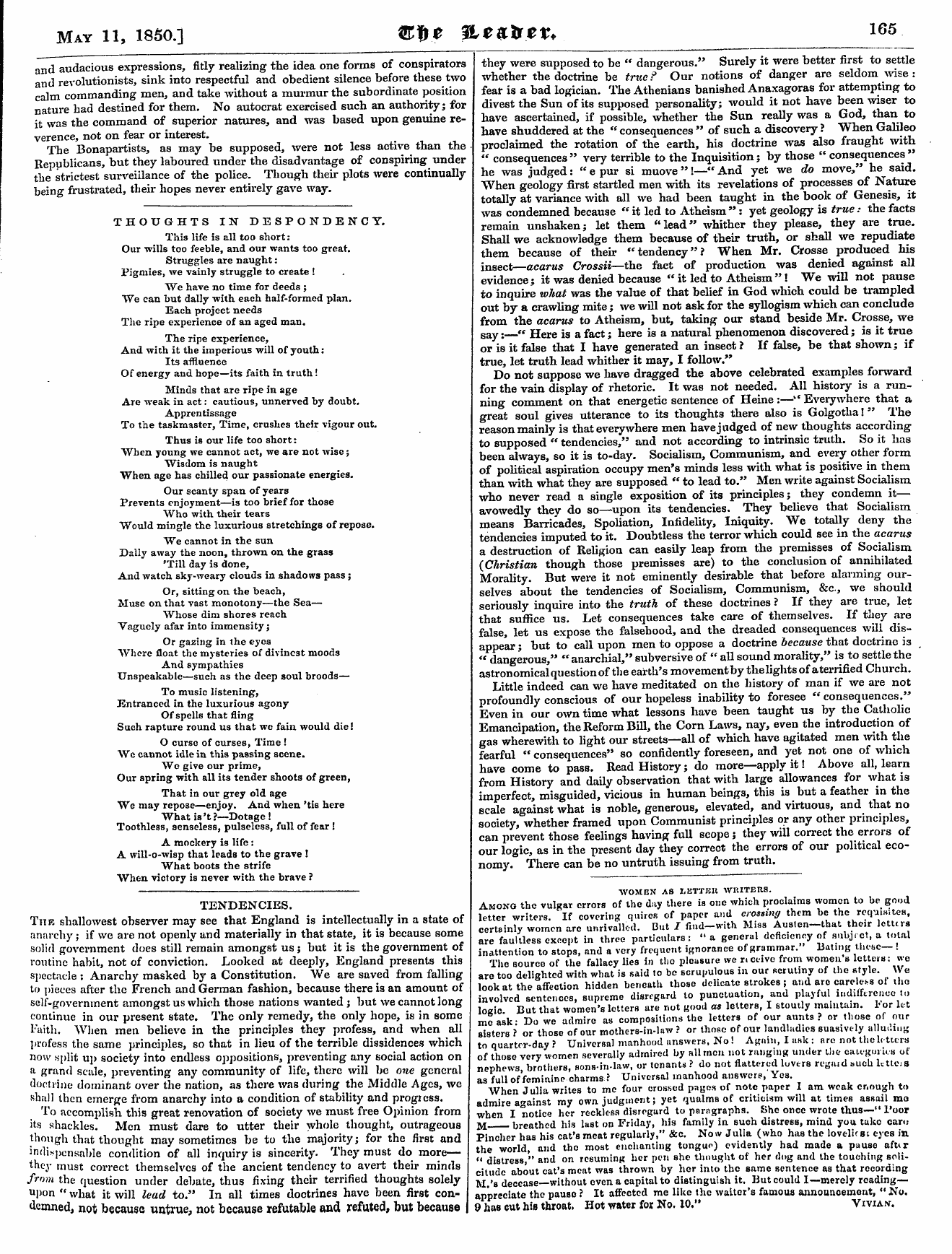
and audacious expressions , fitly realizing the idea one forms of conspirators and revolutionists , sink into respectful and obedient silence before these two calm commanding men , and take without a murmur the subordinate position nature had destined for them . No autocrat exercised such an authority 5 for it was the command of superior natures , and was based upon genuine reverence , not on fear or interest . The Bonapartists , as may be supposed , were not less active than the Republicans , but they laboured under the disadvantage of conspiring under the strictest surveillance of the police . Though their plots were continually being frustrated , their hopes never entirely gave way .
May 11, 1850.] ®T> * &*«**** . 1g5 _
May 11 , 1850 . ] ® t > * &*«**** . 1 G 5 _
Thoughts In Despondency. This Life Is Al...
THOUGHTS IN DESPONDENCY . This life is all too short : Our wills too feeble , and our wants too great . Struggles are naught : Pigmies , we vainly struggle to create ! "We have no time for deeds ; We can but dally with each half-formed plan . Each project needs The ripe experience of an aged man . The ripe experience , And with it the imperious will of youth : Its affluence Of energy and hope—its faith in truth ! Minds that are ripe in age Are weak in act : cautious , unnerved by doubt . Apprentissage To the taskmaster , Time , crushes their vigour out . Thus is our life too short : When young we cannot act , we are not wise ; Wisdom is naught When age has chilled our passionate energies . Our scanty span of years Prevents enjoyment—is too brief for those Who with their tears Would mingle the luxurious stretchings of repose . We cannot in the sun Dally away the noon , thrown on the grass 'Till day is done , And watch sky-weary clouds in shadows pass ; Or , sitting on the beach , Muse on that vast monotony—the Sea—Whose dim shores reach Vaguely afar into immensity ; Or gazing in the eyes Where float the mysteries of divincst moods And sympathies Unspeakable—such as the deep soul broods—To music listening , Entranced in the luxurious agony Of spells that fling Such rapture round us that we fain would die ! O curse of curses , Time ! We cannot idle in this passing scene . We give our prime , Our spring with all its tender shoots of green , That in our grey old age We may repose—enjoy . And when 'tis here What is ' t ?—Dotage ! Toothless , senseless , pulseless , full of fear ! A mockery is life : A wili-o-wisp that leads to the grave ! What boots the strife When victory is never with the brave ?
Tendencies. The Shallowest Observer May ...
TENDENCIES . The shallowest observer may see that England is intellectually in a state of anarchy ; if we are not openly and materially in that state , it is because some solid government does still remain amongst us ; but it is the government of routine habit , not of conviction . Looked at deeply , England presents this spectacle : Anarchy masked by a Constitution . We are saved from falling to pieces after the French and German fashion , because there is an amount of
self-government amongst us which those nations wanted ; but we cannot long continue in our present state . The only remedy , the only hope , is in some Faith . When men believe in the principles they profess , and when all profess the same principles , so that in lieu of the terrible dissidences which now split up society into endless oppositions , preventing any social action on a grand scale , preventing any community of life , there will be one general doctrine dominant over the nation , as there was during the Middle Ages , we shall then emerge from anarchy into a condition of stability and progress .
To accomplish this great renovation of society we must free Opinion from its shackles . Men must dare to utter their whole thought , outrageous though that thought may sometimes be to the majority ; for the first and indispensable condition of all inquiry is sincerity . They must do morethey must correct themselves of the ancient tendency to avert their minds from the question under debate , thus fixing their terrified thoughts solely upon " what it will lead to . " In all times doctrines have been first condemned , not because untrue , not because refutable and refuted , but because
they were supposed to be " dangerous / ' Surely it were better first to settle whether the doctrine be true ? Our notions of danger are seldom wise : fear is a bad logician . The Athenians banished Anaxagoras for attempting to divest the Sun of its supposed personality ; would it not have been wiser to have ascertained , if possible , whether the Sun really was a God , than to have shuddered at the " consequences " of such a discovery ? When Galileo proclaimed the rotation of the earth , his doctrine was also fraught with •* consequences " very terrible to the Inquisition ; by those " consequences " he was judged : " e pur si muove " !— " And yet we do move , " he said . When geology first startled men with its revelations of processes of Nature totally at variance with all we had been taught in the book of Genesis , it was condemned because "it led to Atheism " : yet geology is true : the facts
remain unshaken ; let them " lead" whither they please , they are true . Shall we acknowledge them because of their truth , or shall we repudiate them because of their " tendency" ? When Mr . Crosse produced his insect—acarus Crossii—the fact of production was denied against all evidence ; it was denied because " it led to Atheism" ! We will not pause to inquire what was the value of that belief in God which could be trampled out by a crawling mite ; we will not ask for the syllogism which can conclude from the acarus to Atheism , but , taking our stand beside Mr . Crosse , we say : — « Here is a fact ; here is a natural phenomenon discovered ; is it true or is it false that I have generated an insect ? If false , be that shown ; if true , let truth lead whither it may , I follow . "
Do not suppose we have dragged the above celebrated examples forward for the vain display of rhetoric . It was not needed . All history is a running comment on that energetic sentence of Heine : — lf Everywhere that a great soul gives utterance to its thoughts there also is Golgotha ! " The reason mainly is that everywhere men have judged of new thoughts according to supposed " tendencies , " and not according to intrinsic truth . So it has been always , so it is to-day . Socialism , Communism , and every other form of political aspiration occupy men ' s minds less with what is positive in them
than with what they are supposed " to lead to . " Men write against Socialism who never read a single exposition of its principles ; they condemn itavowedly they do so—upon its tendencies . They believe that Socialism means Barricades , Spoliation , Infidelity , Iniquity . We totally deny the tendencies imputed to it . Doubtless the terror which could see in the acarus a destruction of Religion can easily leap from the premisses of Socialism ( Christian though those premisses are ) to the conclusion of annihilated Morality . But were it not eminently desirable that before alarming ourselves about the tendencies of Socialism , Communism , & c , we should
seriously inquire into the truth of these doctrines ? If they are true , let that suffice us . Let consequences take care of themselves . If they are false , let us expose the falsehood , and the dreaded consequences will disappear ; but to call upon men to oppose a doctrine because that doctrine i 3 " dangerous , " " anarchial , " subversive of " all sound morality , " is to settle the astronomical question of the earth ' s movement by the lights of a terrified Church . Little indeed can we have meditated on the history of man if we are not
profoundly conscious of our hopeless inability to foresee " consequences . Even in our own time what lessons have been taught us by the Catholic Emancipation , the Reform Bill , the Corn Laws , nay , even the introduction of gas wherewith to light our streets—all of which have agitated men with the fearful " consequences" so confidently foreseen , and yet not one of which have come to pass . Read History ; do more—apply it ! Above all , learn from History and daily observation that with large allowances for what is
imperfect , misguided , vicious in human beings , this is but a feather in the scale against what is noble , generous , elevated , and virtuous , and that no society , whether framed upon Communist principles or any other principles , can prevent those feelings having full scope ; they will correct the errors of our logic , as in the present day they correct the errors of our political economy . There can be no untruth issuing from truth .
Women As Letter Writers. Among The Vulga...
WOMEN AS LETTER WRITERS . Among the vulgar errors of the day there is one which proclaims women to be good letter writers . If covering quires of paper and crossing them be the requisites , certainly women are unrivalled . But / find-with Miss Austen—that their letters are faultless except in three particulars : " a general deficiency of subject , a total inattention to stops , and a very frequent ignorance of grammar . Bating these— ! The source of the fallacy lies in the pleasure we ncdve from women s letters : we are too delighted with what is said to be scrupulous in our scrutiny of the style . \ V e delicate strokes and carelets of iho
look at the affection hidden beneath those ; are involved sentences , supreme disregard to punctuation , and playful indifftrcnee to logic But that women ' s letters are not good as letters , I stoutly maintain . l < or let me ask : Do we admire as compositions the letters of our aunts ? or those of our sisters ? or those of our mothers-in-law ? or those of our landladies suasivi ly alluding to quartor-day ? Universal manhood answers , No ! Again , I ask : are not the letters of those very women severally admired by all men not ranging under the categories of nephews , brothers , sons-in-law , or tenants ? do not flattered lovers regaid such Uttcis as full of feminine charms ? Universal manhood answers , Yes .
When Julia writes to me four crossed pages of note paper I am weak enough to admire against my own judgment ; yet qualms of criticism will at times assail mo when I notice her reckless disregard to paragraphs . She once wrote thus— " Poor M breathed his last on Friday , his family in such distress , mind you take can * Pincher has his cat ' s meat regularly , " & c . Now Julia ( who has the loveliest eyes in the world , and the most enchanting tonguo ) evidently had made a pause afttr " distress , " and on resuming her pen she thought of her dog and the touching solicitude about cat ' s meat was thrown by her into the same sentence as that recording M . ' 8 decease—without even a capital to distinguish it . But could I—merely readingappreciate the pause ? It affected me like the waiter ' s famous announcement , " No . 9 has cut his throat . Hot water for No . 10 . " Vivian .
-
-
Citation
-
Leader (1850-1860), May 11, 1850, page 21, in the Nineteenth-Century Serials Edition (2008; 2018) ncse.ac.uk/periodicals/l/issues/cld_11051850/page/21/
-