On this page
-
Text (2)
-
![May 11, 1850.] W&t VLtKiBtt* 14y](/static/media/periodicals/101-CLD-1850-05-11-001-SINGLE/Ar00302S_YmeAy2I.png)
May 11, 1850.] W&t VLtKiBtt* 14y
-

PROTECTION MEETINGS. This has been a bus...
Note: This text has been automatically extracted via Optical Character Recognition (OCR) software. The text has not been manually corrected and should not be relied on to be an accurate representation of the item.
-
-
Transcript
-
Note: This text has been automatically extracted via Optical Character Recognition (OCR) software. The text has not been manually corrected and should not be relied on to be an accurate representation of the item.
Additionally, when viewing full transcripts, extracted text may not be in the same order as the original document.
History Of The Week. The House Of Common...
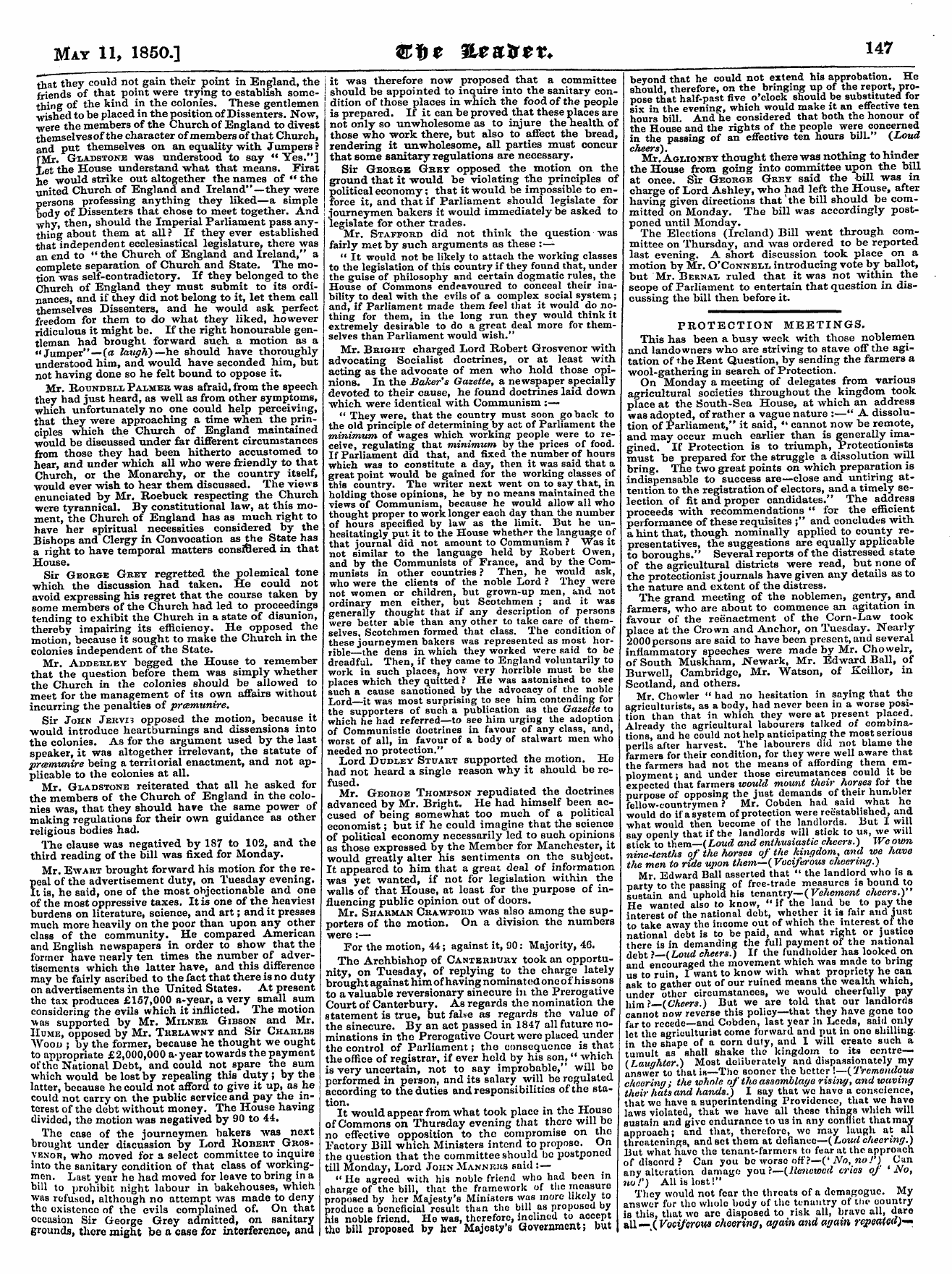
that they could not gain their point in England , the friends of that point were trying to establish something of the kind in the colonies . These gentlemen w ished to be placed in the position of Dissenters . Now , were the members of the Church of England to divest themselves of the character of members of that Church , and put themselves on an equality with Jumpers ? f Mr . Gladstone was understood to say " Yes . " ] X , et the House understand what that means . First he would strike out altogether the names of " the united Church of England and Ireland "—they were persons professing anything they liked—a simple body of Dissenters that chose to meet together . And why , then , should the Imperial Parliament pass
anything about them at all ? If they ever established that independent ecclesiastical legislature , there was an end to ' * the Church of England and Ireland , " a complete separation of Church and State . The motion was self-contradictory . If they belonged to the Church of England they must submit to its ordinances , and if they did not belong to it , let them call themselves Dissenters , and he would ask perfect freedom for them to do what they liked , however ridiculous it might be . If the right honourable gentleman had brought forward such a motion as a " Jumper" — ( a laugh )—he should have thoroughly understood him , and would have seconded him , but not having done so he felt bound to oppose it .
Mr . Rotjndblii Palmer was afraid , from the speech they had just heard , as well as from other symptoms , which unfortunately no one could help perceiving , that they were approaching a time when the principles which the Church of England maintained would be discussed under far different circumstances from those they had been hitherto accustomed to hear , and under which all who were friendly to that
Church , or the Monarchy , or the country itself , would ever wish to hear them discussed . The views enunciated by Mr . Roebuck respecting the Church were tyrannical . By constitutional law , at this moment , the Church of England has as much right to have her spiritual necessities considered by the Bishops and Clergy in Convocation as the State has a right to have temporal matters considered in that House .
Sir George Grey regretted the polemical tone which the discussion had taken . He could not avoid expressing his regret that the course taken by some members of the Church had led to proceedings tending to exhibit the Church in a state of disunion , therebv impairing its efficiency . He opposed the motion , because it sought to make the Church in the colonies independent of the State . Mr . Addeeley begged the House to remember that the question before them was simply whether the Church in the colonies should be allowed to meet for the management of its own affairs without incurring the penalties of prcemunire .
Sir John Jervis opposed the motion , because it would introduce heartburnings and dissensions into the colonies . As for the argument used by the last speaker , it was altogether irrelevant , the statute of pramunire being a territorial enactment , and not applicable to the colonies at all . Mr . Gladstone reiterated that all he asked for the members of the Church of England in the colonies was , that they should have the same power of making regulations for their own guidance as other religious bodies had . The clause was negatived by 187 to 102 , and the third reading of the bill was fixed for Monday .
Mr . Ewart brought forward his motion for the repeal of the advertisement duty , on Tuesday evening . It is , he said , one of the most objectionable and one of the most oppressive taxes . It is one of the heaviest burdens on literature , science , and art ; and it presses much more heavily on the poor than upon any other class of the community . He compared American and English newspapers in order to show that the former have nearly ten times the number of advertisements which the latter have , and this difference may be fairly ascribed to the fact that there is no duty on advertisements in the United States . At present
the tax produces £ 157 , 000 a-year , a very small sum considering the evils which it inflicted . The motion ¦ was supported by Mr . Milner Gibson and Mr . Hume , opposed by Mr . Trelawny and Sir Charles Wood ; by the former , because he thought we ought to appropriate £ 2 , 000 , 000 a-year towards the payment of the National Debt , and could not spare the sum ¦ which would be lost by repealing this duty ; by the latter , because he could not afford to give it up , as he could not carry on the public service and pay the interest of the debt without money . The House having divided , the motion was negatived by 90 to 44 .
The case of the journeymen bakers was next brought under discussion by Lord Robert Grosvknor , who moved for a select committee to inquire into the sanitary condition of that class of workingrnen . Last year he had moved for leave to bring in a bill to prohibit night labour in bakehouses , which , was refused , although no attempt was made to deny the existence of the evils complained of . On that occasion Sir George Grey admitted , on sanitary grounds , there might be a case for interference , and
it was therefore now proposed that a committee should be appointed to inquire into the sanitary condition of those places in which the food of the people is prepared . If it can be proved that these places are not only so unwholesome as to injure the health of those who work there , but also to affect the bread , rendering it unwholesome , all parties must concur that some sanitary regulations are necessary . Sir George Grey opposed the motion on the ground that it would be violating the principles of political economy ; that it would be impossible to enforce it , and that if Parliament should legislate for journeymen bakers it would immediately be asked to legislate for other trades . Mr . Stafford did not think the question was fairly met by such arguments as these : —
" It would not be likely to attach the working classes to the legislation of this country if they found that , under the guise of philosophy and certain dogmatic rules , the House of Commons endeavoured to conceal their inability to deal with the evils of a complex social system ; and , if Parliament made them feel that it would do nothing for them , in the long run they would think it extremely desirable to do a great deal more for themselves than Parliament would wish . " Mr . Bright charged Lord Robert Grosvenor with advocating Socialist doctrines , or at least with acting as the advocate of men who hold those opinions . In the Baker ' s Gazette , a newspaper specially devoted to their cause , he found doctrines laid down which were identical with Communism : —
" They were , that the country must soon go back to the old principle of determining by act of Parliament the minimum of wages which working people were to receive , regulating that minimum by the prices of food . If Parliament did that , and fixed the number of hours which was to constitute a day , then it was said that a great point would be gained for the working classes of this country . The writer next went on to say that , in holding those opinions , he by no means maintained the views of Communism , because he would allow ail who thought proper to work longer each day than the number of hours specified by law as the limit . But he unkAoUntmnln mil it fr » « -V > o TTnuco ti ; 1 i pt > if > r tVif » 1 ancn a « r «» n (
that journal did not amount to Communism ? Was it not similar to the language held by Robert Owen , and by the Communists of France , and by the Communists in other countries ? Then , he would ask , who were the clients of the noble Lord ? They were not women or children , but grown-up men , and not ordinary men either , but Scotchmen ; and it was generally thought that if any description of persons were better able than any other to take care of themselves , Scotchmen formed that class . The condition of these journeymen bakers was represented as most
horrible—the dens in which they worked were said to be dreadful . Then , if they came to England voluntarily to work in such places , how very horrible must be the places which they quitted ? He was astonished to see such a cause sanctioned by the advocacy of the noble Lord—it was most surprising to see him contending for the supporters of such a publication as the Gazette to which he had referred—to see him urging the adoption of Communistic doctrines in favour of any class , and , worst of all , in favour of a body of stalwart men who needed no protection . " motion
Lord Dudle y Stuart supported the . He had not heard a single reason why it should be refused . Mr . George Thompson repudiated the doctrines advanced by Mr . Bright . He had himself been accused of being somewhat too much of a political economist ; but if he could imagine that the science of political economy necessarily led to such opinions as those expressed by the Member for Manchester * it would greatly alter his sentiments on the subject . It appeared to him that a great deal of information was yet wanted , if not for legislation within the walls of that House , at least for the purpose of influencing public opinion out of doors .
Mr . Sharman Crawford was also among the supporters of the motion . On a division the numbers were : — For the motion , 44 ; against it , 90 : Majority , 46 . The Archbishop of Canterbury took an opportunity , on Tuesday , of replying to the charge lately brought against him of having nominated one o f his sons to a valuable reversionary sinecure in the Prerogative
Court of Canterbury . As regards the nomination the statement is true , but false as regards the value of the sinecure . By an act passed in 1847 all future nominations in the Prerogative Court were p laced under the control of Parliament ; the consequence is that the office of registrar , if ever held by his son " which is very uncertain , not to say improbable , " will be performed in person , and its salary will be regulated according to the duties and responsibilities of the
station . It would appear from what took place in the House of Commons on Thursday evening that there will be no effective opposition to the compromise on the Factory Bill which Ministers intend to propose . On the question that the committee should be postponed till Monday , Lord John Mannkks said : — " Ho agreed with his noble friend who had been in charge of the bill , that the framework of the measure proposed by her Majesty ' s Ministers was more likely to produce a beneficial result than the bill as proposed by his noble friend . Ho was , therefore , inclined to accept the bill proposed by her Majesty ' s Government ; but
beyond that he could not extend his approbation . He should , therefore , on the bringing up of the report , propose that half-past five o ' clock should be substituted for six in the evening , which would make it an effective ten hours bill . And he considered that both the honour of the House and the rights of the people were concerned in the passing of an effective ten hours bill . " { Loud cheers ) . Mr . Aglionby thought there was nothing to hinder the House from going into committee upon the bill at once . Sir George Grey said the bill was in charge of Lord Ashley , who had left the House , after having given directions that the bill should be committed on Monday . The bill was accordingly
postponed until Monday . The Elections ( Ireland ) Bill went through committee on Thursday , and was ordered to be reported last evening . A short discussion took place on a motion by Mr . O'Connell introducing vote by ballot , but Mr . Bernal ruled that it was not within the scope of Parliament to entertain that question in discussing the bill then before it .
May 11, 1850.] W&T Vltkibtt* 14y
May 11 , 1850 . ] W & t VLtKiBtt * 14 y
Protection Meetings. This Has Been A Bus...
PROTECTION MEETINGS . This has been a busy week with those noblemen and landowners who are striving to stave off the agitation of the Rent Question , by sending the farmers a wool-gathering in search of Protection . On Monday a meeting of delegates from various agricultural societies throughout the kingdom took place at the South-Sea House , at which an address was adopted , of rather a vague nature : — " A dissolution of Parliament , " it said , * ' cannot now be remote , and may occur much earlier than is generally
imagined . If Protection is to triumph , Protectionists must be prepared for the struggle a dissolution will bring . The two great points on which preparation is indispensable to success are—close and untiring attention to the registration of electors , and a timely selection of fit and proper candidates . " The address proceeds with recommendations " for the efficient performance of these requisites ; " and concludes with a hint that , though nominally applied to county representatives , the suggestions are equally applicable to boroughs . " Several reports of the distressed state
of the agricultural districts were read , but none of the protectionist journals have given any details as to the nature and extent of the distress . The grand meeting of the noblemen , gentry , and farmers , who are about to commence an agitation in favour of the reenactment of the Corn-Law took place at the Crown and Anchor , on Tuesday . Nearly 2000 persons are said to have been present , and several inflammatory speeches were made by Mr . Chowelr , of South Muskham , . Newark , Mr . Edward Ball , of Burwell , Cambridge , Mr . Watson , of Keillor , in
Scotland , and others . Mr . Chowler " had no hesitation in saying that the agriculturists , as a body , had never been in a worse position than that in which they were at present placed . Already the agricultural labourers talked of combinations , and he could not help anticipating the most serious perils after harvest . The labourers did not blame the farmers for their condition , for they were well aware that the farmers had not the means of affording them employment ; and under those circumstances could it be expected that farmers would mount their horses for the purpose of opposing the just demands of their humbler fellow-countrymen ? Mr . Cobden had said what he would do if a system of protection were reestablished , and what would then become of the landlords . But I will say openly that if the landlords will stick to us , we will stick to them—( Loud and enthusiastic cheers . ) We own i / te iww / "i * »^ w
..-nzne-tenins o j nuroco wj w » u « . «« w .. ~ „_ the men to ride upon them —{ Vociferous cheering . ) Mr . Edward Ball asserted that " the landlord who is a party ' to the passing of free-trade measures is bound to sustain and uphold his tenantry— { Vehement cheers . ) He wanted also to know , " if the land be to pay the interest of the national debt , whether it is fair and just to take away the income out of which the interest of the national debt is to be paid , and what right or justice there is in demanding the full payment of the national ( j ebt p l Loud cheers !) If the fundholder has looked on and encouraged the movement which was made to bring
us to ruin , 1 want to know with what propriety ne can ask to gather out of our ruined means the wealth which , under other circumstances , we would cheerfully pay him ? ( Cheers . ) But we are told that our landlords cannot now reverse this policy—that they have gone too far to recede—and Cobden , last year in Leeds , said only let the agriculturist come forward and put in one shilling in the shape of a corn duty , and 1 will create such a tumult as shall shake the kingdom to its centre—( Laughter . ) Most deliberately and dispassionately my answer to that is—The sooner the bettor !—{ Tremendous and
cheering ; the whole of the assemblage rising , waving their hats and hands . ) I say that we have a conscience , that we have a superintending Providence , that we have laws violated , that we have all these things which will sustain and give endurance to us in any conflict that may approach ; and that , therefore , wo may laugh at all threatenings , and set them at defiance—{ Loud cheering . ) But what have the tenant-farmers to fear at the approach of discord ? Can you be worse off ?—( ' . no J' ) Can any alteration damage you ?—{ Renewed cries of ' No , no ?) All is lost !"
They would not fear the threats of a demagogue . My answer for the whole body of the tenantry of the country is this , that we arc disposed to risk all , brave all , dare all— ( Vociferous cheering , again and again repeated ) --
-
-
Citation
-
Leader (1850-1860), May 11, 1850, page 3, in the Nineteenth-Century Serials Edition (2008; 2018) ncse.ac.uk/periodicals/l/issues/cld_11051850/page/3/
-