On this page
-
Text (1)
-

I<O. O&-1 ? * ¦ ^==========5========== •...
Note: This text has been automatically extracted via Optical Character Recognition (OCR) software. The text has not been manually corrected and should not be relied on to be an accurate representation of the item.
-
-
Transcript
-
Note: This text has been automatically extracted via Optical Character Recognition (OCR) software. The text has not been manually corrected and should not be relied on to be an accurate representation of the item.
Additionally, when viewing full transcripts, extracted text may not be in the same order as the original document.
Impmml' Parliament. ' - ¦ ¦ ¦ ' —?— \ Zi...
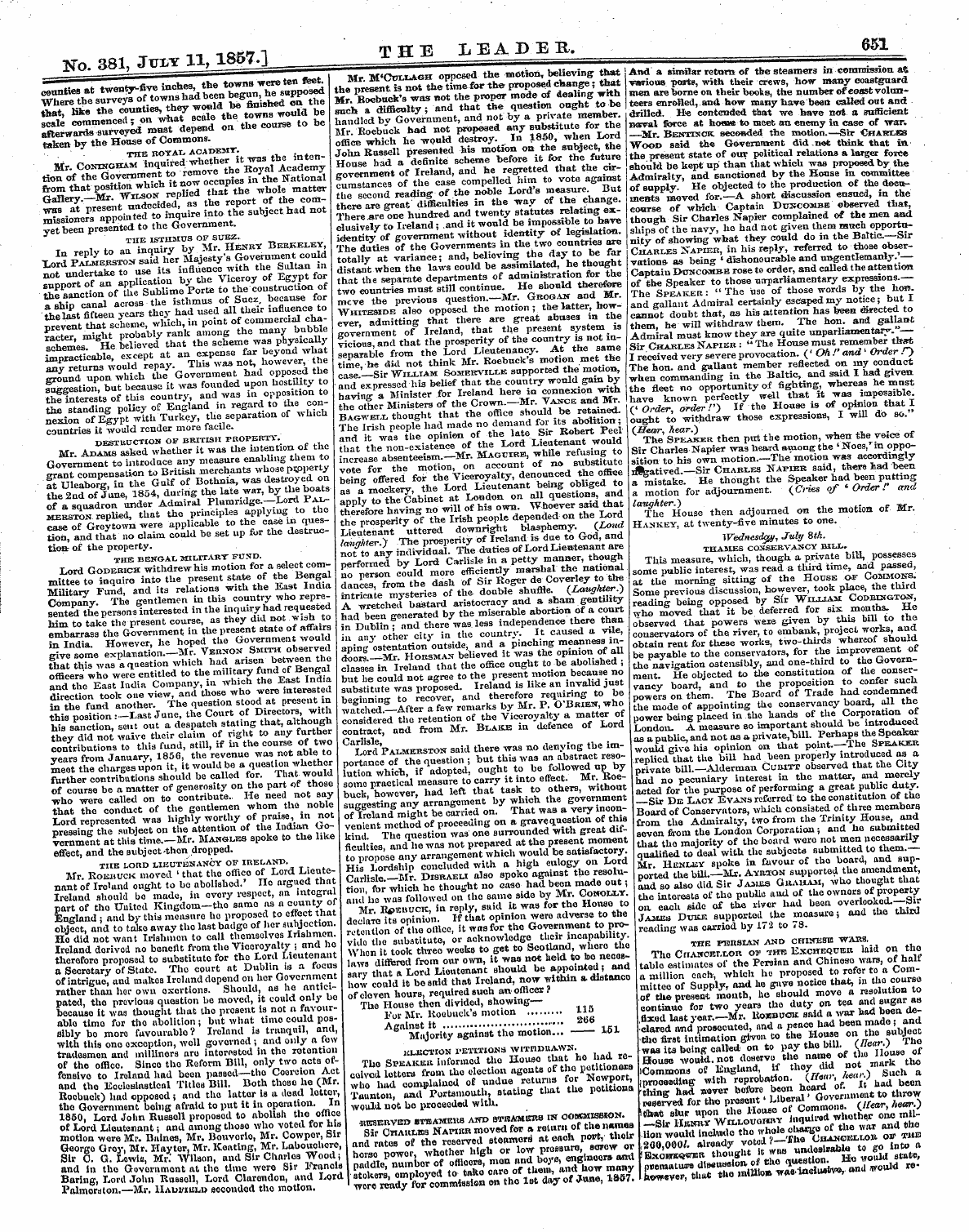
Where the S « rveya of towM hadtew Oeg ^ ^ ^ . tat , Kk . the «?»" ' % , 5 a 7 ^ ae the t » w »» «»» W be taken by the House of Commons . THE KOYAL ACADEJIT . , Mr . Conxnc ^ am Mf ^^^^ AcSS ^ Am of the Government to remote the 7 National sa ^ ars ^ i ? r ^ t ^ r yetbee ^ presented to the Government . THE ISTHMUS OF SUEZ . saSrrS & SSKrFS ? mmmmi £ e vent that scLme , which , in point of con > m ^ character mijrht probably rank among the many bubble S i V believed that the scheme was physically m ^ mam tnfInterest of this country , and was i ^^ he cU t ^ % ^ X ^ p ^ £ vss ; countries it would render more facile . DESTRU CTION OF BRITISH PROPERTY . SS , l ? Zt » claim oould be set up for the destructiea of the property .
THE BENGAl MILITARY FUND . Lord Goderich withdrew his motion for-a . " ^ g « 3 mittee to inquire into the present state of the Bengal Military Fund , and its relations with the East India Company . The gentlemen in this country who repre-Hfe ^ = s ^ W f « sis- ^ rrre ^ rso ^ r ps S « ime " pto » ti < m . _ Mr . VKaHONSMtTK observed ^ K 3 » W 8 £ gSS £ ^^^ OT ^ jTsS a-ysi , ' ^ s r ^ . ffss rs & qg his sanction , sent out a despatch stating that althougl ^ j : j 4 . , ™; , r » fi , r . ir niiiim of riffht to any turtnei ¦
contributions to this fund , still , if in the course of two years from January , 1856 , the revenue was not able to £ eet the charges upon it , \\^\^ , % ^ ^^ M further contributions should be called for . That would of course be a matter of generosity on the part of those who were called on to contribute . He need not say that the conduct of the gentlemen whom the noble Lord represented was hig hly worthy of praise , in not pressing the . subject on the attention of the Indian Government at this time . —Mr . Mangles spoke to the like effect , and the subject-then dropped . THE LORD LIEUTENANCY OF IRELANP . Mr . Roe « uck moved ' that the office of Lord lieutenant of Ire land ought to bo abolished . ' He argued that Ireland should bo made , in every respect , an Integra part of the UuLted Kingdom—the same as a county- o Eqgland ; and by this measure ho proposed to effect thai objfet , and to take away the last badge of her subjection ^» " ¦ ,. ' , . l Tt ~ i „ ., *~ nnii n-i « insalves Irisumon wwuihu —¦
_ jcjLO uia not wiini " «¦ " ^<»»» V i i Ireland dorivod ao beneiit from tho Vicoroyalty ; and no therefore proposed to substitute for the Lord Lieutenant a Secretary of State . The court at Dublin is a focus of intrigue , and makes Ireland depend on her Government rather than her own exertions . Should , as ho anticipated , the previous question bo moved , > t could only bo because it was thought that the present is not a favourable time for tho abolition ; but what time could possibly bo more favourable ? Ireland is tranquil , and , with this ono exception , well governed , and only a low tradesmen and milliners arc interested in tho retention of tho office Since tho Reform Bill , only two acts offensive to Irolandhad boon passed—tho Coercion Act «„ , ! * u ~ i ? n ,. u 0 i 0 atin « i Titian " Rill . Both those he ( M . r . ;
Roobuck ) had oppoaod 5 and tho latter is a dond letter , tho Government being afraid to put it in operation . In I 860 , Lord John Rusaoll proposed to abolish the oflloe of Lord Lieutenant ; and among thoao who voted for Uia motion wore Mr . Baines , Mr . Bouvorio , Mr . Cowpor , Hir George Grey , Mr . Haytor , Mr . Keating , Mr . Lobouohoro , Sir C . G . Lowls , Mr . ' Wilson , and Sir Charloa Wood ; and in tho Government at tho time were Sir Francis Baring , Lord John RubsoII , Lord Clarendon , and Lord Falmoraton . —Ma \ IIadjpiuld seconded tho motion .
Mr M'CtJiXAGH opposed , the present is not the time for the proposed change : j that Mr . Roebuck ' s was not the proper mode of dealing with inch a difficulty ; and that the question ought : Uthe handled bv Government , and not by a private member . Mr Roebuck had not proposed any »* f ^ J ? " * office which he would destroy . . In 1850 , when . Lord John Rassell presented his motion on the abject , the House had a definite scheme before *** . <*"** % * ? ove 7 n ment of Ireland , and he regretted that the cht-SmTfBces of the case compelled him to vote against the second reading of the noble Lords insure . But there are great difficulties in the way of the change . There are one hundred and twenty statutes "ktuige * - clusively to Ireland ; and it would be impossible tobm Sentity of government without identity of legislation . Th ? duties if the Governments in the twe countries are sss ^ rrr , ; . ^ r »^ : c r ^ sars ^ BKiarw ^ g ever , admitting that there are great abases m the ssss & ss & x - - = V H £ case . —Sir William Somervillk supported the motion , r . e . r / n ^ i ^ fx ^^ eM ^ fr Sr IS °£ ST " ^ % * i £ 5 Z % ? hat the non-existence of the Lord Lieutenant would n : rease absenteeism . -Mr . Mao ™ , j Uj . «*™* £ vote for the motion , on account of no substitute . S ^^ jrassiS ^ w ¦ asSfcjasa ^ = £ haarytsr » » sf 5 f ^ 53 g lanaltter > The prosperity of Ireland is due to God , ana Z ^ I y ^ Widnl The duties o ^ Lord Uente ^ nt ave Performed by Lord Carlisle in a petty manner , though I no Sn could more efficiently marshal the national danceT from the dash of Sir Roger de Coverley to . the St . mysteries of the double shuffle . C ^ -gSS : ioi ^^^^ it ^ f ^ ss ' closes in Ireland that the office ought to be abolished ; t bU h " could not agree to the P ^^ VT ^ TinvSSiu L substitute was proposed . V ^ J m . irin- t > be t beginning to recover , and therefore requiring ^ to be i watched—After a few remarks by Mr . P . O Uribn , wno considered the retention of the Viceroyalty a matter of r contract , and from Mr . Blaise m defence of Lord
Ca Lord Palmerston said there was no denying the ^ im-= h ?* : ws rE ^ T ^ s some practical measure to carry it into effect . Mr ., Koe-Wk however , had left that task to others , without Sadng any arrangement by which the government offetndV . ght be carried on . That wa 3 a very inconvenient method of proceeding on a ^ qw ^ tooof th ^ kind The question was one surrounded with great dilficu ties and he was not prepared at the present moment t ^ oso any arrangement which would be aatisfactory His Lordship concluded with a high eulogy on Lord : Cttriisle ' -Mn Disraeli also spoke against the resolu-[ tiZ tor Which he thought no case had been rna £ mj £ , and he was followed on the same side by Mr . Co » olly . Mr Rpkbuck , in reply , said it was for the House to " declare ifs opinion . If that opinion were adverse to the ' retention of the office , it was for the Government to provMotioT substitute , or acknowledge their mcapabihty . Whon it took three weeks to get to Scotland , where the 2 ^ dUlKd SSL our own , It was not held to bo mom-*!„ .. " , . T . « r . i T . ioatonant should be appointed ; and
how could it beaaTd that Ireland , now within a distance of cloven hours , required such on officer r Tho House then divided , showing—For Mr . Roebuck ' s motion JJJ Against it I " - ""'" iki Majority against thq motion .,. *>»* - KLKCl'ION I'ETmCMSa WlTHDttAWN . J 5 eaafi ss ajg = ™ i « hn / i nnnxnlaiuod of undue returns for « owport . tue
, Tmmton " and Portsmouth atating that peuw » . would not bo proceeded with . aussnuvim sttsamkus aitd stuamkhb » o ««™ J 25 > a Sir CnAuuss Napibb moved for a rtuwo f t Ue qnw and ratoB of the reserved eteamord at e « oh port , tuoir ToUpoU- Aether high or *" £ ? ' %£££ paddle number of offlcora , mon and bo ,-a , englneor » anU
! ^ Tarioos poartB , with their crews , ho-w many coastguard men ore borne on their boots , the number of coast volunteers enrolled ,. and how many have been called ont and drilled' He contended that we have not a irafHcient naval force at howe to meet an enemy in case of war . —Mr . Bentinok . seconded the motion . —Sir Charles Wood said the Government did . not think that in the present state of our political relations a larger fort * should be kept up than that which was proposed by the Admiralty , and sanctioned by the House in committee of supply . He objected to the production of the docamettts moved for . —A short discussion ensued , in the course of which Captain Dukcombe obaerved that , though Sir Charles Napier complained of the men aad ships of the navy , he had not given them much opportenity of showing what they could do in the Baltic—Sir Carles Napier , in his reply , referred to those observations as being ' dishonourable and ungentlemanly . — Captain I > uncomb-b rose to order , and called the attention of the Speaker to those urrparliamentary expressions . — The Speaker : " The use of those words by the hoir . and gallant A dmiral certainly escaped my notice ; but 1 cannot doubt that , as his attention has been directed to them , he will withdraw them . The hon . and gallant Admiral must know they are quite unparliamentair- - — Sir Chables Napier : ' The House must ^ member that I received very severe provocation . ( ' Oh ! ' and Order ry The hon . and gaUant member reflected on my conduct when commanding in the Baltic and said I had given the fleet no opportunity of fighting whereas h « must nave known perfectly well that it wa * impossible . (« Order , order H If the House » of opmion . that I ou ^ it to withdraw those expressions , I will do so . ( Sear , hear . ') , . * . *¦ iiiuuvtj T ^— —
Xne bpeaker men puii uc »» , ,. y - Sir Charles Napier was heard among the ' Noes , m opposition to his own motion . — The motion was accordingly dfeatived . —Sir Charles NApier said , th « re lad been Hnistake . He thought the Speaker had been putting a motion for adjournment . ( Ones of ' Order ! and a The e 7 House then adjourned on the motioa of Mr . Haskey , at twenty-five minutes to one .
^ Wednesday , July 8 tk . THA 3 LES COXSERVAXCY BILL , This measure , which , though a private bill , possesses some public interest , was read a third toe , and passea , at the morning sitting of the House of Colons . Some previous discussion , however , took place , the third riding being opposed by Sir William CoDRmoTO | who moved that it be deferred for sxx months . He observed that powers weie given by this bill to the conservators of the river , to embank , project works , ana obtain rent for these works , two-thirds whereof should be payable to the conservators , for the i mprovement ot the navigation ostensibly , and one-third to the Government . He objected to the constitution of the conservancy board , and to the proposition to confer such powers on them . The Board of Trade had condemned . the mode of appointing the conservancy board , all the power being placed in the hands of the Corporation of Lonaoru I measure so important should be introduced . _ , _ « a * ., 0 „ ™ . ; v < it . i > \ rill . Perhaps the Speaker
would give his opinion on that po . int .-The Speaker replied that the bill had been properly introduced as a private bUL—Alderman Cuiutt observed that the City had no pecuniary interest in tho matter , and merely acted for the purpose of performing a great public duty . —Six De Lacy Evans referred to the constitution of the Board of Conservators , which consisted of three memberQ from tho Admiralty , two from the Trinity House , and seven from the London Corporation ; and he submitted that the majority of the board were not men aeaeuainl ? qualified to deal with the subjects submitted to them . — Mr Henlicy spoke in favour of the board , and supported the bill—Mr . Aviva'ON ^ l ^^^ . ^^ htThat and so also did Sir JAiUi 3 Guaham , who thought that SJe interest * of tho public aud of the owners of property on each side of the river had been » verl 0 oked . _ Sir James Dinus supported the measure ; and the tharU reading was carried by 172 to 78 . THE PERSIAN AND CHIWESTS "WAIta . The CriAWOBrxoR op two Exchequer laid on tho table estimates of the Persian and Ch J V ^ Com .... 1 . UJ « 1 . Ua Tvnnnnsflfi to TOfer tO a
tOlnof tU . present mouth , ho should roove a « " *» " ™ ^ : r ^ = r ^ r to « ^*~ zg ?& as srr . a ? ^\ Hr- ssai-sts ^ n ^ Aji-Ls bo
thing had n « ver ^ e ^ - ^^ nmont to throw waerved for tho prosent Liberal « £ vw ^ icsr ^ rsft ^ ss ^^ - —* *
I<O. O&-1 ? * ¦ ^==========5========== •...
I < O . O & -1 ? * ¦ ^ ========== 5 ========== ftinT i i nniln I , iii r lln I i in rnmmrnf-n at xr * yj > * -r ^ - * i —— == ^ s ^ r-== === ^^ :== SiS ' ' the motionbelieving thatAnd a similar return of the steamers in eomrmssion at
-
-
Citation
-
Leader (1850-1860), July 11, 1857, page 3, in the Nineteenth-Century Serials Edition (2008; 2018) ncse.ac.uk/periodicals/l/issues/cld_11071857/page/3/
-