On this page
-
Text (2)
-
![Hm38^ JTOY lV1857.] " THE LEA ' dBB. 655](/static/media/periodicals/101-CLD-1857-07-11-001-SINGLE/Ar00701S_xkZb8IG.png)
Hm38^ JTOY lV1857.] " THE LEA ' dBB. 655
-

OUK CIVILIZATION. —: ? THE TRIAL OF MISS...
Note: This text has been automatically extracted via Optical Character Recognition (OCR) software. The text has not been manually corrected and should not be relied on to be an accurate representation of the item.
-
-
Transcript
-
Note: This text has been automatically extracted via Optical Character Recognition (OCR) software. The text has not been manually corrected and should not be relied on to be an accurate representation of the item.
Additionally, when viewing full transcripts, extracted text may not be in the same order as the original document.
Hm38^ Jtoy Lv1857.] " The Lea ' Dbb. 655
Hm 38 ^ JTOY lV 1857 . ] " THE LEA ' dBB . 655
Ouk Civilization. —: ? The Trial Of Miss...
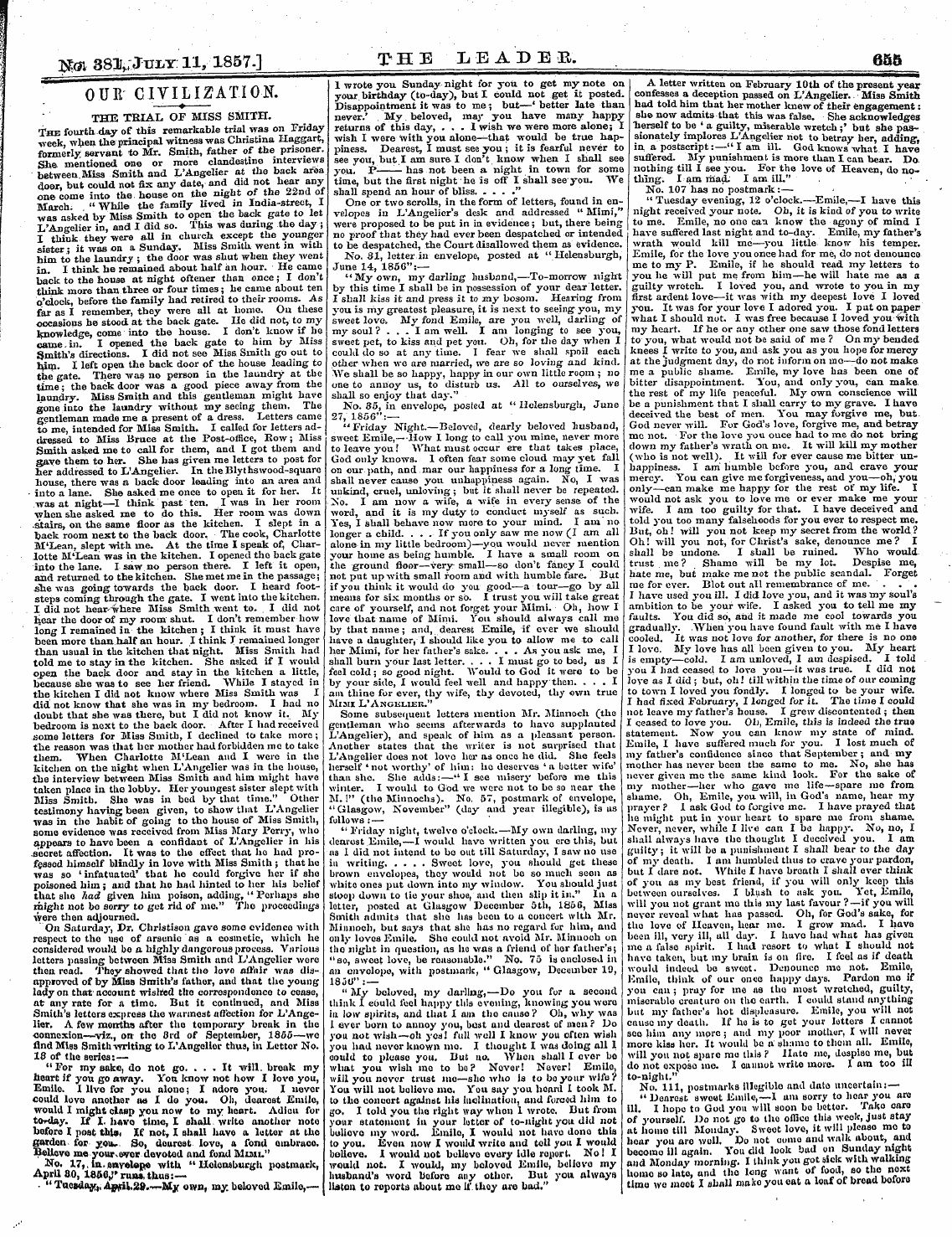
OUK CIVILIZATION . — : ? THE TRIAL OF MISS SMITH . The fourth day of this remarkable trial was on Friday ¦ week when the principal witness was Christina Haggart , formerly ' servant to Mr . Smith , father of the prisoner . She mentioned one or more clandestine interviews between Miss Smith and L'Angelier at the back area door , but could not fix any date , and did not hear any one come into the house on the night of the 22 nd of March " While the family lived in India-street , I was asked by Miss Smith to open the hack gate to let L'Angelier in , and I did so . This was dimng the day ; I think they were all in church except the younger sister ; it was on a Sunday . Miss Smith went in with him to the laundr y ; the door was shut when they went
in . I think he remained about half an hour . He came back to the house at night oftener than once ; I don ' t think more than three or four times ; he came about ten o ' clock , before the family had retired to their rooms . As far as I remember , they were all at home . On these occasions be stood at the back gate . Ho did not , to my knowledge , come into the house . I don ' t know if he came . in . I opened the back gate to him by Bliss Smith ' s directions . I did not see Miss Smith go out to him . I left open the back door of the house leading to the gate . There "was no person in the laundry at the time ; the back door was a good piece away from the laundry . Miss Smith and this gentleman might have gone into the laundry without my seeing them . The
gentleman made me a present of a dress . Letters came to me , intended for Miss Smith . I called for letters addressed to Miss Bruce at the Post-office , Row ; Miss Smith asked me to call for them , and I got them and gave them to her . She has given me letters to post for her addressed to L'Angelier . In the Blythswood-square house , there was a back door leading into an area and into a lane . She asked me once to open it for her . It was at night—I think past ten . I was in her room when she asked rne to do this . Her room was down . stairs , on the same floor as the kitchen . I slept in a back room next to the back door . The cook , Charlotte M'Lean , slept with me . At the time I speak of , Charlotte M'Lean was in the kitchen . I opened the back gate
into the lane . I saw no person there . I left it open , and returned to the kitchen . She met me in the passage ; -slie was going toivards the back door , I heard footsteps coming through the gate . I went into the kitchen . I did not hear-TJrbere Miss Smith went to . I did not hear the door of my room shut . I don ' t remember how long I remained in the kitchen ; I think it must have been more than half an hour . I think X remained longer than usual in the kitchen that night . Miss Smith had told me to stay in the kitchen . She asked if I would open the back door and stay in the kitchen a little , because she was to see her friend . While I stayed in the kitchen I did not know where Miss Smith was I did not know that she was in my bedroom . I had no doubt that she was there , but I did not know it . My bedroom is next to the back door . After I had received some letters for Miss Smith , I declined to take more ; the reason was that her mother had forbidden me to take them . When Charlotte M'Lean and I were in the kitchen on the night when L'Angelier was in the house , tbe interview between Miss Smith and him might have taken place in the lobby . Her youngest sister slept with Miss Smith . Sao was in bed by that time . " Other testimony having been given , to show U > at L'Angelier was in the habit of going to the house of Miss Smith , some evidence Avas received from Miss Mary Perry , who appears to have been a confidant of L'Angelier in his secret affection . It was to the effect that ho had professed himself blindly in love with Miss Smith ; that he was so ' infatuated' that he could forgive her if she poisoned him ; and that he had hinted to her his belief that she had given him poison , adding , Perhaps she might not bo sorry to get rid of mo . " The proceedings were then adjourned .
On Saturday , Dr . Christison gave some evidence with respect to the use of arsenic as n cosmetic , which he considered would be a highly dangerous process . Various letters passing between Miaa Smith and L'Angelier were then read . They showed that the lovo affair was disapproved of by Miss Smith ' s father , and that the young lady on that account wished tiro correspondence to cease , at any rate for a time . But it continued , and Miss Smith ' s letters oxpress the wannest affection for L'Angelier . A few morrths after the temporary breuk in the connexion- — -viz ., on the 8 rd of SeptetnJjcr , 1855—we find Miaa Smith writing to L'Angelier thus , in Letter No . 18 of the series : —
" For my sake , do not go . ... It ¦ will , break my heart if you go away . You know not how I lovo you , Etnilo . I Hvo for you alone ; I adore you . I never could lovo another aa I do you . Oh , dearest Emilo , would I might clasp you now to my heart . Adieu for to-rday . If I . h-avo time , I ah . aU write another note before I post thl » , If not , I shall havo a letter at tho garden for yoiw So , dourest lovo , a fond embrace . Bellovo me youTvWor devoted and fond Mian . " No . 17 ,. in . Qnvelepe with , " Uelensbunch postmark . April 80 , 1800 , ? ' ram thns : — - " Taeadajr ,, Ap ^ U . 2 » .- —My own . my . beloved Emilo ,-
—1 wrote you Sunday night for you to get my note on your birthday ( to-day ) , but I could not get it posted . Disappointment it was to me ; but— ' better late than never . ' My beloved , may you have many happy returns of this day , . . . I wish we were more alone ; I wish I were with you alone—that would be true hapjiiness . Dearest , I must see you ; it is fearful never to see you , but . I am sure I don ' t know when I shall see you . P — has not been a night in town for some time , but the first night he is off I shall see you . We shall spend an hour of bliss "
One or two scrolls , in the form of letters , found in envelopes in L'Angelier ' s desk and addressed " Mimi , " were proposed to be put in in evidence ; but , there being no proof that they had ever been despatched or intendec to be despatched , the Court disallowed them as evidence . No . 31 , letter in envelope , posted at " Helensburgh , June 14 , 1856 " : — "M y own , my darling husband , —To-morrow night by this time I shall be in possession of your dear letter .
I shall kiss it and press it to my bosom . Hearing from you is my greatest pleasure , it is next to seeing you , my sweet love . My fond Emile , are you well , darling of my soul ? . . . I am well . I am longing to see you , sweet pet , to kiss and pet you . Oh , for the day when I could do so at any time . I fear we shall spoil each other when we are married , we are so loving and kind . We shall be so happy , happy in our own little room ; no one to annoy us , to disturb us . All to ourselves , we shall so enjoy that day . "
JSTo . 35 , in envelope , posted at " Helensburgh , June 27 , 185 G " : — " Friday Night . —Beloved , dearly beloved husband , sweet Emile , — -How I long to call j-ou mine , never more to leave you ! What must occur ere that takes place , God only knows . 1 often fear some cloud may yet fall on our path , and mar our happiness for a long time . I shall never cause you unhappiness again . No , I was unkind , cruel , unloving ; but it ' shall never be repeated . No . I am now a wife , a wife in every sense of the word , and it is my duty to conduct myself as such . Yes , I shall behave now more to your mind . I am no longer a child . ... If you only saw me now ( I am all alone in my little bedroom )—you would never mention
your home as being humble . I have a small room on the ground floor—very small—so don ' t fancy I could not put up with small room and with humble fare . But if you think it would do you good—a tour—go by all means for six months or so . I trust you will take great care of yourself , and not forget your Mimi . Oh , how I love that name of Mimi . You should always call me by that name ; and , dearest Emile , if ever we should have a daughter , I should like you to allow me to call her Mimi , for her father ' s sake . ... As you ask me , I shall burn your last letter . ... I must go to bed , as I feel cold ; so good night . "Would to God it were to be by your side , I would feel well and happy then . ... I am thine for ever , thy wife , thy devoted , thy own true Mian L'Angklier . "
Some subsequent letters mention Mr . Minnoch ( the gentleman who seems afterwards to have supplauted L'Angelier ) , and speak of him as a pleasant person . Another states that the writer is not surprised that L'Angelier does not lovo her as once he did . She feels herself ' not worthy' of him : he deserves ' a better wife ' than she . She adds : — "I see misery before me this winter . I would to God we wore not to be so near the M . ! " ( tho Minnochs ) . No . 57 , postmark of envelope , " Glasgow , November" ( day and year illegible ) , is us follows : —
" Friday night , twelve o ' clock . —My own darling , my dearest Emile , —I would have written you ere this , but as I did not intend to be out till Saturday , I saw no use in writing Sweet love , you should get these brown envelopes , they would not be so much seen as whito ones put down into my window . You should just stoop down to tic your shoo , and then slip it in . " In a letter , posted at Glasgow December 5 th , 1856 , Miss Smith admits that she has been to u concert with Mr . Minnoch , but says that she has no regard for him , and only loves Emile , She could not avoid Mr . Minnooh on the night in question , as ho was a friend of her father ' s ; " , sweet love , be rousonable . " No . 75 ia enclosed in an envelope , with postmark , " Glasgow , Decouiber 19 , 183 U " : —
" My beloved , my darling , —Do you for a , second think I could feel happy this evening , knowing you wore in low spirits , and that I am the cause ? Oh , why was 1 ever born to annoy you , best and dourest of men ? Do you not wish—oh yoal full well I know you often wiah you had never known mo . I thought I was doing all I could to plcaso you . But no . When shall I over bo wliat you wiah mo to bo ? Novor ! Never ! Emilo , will you never trust mo—she who ia to bo your wife ?
You will not boliovo mo , You say you hoa . nl I took M . to tho concert against hid Inclination , and forced him to go . I told you the right way when 1 wrote . But from your statement in your lottor of to-night you did not boliovo my word . Emilo , I would not liuvo dono this to you . Evou now I would write and toll yon I would boliovo . I would not bellovo every idle roport . No 1 I would not . I would , my bolovod Emilo , boliovo my husband ' s word before any other . But you always lbtou to reports about mo if . thoy aro bad . "
A letter Written on February 10 th of the present year confesses a deception passed on L'Angelier . Miss Smith had told him that her mother knew of their engagement she now admits that this was . false . She acknowledges lierself to be ' a guilty , miserable wretch ; ' but she passionately implores L'Angelier not to betray her , adding , in a postscript : — "lam ill . God knows what . I have suffered . My punishment is more than I can bear . Do nothing till I see you . For the love of Heaven , do nothing . I am mad . I am ill . " . No . 107 has no postmark : —
" Tuesday evening , 12 o ' clock . —Emile , —I have this night received your note . Oh , it is kind of you to write to me . Emile , no one ca-a know the agony of mind I have suffered last night and to-day * . Emile , my father ' s wrath would kill me—you little know his temper . Emile , for the love you once had for me , do not denounce me to my P . Emile , if he should read my letters to you he will put me from him—he will hate me as a guilty wretch . I loved you , and wrote to you in my first ardent love—it was "with my deepest love I loved you . It was for your love I adored you . I put on paper what I should not . I was free because I loved you with my heart . If he or any other one saw those fond letters to you , what would not be said of me ? On my bended
knees I write to you , and ask you as you hope for mercy at the judgment day , do not inform on me—do not make me a public shame . Einile , my love has been one of bitter disappointment . You , and only you , can make the rest of my life peaceful . My own conscience will be a punishment that I shall carry to my grave . I have deceived the best of men . You may forgive me , but God never will . For God ' s love , forgive me , and betray me not . For the love you ouee had to me do not bring clown my father ' s wrath on me . It will kill my mother ( who is not well ) . It will for ever cause me bitter unbappiness . I am humble before you , and crave your mercy . You can give me forgiveness , and you—oh , you only—can make me happy for the rest of my life . I
would not ask you to love me or ever make me your wife . I am too guilty for that . I have deceived and told you too many falsehoods for you ever to respect me . But , oh ! will you not keep my secret from the world ? Oh ! will you not , for Christ ' 3 sake , denounce me ? I shall bs undone . I sball be ruined . Who would trust me ? Shame -will be my lot . Despise me , hate me , but make me not the public scandal . Forget me for ever . Blot out all remembrance of me . . . . I have used you ill . I did love you , and it was my soul ' s ambition to be your wife . I asked you to tell me my faults . You did so , and it made me cool towards you gradually . When you have found fault with me I have cooled . It was not love for another , for there is no one
I love . My love has all been given to you . My heart is empty—cold . I am unloved , I am despised . I told 3-011 I had ceased to love you—it was true . I did not love as I did ; but , oh ! till within the time of our coming to town I loved you fondly . I longed to be your wife . I had fixed February , I longed for it . The time I could not leave my father ' s house . I grew discontented ; then I ceased to love you . Oli , Emile , this is indeed the truo statement . Now you can know my state of mind . Eraile , I have suffered much for you . I lost much of my father ' s confidence since that September ; and my mother has never been tbe same to me . No , she has never given me the same kind look . For the sake of my mother—her who gave me life—spare me from
shame . Oh , Emile , you will , in God 3 name , hear my prayer ? 1 ask God to forgive me . I have prayed that lie might put in your heart to spare me from shame . Never , never , while I liv « 3 can I be happy . No , no , I shall always have the thought I deceived you . I am guilty ; it will bo a punishment I shall hear to the day of my death . I am humbled thus to crave 3 'our pardon , but I dare not . While I have breath I shall ever think of you as my best friend , if you will only keep thia between ourselves . I blush to ask you . Yet , Emile , will you not grant me thia my last favour ?—if you will never reveal what has passed . Oh , for God ' s sake , for the love of Heaven , hear mo . I grow mad . I liavo been ill , very illull day . I huvo had what has given
, me a false npirit . I hud resort to what I should not have taken , but my brain id on ( Iro . I feel as if death , would indeed bo swoot . Denounce mo not . Emilo , Emilo , think of our on « o happy days . Pardon me if you can ; pray for mo « s tho most wretched , guilty , miserable croaturo on tho earth . I could stand anything but my father * hot displeasure . Einile , you will not cauao my death . If ho is to got your letters I cannot see him any move ; and my poor mother , I will never more kisa her . It would bo u . shamo to thorn all . Emilo , will you not spare mo this ? Hato mo , dospiao me , but too ill
do not oxpoao mo . I cannot write inoro . I am to-night . " No . Ill , postmarks illegible and date uncertain : — " Dearest awcut EnilU , —1 urn aorry to hoar you aro ill . I hope to God you will soon bo bettor . Tako caro of yourself . Do not go to the office thia weok , just stay at homo till Monday . Swoot lovo , it will ploaao mo to hoar you aro well . Do not owmo and walk about , ana bocorao ill again . You did look bad on Sunday night and Monday morning . I think you got sick with walking Uo . no bo lato , and tho long want of food , bo tho next tiino wo moot I shall make you oat a loaf of broad boforo
-
-
Citation
-
Leader (1850-1860), July 11, 1857, page 7, in the Nineteenth-Century Serials Edition (2008; 2018) ncse.ac.uk/periodicals/l/issues/cld_11071857/page/7/
-