On this page
-
Text (2)
-
![November 13, 1852.] THE LEADER. 1097](/static/media/periodicals/101-CLD-1852-11-13-001-SINGLE/Ar02102S.png)
November 13, 1852.] THE LEADER. 1097
-

J U L L I H N' S CONC E 11 T S..ToLi/ncN...
Note: This text has been automatically extracted via Optical Character Recognition (OCR) software. The text has not been manually corrected and should not be relied on to be an accurate representation of the item.
-
-
Transcript
-
Note: This text has been automatically extracted via Optical Character Recognition (OCR) software. The text has not been manually corrected and should not be relied on to be an accurate representation of the item.
Additionally, when viewing full transcripts, extracted text may not be in the same order as the original document.
Anne 1j L A K E. Lioinonhth In Bifl Lear...
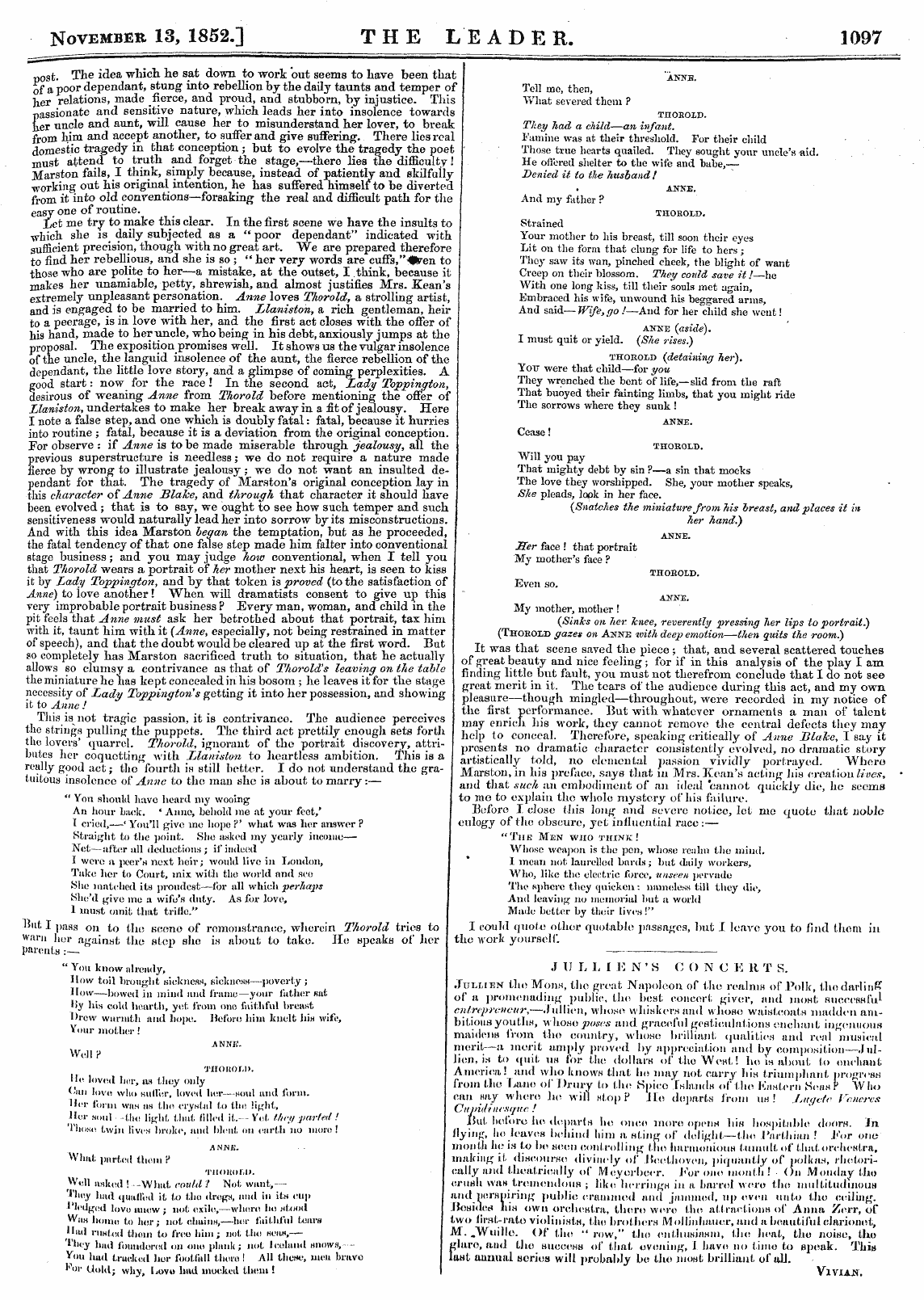
pO gt . The idea which , he sat down to work out seems to have been that of a poor dependant , stung into rebellion by the daily taunts and temper of Jier relations , made fierce , and proud , and stubborn , by injustice . This pass ionate and sensitive nature , which , leads her into insolence towards ker uncle and aunt , will cause her to misunderstand her lover , to break from him and accept another , to suffer and give suffering . There lies real d omestic tragedy in that conception ; but to evolve the tragedy the poet must attend to truth and forget the stage , —there lies the difficulty ! Harston fails , I think , simply because , instead of patiently and skilfully working out his original intention , he has suffered himself to be diverted from it into old conventions—forsaking the real and difficult path for the easy one of routine . Let me try to make this clear . In the first scene we have the insults to ' ¦ :
which she is daily subjected as a " poor dependant" indicated with sufficient precision , though with no great art . We are prepared therefore to find her rebellious , and she is so ; " her very words are cuffs , " # fcren to those who are polite to her—a mistake , at the outset , I think , because it makes her unamiable , petty , shrewish , and almost justifies Mrs . Elean ' s extremel y unpleasant personation . Anne loves Thorold , a strolling artist , and is engaged to be married to him . Llaniston , a rich gentleman , heir to a peerage , is in love with her , and the first act closes with the offer of his hand , made to her uncle , who being in his debt , anxiously jumps at the proposal . The exposition promises well . It shows us the vulgar insolence of the uncle , the languid insolence of the aunt , the fierce rebellion of the dependant , the little love story , and a glimpse of coming perplexities . A
good start : now for the race ! In the second act , Lady Toppington , desirous of weaning Anne from Thorold before mentioning the offer of Llaniston , undertakes to make her break away in a fit of jealousy . Here I note a false step , and one which is doubly fatal : fatal , because it hurries into routine ; fatal , because ifc is a deviation from the original conception . For observe : if Anne is to be made miserable through jealousy , all the previous superstructure is needless ; we do not require a nature made fierce by wrong to illustrate jealousy ; we do not want an insulted dependant for that . The tragedy of Marston ' s original conception lay in this character of Anne Blake , and through that character it should have been evolved ; that is to say , we ought to see how such temper and such sensitiveness would naturally lead her into sorrow by its misconstructions . And with this idea Mars ton began the temptation , hut as he proceeded ,
the fatal tendency of that one false step made him falter into conventional stage business ; and you may judge how conventional , when I tell you that Thorold wears a portrait of her mother next his heart , is seen to kiss it by Lady Toppington , and by that token is proved ( to the satisfaction of Anne ) to love another ! When will dramatists consent to give up this very improbable portrait business ? Every man , woman , and child in the pit feels that Anne must ask her betrothed about that portrait , tax him with it , taunt him with it ( Anne , especially , not being restrained in matter of speech ) , and that the doubt would be cleared up at the first word . But so completely has Marston sacrificed truth to situation , that he actually allows so clumsy a contrivance as that of Thorold's leaving on the table the miniature he has kept concealed in his bosom ; he leaves it for the stage necessity of Lady Toppington s getting it into her possession , and showing it to Anne !
This is not tragic passion , it is contrivance . The audience perceives the strings pulling the puppets . The third act prettily enough sets forth the lovers' quarrel . Thorold , ignorant of the portrait discovery , attributes her coquetting with Lilaniston to heartless ambition . This is a really good act ; the fourth is still better . I do not understand the gratuitous insolence of Anne to the man she is about to marry : — " You should have heard my wooing An hour back . ' Anne , behold me at your feet , ' I cried , — ' You'll give me hope ? ' what was her answer ? Straight to the point . She usked my yearly income—Net—after all deductions ; if indeed I were a peer ' s next heir ; Avould live in London , Take her to Court , mix with the world and see She matched its proudest—lor all which perhaps She'd give me a wife ' s duty . As for love , I must omit thut trifle . " " nt I pass on to the scono of romonstrance , wherein Thorold tries to warn her against the step she is about to take . He speaks of her parents : — " You know already , How toil brought sickness , sickness—poverty ; How—bowed in mind and frame—your lather Bat Uy his cold hearth , yet , from 0110 faithful breast Drew warmth and hope . Before him knelt 1 uh wife , Your mother ! ANNE . Well P TIlOHOTil ) . He loved hor , an they only (' an love who slitter , loved her—noul and form . Her forin wan as the crystal to the light , Her soul -the light thai ; filled it-- Yet they parted ' . Those twin liven broke , and blent on earth no more ! A NUB . What parted them ? THOltOIiO . Well asked ! -What- could ! Not want , --' 'hey had quailed it to the dregn , and in its cup ' 'ledged lovo anew ; not exile , —where ho . stood Was honu > to her ; not chains , —her faithful tears Had ruHlod thoin to frco him ; not the hoiih , — '"'bey had foundered on one plunk ; not Iceland hiiows , - y « u had tracked her footfall thtiro ! All thene , men bravo I ° I" Uold ; why , liovo had mocked them !
' ANNB . Tell me , then , "What severed them ? thoeoxd . They had a child—an infant . Famine was at their threshold . Tor their child Those true hearts quailed . They sought your uncle ' s aid . He offered shelter to the wife and babe , — Denied it to the husband I ANNE . And my father ? THOEOLD . Strained Your mother to his breast , till soon their eyes Lit on the form that clung for life to hers ; They saw its wan , pinched cheek , the blight of want Creep on their blossom . They could save it!—he With one long kiss , till their souls met again , Embraced his wife , unwound his beggared arms , And said— Wife , go !—And for her child she went ! anne ( aside ) . I must quit or yield . ( She rises . ) thorold ( detaining her ) . Yotr were that child—for you They wrenched the bent of life , —slid from the raft That buoyed their fainting limbs , that you might ride The sorrows where they sunk ! ANNE . Cease ! THOROLD . Will you pay That mighty debt by sin ?—a sin that mocks The love they worshipped . She , your mother speaks , She pleads , lopk in her face . ( Snatches the miniature from his breast , and places it in her hand . ) ANNE . Her face ! that portrait My mother's face ? THOEOI / D . Even so . ANNE . My mother , mother ! ( Sinks on her knee , reverently pressing her lips to portrait ?) ( Thorold gazes on Anne toith deep emotion—then quits the room . ) It was that scene saved the piece ; that , and several scattered touches of great beauty and nice feeling ; for if in this analysis of the play I am finding little but fault , you must not therefrom conclude that I do not see great merit in it . The tears of the audience during this act , and my own pleasure—though mingled—throughout , were recorded in my notice of the first performance . But with whatever ornaments a man of talent may enrich his work , they cannot remove the central defects they may help to conceal . Therefore , speaking critically of Anne Slake , I Bay it presents no dramatic character consistently evolved , no dramatic story artistically told , no elemental passion vividly portrayed . Where-Marston , in his jn'eface , says that in Mrs . Kean ' s acting his creation Itves , and that such an embodiment of an ideal ' cannot quickly die , he seems to me to explain the whole mystery of his failure . Before I close this long and severe notice , let me quote that noble eulogy of the obscure , yet influential race : — " The Men who think ! Whose weapon is the pen , whose realm the mind . I mean not laurelled bards ; but daily workers , Who , like the electric force , unseen pervade The sphere they quicken -. nameless till they die , And leaving no memorial but a world Made better by their lives !" I could quote other quotable passages , but I leave you to find them in the work yourself .
November 13, 1852.] The Leader. 1097
November 13 , 1852 . ] THE LEADER . 1097
J U L L I H N' S Conc E 11 T S..Toli/Ncn...
J U L L I H N' S CONC E 11 T S . . ToLi / ncN the Moils , the great Napoleon of the realms of Polk , thodarlinff of a promenading public , tho best concert giver , and most Hueeensiul cntrepvtmeur , — . Jullien , whoso whiskers and whoso waistcoats madden ambitious youths , whose poses and graceful gesticulations enchant ingenuous maidens from tho country , whoso brilliant qualities and real musical merit—a merit amply proved by appreciation and by composition— . Jullien , is to quit uh for the dollar * of tho Went ! he is about to enchant America ! and who known that ho may not curry his triumphant progress from the Lane of Drury to tin ; Spiee ' Islands of the Kastoni Sean V Who can Hay where he will utop H JIo departs from us ! . Lugctc Vencrcs Cwpidm !
csquc But before he donaHs he oneo more opens bin hospitable doors . In flying , he leaves behind him a sting of delight—the Parthian ! For one month he is to be neon controlling the harmonious tumult of that orchestra , making it discourse divinely of Beethoven , piquanUy of polkas , rhetorically and theatrically of Meyerbeer . For one month . ' On Monday tho crush vvji 8 tremendous ; like herrings in . n barrel wero the multitudinoun and perspiring public crammed and jammed , up oven unto tho ceiling . BoHidecJ his own orchestra , there were the attractions of Anna Zerr , of two first-rato violinists , the brothers Mollinlmuer , and a beautiful clarionet , M . . Wuillo . Of the " , " tho entliuNJnmn , the heal ,, tho noise , tho glare , and the success of thai evening , I huve no time- to speak . This lust uunual series will probably be the most brilliant of all . VlviAfl .
-
-
Citation
-
Leader (1850-1860), Nov. 13, 1852, page 21, in the Nineteenth-Century Serials Edition (2008; 2018) ncse.ac.uk/periodicals/l/issues/cld_13111852/page/21/
-