On this page
-
Text (3)
-
![October 18, 1856.] THE XEIDER. 1003](/static/media/periodicals/101-CLD-1856-10-18-001-SINGLE/Ar01903S.png)
October 18, 1856.] THE XEIDER. 1003
-

THE AGE OF LOUIS XIV. Louis Fourteenth, ...
-

RETROSPECTS OF HUNGARY. La llongrh*, son...
Note: This text has been automatically extracted via Optical Character Recognition (OCR) software. The text has not been manually corrected and should not be relied on to be an accurate representation of the item.
-
-
Transcript
-
Note: This text has been automatically extracted via Optical Character Recognition (OCR) software. The text has not been manually corrected and should not be relied on to be an accurate representation of the item.
Additionally, when viewing full transcripts, extracted text may not be in the same order as the original document.
Wordsworth: A Biogranir. William Wordswo...
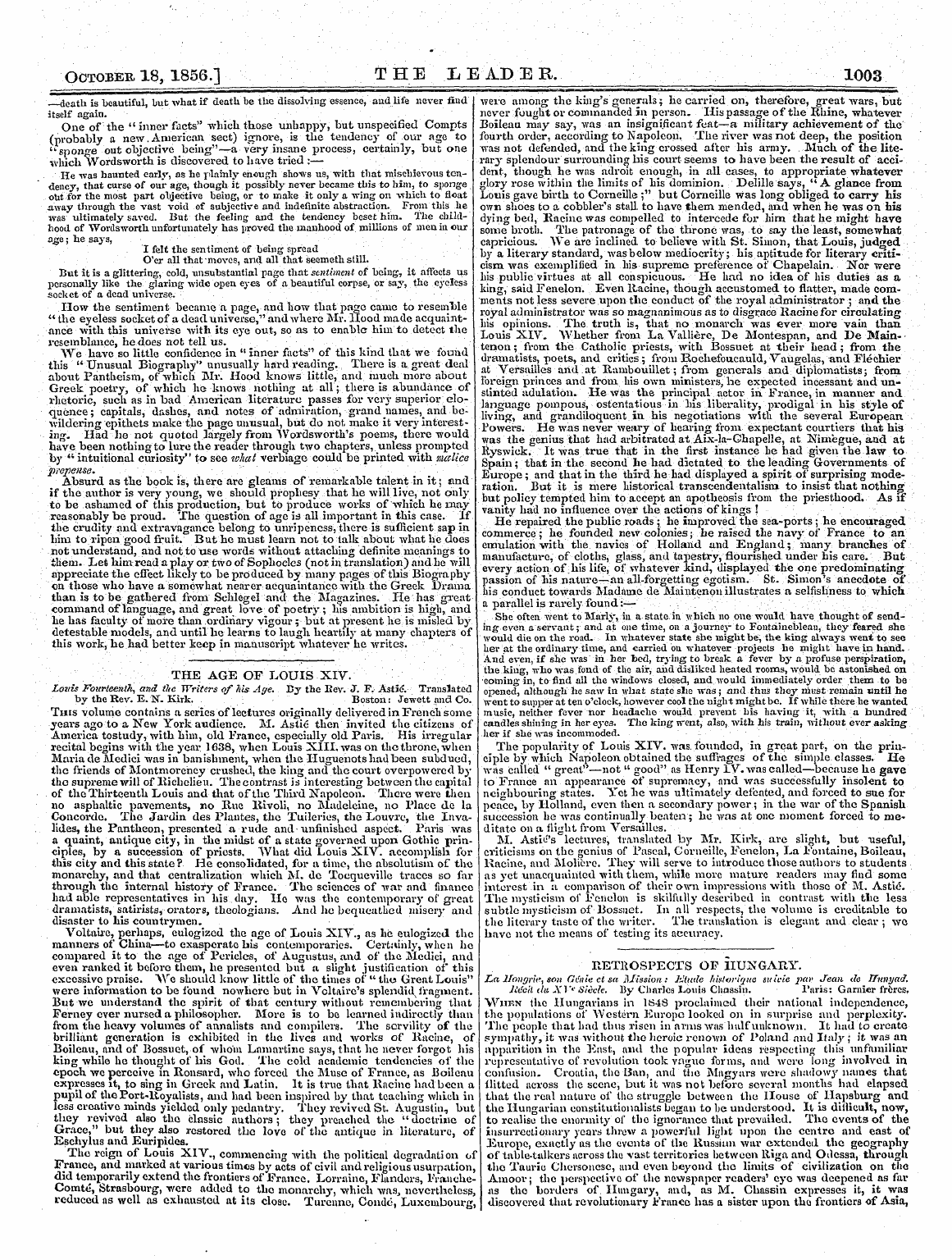
—death is beautiful , but what if death be the dissolving essence , and life never find itself again . . One of the " inner facts" -which , those unhappy , but unspecified Compts ( probably a new . American sect ) ignore , is the tendency of our age to " sponge out objective being "— -a very insane process , certainly , but one which ' Wordsworth is discovered to have tried : — He was haunted early , as lie plainly enough shows us , with that mischievous tendency , that curse of our age , though it possibly never became this to him , to sponge out for the most part objective being , or to make it only a wing on vfhich to float away through the vast void of subjective and indefinite abstraction . From this he was ultimately saved . But the feeling and the tendency beset him- The childhood of "Words-worth unfortunately has proved the manhood of millions of men in our age ; he says , : I felt the sentiment of being spread O ' er all that moves , and all that seemeth
still-But it is a glittering , cold , unsubstantial page that senlbneiit of being , it affects us personally like the glaring wide open eyes of a beautiful corpse , or say , the eyeless socket of a dead universe . How the sentiment became a page , and how that page came to resenVble " the eyeless socket of a dead universe , " and where Mr . Hood made acquaintance with this universe with its eye out , so as to enable him to detect the resemblance , he does not tell us . We have so little confidence in " inner facts ' of this kind that we found this " Unusual Biography" unusually hard reading . There is a great deal about Pantheism , of which 3 Mr . Hood knows little , and much more about Greek poetry , of which he knows nothing at all ; there is abundance of rhetoric , sucli as in bad American literature passes for very superior eloquence ; capitals , dashes , and notes of admiration , grand names , and bewildering epithets make the page unusual , but do not , make it very interesting . Had he not quoted largely from " Wordsworth's poems , there -would have been nothing to lure the reader through two chapters , unless prompted by ¦ " intuitional curiosity" to see ichat verbiage could be printed with mcclice
prepense . Absurd as the book isj there are gleams of remarkable talent in it ; and if the author is very young , we should prophesy that he will live , not only to be ashamed of this production , but to produce works of which he may reasonably be proud . The question of age is all important in this case . If the crudity and extravagance belong to unripeness , there is sufficient sap in him to ripen good fruit . But he must learn not to talk about what lie does not understand , and not to use words -without attaching definite meanings to iliern . Let him read a play or two of Sophocles ( not in translation ) and he will appreciate the effect likely to be produced bv many pages of this Biography on those who have a somewhat nearer acquaintance with the Greek Drama than is to be gathered froni Schlegel and the Magazines . He has great command of language , and great love : of poetry ; his ambition is high , and he has faculty of more than ordinary vigour ; but at present he is misled by detestable models , and until he learns to laugh heartily at many chapters of this work , he had better keep in maauscript whatever he writes .
October 18, 1856.] The Xeider. 1003
October 18 , 1856 . ] THE XEIDER . 1003
The Age Of Louis Xiv. Louis Fourteenth, ...
THE AGE OF LOUIS XIV . Louis Fourteenth , and the Writers of Ins Aye . By the Bev . J . F . AstieY Translated by the Rev . E . N . Kirk . Boston : Jewett and Co . This volume contains a series of lectures originally delivered in Fi'ench some years ago to a New York audience . M . Astie then invited the citizens of America tostudy , with him , old France , especially old Paris . His irregular recital begins with the year 1638 , when Louis XIII , was on the throne , when Maria de Medici was in banishment , when the Huguenots had been subdued , the friends of Montmorehcy crushed , the king and the court overpowered by the supreme will of ltichelieu . The contrast is interesting between the capital of the Thirteenth Louis and that of the Third Napoleon . There were then no asphaltic pavements , no Rue Rivoli , no Madeleine , no Place de la Concorde . The Jardin des Plautes , the Tuileries , the Louvre , the
Invahdes , the Pantheon , presented a rude and unfinished aspect . Paris was a quaint , antique city , in the midst of a state governed upon Gothic principles , by a succession of priests . " What did Louis XIV . accomplish for this city and this state ? He consolidated , for a time , the absolutism of the monarchy , and that centralization which JVI . do Tocqueville traces bo far through the internal history of France . The sciences of -war and finance had able representatives in his day . Ho was the eontemporai'y of great dramatists , satirists , orators , theologians . And he bequeathed , misery and disaster to liis countrymen . Voltaire , perhaps , eulogized the age of Louis XIV ., as lie eulogized the manners of China—to exasperate his contemporaries . Certainly , when he compared it to the age of Pei'icles , of Augustus , and of the Medici , and even ranked it before them , lie presented but a slight justification of" this excessive praise . " We should know little of the times of " the Great Louis "
were information to be found nowhere but in Voltaire ' splendid fragment . But we understand the spirit of that century without remembering that Ferney ever nursed a philosopher . More is to be learned indirectly than from the heavy volumes of annalists and compilers . The servility of the brilliant generation is exhibited in the lives and works of llacine , of Boileau , and of Bossuet , of whom Lamartinc says , that he never forgot his king while he thought of his God . The cold academic tendencies of the epoch we p erceive in Ronsard , who forced the Muse of France , as Boileau expresses it , to sing in Greek and Latin . It is true that Racine had been a pupil of tho Port-Royalists , and had been inspired by that teaching which in less creative minds yielded only pedantry . They revived St . Augustin , but they revived also tho classic authors ; they preached the " doctrine of Grace , " but they also restored the love of the antique in . literature , of Eschylus and Euripides .
The reign of Louis XIV ., commencing with the political degradation of France , and marked at various times by acts of civil and religious usurpation , did temporarily extend the frontiers of France . Lorraine , Flanders , Franche-Comte , Strasbourg , were added to the monarchy , which was , nevertheless , reduced as well as exhausted at its close . Turenne , Conde , Luxembourg ,
were among- the king ' s generals ; he carried on , therefore , great wars , but never fought or commanded in person . His passage of the Rbine , whatever Boileau may say , was an insignificant feat—a military achievement of the fourth order , according to Napoleon . The river was not deep , the position was not defended , and the king crossed after his army . Much of the literary splendour surrounding his court seems to have been the result of accident , though he was adroit enough , in all cases , to appropriate whatever glory rose within the limits of his dominion . Delille says , "A glance from Louis gave birth to Corneille ; " but Corneille was long obliged to carry his own shoes to a cobbler ' s stall to have them mended , arid when he was on his dying bed , llacine was compelled to intercede fox * him that he might have some broth . The patronage of the throne was , to say the least , somewhat capricious . We are inclined to believe with St . Simon , that Louis , judged
by a literary standard , was below mediocrity ; his aptitude for literary criticism was exemplified in his supreme preference of Chapelain . Nor were his public virtues at all conspicuous . He had no idea of his duties as a king , said Fenelon . Even Racine , though accustomed to flatter , made comments not less severe upon the conduct of the royal administrator ; and . the royal administrator was so magnanimous as to disgrace llacine for circulating his opinions . The truth is , that no monarch was ever more vain than Louis XIV . Whether from La Valliere , De Montespan , and De Maintenon ; from the Catholic priests , with Bossuet at their head ; from the dramatists , poets , and ci'itics ; from Rochefoucauld , Vaugelas , and Flechier at Versailles arid at Rambouillet ; from generals and diplomatists : from
foreign princes and from , his own ministers , he expected incessant and unstinted adulation . He was the principal actor in France , in manner and language pompous , ostentatious in his "' .. liberality , prodigal in his style of living , and grandiloquent in his negotiations with the several European Powers . He was never weary of hearing from expectant courtiers tkat his was the genius that had arbitrated alAix-la-Ghapelle , at Nimegue , and at liyswick . It was true that in the first instance he had given the law to Spain ; that in the second lie had dictated to the leading Governments of Europe ; and that in the third he had displayed a spirit of " surprising moderation . But it is mere historical transcendentalism to insist that nothings but policy tempted him to accept an apotheosis from the priesthood . As if vanity had no influence over the actions of kings !
He repaired the public roads ; he improved the sea-ports ; he encouraged commerce ; he founded new colonies ; he raised the navy of France to an emulation with the navies of Holland and England ; many branches of manufacture , of cloths , glass , and tapestry , flourished under his care . But every action of his life , of whatever kind , displayed the one predominating : passion of his nature—an all-forgetting egotism . St . Simon ' s anecdote of his conduct towards Madame de Maintenoii illustrates a selfishness to which a parallel is rarely found ' :- — ; She often went to Marly , in a state in -which no one would have thought of sending even a servant ; and at one time , on a journey to Fontainebleau , they feared she
would die on the road . In whatever state she might beVthe king always went to see her at the ordinary time , and carried on whatever projects he might have in hand . And even , if she was iii her bed , trying to break a fever by a profuse i nspiration , the king , wlio was fond of the air , and disliked heated rooms , would be astonished on coming in , to find all the windows closed , and would immediately order them to be opened , although he saw in what stateslie was ; and thus they must remain until he went to supper at ten o ' clock , however cool the night might be . If while there he wanted music , neither fever nor headache would prevent his having it , "with a hundred candles shining in her eyes . The king went , also , with his train , without ever asking her if she was incommoded .
The popularity of Louis XIV . was . founded , in great part , on the principle by ¦ which . Napoleon obtained the suffrages of the simple classes . He was called " great "—not " good" as Henry 1 V . was called—because he gave to France an appearance of supremacy , and was successfully insolent to neighbouring states . Xet he was ultimately defeated , and forced to sue for peace , by Holland , even then a secondary power ; in the war of the Spanish succession he was continually beaten ; he was at one moment forced to meditate on a flight from Versailles . M . Astie ' s lectures , translated by Mr . Kirk , '• arc slight , but useful , criticisms on the genius of Pascal , Gorneillc , Fenelon , La Fontaine , Boileau , Racine , and Moliere . They will serve to introduce those authors to students as yet unacquainted with them , while more mature readers may find some interest in a comparison of their own impressions with those of M . Astie . The mysticism of Fenelon is skilfully described in contrast with the less subtle mysticism of Bossuet . In all respects , the volume is creditable to the literary taste of the writer . The translation is elegant and clear ; we have not the means of testing its accuracy .
Retrospects Of Hungary. La Llongrh*, Son...
RETROSPECTS OF HUNGARY . La llongrh * , son Gdnie ct sa Mission : J ' Jlude fintorique suieie pav Jean de ITnnyad . Jitlcit tlu Xl ' Siiivk : By Charles Louis Chassin . Paris : Gamier freres . When the Hungarians in 1 S 48 proclaimed their national independence , the populations of Western Europe looked on in surprise and perplexity . The people that had thus risen in arms was half unknown . It hud to ex'cato sympathy , it was without tho heroic renown of Poland and Italy ; it was an apparition in tho East , and the populai" ideas respecting this unfamiliar representative of revolution took vnguc forms , and were long involved in confusion . Croatia , the I 5 an , and the Magyars were shadowy names that
flitted across the scene , but it was not before several months had elapsed that the real nature of the struggle between the House of Ilapsburg and the Hungarian constitutionalists began to he understood . It is dillicult , now , to realise the enormity of tho ignorance tluit prevailed . Tho events of the insurrectionary years threw a powerful light upon the centre and east of ^ Europe , exactly as the events of the Russian war extended the geography of table-talkers across the -vast territories between Riga and Odessa , through tho Tauriu Chersonese , and even beyond the limits of civilization on the Amoov ; the perspective of the newspaper readers' eye was deepened as far us the borders of , Hungary , and , as M . Chassin expresses it , it was discovered that revolutionary Franco has a sister upon tho frontiers of Asia ,
-
-
Citation
-
Leader (1850-1860), Oct. 18, 1856, page 19, in the Nineteenth-Century Serials Edition (2008; 2018) ncse.ac.uk/periodicals/l/issues/cld_18101856/page/19/
-