On this page
-
Text (2)
-

1198 THE LEADER. [Satprday.
-

THE PARLIAMENT OF THE WEEK. FINANCIAL DE...
Note: This text has been automatically extracted via Optical Character Recognition (OCR) software. The text has not been manually corrected and should not be relied on to be an accurate representation of the item.
-
-
Transcript
-
Note: This text has been automatically extracted via Optical Character Recognition (OCR) software. The text has not been manually corrected and should not be relied on to be an accurate representation of the item.
Additionally, when viewing full transcripts, extracted text may not be in the same order as the original document.
Throughout The Week The Ministerial Part...
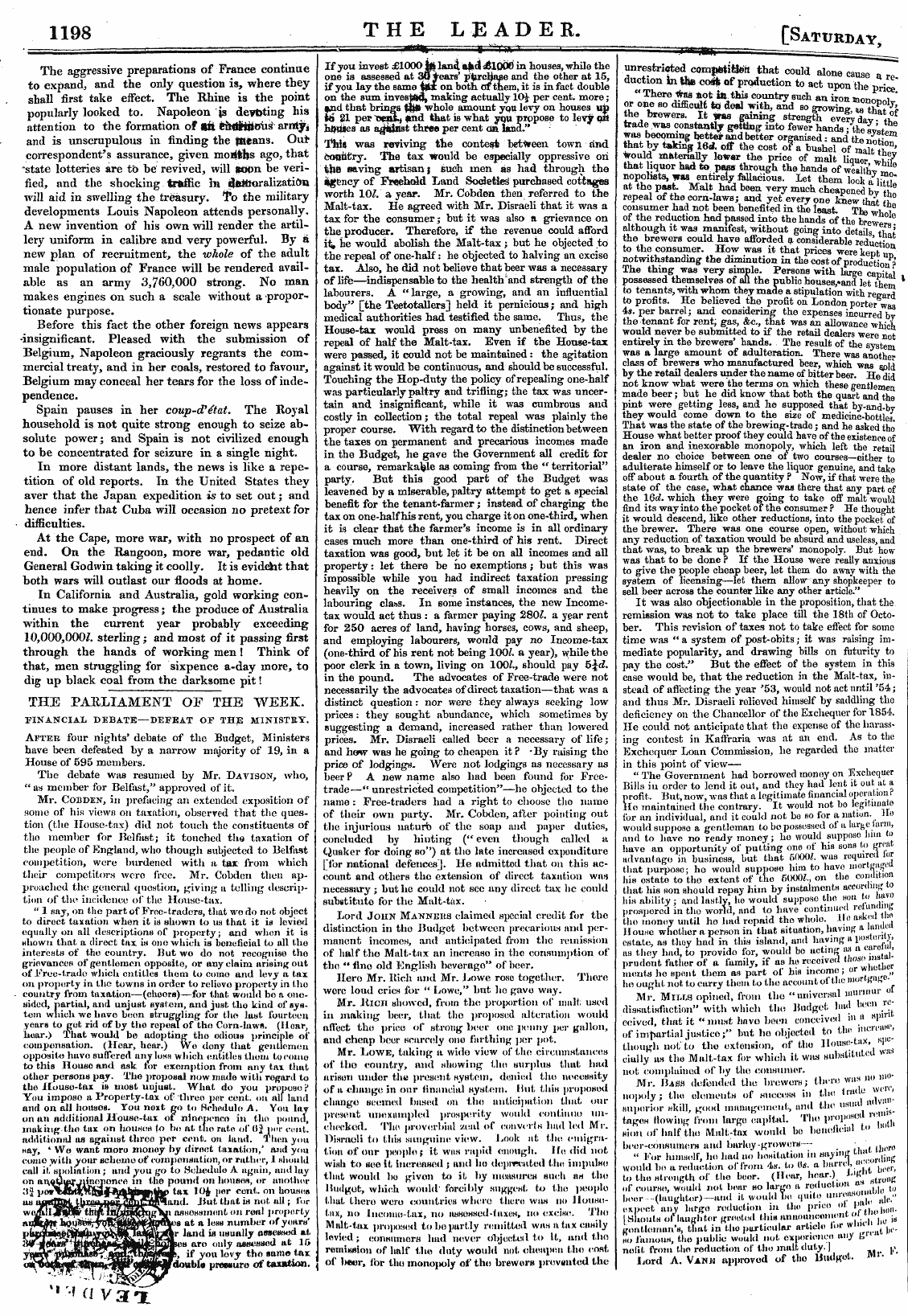
The aggressive preparations of France continue to expand , and the only question is , where they shall first take effect . The Rhine is the point popularly looked to . Napoleon is devoting his attention to the formation of itk fcfr 0 fcftious arrAji and is unscrupulous in finding the fneans . Out correspondent's assurance , given mo 4 iljs ago , that state lotteries are tb be revived , will jtOOn be verified , and the shocking traffic In jJtttttGralizatidn will aid in swelling the treasury . To the military developments Louis Napoleon attends personally . A new invention of his own will render the
artillery uniform in calibre and very powerful . By a new plan of recruitment , the whole of the adult male population of France will be rendered available as an army 3 , 760 , 000 strong . No man makes engines on such a scale without a proportionate purpose . Before this fact the other foreign news appears insignificant . Pleased with the submission of Belgium , Napoleon graciously regrants the commercial treaty , and in her coals , restored to favour , Belgium may conceal her tears for the loss of independence .
Spam pauses in her coup-d ' etat . The Royal household is not quite strong enough to seize absolute power ; and Spain is not civilized enough to be concentrated for seizure in a single night . In more distant lands , the news is like a repetition of old reports . In the United States they aver that the Japan expedition is to set out ; and hence infer that Cuba will occasion no pretext for difficulties .
At the Cape , more war , with no prospect of an end . On the Rangoon , more war , pedantic old General Godwin taking it coolly . It is evideht that both wars will outlast our floods at home . In California and Australia , gold working continues to make progress ; the produce of Australia within the current year probably exceeding 10 , 000 , 000 / . sterling ; and most of it passing first through the hands of working men ! Think of that , men struggling for sixpence a-day more , to dig up black coal from the darksome pit !
1198 The Leader. [Satprday.
1198 THE LEADER . [ Satprday .
The Parliament Of The Week. Financial De...
THE PARLIAMENT OF THE WEEK . FINANCIAL DEBATE—DEFEAT OF THE MINISTRY . After four nights' debate of the Budget , Ministers have been defeated by a narrow majority of 19 , in a House of 695 members . The debate was resumed b y Mr . Dayison , who , " member for Belfast , " approved of it . Mr . Cobden , iii prefacing an extended exposition of some of his viewn on taxation , observed that the question ( the House-tax ) did not touch the constituents of tlio member for Belfast ; it touched the taxation of the people of England , who though subjected to Belfast competition , were burdened with a tax from which their competitors were free . Mr . Cobden then approached the general question , giving a telling description of the incidence of the House-tax .
" 1 say , on the part of Free-traders , that wo do not object to direct taxation when it is shown to us that it ia levied equally on all descriptione of property ; and when it is uhown that a direct tax is one which is beneficial to all the interests of the country . But wo do not recognise the grievances of gentlemen opposite , or any claim arising out of Free-trade which entitles them to eomo and levy a tax on property in the towns in order to relieve property in the country from taxation —( choors )—for that would bo a one-Bided , partial , and unjust system , and just the kind of system which we have boon struggling for the last fourteen years to get rid of by the repeal of tho Corn-lawn . ( Hear ,
hoar . ) That would be adopting tho odious principle of compensation . ( Hear , hear . ) We deny that gentlemen opposite have Buffered any Iosh which entitles them luciiiau to this House and ask for exemption from any tax that other persons pay . The proposal now made with regard to tho Itouso-tax ib most unjust . What do you propose P You imposo a Property-tax of "three por cent , on all land and on all Iiouhob . You noxt eo to Rchnilulo A . You lay on an additional House-tax of ninopenco in tho pound , making the tax on liouses | o bo at the rate of ( $ 2 per emit , additional as against three pot * cent , on land . Then you
way , * We want moru monoy by direct taxation , ' and you come with your scheme of compensation , or rather , J nliould call it spoliation ; and vou go to Hohedulo A again , and lay on anauigryiiirieponce m the pound on houeen , or another l \ l l p 1111 'ffilyirfijjl j [ Tl | lhi | M | iyyi tax 1 O £ por cent , on liournm 1441 ff Jf * SBA ^ l ? ''" jlffi rj KHflFTc ^' ' ^ ' J * '' that it ) not all ; for wo ^ l ^ Sw thm j S &^ mngTyi assessment on real property aupU $ r Jwu ^ % yTjfl ^^^ p toAi ) 8 at a lens number of years ' p ( u ?» l <^> ijii ^ wr ^^ land is usually awfenrtod at yW fyf ^^^^^^^^ p ^^ fflP' if you levy tho same tax uif fliMjLwf litWiljTjTOi 1 UWMFy'l'iiil'l'i presiiuro of taxation 1 | r - » avai
If you invest £ 1000 m land , afcdi & 1 Q 0 Q in houses , while the one is assessed at 30 dears' purchase and the other at 15 , if you lay the same nx on both or them , it is in fact double on the sum invest & q , making actually 1 OJ- per cent , more ; fjid that brings $ 80 whole amount ypu levy on houses up tt » 21 per ~ oen |» 4 < jtnd that is what you propose to levjr ati hiH & es as ag ^ iflst three per cent on land . " T * hh was reviving the contest between town and country . The tax would be especially oppressive on thB saving artisan } feuch men as had through the Igency of Freehold Land Societies purchased cottages worth 101 . a year . Mr . Cobden then referred to the
Malt-tax . He agreed with Mr . Disraeli that it was a tax for the consumer ; but it was also a grievance on the producer . Therefore , if the revenue could afford iit he would abolish the Malt-tax ; but he objected to the repeal of one-half : he objected to halving an excise tax . Also , he did not believe that beer was a necessary of life—indispensable to the health ' and strength of the labourers . A " large , a growing , and an influential body" [ the Teetotallers ] held it pernicious ; and high medical authorities had testified the same . Thus , the House-tax would press on many unbenefited by the repeal of half the Malt-tax . Even if the House-tax were passed , it could not be maintained : the agitation against it would be continuous , and should be successful
Touching the Hop-duty the policy of repealing one-half was particularly paltry and trifling ; the tax was uncertain and insignificant , while it was cumbrous and costly in collection ; the total repeal was plainly the proper course . With regard to the distinction between the taxes on permanent and precarious incomes made in the Budget , he gave the Government all credit for a course , remarkable as coming from the " territorial " party . But this good part of the Budget was leavened by a miserable , paltry attempt to get a special benefit for the tenant-farmer ; instead of charging the tax on one-half his rent , you charge it on one-third , when it is clear that the farmer ' s income is in all ordinary cases much more than one-third of his rent . Direct
taxation was good , but let it be on all incomes and all property : let there be no exemptions ; but this was impossible while you had indirect taxation pressing heavily on the receivers of small incomes and the labouring class . In some instances , the new Incometax would act thus : a farmer paying 2801 . a year rent for 250 acres of land , having horses , cows , and sheep , and employing labourers , would pay no Income-tax ( one-third of his rent not being 1001 . a year ) , while the
poor clerk in a town , living on 1001 ., should pay 5 % d . in the pound . The advocates of Free-trade were not necessarily the advocates of direct taxation—that was a distinct question : nor were they always seeking low prices : they sought abundance , which sometimes by suggesting a demand , increased rather than lowered prices . Mr . Disraeli called beer a necessary of life ; and how was he going to cheapen it ? -By raising the price of lodgings . Were not lodgings as necessary as beer P A new name also had been found for
Freetrade— " unrestricted competition —he objected to the name : Free-traders had a right to choose tho name of their own party . Mr . Cobden , after pointing out the injurious naturb of the soap and paper duties , concluded by hinting ( " even though called si Quaker for doing so" ) at tho late increased expenditure [" for national defences ] . He ndmittod that on this account and others tho extension of direct taxation was necessary ; but he could not see any direct tax he could substitute for the Malt-tax . Lord John Manners claimed special credit for the distinction in tho Budget between precarious and permanent incomes , and anticipated from the remission of half tho Malt-tax an increase in the consumption ot the " fine old English beverage" of beer .
Hero Mr . llich and Mr . Lowe rose together . There were loud cries for " Lowe , " but ho gave way . Mr . Kiori showed , from tho proportion of mult used in making beer , that the proposed alteration woxild afl ' eet the price of strong beer one penny per gallon , and cheap beer scarcely one farthing per pot . Mr . Lowe , taking a wide view of the circum . stanees of tho country , and showing tho surplus that had arisen xnidor th « present system , denied tho necessity of u change in our financial system . Hut this proposed change seemed based on the anticipation that our present unexampled prosperity would continue
unchecked . Tho proverbial zeal of convertk hud led Mr . DiHraoli to this sanguine view . Look at the emigration of our ]> eopl «{ it was rapid enough . Ifo did not wish to see it increased ; and ho deprecated the impulse that would bo givon to it by measures such an the Hudgol ; , which would forcibly . suggest to the people that there were countries where- there was no Jlousetux , no Income-tax , no asHessed-iaxes , net excise . The Mult-tax proposed to bo partly remitted was a tux easily levied ; conHivmors had never objected to It , und the remission of half tho duty would not cheapen tho cost of l )« ur , for tho monopoly of tho brewers prevented the
unrestricted compfetifcfeii that could alone cause a ro dudaon in the cc # of production to act upon the prfc ! " There wfts not in this country such an iron monnl i ' or owso difficult to deal with , aid so ^ wSTt & the brewers . It was gaming strength evefylt . ° Jade was constantl y geftitog into fewer hands Si was becoming better and better organised : and tteSlthat by taking 16 * off the cost o ? a bushefof ^ It ^ Jould materially lower the price of malt hW * £ ? that liquor had to pass through the hands of wealthy ^ nopolists , was entirely fallacious . Let them look a li ? t ? at the past . Malt had been very much cheapened bv 5 S repeal of the corn-laws ; and yet every one knew that «!
consumer had not been benefited in the least . The -wl T of the reduction had passed into the hands of the brewer although it was manifest , without going into details th I the brewers could have afforded a considerable reducHn to the consumer . How was it that prices were kept m notwithstanding the diminution in the cost of production ? The thing was very simple . Persons with large capital possessed themselves of all the public houses ,-and let them to tenants , with whom they made a stipulation with regard to profits . He believed the profit on London porter was 4 s . per barrel ; and considering the expenses incurred by the tenant for rent ; gas , & c , that was an allowance which would be submitted to if the retail dealers
never were not entirely in the brewers' hands . The result of the syste m was a large amount of adulteration . There was another class of brewers who manufactured beer , which was sold by the retail dealers under the name of bitter beer . He did not know what were the terms on which these gentlemen made beer ; but he did know that both the quart and the pint were getting less , and he supposed that by-and-by they would come down to the size of medicine-bottles . That was the state of the brewing-trade ; and he asked the House what better proof they could have of the existence of an iron and inexorable monopoly , which left the retail dealer no choice between one of two courses—either to
adulterate himself or to leave the liquor genuine , and take off about a fourth of the quantity ? Now , if that were the state of the case , what chance was there that any part of the 16 c ? . which they were going to take off malt would find its way into the pocket of the consumer ? He thought it would descend , like other reductions , into the pocket of the brewer . There was one course open , without which any reduction of taxation would be absurd and useless , and that was , to break up the brewers' monopoly . But how was that to be done ? If the House were really anxious to give the people cheap beer , let them do away with the system of licensing—let them allow ^ any shopkeeper to sell beer across the counter like any other article . "
It was also objectionable in the proposition , that the remission was not to take place till the 18 th of October . This revision of taxes not to take effect for some time was " a system of post-obits ; it was raising immediate popularity , and drawing bills on futurity to pay the cost . " But the effect of the system in this case would be , that the reduction in the Malt-tax , instead of affecting the year ' 53 , would not act until ' 54 ; and thus Mr . Disraeli rolieved himself by saddling the deficiency on the Chancellor of the Exchequer for 1854 . He could not anticipate that the expense of the harassing contest in Kaifraria was at an end . As to the Exchequer Loan Commission , he regarded the matter in this point of
view" The Government had borrowed money on Exchequer Bills in order to lend it out , and they had lent it out at a profit . But , now , was that a legitimate financial operation i He maintained the contrary . It would not bo legitimate lor an individual , and it could not be so for a nation . Jlo would suppose a gentleman to be possessed ot alar elann , and to have no ready money ; ho would supposo him to have an opportunity of putting one of his sons to great advantage in business , but that 5000 ? . was required lor that purpose ; he would suppose him to havo mortgage his estate to tho extent of the 6 CXXM ., on the condition that his son Bhould repay him by instalments according ™ his ability : and lastly , ho would supposo tho sou to " < i ™ relunti
prospered in tho world , and to havo continual ^ the money until ho had repaid tho whole , llo anked tho House whother a perHon in that situation , having a lanutu estate , as they had in this island , and having a postoiiij , as they had , to provide for , would bo acting as a core u , prudent father of a family , if as ho received tlioso ins amenta ho spent them as part of his income ; or wh ^ i () he ought not to carry them to the account ot the inori | , uf , . Mr . MlMS opined , from the " universal murmur o dissatisfaction" with which the Budget had toon received , that it " must linvo been conceived ma « pn of impartial juHtico ; " but he objected to th « ««™ ' though not " to the extension , of tho House-tux , t >] cially as tho Malt-tax for which it was substituted v- ¦
not complained of by tho consumer . Mr . BASB defended the brcwora ; tin-re was no " ^ nopoly ; tho elements of huccush in the *» ° ^ [ miperior skill , good management , and the uwial acivi tnges Mowing from large capital . The propone" ««> . Hitm ( if hnlf the Mult-tax would bo boneflcnd to beer-consumers and barley-growers— ¦ Jj ( ir 0 " For himself , he had no hesitation in saying U"i | ¦ ¦ would be a reduction of from 4 , n . to Us . a barrel , ««•• ^^ to tho strength of the beer . ( Hoar , hoar . ) i ^ k ' of course , would not boar so largo a reduction a » ¦ boor ( laughtor ) -and it would Tio quito unroum > u **> ' ^ „ expect any largo reduction in tho price ol ' ' . ,,, „„ . Shouts of laughter greeted this announcoment <> ' ' j ( J irontloman'H , that in Uio particular article lor w » " ^ ho famous , tho public would not experience any b nofit from tho reduction of the malt duty . ] ^ Lord A . Vamjo approved of tho Uudffut . mi .
-
-
Citation
-
Leader (1850-1860), Dec. 18, 1852, page 2, in the Nineteenth-Century Serials Edition (2008; 2018) ncse.ac.uk/periodicals/l/issues/cld_18121852/page/2/
-