On this page
-
Text (2)
-

584 The Leader and Saturday Analyst. [Ju...
-

INDIA..—MILITARY CHANGES. AT present, ou...
Note: This text has been automatically extracted via Optical Character Recognition (OCR) software. The text has not been manually corrected and should not be relied on to be an accurate representation of the item.
-
-
Transcript
-
Note: This text has been automatically extracted via Optical Character Recognition (OCR) software. The text has not been manually corrected and should not be relied on to be an accurate representation of the item.
Additionally, when viewing full transcripts, extracted text may not be in the same order as the original document.
The National Defence Question. Rational ...
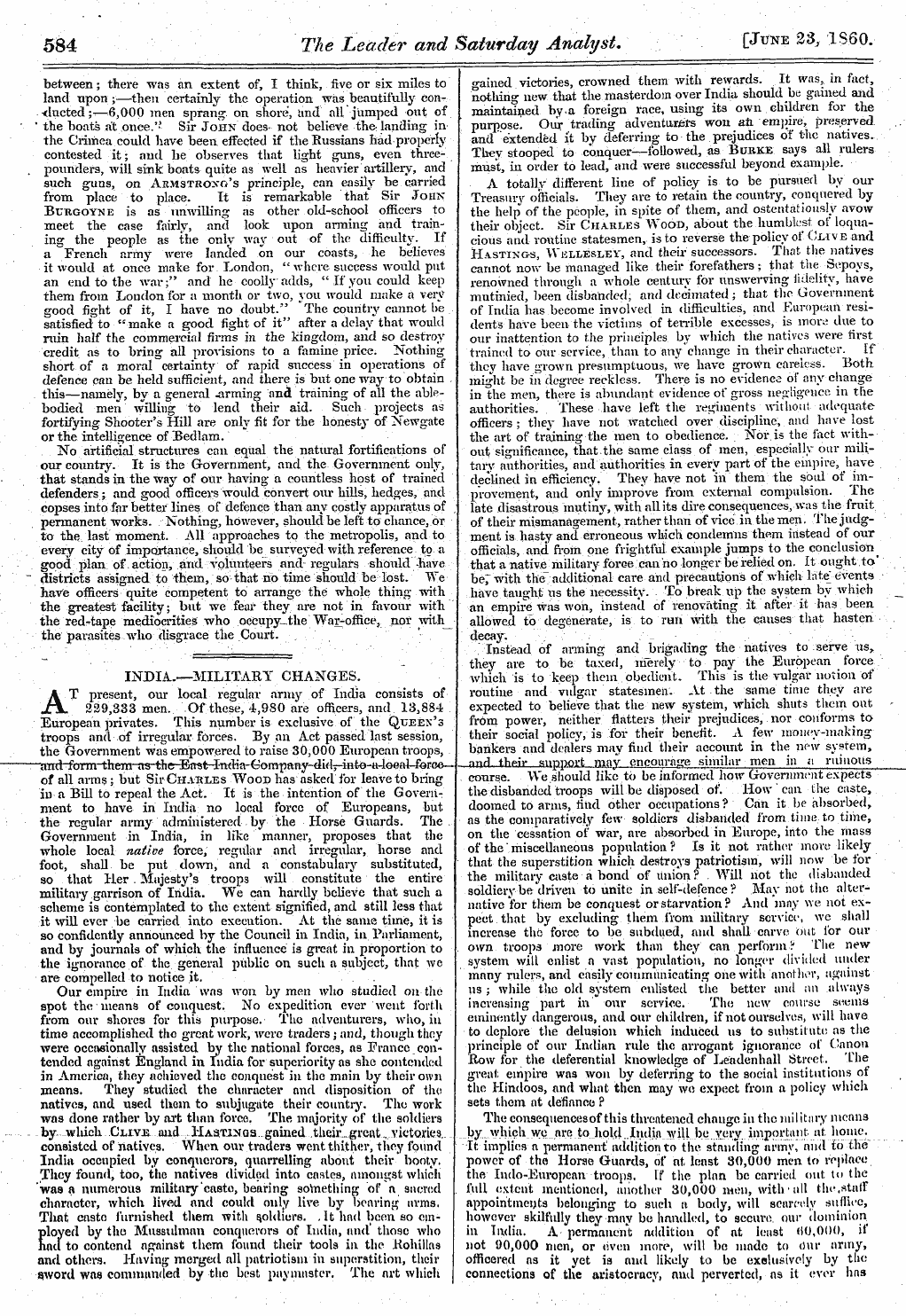
between ; there was an extent of , I think , five or six miles to land upon;— -then certainly the operation "was beautifully con--dueted ; - —6 , 000 men sprang on shore , and all jumped out of the boats at once . ' - ' Sir John does- not believe the-, landing in the Crimea could have been effected if the Russians had properly contested it ; and be observes that light guns , even threepoimders , will sink boats quite as well as heavier artillery , and such guns , on Armstrong's principle , can easily be carried from place to place . It is remarkable that Sir John BuuGOYNE is as unwillinsr as other old-school officers to
meet the case fairly , and look upon arming and training the people as the only way out of the difficulty . If a French army were landed on our coasts , he believes it would at once make for London , " where success would put an end to the war ; " and he coolly adds , "If you could keep them from London for a month or two , you would make a very good fight of it , I have no doubt . " The country cannot be satisfied to " make a good fight of it" after a delay that would
ruin half the commercial firms in the kingdom , and so destroy credit as to bring all provisions to a famine price . Nothing short of a moral certainty of rapid success in operations of defence can be held sufficient , and there is but one way to obtain this—namely , by a general . arming and training of all the ablebodied men willing to lend their aid . Such projects as fortifying Shooter's Hill are only fit for the honesty of Newgate or the intelligence of "Bedlam .
No artificial structures can equal the natural fortifications of our country . It is the Government , and the Government only , that stands in the way of our having a countless host of trained defenders ; and good officers would convert our hills , hedges , and copses into far better lines of defence than any costly apparatus of permanent works . Nothing , however , should be left to chance , or to the last moment . All approaches to the metropolis , and to every city of importance , should be surveyed with reference to a good plan of , action , and volunteers and regulars should -have districts assigned to them , so that no time should be lost . We have officers quite competent to arrange the whole thing with the greatest facility ; but we fear they are not in favour with the red-tape mediocrities who occupy-the War ^ office , nor with the parasites who disgrace the Court .
584 The Leader And Saturday Analyst. [Ju...
584 The Leader and Saturday Analyst . [ June 2 . 3 , I 860 .
India..—Military Changes. At Present, Ou...
INDIA .. —MILITARY CHANGES . AT present , our local regular army of India consists of 239 , 333 men . Of these , i , 9 S 0 are officers , and 13 , 884 European privates . This number is exclusive of the Queen ' s troops and of irregular forces . By an Act passed last session , the Government was empowered to raise 30 , 000 European troops , mid ~ foTm ^ hem-tre ^ e- ^ st ^ n ^ of all arms ; but Sir Charles Wood has asked for leave to bring iu a Bill to repeal the Act . It is the intention of the Government to have in India no local force of Europeans , but the regular army administered by the Horse Guards . The
Government in India , in like manner , proposes that the whole local native force , regular and irregular , horse and foot , shall be put down , and a constabulary substituted , so that Her . Majesty ' s troops will constitute the entire military garrison of India . We can hardly believe that such a scheme is contemplated to the extent signified , and still less that it will ever be carried into execution . At the same time , it is so confidently announced by the Council in India , in Parliament , and by journals of which the influence is great in proportion to the ignorance of the general public on , such a subject , that we are compelled to notice it . . .
Our empire in India was won by men who studied on the spot the means of conquest . No expedition ever went forth from our shores for this purpose . The adventurers , who , in time accomplished the great work , were traders ; and , though they were occasionally assisted by the national forces , as Prance contended against England in India for superiority as she contended in America , they achieved the conquest in the main by their own means . They studied the character and disposition of tho
natives , and , used them to subjugate their country . The work was done rather by art than force . The majority of the soldiers by wliich Cliyje and Hastings , gained their great . . victories consisted of natives . When our traders went thither , they found India occupied by conquerors , quarrelling about their booty . They found , too , the natives divided into castes , amongst which Was a numerous military caste , bearing something of a sacred character , which lived and could only live by bearing iwms . That easto furnished them with soldiers . , It had been so
employed by the Mussulman conquerors of India , and those who hacf to contend against them found their tools in the Kohillos and others . Having merged all patriotism in superstition , their sword was commanded by the best paymaster . The nvt which
gained victories , crowned them with rewards . It was , in fact , nothing new that the masterdom over India should be gained and maintained by . a foreign race , using its own children for the purpose ! Our trading adventurers won an empire , preserved and extended it by deferring to the prejudices of the natives . They stooped to conquer—followed , as Bubke says all rulers must , in order to lead , * and were successful beyond example . A totallv different line of policy is to be pursued by our
Treasury officials . They are to retain the country , conquered by the help of the people , in spite of them , and ostentatiously avow their object . Sir Charles Wood , about the humblest of loquacious and routine statesmen , is to reverse the policy of Olive and Hastings , Wkllesley , and their successors . That the natives cannot now be managed like their forefathers ; that the Sepoys , renowned through a whole century for unswerving fidelity , have mutinied , been disbanded , and decimated ; that the Government of Tndia has become involved in difficulties , and European
residents have been the victims of terrible excesses , is more due to our inattention to the principles by which the natives were first trained to our service , than to any change in their character . If they have grown presumptuous , we have grown careless . Both might be in degree reckless . There is no evidence of any change in the men , there is abundant evidence of gross negligence in the authorities . These have left the regiments ' without ¦ adequateofficers ; they have not watched over discipline , and have lost the art of training the men to obedience . Nor is the fact without significance , that . the same class of men , especially our military authorities , and authorities in everv part of the empire , have
declined in efficiency . They have not in them the soul ot improvement , and only improve from external compulsion . The late disastrous mutiny , with all its dire consequences , was the fruit of their mismanagement , rather than of vice in the men . The judgment is hasty and erroneous which condemns them instead of our officials , and * from one frightful example jumps to the conclusion that a native military force can no longer be relied on . It ought to be 7 with the " 7 additional cai-e and precautions of which late events have taught us the necessity . To break up the system by which an empire was won , instead of renovating it after it has been allowed to degenerate , is to run with the causes that hasten
decay . ' Instead of ¦ arming- and brigading the natives to serve us ,, they are to be taxed , merely to pay the European force which is to keep them obedient . This is the vulgar notion of routine and vulgar statesmen . At the same time they are expected to believe that the new system , which shuts them out from power , neither flatters their prejudices , nor conforms to their social policy , is for their benefit . A few money-making bankers and dealers may find their account in the new system , ¦ . and , thftir support may encourage similar men in \ n ruinous
course . We should like to be informed how Government expects the disbanded troops will be disposed of . How can the caste , doomed to arms , find other occupations ? Can it be absorbed , as the comparatively few soldiers disbanded from time to time , on the cessation of war , are absorbed in Europe , into the mass of the miscellaneous population ? Is it not rather more likely that the superstition which destroys patriotism , will now be for the military caste a bond of Union ? Will not the disbanded soldiery be driven to unite in self-defence ? May not the alternative for them be conquest or starvation ? And may we not expect that by excluding them from military scrvici ' , we shall increase the force to be subdued , and shall carve but for our
own troops more work than they can perform '? The new system will enlist a vast population , no longer divided under many rulers , and easily communicating one with another , against us ; while the old system enlisted the better and an always increasing part in our service . The new course sneina eminently dangerous , and our children , if not ourselves , will have to deplore the delusion which induced us to substitute ; as the principle of our Indian rule the arrogant ignorance of Canon Row for the deferential knowledge of Leadenhall Street . The great empire was won by deferring to the social institutions of the Hindoos , and what then may we expect from a policy which sets them at defiance ?
The consequences of this threatened change in the military means bywhich we are ^ ^ l 10 me " It implies a permanent addition to the standing army , nnd to the power of the Horse Guards , of at least 80 , 000 men to replace the Indo-European troops . If the plnn be carried out to-the full extent mentioned , another 30 , 000 men , with-nil the . staff appointments belonging to such n body , will scarcely suffice , however skilfully they may be handled , to secure , our dominion in Tivlia . A permanent addition of at least < 50 , 000 , if not 90 , 000 men , or oven more , will be made to our army , officered as it yet is nnd likely to be exclusively by the connections of the aristocracv , and perverted , as it ever has
-
-
Citation
-
Leader (1850-1860), June 23, 1860, page 4, in the Nineteenth-Century Serials Edition (2008; 2018) ncse.ac.uk/periodicals/l/issues/cld_23061860/page/4/
-