On this page
- Departments (2)
- Adverts (1)
-
Text (7)
-
Public Affairs.] THE LEADER. 769
-
. ¦ — -arsf. f^tdT^ S tflvhP>> vJl %/ ^ t/J C 'HBc^C^iV eJv ^b" **. j±JL/ _ ^JJ Q §^ ajL JLM » ML <^ j£& "7 d^^ ' VV / V ty \ " 4 \_y^ \ _J $
-

SATURDAY, JUNE 25, 1859.
-

~~ ~ wUvIixI ^ fjf jttTS* ^
-
There is nothing' so revolutionary, beca...
-
-ar. ^tflvhP>> ^ t/J C ^iV eJv ^b" **. j±JL §^ ajL JLM » ML VV / V ty \ "
-
the fetters whicli the House of llapsbur...
Note: This text has been automatically extracted via Optical Character Recognition (OCR) software. The text has not been manually corrected and should not be relied on to be an accurate representation of the item.
-
-
Transcript
-
Note: This text has been automatically extracted via Optical Character Recognition (OCR) software. The text has not been manually corrected and should not be relied on to be an accurate representation of the item.
Additionally, when viewing full transcripts, extracted text may not be in the same order as the original document.
Public Affairs.] The Leader. 769
Public Affairs . ] THE LEADER . 769
Ad01307
"Subscription to " the leader . " ONE GUINEA PER YEAR , UNSTAMPED , PREPAID . ( Delivered Gratis . } OFFICE , NO . , CATHERINE-STREET , STKATJD , TV . C .
. ¦ — -Arsf. F^Tdt^ S Tflvhp≫≫ Vjl %/ ^ T/J C 'Hbc^C^Iv Ejv ^B" **. J±Jl/ _ ^Jj Q §^ Ajl Jlm » Ml ≪^ J£& "7 D^^ ' Vv / V Ty \ " 4 \_Y^ \ _J $
Saturday, June 25, 1859.
SATURDAY , JUNE 25 , 1859 .
~~ ~ Wuviixi ^ Fjf Jttts* ^
JgttWi ^ SjJatTS . ¦ * -
There Is Nothing' So Revolutionary, Beca...
There is nothing' so revolutionary , because there is nothing so unnatnral and ¦ convulsive , as the strain to keep things fixed when all the world is by the very law of its creation in eternal progress . —Dr . Arnold .
-Ar. ^Tflvhp≫≫ ^ T/J C ^Iv Ejv ^B" **. J±Jl §^ Ajl Jlm » Ml Vv / V Ty \ "
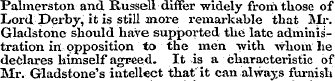
Palmerston and Russell differ widely from those of Lord JDerby , it is still anore remarkable that Mr . Gladstone should have supported the late administration in opposition to the men with whom lie declares himself agreed . It is a characteristic of Mr . Gladstone ' s intellect that it can always furnish a reason for acting in opposition to any principle which it recognises , and hence , neither respect finhis integrity , nor admiration of" his talents , can remove him from the category of doubtful men .
As a reason for joining Lord Palmerston ' s cabinet , he refers-to its . probable ability to deal with parliamentary reform , and after alluding to the incapacity of the late Government , he exclaims : — " 1 therefore naturally turn to the hope of its being settled by a cabinet mainly constituted and led hy the men together with wliom I was responsible for framing and preparing a Reform Bill in 1854 , " and following this paragraph conies a sort of apology for consenting to sit beside Messrs . Cobden and Gibson .
A prominent feature of the Bill of 1854 was the extent of its disfranchisemenfc of rotten boroughs , of which nineteen were to cease to return any members at all . Moreover , thirty-three borou ghs returning two members each , were to be reduced to one . In striking contrast to this bold scheme was that proposed by Lord Derby ' s Government , in which every rotten borough was to be preserved , but fifteen small places were to surrender one member each . In the discussion which took place in March , Lord
Palmerston alluded favourably to this portion of the Tory bill , and Mr . Gladstone made the following remarks : — - " . I confess I agree with the noble lord the member for Tiverton on that portion of the bill which has reference to the re-distribution of scats . I think myself that very scant justice has been done to that portion of the bill , which , I cannot help thinking a great improvement on the measure of 1854 . The measure has been framed wisely in this respect , and is vastly superior in this respect to the measure of 1854 . " Gladstone
Some observers of Mr . may expect , that having demonstrated to his own satisfaction the beauty and pre-eminence of rotten boroughs , he will become the more willing to offer them up in sacrifice ; and that , having proved the superiority of certain parts of the Derby-l ) israeh Bill of 1859 over the measure which he helped to frame in 1854 , he may consider the former as tod good for this world , and be content to revert to the principles of the latter . For our parts , we wonder at Mr . Gladstone ' s mental conjuring as much as the Arabs did at the prestidigitation of Robert-Houdin—not that we mean a comparison , for we are aware that " none but himself can be his parellel , " and we hope for his own sake to see him emerge safely from his many-winding ways of
thought . Mr . Blight ' s friends are very angry that he was not invited to take a seat in the Cabinet , but we can easily imagine he would not have contributed to make it a " happy family , " especially as Mr . Gladstone , Svhen alluding to his own benevolence in consenting to sit with Messrs , Gibson and Cobden , reminds the Provost of Oriel , that " among the faults which have at any time been found with him , has never been that of undue subserviency to the opinions of others . " reform Gladstone
Thus upon parliamentary Mr . is as obscure as a conjuror in his smoke , while upon foreign affairs liis utterances are l > elpluc doubts , for he tolls us he is in favour of using the influence of England on behalf of the " stability and justice of political arrangements abroad , ' a sentiment which the Fate Prince Mettcrnicli mi _« t have pronounced to lie without fault . J hat the friend of Pocrio means well to Italy we do not doubt , but Mr . Gladstones is a chvellor in cobwebs—wo ike to stand on solid earth .
for dissolving Parliament , and thinks it " undeniable that the return of an adverse and no longer indulgent majority rendered the settlement of this question ( reform ) by the late ministers impossible . " An ordinary man , who regarded reform as a " pai'amount interest and duty of the period , " would have esteemed the nonability of the late cabinet to deal with it as a good cause for declaring that they did not possess the confidence of the House of Commons . Not so Mr . Gladstone 5 he was unwilling to support the motion of Lord Harrington because " it appenrcd to imply a previous course of opposition . " Of nil curious reasons for not doing that which he thought in itself desirable this is the strangest , and we tlnnhf . wlint . lmv thft famous casuists of the Jesuits
^ MR . GLADSTONE'S MANIFESTO . India may not be . able to rejoice at finding herself subjected to Sir Charles Wood , but it is some comfort for England , condemned to an immense expenditure for national defences , and dreading the imposition of new taxes , to have escaped the honourable baronet ' s re-appearance as . Chancellor of the Exchequer , and the consequent exhibition of his " supercilious knowledge in accounts . " With Mr . Gladstone in that important office we have some guarantee for the enforcement of economy , and the preparation of a budget that will press as lightly uponjndustry as public requirements will permit : but we wait with curiosity to see how the super-subtle mind of the member for Oxford will deal with other questions upon which lie must come to a joint decision with his very heterogeneous colleagues . It often happens to scholars to find a commentary more puzzling' than the text , and Mr . Gladstone ' s explanation of himself to the Provost of Oriel is scarcely more luminous than the " Asian mystery , " on which Mr . Disraeli delighted to discant . He condemns the conduct of Lord Derby ' s Government in rejecting the counsels of Mr . Walpole and Mr . Henley , when preparing their Reform Bill ; lie blames them
ever invented so singular a pretext . Translated into plainer language Mr . Gladstone ' s phraseology would run thus —" I thought Lord Derby wrong in principle ; I regarded him as incapable of dealing with tlic weightiest question of the day , but I would not say so , because that would have implied that I had been previously opposed to him . " If Mr . Gladstone means that by supporting Lord AI J . M . JL . \ J IUU . Bt . UIlU lllV . tH » Q liliuiv * JJ w « . j ( # |» w . — .-j , —
_ Ifartington ' s motion ho would have made himself responsible for the previous opposition of the AVhigpnrty , we must observe tlintno one else could hnvo imagined a connexion between matters so palpably separate ; mid if tho principle wore admitted it flhoulil have prevented his joining Lord l ' nlmorston 111 all , lost it should implv . an abandonment of tho course of " previous opposition to that minister , in which ho reminds us ho took a part .
Upon tho Italian question Mr . Gladstone says" over sineo my mind was turned to tho case or Italy my views and convictions have boon in unison with ( hose of the statesmen who will now ho chiefly charged with our foreign aimirs . If so , and if , as wo imagine , the views of Lords
The Fetters Whicli The House Of Llapsbur...
the fetters whicli the House of llapsburg has imposed , nor ought he to regard the depression of Austria in any other light than that of a necessary condition which must precede the union and regeneration of his own fatherland . We know that a large portion of the German people are mad on the subject of a possible French invasion ; but as a precautionary measure nothing could bo worse than entangling themselves in alliance with Austria , and forcing the French into a collision , in which moral justice would be on their side . There is no evidence , save tliat supplied by the phantasmagoria of fear , that the French Emperor has any
desire to risk a repetition of the aggressive conduct that sent his uncle to a solitary rock in the Atlantic ; but if he should wish to make the Rhine the boundary of France , no folly could be more fatal than for the Germans to place themselves in a position in which a war would be inevitable , and a defeat richly deserved . To" fight for the slavery of the Italians , for the oppression of Hungary , and for the dominance of the worst form of ultramontane Popery , would be an accumulation of disgrace and crime that Germany -would have to expiate by years of suffering ; and all this and more would be involved if the sword of Prussia should be drawn in the Austrian cause . It is said that when Louis
Napoleon has conquered Austria in Italy , it will be easier for him to assail the German States , and that it is better for them to make common cause with the Hapsbiirgs now than to wait until the most powerful member of their Confederation is humbled and torn . Setting aside for a moment the immense disadvantage to Germany of making her cause morally wrong , by allying it with the " crimes of the House of Hapsburg , " let us examine the physical considerations involved in the calculation . An alliance with Austria means a partnership with a fraudulent bankrupt to carry on an expensive business ; and surely the Germans must have imbibed very much beer , and smoked an unusual quantity of tobacco , before that can be looked iipon as an eligible move .
As a numerical question of disposable forces the matter is still -worse . By fighting against the independence of Italy the Germans would bring against them the military power of twenty-six millions of Italian people ; for in such a crisis Louis Napoleon would become the virtual sovereign of hearts , as well as of territory , from the Alps to the last rock which Sicily opposes to the blue waves of tlie sea . Ag ain , they would compel fourteen millions of Hungarians to fight against them , and a linger number of German troops would be neutralised by tho concentration of a Russian force on their frontiers than could be replaced by all tlie soldiers that ( what remained of ) Austria could bring .
It is understood that the recent invitation to Kossuth to proceed immediately to Italy is not unconnected with the threatening conduct of Prussia ; and whatever may happen under other" circumstances , it is tolerably certain that Loui . s . Napoleon would assist tlie Hungarians—who are ready for revolt the moment he saw himself likely to be attacked by the German Powers . The Prihccof Prussia is , unfortunately , no statesman , and -vacillates between ambition to wear the imperial crown of Germany and dread of constitutional , or . as he cnlU them , " revolutionary " movements . Under ordinary circumstances France would holp Austrian intrigues to prevent German union , but thorn \ h rnason to believe Louis Napoleon would which
« reatly prefer it to an enlargement of tho war , Ts already sufliciently costly Tn men awl money to be a matter of serious consideration . 1 his union is oi iarmoro importance to Germany than tho nonsense about ' defending of tho ^ limo or the M c , o which Lord MnlmosEury looked upon oh sufficient to induce Prnasiu to commence hostilities . Ihc passage we refer to occur * in tho " Fur 11 , ^ , ¦ roBiionSoiioo respecting the nffliiru of Italy , " ro-37 p SuUKl ? o Parliament . The lateForc . mi b \ " orotnvy , writing to Sir James Hudson , obnerved"It ia fult that success In Italy , followed as It would bo by th « breaking up of those great fortresses which form a bulwark to all CJprmnny on tho Tyroloso frontier , and of tho territorial w ^ W" ? *" n / iHin . imnlloAblo to that country , will be but an her
THE 1 UIINE AND THE MINCIO . Tub expected battle on tho Mincio does not create so much / uixiely ns the attitude of Prussia , which constitutes 11 puzzle to friends as well as foes . To any statesman who desires tho welfhro of tho Germans , tho duty of their great Protestant power admits of no doubt . Towards Franco tliu > osition of Prussia should be , like that of In land , ono of sympathy , ho long as tho acts of Louis -Napoleon correspond vith tho solemn declarations which ho has made . No true German ought to fool tho ( slightest de . siro to prevent eithor the Itnliuns or tho Hungarians from' brooking asunder
nduooiiionVto bianco to make a flirt attempt w subvert those arrangements on tho . Khino } a « 4 thftt ! h . probability of success in the latter « ° u' *^ "l bo jrroutly In favour of Franco , if she does not
-
-
Citation
-
Leader (1850-1860), June 25, 1859, page 13, in the Nineteenth-Century Serials Edition (2008; 2018) ncse.ac.uk/periodicals/l/issues/cld_25061859/page/13/
-