On this page
-
Text (8)
-
Politics.] THE LEADEB. 7Q$
-
AFFAIRS AT VENICE. On the 14th the rumou...
-
ATTITUDE OF PRUSSIA. Tub Nord announces ...
-
THE HOLY FATHER AND HIS SUBJECTS. The ci...
-
GARIBALDI. Tins chieftain has issued a b...
-
THE AC CUSATION AGAINST MARSHAL Count Ca...
-
COUNT SCirLTCK. The new commander-an-chi...
-
MR, BUCHANAN ON THE UNION. Pjussidbnt Br...
Note: This text has been automatically extracted via Optical Character Recognition (OCR) software. The text has not been manually corrected and should not be relied on to be an accurate representation of the item.
-
-
Transcript
-
Note: This text has been automatically extracted via Optical Character Recognition (OCR) software. The text has not been manually corrected and should not be relied on to be an accurate representation of the item.
Additionally, when viewing full transcripts, extracted text may not be in the same order as the original document.
Position Of The Allies And The Austrians...
appear , his Majesty the Emperor of the French , disregarding the standard rule of warfare , to leave no fortress in the rear untaken , intends to give Verona the gp-by , and push on to the east of Venice , withr out troubling himself with the formidable square of fortresses on the Mincio and Adige . Since the 10 th of June , the corps of General Niel and a PLedmontese brigade have been organised , so as to be able to join Garibaldi in his attack against the southern part of the Tyrol . There are two easy roads through the mountains to Itoveredo and Trient , General Niel , when once in possession of Trient or Roveredo , can , if he likes , push on at once to tke rear of the Austrians , and establish himself at Vicenza . Napoleon would then , either by an attack on Verona , or an advance a little to the east , have to restore his communication with these troops from the north . Supposing the case that the movements sketched out in these hasty words be cleverly executed , the Austrians would have kept their inaccessible fortresses , but lost Italy . *' Some encounters took place on Thursdaj r . The Sardinians advanced from Lonato in the direction of Peschiera , and had an affair with Austrian outposts . The French , after some fighting , passed the Chiese at Montechiaro , with great force , and pushed a reconnaissance as far as Goita , in the direction of Mantua . These encounters were evidently but insignificant , though the report from Turin , which is , as yet , the onty one we have received , tries to make the most of them . The loss of life seems to have been very small .
Politics.] The Leadeb. 7q$
Politics . ] THE LEADEB . 7 Q $
Affairs At Venice. On The 14th The Rumou...
AFFAIRS AT VENICE . On the 14 th the rumour was spread in this city that the French were coming , and . that the Austrians were about to capitulate . A large crowd was soon collected in the Piazzetta , which continued to perambulate the Piazza and the Piazzetta very harmlessly ; but towards five o ' clock some noisy patriots began to hiss before the Austrian guard-house at the Palazzo Dogale , and as the soldiers made no demonstration , their example was speedily followed , and there ' was a regular tumult of fteschi , via i Tedeschi , & c . The soldiers behaved very sensibly : they brought out their colours , formed hi a long line , and the officer ordered his men to load with ball cartridge and to fix bayonets ; and three summonses made , the mob dispersed . About six o ' clock an order was posted up recommending all well-disposed people to stare a casa , and intimating that the soldiers would make use of their arms on the slightest provocation . The Piazzetta . and the Piazza San Marco were filled with troops during the night . On the 20 th the commander of the fortress announced that : several disturbers of the peace had been expelled the town . The arrival of foreigners at "Venice is onlj' allowed on special permission . " We are in a comfortable state here , trul y , " says a letter from Venice ;—" a , French fleet outside —proclamations inside , stating that at the smallest sympton of insurrection the city will be subjected to fire and sword , and that anybody ringing church bells , waving a flag , ov making a signal of any kind , will be immediately shot , without the formality of a trial . The excitement I find to l > c a most excellent thing for a sluggish liver ; " it beats calomel hollow . The Milan Gazette relates that on the 6 th the authorities of that city ordered n grand illumination for the victory of Magenta . The Venetians , it ia added , were thrown into consternation at this news , but were soon consoled on seeing at a distance the French fleet illuminating also ! A French squadron , with 15 , 000 fighting men . on board , has quitted Toulon , and it is suspected that the expedition is directed to the Tagliamento , a sluggish and shallow river , whicl ) rises in the Julian Alps , and falls into the Adriatic a few miles to tho east of Venice . It is . probable that tho Piave , which is close to Vonice , has not dept h of water enough for vessels carrying artillery . A corps d ' arm € e has loft Vienna for tho coast , and another corps , under Lieutenant-Gonoral Count Degciifold , is now passing through Germany on its way to the Southern Tyrol . « -
Attitude Of Prussia. Tub Nord Announces ...
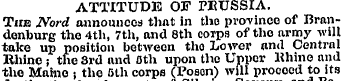
ATTITUDE OF PRUSSIA . Tub Nord announces that in tho province of Brandenburg tho 4 th , 7 th , and 8 th corps of tho army will take up position between tho Lower and Central Rhino ; the 3 rd and Oth upon the Upper Rhine and tho Mahie j the 5 th corps ( Poson ) will proceed to its destination by the route of Silesia , Saxony , and Bavaria . The doparturo of troops will take place about the 1 st of July . , , We also learn that Prussia lias demanded permission to march 31 , 000 troops through Hanover to the Ifchino between tho let andtlio 5 th of July . . ¦ " Those telegrams ( says % \\ Q Daily News ) are calculated to glvo rlso to exaggerated apprehensions , if regarded apart from the diplomatic attitudp of the Prussian Government . So far us those military arrangements tend to commit Prussia to active intervention at a futuro stage of tho war , they , of
course , add to the complications of European politics ; but at present they are merely precautionary . The advance of a Prussian army to the Rhine after a grave diplomatic disagreement with France , such , as the rejection of an offer of mediation , would have a seriousness which would be incontestable . But that is not the present situation . Although the Prussian Government has announced its intention to interfere diplomatically for the restoration of peace , it has not yet thought the time come for proposing bases of pacification to France . Much remains , therefore , to be done before a case for the employment of these troops can arise .
Prussia arras in order that when the time for mediation comes she may intervene with effect . It follows from-what we have stated , that the reports of the Belgian papers respecting the terms of Prussian mediation are premature . Should the conflict on the Mincio prove of a decisive character , and not degenerate , owing-to the successful resistance ' of the fortresses , into a protracted war , the diplomatic intervention of Prussia will probably follow the first great battle . Early in the week we noticed t . he prevalent rumour that a treaty had been concluded between Austria and Prussia with reference to this war . We are enabled to state that this report is completely erroneous . "
The Holy Father And His Subjects. The Ci...
THE HOLY FATHER AND HIS SUBJECTS . The city of Perugia , in the Papal States , obeying the impulse given from Northern Italy , declared openly for Italian unity , established a kind of provisional municipal Government , and offered to place itself under the dictatorship of the King of Sardinia . The King of Sardinia , under the guidance of-the Emperor " of ' the French , declined' the offer . The city was consequently left to sue for mercy from the Papal Government , which , however , it does not seem to have boen inclined to do . A despatch from Turin says :-: —Advices have been received from Arezzo to the 21 st . The Swiss regiments which have left Rome attacked Perugia on the 20 th hist . Great resistance was made , ' notwithstanding " that the defender . * were few . After three hours'fighting outside the . town the Swiss entered , and the combat continued , for two hours in the streets . The Swiss trampled down and killed even women and inoffensive persons . The next day the outrages , arrests , and firing on the people recommenced . The town is in a state of siege . " Doubts are thrown upon the accuracy of a speech attributed to the King of Sardinia declining the dictatorship of Bologna . It now appears that the King has actually appointed two provisional administrators of Bologna—the Marquis d'Azeglio and the Marquis de Rora , and that he does not intend to abandon the Roman provinces to anarchy if the Pone shows himself unable to protect them .
Garibaldi. Tins Chieftain Has Issued A B...
GARIBALDI . Tins chieftain has issued a bombastical proclamation to the inhabitants of Brescia , which wns received with tumultuous enthusiasm . " The incredible successes of Garibaldi and his band ( says a contemporary ) against strong divisions of disciplined troops are now explained . That active and daring partisan commands no motlej * troop of adventurers or outcasts . The * Chasseurs of tho Alps' represent the volunteers of Italy fighting for their freedom . When we learn that a single town of some 40 , 000 inhabitants gave 3 , 000 willing and eager soldiers to Garibaldi ' s corps wo nro no longer at a loss to corapreliend that leader ' s victories . Tho truth is , that he has been thrown into the very country best prepared for hia reception , and best calculated to provide him with what ho needod . Garibaldi had but to advnneo and occupy . With a consummate appreciation of his duty this intrepid chieftain pushed his enterprises to tho very verge of temerity , Knowing that audacity , under such circumstances , was his true policy , he declined no odds , however desperate , nnd soon found that the followers whom ho lost by his daring were replaced by volunteers attracted by his renown . Altogether , what with the universal sympathy of the population , the natural advantages of tho country , and the prestige now acquired l > y five weeks of victory , it is probable that Garibaldi commands as effective a division of troops as « ny in the Italian armies . "
The Ac Cusation Against Marshal Count Ca...
THE AC CUSATION AGAINST MARSHAL Count Cavouh has addressed a circular to tho ministers of Sardinia abroad , in which lie brings a charge against this Austrian general amounting to nothing loss than cold-blooded murder . He says that on tho 20 th of N * y «¦* Torrioella , an Austrian patrol arrested tho constable of tho vlllngo , and comnollea him to take thorn to tho house of a family named Cignoli . Waving searched ovorv pnrt of tho house the soldiers ordered all tho family and somo other persons who happened to bo in tho farmyard
to follow them . The search had resulted in the discovery of asmall amount of shot . The persons arrested were nine in number—seven men , a girl , and a boy of fourteen . The patrol led them up to tlie Austrian commander , who was on horseback on the high road , in the midst of his men . After exchanging a few words in German with the soldiers in charge of the prisoners the commandant told the constable who had served as a guide to remain where-he was . He then ordered the nine i : nfortunate peasants , who could not make themselves understood , and who were trembling all over , to descend into a path by the roadside ; they had scarcely gone a few steps when the commandant gave a signal to a platoon to fire on them Eight of these unfortunate men fell dead ; old Cignoli , mortally wounded , gave no signs of life . The Austrian troops resumed their march , and the conimandant , -turning : to the constable , told him he might go ; and that he might not bo detained by other Austrian troops in the neighbourhood he gave him a card to present , if necessary , as a safe conduct . This card was a simple visiting card , bearing , under a count ' s coronet , this name : — " Feld .-Marscb . all-Lieutcnant Urban . " Shortly afterwards the inhabitants approached the spot . Old Ciguoli , who had recovered his senses , was taken to the hospital at Vog . hcra , where he died five d ; iys afterwards . ' Such enormities , " says the Count , " need no comment . It is an assassination as cowardly as it is vile , and of which , at most , an . example could be found only among savages and barbarians . ' ' We are glad to observe that the Austrian Government declares it is in a position to oppose a flat denial to the reported cruelties attributed to General Urban in the message of Count G . ivour . The Austrian Government , promises soon to publish ample details .
Count Scirltck. The New Commander-An-Chi...
COUNT SCirLTCK . The new commander-an-chicf of the Austrian army was born at Prague and entered the military service in 1808 . At the battle of Aspcrn , in ISO !) , he was lieutenant of lancers in the coi-ps of General Hubna . In ISI . ' j he was named chef d'escsi'dron and orderly officer to the Emperor Francis JJ ., and took part in all the principal engagements of that ' period . He lost ail . eye in the battle of Wrtehau , which prevented his beinjy employed during tlie campaign of ¦ ' 1814 . The remainder of his promotion to that of general of division took place during a time of peace . After the involution of Vienna , in 1848 , he was appointed commandant of a corps d ' armec , not more than 8 , 000 strong . He succeeded in maintaining himself against th < e insurgents , and when he was afterwards united to General Hnynau against the revolted Hungarians , he took a . brilliant part in that campaign , particularly in opposing the junction of the armies of Dembinski and Gcorgey , and in co-operating by that manoeuvre in thu surrender of CJuorgey to the Russians , In 1854 , when Austria armed at tho time af the Eastern question , he had successively the command of the 1 st and 4 th corps d ' amide in Gallicia . Count Schlick is a distinguished and energetic soldier , and a great favourite with the army , every member of which knows by si ^ ht the veteran , who for many years has worn u bluck patch over his left eye . Schlick is an excellent cavalry officer , but it remains to be seen whether lie knows how to handle an army of 150 , 000 men . General Count Degenftild , who formerly belonged to the corps oi Engineers , succeeds Sehliuk » s commander of tho 4 th army .
Mr, Buchanan On The Union. Pjussidbnt Br...
MR , BUCHANAN ON THE UNION . Pjussidbnt BroiiANAX was entertained at Ralcigli , North CuToliiia , on the 2 nd inst ., and responded to mi address as follows :- ^ - " My public life has been a long one , and I have been engaged in many political battles ,. nnd they are now rewarded hy your muiIoh of approval . I am glad to be hero in I he capital ot North Carolina , which you h ave rightly niimci Raleigh , thus aiding in perpetuating that great name . Ho fell a victim to a waulc und pusillanimous tyrant t but , thank God , nothing of that kind can occur hero-no such injustice can . be perpetrate , ! in this land of liberty . It has become fashionable now-a-duyfl to discus * the valuo of tho iTniAn . it was not fashionable twenty yoara ago .
It was not every transitory evil that led us to a division of the Union . Let the friends of a separation of tlwi Union succeed , and tho cause o civil and rolifflous liberty throughout tho world will receive a deathblow . My friends havo spoken of tho war procroBflin g in Europe , In which kings nru endeavouring to overthrow dynasties , and generals to win now glories , wliilo tho poor people , who are really tho Buirerorfl , are not thought of . Thin npoctuclu ought to teach us tho valuo of our institutions . I lore you are to-day a body of sovereigns , who have elected mo your executivo—not your ruler—whoso aotn are to bo jealously watched and accounted for , beside © some acts lor which lie Is not guilty . Though the sun of my political lite is growing dim , I shall novor
-
-
Citation
-
Leader (1850-1860), June 25, 1859, page 7, in the Nineteenth-Century Serials Edition (2008; 2018) ncse.ac.uk/periodicals/l/issues/cld_25061859/page/7/
-
