On this page
-
Text (2)
-

Sei.-SrKvc.-,,-¦. ..-„..- .. -,,-..- ¦,....
-

HISTORY OF PSYCHOLOGICAL METHOD. The Pri...
Note: This text has been automatically extracted via Optical Character Recognition (OCR) software. The text has not been manually corrected and should not be relied on to be an accurate representation of the item.
-
-
Transcript
-
Note: This text has been automatically extracted via Optical Character Recognition (OCR) software. The text has not been manually corrected and should not be relied on to be an accurate representation of the item.
Additionally, when viewing full transcripts, extracted text may not be in the same order as the original document.
Theological And Social Essays. Essays Ec...
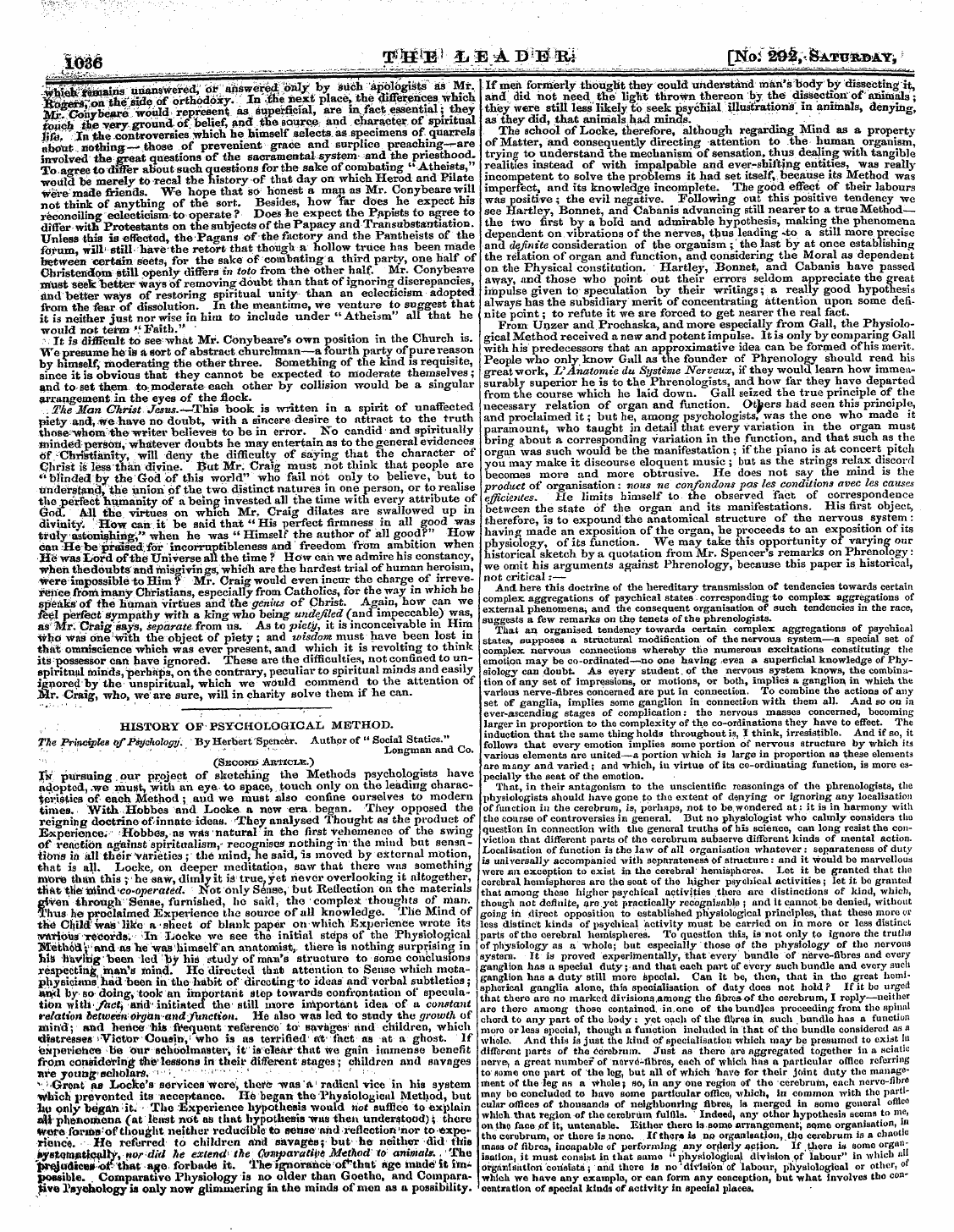
l-M & ftmiaii * unanswered , bir answered onl * > y J _ Wj ^ ** ^ / SSsiStite . wde of brfchodp-iy . In ihe next place , the & ff W ces which Sfr £ ? bnybe » re Would represent as superficial , are in 5 fact essential ; they linicfa the very ground , of belief , and the source and character of spiritual life , jn the confaroversies yrhich he himself selects as specimens of quarrels obout jrtothins-r- those of prevenient grace and surplice preaehing-r-are involved the great questions of the sacramental system and the priesthood To . a « rree to diHer about such questions for the sake of combating " Atheists , " woulcl be merely to recal the history of that day on which Herod arid Pilate Were made fiiends . We h 6 pe that so honest a man as Mr . Conybeare-will not think of anything of the sort . Besides , how Tar does he expect his
reconciling eclecticism to operate ¦? Does he expect the Papists to agree to differ with Protestants on the subjects of the Papacy andTransubstantiation . Unless this is effected , the Pagans of the factory and the Pantheists of the fbrum , will' still have the retort that though a hollow truce has been made between certain seets , for the sake of combating a third party , one half of Christendom still openly differs in toto from the other half . Mr . Cortybeare must seek better -ways of removing doubt than that of ignoring discrepancies , and better ways of restoring spiritual unity than an eclecticism adopted from the fear of dissolution . In the meantime , we venture to suggest that it is neither just nor wise in him to include under " Atheism" all that he would not term " Faith . " __ ¦ _ . ¦
- ¦ It is difficult to see-what Mr . Conybeare ' s own position in the Church is . "We presume he is a sort of abstract churchman—a fourth party of pure reason by himself , moderating the other three . Something of the kind is requisite , since it is obvious that they cannot be expected to moderate themselves ; and to set them ta moderate each other by collision would be a singular arrangement , in the eyes of the flock . The Man Christ Jams .- —This book is written in a spirit of unaffected piety and , we have no doubt , with a sincere desire to attract to the truth those "Whom the writer believes to be in error . No candid and spiritually minded person , whatever doubts he may entertain as to the general evidences of-Christianity , will deny the difficulty of saying that the character of Christ is less than divine . But Mr . Craig must not think that people are '' blinded by the God of this world" who fail not only to believe , but to underhand , the union of the . two . distinct natures in one person , or to realise the perfecthumanity of abemcr invested all the time with every attribute of
God . Ml the virtues on which Mr . Craig dilates are swallowed up in divinity . How can it be said that " His perfect firmness in all good _ was truly astoni s hing /* when he was " Himself the author of all good ? " How can -He ; fee praised ; for incorruptibleness and freedom from ambition when He was Ijord of the Universe all the time ? How can we admire his constancy , TVhen thedoubts and misgivings , which are the hardest , trial of human heroism , ¦ were impossible to Him ? Mr . Craig would even incur the charge of irreverence from many Christians , especially from Catholics , for the way in which he speaks of the human virtues and the geniics of Christ . Again , how can we feel perfect sympathy with a king who being undefiled ( and impeccable ) was , as * Mr . Craig says , separate from us . As to piety , it is inconceivable in Him f th ' o was one ' with the object of piety ; and wisdom must have been lost in that omniscience which was ever present , and which it is revolting to think its possessor can have ignored . These are the difficulties , not confined to unspirituui minds , perhaps , on the contrary , peculiar to spiritual minds and easily ignored by the unspiritual , which we would commend to the attention of Mr . Craig , who , we are sure , will in charity solve them if he can .
Sei.-Srkvc.-,,-¦. ..-„..- .. -,,-..- ¦,....
Sei .-SrKvc .-,,- ¦ . ..- „ ..- .. -,,-..- ¦ ,. ¦ -. ¦ .- < --. -- ¦ -- —t - •—¦ -, ¦ -- — - — - - ' - . jt ^ L ^ Zi : -11 1 ^ —¦——i—^^ i
History Of Psychological Method. The Pri...
HISTORY OF PSYCHOLOGICAL METHOD . The Principles of Psychology . By Herbert Spencer . Author of " Social Statics . " '• : i ' — Longman and Co . ( Second AirMcr * :. ) fp ' : pursuing pur project of sketching the Methods psychologists have adopted , . we must , with an eye to space , touch only on the leading charact eristics of each Method ; and we must also confine ourselves to modern times . With Hobbes and Locke a now era began . They opposed the reigning doctrine of innate ideas . They analysed Thought aa the product of Experience ; Hbbbes , as wjts natural in the first vehemence of the swing of reftctibn against spiritualism ,- recognises nothing in the mind but sensniiorts in all their varieties ; the mind , lie said , is moved by external motion , that is all . Locke , on deeper meditation , saw that there was something it
more thutu this ; he saw , dimly it ia true , yet never overlooking altogether , ttiafctnejriind'co-opertMetf . Not only Sense , but Reflection on the materials given through Sense , furnished , ho said , the com pie ± thoughts of man . i'hus he proclaimed Experience the source of all knowledge . The Mind of tfee Child ' was like a sheet of blank paper on which Experience wrote its tvK \ rious mfceordai In Locke we see the initial steps of the Physiological Method * and as he was himself an anatomist , there is nothing surprising in his having been ledi by his study of mam ' s structure to some conclusions respecting man ' s mind . Ho directed that attention to Sense which mefcaphysici » ns had been in the habit of directing to ideas and verbal subtleties ; fcn-d by so doing , took an important step towards confrontation of speculation -with . / acty arid' initiated the still more important idea of u constant relation between organ-and function * . He also was led to study the growth of mind ; and hence his fi'equtmt reference to Bavages and children , which hostIf
distresses > Victor Cousin , ' who is us terrified at fact aa at a g . CNperiehce -be our sehoolmivster , it'is ' clear that we gain immense benefit frprn considering tlhe ' les ^ ons in theil * different stages ; children and savages are young * scholars , > ¦ : ; i ' - '' ;¦ ' ¦'• ¦ ¦ ' ¦ <^ ' ¦ ¦¦ . v ' "Gro » t na X » ocfee ' a services wore ' , ther ^ e y r & s A , ' radical vice in his system Which prevented its acceptance . He began the Physiological Method , but ho only began it . The Experience hypothesis would not suffice to explain a < M phenomena ( at least not as that hypothesis was then understood ) \ there Wore fowna of thought neither reducible to sense and reflection ' nor to expo-Jrionc « . He referred to children and savages f but he neither did this ^ GtqtDHtically , nor did he extend' the Qrmj > aratit > t Method to animal * . , The prejudices <> f ^ that a » e forbade it . The ignorance of ^ thnt age made it impossible . . Comparative Physiology is no older than Gootho , and Comparative Psychology is only now glimmering in the minds of men as a possibility .
If men fornierly thought they could understand man ' s body by dissectmg it , and did hot need the light thrown thereon by the" dissection "'' of ; animals ; they were still less likely to seek psycKial illustrations" in animals , denying , as they did , that animals ha » J minds . The school of Locke , therefore , although regarding Mind as a property of Matter , and consequently directing attention to the human organism , trying to understand the mechanism of sensation , thus dealing with tangible realities instead of with impalpable and ever-shifting entities , was really incompetent to solve the problems it had set itself , because its Method was imperfect , and its knowledge incomplete . The good effect ^ of their labours was positive ; the evil negative . [ Following out this positive tendency we see Hartley , Bonnet , and Cabanis advancing still nearer to a true Methodthe two first by a bold and admirable hypothesis , making the phenomena dependent on vibrations of the nerves , thus leading -to a still more precise last bat
and definite consideration of the organism ; the y once establishing the relation of organ and function , an d considering the Moral as dependent on the Physical constitution . Hartley , Bonnet , and Cabanis have passed away , and those who point out their errors seldom appreciate the great impulse given to speculation by their writings ; a really good hypothesis always has the subsidiary merit of concentrating attention upon some definite point ; to refute it we are forced to get nearer the real fact . From Unzer and Prochaska , and more especially from Gall , the Physiological Method received a new and potent impulse . It is only by comparing Gall with his predecessors that an approximative idea can be formed of his merit . People who only know Gall as the founder of Phrenology should read his great work , L'Anatomie du Systeme Nerveux , if they would learn how immeasurably superior he is to the Phrenologists , and how far they have departed from the course which he laid down . Gall seized the true principle of the necessary relation of organ and function . Otters had seen this principle ,
and proclaimed it ; but he , among psj'chologists , was the one who made it paramount , who taught in detail that every variation in the organ must bring about a corresponding variation in the function , and that such as the organ was such would be the manifestation ; if the piano is at concert pitch you may make it discourse eloquent music ; but as the strings relax discord becomes more and more obtrusive . He does not say the mind is the product of organisation : nous tie confondons pas les conditions avec les causes efficieiues . He limits himself to the observed fact of correspondence between the state of the organ and its manifestations . His first object , therefore , is to expound the anatomical structure of the nervous system : having inade an exposition of the organ , he proceeds to an exposition of its physiology , of its function . We may take this opportunity of varying our historical sketch by a quotation from Mr . Spencer ' s remarks on Phrenology : we omit his arguments against Phrenology , because this paper is historical , not critical : —
And here this doctrine of the hereditary transmission of tendencies towards certain complex aggregations of psychical states corresponding to complex aggregations of external phenomena ; and the consequent organisation of such tendencies in the race , suggests a few remarks on the tenets of the phrenologists . That an organised tendency towards certain complex aggregations of psychical states , supposes a structural modification of the nervous system—a special set of complex nervous connections whereby the numerous excitations constituting the emotion may be co-ordinated—no one having ev « p a superficial knowledge of Physiology can doubt . As every student . of the nervous system , knows , the
combination of any set of impressions , or motions , or both , implies a ganglion , in -which the various nerve-fibres concerned are put in connection . To combine the actions of any set of ganglia , implies some ganglion in connection with them all . And so on in ever-ascending stages of complication : the nervous masses concerned , becoming larger in proportion to the complexity of the co-ordinations they have to effect . The induction that the same thing holds throughout is , I think , irresistible . And if so , it follows that every emotion implies some portion of nervous structure by which its various elements are united—a portion which is large in proportion as these elements are many and varied ; and ¦ which , iu virtue of its co-ordinating function , is more especially the seat of the emotion .
That , in their antagonism to the unscientific reasonings of the phrenologists , the physiologists should have gone to the extent pf denying or ignoring any localisation of function in the cerebrum , is , perhaps , not to be . wondered at : it is in harmony with the course of controversies in general . But no physiologist who calmly considers the question in connection with the general truths of his science , can long resist the conviction that different parts of the cerebrum subserve different kinds of mental action . Localisation of function is tho law of all organisation whatever : senaratenesa of duty is universally accompanied with separateness of structure : and it would be marvellous wore an exception to exist in the cerebral hemispheres . Let it be granted that the cerebral hemispheres are the seat of the higher psychical activities ; let it bo granted that among those higher psychical activities there are distinctions of kind , which , though not definite , ? ro yet practically recognisable ; and it cannot bo denied , without going in direct opposition to established physiological principles , that these more or less distinct kinds of psychical activity must bo carried on in more or less distinct
parts of the cerebral hemispheres . To question this , ia not only to ignore the truths of physiology as o whblo ; but especially those ot the physiology of tho nervous system . It ia proved experimentally , that every bundle of nerve-fibres and every ganglion has a special duty ; and that each part of every such bundle and every such ganglion has a duty still more special . Can it bo , then , that in the great hemispherical ganglia alone , thia specialisation of duty does not hold ? If it bo urged that there are no marked divisions . among the fibroaof the cerebrum , I reply—neither are tliore among those contained , in , one of tho bundles proceeding from tho spinal chord to any part of tho body : yet each of the fibres in , a \ ich bundle has a function more or less special , though a function included in that of tho bundle considered as a whole . And this is juat tho kind of specialisation which may be presumed to exist in different parts of tho eerobrum . Just as there nro aggregated together in a Hciatie
nerve , n great number * of norvc-nbros , each of which has a particular office referring to some one part of the log , but all of which have for their joint duty tho managoment of the leg ns a whole } so , in any one region of tho cerebrum , each norvo-fibre may bo concluded to have some particular office , which , in common with tho particular offices of thousands of neighbouring fibres , la merged in some general ofllco whicli that region of tho cerebrum fulfils . Indeed , any other hypothesis seems to me , on the fape of it , untenable . Either there is , some arrungernent ; BQmo organisation , »» tho corobrum , or there is none . If ther « iu , np organriaatjioH , tho cerebrum ia a chaotic mass of fibres , incapable of performing any orderly . action . If there i » some organisation , it must consist in that same " physiologieaji division of labour" in which »» organisation consists ; and there ia no division of labour , physiological or other , ot which we have any example , or can form any conception , but what involves tho concentration of special kinds of activity in special places .
-
-
Citation
-
Leader (1850-1860), Oct. 27, 1855, page 16, in the Nineteenth-Century Serials Edition (2008; 2018) ncse.ac.uk/periodicals/l/issues/cld_27101855/page/16/
-