On this page
-
Text (1)
-
![Hay 30, 1857.] THE LEADER. 507](/static/media/periodicals/101-CLD-1857-05-30-001-SINGLE/Ar00300S_lL7fUgG.png)
Hay 30, 1857.] THE LEADER. 507
Note: This text has been automatically extracted via Optical Character Recognition (OCR) software. The text has not been manually corrected and should not be relied on to be an accurate representation of the item.
-
-
Transcript
-
Note: This text has been automatically extracted via Optical Character Recognition (OCR) software. The text has not been manually corrected and should not be relied on to be an accurate representation of the item.
Additionally, when viewing full transcripts, extracted text may not be in the same order as the original document.
Imperial Parliament. —?—Monday, May 25t7...
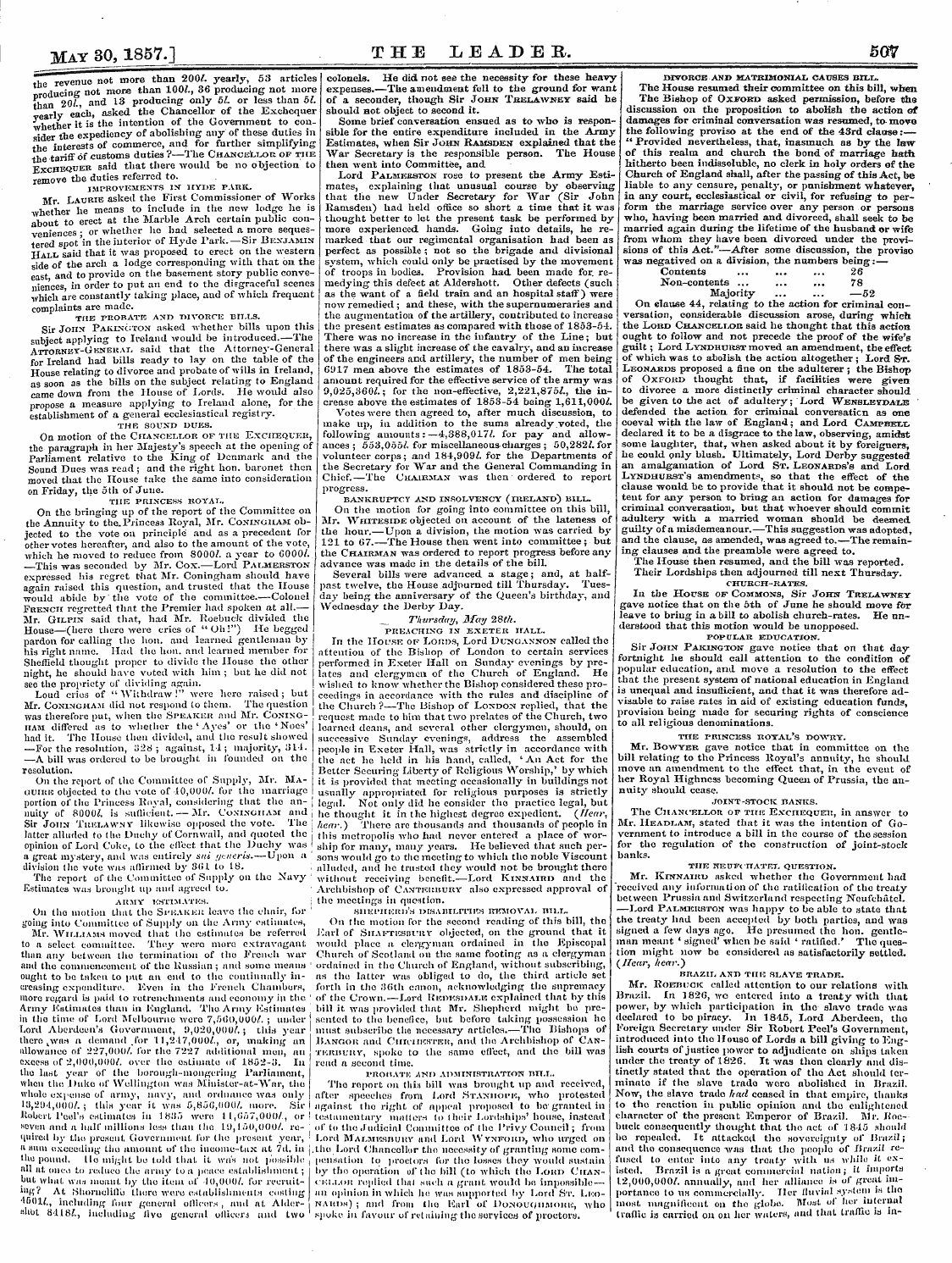
t he revenue not more than 2001 . yearl y , 53 article ; nroducing not more than 100 / ., 36 pr o ducing not m o re than 20 / ., and 1 3 pro d ucing onl y 51 . or less than 51 L arl y each , asked the Chancellor of the Exchequei whether it is the intention of the Government to consider the expediency of abolishing any of these duties in the interests of commerce , a nd f or f urther s imp lifying the tariff of customs duties ?—The Chancellor of the Exchequer s i d t h at there would b e no obj ec tion to remove the duties referred to . IMPROVEMENTS IN HYDE PARK . Mr . Laurie asked the First Commissioner of Works whether he means to include in the new lodge he is about to erect at the Marble Arch certain public conveniences or whether he had selected a more sequestered spot ' in the interior of Hyde Park . —Sir Benjamin Hall said that it was proposed to erect on the western side of the arch a lodge corresponding with that on the east and to p rovide on the basement story public conveniences , in order to put an end to the disgraceful scenes which are constantly taking place , aud of which frequent comp laints are made . THE PROBATE AND DIVORCE BILLS . Sir John Pakington asked whether bills upon this subject apply ing to Ireland would be introduced . —The Attorney- Genera ! ., said that the Attorne } --General for Ireland had bills ready to lay on the table of the House relating to divorce and probate of wills in Ireland , as soon as the bills on the subject relating to England came down from the House of Lords . He would also propose a measure apply ing to Ireland alone , for the establishment of a general ecclesiastical registry . THE SOUND DUES . On motion of the Chancellor of the Exchequer , the paragrap h in h e r M aj esty ' s speech at the opening of Parliament relative to the King of Denmark and the Sound Dues Avas read ; and the right lion , baronet then mov ed t ha t the Hou s e ta k e t he sam e iuto consi de ration on Friday , the 5 th of June . THE PRINCESS ROYAL . On the bringing up of the report of the Committee on the Annuity to the . P r incess R o y a l , Mr . Coningham objected to the vote on principle and as a precedent for other votes hereafter , and also to the amount of the vote , which he moved to reduce from 8000 / . a year to G 000 / . This was seconded by Mr . Cox . —Lord Paoierston expressed his regret that Mr . Coningham should have again raised this question , and trusted that the House would abide by the vote of the committee . —Colonel French regretted that the Premier had spoken at all . — Mr . Gilpin said that , had Mr . Roebuck divided the House —{ here there were cries of " Oh ! " ) He begged pardon for calling the hon . and learned gentleman by his rig ht name . Had the hon . and learned member for Sheffield thought proper to divide the House the other night , he should have voted with him ; but he did not see the propriety of dividing again . Loud crius of " Withdraw ! " were here raised ; but Mr . Coningham did not respond to them . The question was therefore put , when the Speaker and Mr . Coningham differed as to whether the ' Ayes' or the ' Noes ' had it . The House then divided , and the result showed —For the resolution , o 2 S ; against , 11 ; majority , ail . —A bill was ordered to be brought in founded on the resolution . On the report of the Committee of Supply , Mr . Maguire objected to the vote of 10 , 000 / . for the marriage portion of the Princess Royal , considering that the an- j nuity of 8000 / . is sufficient . — Mr . Conlngham and j Sir John Trklawny likewise opposed the vote . The j latter alluded to the Duch y o f C o rnw a ll , and quoted the op inion of Lord Coke , to the effect that the Duchy was a great mystery , and w ; is entirely sni ( jawris . —Upon a ' division the vote wa .-s ufllrmcd by 3 (> l to L 8 . ' , The report of the Committee of Supply on the Xavy ' Estimates was brought up and agreed to . : ARMY ESTIMATES , i On the motion that the Si'EAKkk leave the chair , for going into Committee of Supply on the Army entiniateB , Mr . Williams moved that I ho estimates be referred to a select committee . They were more extravagant than any between the termination of tho French war and the commencement of the Russian ; and some meaiiH ' ought to bo taken to put an end to tho continually increasing expenditure . Even in the French Chninborn , more regard is paid to retrenchments and economy in the ' Army Estimates than in Kngland . Tho Army Estimates in tho time of Lord Melbourne- wero 7 , r )( i () , 000 / . ; under Lord Aberdeen ' s Government , 5 ) , 020 , 000 / , ; thi . i year there wan a demand Cor 11 , 2-17 , 000 / ,, or , making an ullowunec of 227 , 000 / , for the 7227 additional men , an excess of 2 , 000 , 000 / . over tho estimate of 18 o 2-iJ . In the last year of the borough-niongoring Parliament , when tho Duke of Wellington wan Ministor-at-War , tho whole expenso of army , navy , and ordunnco was only l » , 21 ) 'l , ()()()/ . ; thin year it wan 6 , 856 , 000 / . more . Sir I Rob e r t 1 ' col'n critiniatoa in 18 . 'l . "> worn 1 I , ( io 7 , 000 / . , or I hovuh and a half millions los . s than the 11 ) , I .. 10 , 000 / . required \> y Mui present , Government for tho present your , ' a sum exceeding tho amount of tho income-tax at 7 d , in j , tho pound . llo might , bo told thai , it was not possible ( nil at onoo to reduce the army to a peace eHtablinlnnont ; but what \\ n .-i meant by tho item of 10 , 000 / . for reeruit'" g ? At iShornolillo thoro woro cstablidhnu-utH conting 'IGO'U , including four general olllcor . s , and at . Alderwlibt 8418 / ., including flvo general officers oiul two
colonels . He did not aee the necessity for these heavy expenses . —The amendment fell to the ground for want of a seconder , thoug h Sir Johk Tkelawney said he should not object to second it . Some brief conversation ensued as to who is responsible for the entire expenditure included in the Army Estimates , when Sir John Ramsden explained that the War Se c ret a ry is the responsible person . The House then went into Committee , and Lord Palmerston rose to present the Army Estimates , exp l ai ni n g that unusual c our s e by ob s erving tha t the ne w Un d er Se c retary for War ( Sir John R a m s den ) h ad h e l d offic e so short a time t h a t it was thought better to let the present task be performed by more experienced , hands . Going into details , he remarked that our reg iment a l org a nisation ha d been as perfect as possible ; not so the bri gade an d d ivi s ional system , which could only be practised by the movement of troops in bodies . Provision had been made for . remedying this defect at Aldershott . Other defects ( such as th e want o f a fi e l d tr a in an d an h osp ital staff ) were now remedied ; and these , with the supernumeraries and the augmentation of the artillery , contributed to increase the present estimates as compared with those of 1853-54 . There was no i nc r e a se in the inf a ut r y o f the Line ; but there was a slight increase of the cavalry , and an increase of t he eng ineers and artillery , the num b er of men b eing 6917 men above the estimates of 1853-54 . The total amount required for the effective service of the army was 9 , 025 , 360 / . ; for the non-effective , 2 , 221 , 875 / ., the increase above the estimates of 1853-54 being 1 , 611 , 000 / . V o te s were th e n a gree d to , after much discussion , to make up , in addition to the sums already voted , the following amounts : —4 , 388 , 017 / . for pay and allowances ; 553 , 055 / . for miscellaneous charges ; 50 , 282 / . for volunteer corps ; and 184 , 909 / . for the Departments of the Secretary for "War and the General Commanding in Chief . —The Chaakmax was then ordered to report progress . BANKRUPTCY ASD INSOLVENCY ( IRELAND ) BILL . On the motion for going into committee on this bill , Mr . Whiteside objected on account of the lateness of the hour . —Upon a division , the motion was carried by 121 to ( 57 . —/ The House then went into committee ; but the Chairman was ordered to report progress before any advance was made in the details of the bill . Several bills were advanced a stage ; and , at halfpast twelve , the House adjourned till Thursday . Tuesday being the anniversary of the Queen ' s birthday , and Wednesday the Derby Day . __ Thursday , May 28 th . PREACHING IN EXETER HALL . In the House of Lords , Lord Dungannon called the attention of the Bishop of London to certain services performed in Exeter Hall on Sunday evenings by prelates and clergymen of the Church of England . He wished to know whether the Bishop considered these proceedings in accordance with the rules and discipline of the Church ?—The Bishop of London replied , that the request made to him that two prelates of the Church , two learned deans , and several other clergymen , should , on successive Sunday evenings , address the assembled peop l e in E xe ter H a ll , was strictly in accordance with the act he held in his hand , called , 'An Act for the Better Securing Li be rty of R e lig ious Worship , ' by which it is provided that meeting occasionally in buildings not usually appropriated for relig i o u s purp os es is st r i c tl y legal . Not only did he consider tho practice legal , but he thought it in the highest degree expedient . (/ Tow , hear . ) There arc thousands and thousands of people in this metropolis who had never entered a place of worship for many , mnny years . He believed that such persons would go to the meeting to which tho noble Viscount alluded , and he trusted they would not be brought there without receiving benefit . —Lord Kinnaird and the Archbishop of Cantkiuujry also expressed approval of the meetings in question . siiEi'HKR-n ' s disabilities bicjiovai , bill . On the motion for the second reading of this bill , tho Earl of SiiAFTicsniTitY objected , on tho ground that it would place a clergyman ordained in tho Episcopal Church of Scotland on tho flame footing as a clergyman ordained in the Church of England , without subscribing , as the latter wan obliged to do , the third article set forth in tho . ' 36 th onnon , acknowledging tho supremacy of the Crown . —Lord IJedksdale explained that by this bill it was provided that Mr . Shepherd might bo presented to the bcnuCice , but before taking possession ho must subscribe tho necessary articles . —The Bishops of Bangor anil Ciiu'IIicrteh , and tho Archbishop of Cantkriiuuy , Hpoko to tho same effect , and the bill was read a second time . PROIIATK - AND ADMINISTRATION BILL . Tho roport on thin hill was brought up and received , after Hpoochcs from Lord Stanhope , who protested against tho right of appeal proposed to bo'granted in testamentary matters to t heir Lordship . ** ' house , instea d of to tho Judicial Committee of tho Privy Council ; from Lord Maliwesburv and Lord Wynfoud , wh o urged on tho Lord Chancellor tho noeosnity of granting some compensation to prootop . s for tho Iohhch they would HU . st . ain by tho operation of tho bill ( to which tho Loud Chani . 'Ki . Loit roplicd ( . hut . Hiich a grant would bo impossible — an opinion in which ho wan ( supported by Lord St . Lkonard . h ) ; and from tho Hurl of Donouoiiaiouic , avIio Hpuko in favour ol ' rvtiihiiiig tho services of proctora .
: nrVORCB AN » MATRIMONIAL CAUSES BILL .. The House resumed their committee on this bill , when The Bishop of Oxford asked permission , before the discussion on the proposition to abolish the action of damages for criminal conversation was resumed , to- move the following proviso at the end of the 43 rd clause : — " Provided nevertheless , that , inasmuch a s by the law of this re a lm a n d chur c h t he b on d of marriage hath hithert o been in d iss o lu b l e , no clerk in hol y o rders of the Chur c h of England shall , after the passing of this Act , be lia b l e to any c e nsure , penalty , or punishment whatever , in any c ourt , ecclesiastical or civil , for refusing to perform the marri a ge service over any p e rs on or persons who , having been married and divorced , s h a ll seek to be married ag'ain during the lifetime of the husband or wife from whom they have been divorced under the provisions of this Act . "—After some discussion , the proviso was negatived on a division , the numbers being : — Contents ... ... ... 26 Non-contents ... ... ... 78 Majority ... ... —52 On clause 44 , relating to the action for criminal conversation , consi de r a ble d is c us s i o n arose during which the Lord Chancellor said he thought that this action ought to follow and not precede the proof of the wife ' s guilt ; Lord Lyndhurst moved an amendment , the effect of which was to abolish the action altogether ; Lord St . Leonards pr o pos ed a fine on the ad ulterer ; the Bishop of Oxford thought that , if facilities were given to divorce a more distinctly criminal character should be given to the act of adultery ; Lord Wensleydaus ' defended the action , for criminal conversation as one co eval with th e law of Eng land ; and Lord Campbixl declared it to be a disgrace to the law , observing , amidst some laughter , that when asked about it by forei gn e rs he could pnly blush . Ultimately , Lord Derb y sugg e sted an amalgamation of Lord St . Leonards ' s an d Lor d Lyndhurst ' s amendments , s o th a t the eff e ct o f the clause would be to provide that it should not be competent for any person to bring an action for damages for criminal conversation , but that whoever should commit adultery with a married woman should be deemed guilty of a misdemeanour . —This suggestion was adopted , and the clause , as amended , was agreed to . —The remaining clauses and the preamble were agreed to . The House then resumed , and the bill was reported . Their Lordships then adjourned till next Thursday . CHURCH-RATES . In the House of Commons , Sir John Trelawney gave notice that on the 5 th of June he should move for leave to bring in a bill to abolish church-rates . He understood that this motion would be unopposed . POPULAR EDUCATION . Sir John Pakington gave notice that on that day fortnight he should call attention to the condition of popular education , and move a resolution to the effect that the present system of national education in England is unequal and insuflicient , and that it was therefore advisable to raise rates in aid of existing education funds , provision being made for securing ri g ht s of c onscience to all religious denominations . THE PRINCESS ROYAL ' S DOWRY . Mr . Bovvyer gave notice that in committee on the bill relating to tho Princess Royal ' s annuity , he should move an amendment to the effect that , in th e e vent of her Royal Highness becoming Queen of Prussia , the annuity should cease . JOINT-STOCK BANKS . The Chancellor of the Exchequer , in answer to Mr . Headlam , stated that it was the intention of Government to introduce a bill in the course of the session for tho regulation of tho construction of joint-stock banks . THE NEClfCITA'iTX QUESTION . Mr . KrNNAiRD asked whether the Government had received any information of the ratification of the treaty between Prussia and Switzerland respecting Neufchatol . —Lord Palmerston was happy to bo able to state that the treat 3 had been accepted by both parties , and was signed a few days ago . He presumed the hon . gentleman meant ' signed' when be said ' ratified . ' Tho question might now bo considered as aatisfactorily settled . ( J l car / tear . ' ) BRAZIL AND THE SLAVE TRADE . Mr , Roebuck called attention to our relations with Brazil . In 1826 , wo entered into a treaty with that power , b y whi c h partici pation in the slave trade was declared to bo piracy . In 1845 , Lord Aberdeen , tho Foreign Secretary under Sir Robert Peel ' s Government , introduced into tho Houso of Lords a bill giving to English courts of justice power to adjudicate on shi p s taken under tho treaty of 1826 . It was then clearly and distin c tl y stated that tho operation of tho Act should tcrminuto if the » lavo trade wcro abolished in Brazil . Now , the slave trado had ceased in that empire , th a nks to tho rea c tion in pu b lic op inion and tho enlightened character of tho present Emperor of Bruzil . Mr . Roo . ~ buck consequentl y thoug ht that tho act of 18-15 ( mould bo repealed . It attacked tho Hovorcignty of Brazil ; and tho consequence was that tho people of Brazil refused to enter into any treaty with ma whlhi it e . \ - inted . Brazil is a grout commercial nation ; it imports 1 . 2 , 000 , 000 / . annuall y , and her alliance i \ s of groat importance to us commercially . Her fluvial . synloni >'« tho most magnificent on tho globe . Moat , of her internal I radio is carried on on her waters , and that traffic ia in-
Hay 30, 1857.] The Leader. 507
Hay 30 , 1857 . ] THE LEADER . 507
-
-
Citation
-
Leader (1850-1860), May 30, 1857, page 3, in the Nineteenth-Century Serials Edition (2008; 2018) ncse.ac.uk/periodicals/l/issues/cld_30051857/page/3/
-