
On this page
-
Text (2)
-
![No. 275, June 30, 1855.] TELE LEAB1B. G$...](/static/media/periodicals/101-CLD-1855-06-30-001-SINGLE/Ar01102S.png)
No. 275, June 30, 1855.] TELE LEAB1B. G$...
-
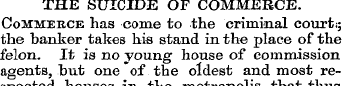
THE SUICIDE OF COMMERCE. Commerce has co...
Note: This text has been automatically extracted via Optical Character Recognition (OCR) software. The text has not been manually corrected and should not be relied on to be an accurate representation of the item.
-
-
Transcript
-
Note: This text has been automatically extracted via Optical Character Recognition (OCR) software. The text has not been manually corrected and should not be relied on to be an accurate representation of the item.
Additionally, when viewing full transcripts, extracted text may not be in the same order as the original document.
The Austrian Debate. ¦Lo Ud Ciaeendon's ...
perveraeagility to the Vienna Conferences , and finds a new explanation-of Austrian policy . And his explanation is tMs * —that Austria ' s policy is—expectant . The Earl believes that , "if while these negotiations were pending , Sevastopol had fallen , we should either have secured peace with Bussia , or obtained the active co-operation of Austria . " From the confusion of this logic we infer , that the Emperor Francis-Joseph at first
sympathised with Turkey and the Western Powers ; next , that he was estranged from , them—that " his feelings greatly changed , "—through manifestations of opinions over which the Cabinet of England had no control , and which were not permitted in France . Thirdly , he affected to expel the Russians from the territory they had seized , and only waited for their discomfiture in the Crimea to coerce
them , if necessary , by arms . One of these contradictory phrases confutes the other . To us it appears that Austria adheres to a distinct line of action . She raised her military forces at an enormous cost to a formidable efficiency . She stationed herself upon the Danube—the long-sought object of her ambition—she maintained her armies in a threatening attitude while she demanded concessions from
. Russia at Vienna—concessions for herself , not for Turkey , which she abandoned . Russia acquiesced , and after a last pretence at negotiations , which Lord Claeendon admits to have been a sham , the imposing panoply of Austria dissolves , and the flower of the Czab ' s troops , which had been detained upon the Gallician frontier , march southwards to press upon the " Western Allies .
If there be a logic in human policy , this proves , not that Austria has been irritated by England , but that she has been drugged by Russia . Count BuoT ; has declared so much . Xet Turkey b . e guarded , he suggests , by a tripartite treaty . Let the Sultan open the Straits when he is in danger . Austria , meanwhile , will continue to occupy the Principalities , and Russia agrees to ratify the privileges of her neutral ally on the Danube . Is there more than this in the speech of the Earl of Clarendon ? The infatuation of the
British Government consists in its regarding as an advantage the maintenance in the Principalities of an Austrian army large enough to enforce martial law , but too small to menace Russia . Lord Lyndhurst put this with perfect clearness to the House of Peers . He demonstrated that the diminution of the Austrian forces in Gallicia afforded a corresponding opportunity to the Russian generals ; and ho hinted at the secret and sinister understanding on this subject which may bo supposed to exist between the Cabinets of Vienna and St . Petersburg .
Lord Clarendon , on the part of the Government , gave no explanation on this point . His nerveless speech was the- shy and sickly plea of a helpless applicant affecting to prize evcu . the negativo duplicity of an equivocal ally . Incapable of dealing with the question , he glided over its surface , 11 uttering about tho writings and speeches that have wounded the susceptibilities of Germany , forsooth !—as if tho Germany of Courts and Camarillas were tho German nation— excusing the retreat of Austria from her engagements ,
alluding vaguely to future terms of peace , and trying to show that llio presenco of an Austrian division on tho Danube was of importance to " tllo Allies . He did not utter a word to satisfy the nation an to the tenure by which tho Austrian Emperor holds hin ground , or as to the condition of tho provinces which his barbariiuia scourge . He confounded n gratuity which that potentate lias received with ft service roiulercd . It iB necessary to insist on this distinction . It may " be well that Austria should
arm her legions , as it has been pretended , to extort .. concessions from Russia , and disarm , as-soon , as these concessions haste been obtained . She thus fulfils her own policy , and leaves Russia free to fulfil hers . Rut it is as silly as it is false to represent this conduct as serviceable to the Ottoman Empire or to the Western , Powers . Lord Clarendon did not even attempt to meet the powerful and comprehensive statement of Lord LrNDHDRST with a reply . He simply -exhibited himself and his colleagues as the voluntary dupes of a Power whose ambiguous neutrality in London is lawless domination at Bucharest .
No. 275, June 30, 1855.] Tele Leab1b. G$...
No . 275 , June 30 , 1855 . ] TELE LEAB 1 B . G $ B
The Suicide Of Commerce. Commerce Has Co...
THE SUICIDE OF COMMERCE . Commerce has come to the criminal court ;; the banker takes his stand in the place of the felon . It is no young house of commission agents , but one of the oldest and most respected houses in the metropolis that thus represents commerce in that tribunal . "We have never been among the adulators of trade ; the old boasted soundness of the English commercial world was not quite sound—the plain , downright , pay-your-way , solid man of business had his virtues , but
also his narrownesses ; and he it was who paved the way for the vices which have sapped the very life of commerce ; have poisoned it with depravity until it becomes criminal . If there is anything real in the world , it ought to be trade , commerce , " business . " It deals with solid , tangible things ; its laws are simple , its results are palpable , personally appreciated ; yet commerce , as we have said before , partakes the same unreality , the same hypocritical smoothness of surface over a disordered interior which it has been our
business to expose in reference to many other sections of society . " With what object have we insisted upon the uniform characteristic of these exposures ? Has it been in the love of decrying oxir fellow-creatures ; in the pleasure of exposing sore places , and of making human fallibility feel its shame more - bitterly ? Quite the reverse . " We know that our purpose in persevering with that great task has been by some misinterpreted , but by many more it has been clearly understood . We
know that the body of the English people , high and low , is more " genuine" than the artificial product into which it converts itself , called " society ; " that its real motives , its fiesh-and-blood sympathies , are more healthy , and in the long run are stronger than its factitious requirements and convenances . But it is precisely because we know man to be bettor than the best disguise which he puts on , for the purposes of the " world , " as it is called , that we urge him to throw off the disguise ; that we point out its shocking nfFects on himself and on all that he holds
dear . The man , we say , is better than the tradesman , the clergyman , the aristocrat , the representative of any class ; and if he will but look boldly into Ms own experience , he will liud that the basest practices which ho thinks necessary to get on in the world , bring with tliem their own penalty , and are indeed useless and profitless . Thero is no part of society in which the reality is not diaguiscd by the unreality . In this free country we have a majority of men who are bound by laws , in the formation of which they have ' no voice . Tho Church , as wo have shown over and over again , ia
thronged with dissenters and unbelievers , who conceal thoir non-conformity for the salto of tho pay and position . The aristocracy , which ' professes to bo so elevated by hi # h birth , wealth , and refined training , in delected in cheating at cavda ; a ViJ'MKks runs away from fraudulent turf liabilities ;
a . GoEflDOir ist . before the . polieancourts for making away with securities ; zu Baronet stands in the same -place on the same ( charge ; and ntaw commerce seems to convict itself as the most unreal among all these disguises and artificial creations . It will be almost a safe rule for the Englishman not to- believe anything that he sees . What was once genuine , may now be spurious . If he sees a man preaching in the pulpit , let him not be sure that that man is not a Papist , a Unitarian , or an Atheist ; for such things are , and we can point to individual instances , — - which are not solitary . If he sees an " Honourable" welcomed in
the highest society , let him not be sure that the man is not a swindler or a blackleg . If he sees a peculiarly well-ordered domestic circle , let him watch the proceedings in the courts matrimonial or testamentary . If he sees a British merchant , let him not be sure that he has not before him a dealer in flash goods ; if a banker , that he is not an . embezzler . " We have from time to time made out the case against the peculiar sustainers of " our civilisation" in other circles of society ; our business now is with the "banker and with the trader .
There is no country in the world that should serve the purpose of the commercial enterprise better than England . It is the spoilt child of fortune ; and this season of all others is nearly the brightest that commerce could desire . The war is kept aloof by the power of our marine ; we have opened up communication with every centre of population in the world ; commerce has procured its great measure of free-trade , —the monopoly of the landowner has been destroyed ; and
while this country , at the present season , smiles with a growing harvest everywhere of the finest promise , we have the same cheering reports from abroad , and especially from America . We are suffering from the failure of a past season , but there is every prospect of plenty . By relieving the labour-market , emigration has caused an actual rising of wages ; yet the rise is not more than Sufficient to relieve the poor-rate , leaving to commerce still an abundant supply of handlafcour . Markets more widened , therefore ,
either at home or abroad , machinery more perfect , roads of transit more open , commerce could not have . Yet in the very midst of this prosperity , while constructive enterprise of various kinds is still opening new investments , and laying tlvc foundation for future successes , commerce brings bankruptcy upon itself . It is not that it is unprotected . It has laws to restrain the swindler ; and policemen aid to protect the quiet entrance to the bank . But it is the banker himself who enters into the stronghold of the establishment , and carries away the property . It is the merchant himself who tampers with
securities , and competes with the ordinary swindler in . unlawful acts . Go wherovor you will into trading society , you find some element introduced foreign to the very nature of the trade . Manufacturers become petty dealers in provisions , competing with the village " shop , " by forcing their workpeople into the truck system . The same nmnuiacturers compete with another branch ot trade , and becoming their own agents , assist to American
heap up that glut in Australian , , and . Indian markets , which put the lust groat general check to our commercial proaponty . Tlio retail tradesman hardly sells an article which it * not adulterated , and tho conduct ot traders has entirely destroyed faith in the wares they Hell , Merchants profess to be very exact in their dealing , but from the cases of Daniiu . Mitchell Davidson , aud Cosmo AVjUiam Goicdon , wo find n » . existing practice of strangely dealing in ma *
-
-
Citation
-
Leader (1850-1860), June 30, 1855, page 11, in the Nineteenth-Century Serials Edition (2008; 2018) ncse.ac.uk/periodicals/l/issues/cld_30061855/page/11/
-