On this page
-
Text (7)
-

Untitled Article
-
Untitled Article
-
Untitled Article
-
Untitled Article
-
Untitled Article
-

Untitled Article
-

Untitled Article
Note: This text has been automatically extracted via Optical Character Recognition (OCR) software. The text has not been manually corrected and should not be relied on to be an accurate representation of the item.
-
-
Transcript
-
Note: This text has been automatically extracted via Optical Character Recognition (OCR) software. The text has not been manually corrected and should not be relied on to be an accurate representation of the item.
Additionally, when viewing full transcripts, extracted text may not be in the same order as the original document.
Untitled Article
CRIMES AND OUTRAGES IN AMERICA . The American papers received by the last mail contain accounts of an unusual number of crimes and outrages in Philadelphia . It appears that the city of Brotherly Love is divided into several independent municipal districts , and that the police of any one of the boroughs dare not act in any district but their own . The villains who are guilty of flagrant crimes , therefore , go from one district into another , laugh at the police , and set them at defiance . A few nights before the mail left Boston , four men set upon a jewellerMr . Charles Burd , stabbed him to the heart ,
, and robbed him of a box of jewellery , his watch , and money ; and all this in a crowded street , as eraly as eight o ' clock in the evening . Several citizens saw the affair , but thought it was merely an affray of ruffianly gangs , and that if they interfered they might be shot ox stabbed . Less than forty-eight hours before this fatal deed , a youth named Armitage was shot dead by assassins near the same place ; and a few nights before that again , Mr . Stousholtz was shot dead by a gang of ruffians , to whom he had
given no provocation . Within the same brief period there were six attempts at assassination against police officers and others , chiefly in the lower districts of Philadelphia , where scarcely a night passes without attempts at incendiarism being made , many of which are destructively successful , Several gangs of outlaws pollute these districts with their presence , and commit all kinds of outrages with impunity . Nay , such is the power of their evil combinations , that in numerous instances constables are afraid to
act , and witnesses are intimidated from giving testimony . Such are the alarming effects of timidity in carrying out the law , and also of au inefficient police . At White Oak , Virginia , a fortnight ago , William Brown killed Mr . John Fagot , and then destroyed himself . At Hancock , Indiana , a rich farmer named Kennedy , shot his daughter in mistake for his wife , whom he said he intended to kill . Mrs . Secors , of Fishkill , New York , killed her servant girl with a razor on Sunday fortnight , and then cut her own throat during a fit of mental derangement .
Untitled Article
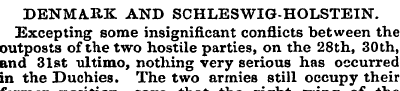
DENMARK AND SCHLESWIG-HOLSTEIN . Excepting some insignificant conflicts between the outposts of the two hostile parties , on the 28 th , 30 th , and 31 st ultimo , nothing very serious has occurred in the Duchies . The two armies still occupy their former position , save that the right wing of the Danes has made a retrograde movement , viz ., their brigade , which was stationed near Kochendorf , between Fleckebye and Eckernfoerde , has recrossed the river Schlei , and retired to Missunde and
Brodersbye . In short , a truce de facto exists , which will , however impatient the armies may be , \ most likely last for a lengthened period ; in fact , the heavy rains have rendered every renewal of military operations of importance quite impossible . To the north of Friedrichstadt , between that town and Stolinghausen , the marshes are flooded , so that the whole of the territory north-west of llendsburg may be considered impassable for any important military purpurpose . The flat meadows around Friedrichstadt are also under water .
On the 31 st ultimo eight Russian men-of-war and a Danish frigate took their position before the harbour of Kiel ; but on the 3 rd instant that squadron was reduced to four men-of-war and one brig . Is that already the beginning of carrying out the combined threat of Russia and England , which was lately spoken of in diplomatic circles at Berlin ? viz ., that a joint note , signed by the Russian and English Ministers , had reached the Berlin Cabinet on the 4 th instant , requiring the armed intervention of Prussia in Molstein , for the purpose of restoring peace . Should Prussia decline this duty , the united fleets of the two powers arc to bombard Kiel .
The Irankfort Diet has nominated a commission to take in hand the affairs of Schleswig-Holstein . Persons who think they are well informed as to the intentions of the Diet , state that this committee will name a commissioner to proceed to Rcndsburg to endeavour to effect a reconciliation . But it is stated at the same time that the commissioner will not be well received in Holstcin . This proceeding is throughout calculated to prove a source of embar « rassment to Prussia . Seventeen or eighteen governments of the union have ratified the Danish treaty at lierlin .
The dohujne Gazvttc hns a telegraphic despatch , dated Altonti , Sept . 9 , stating that on a previous day mi action had taken phieo along the whole line of the outposts . The ; lighting wns more especially lively along the loft wing of the Srhloswig-IIolstein army . This . e . onsisting of the «) th and 11 th infantry battalions , and the first division of cavalry , was at iirat forced to fall buck upon Niidorstupel ; after which , rcinforcej nontH having arrived , tlio Danes wore thrown into disorder by thorn and pressed back to the Trccne . lufty . eight prisoners were brought into Iicndsburg , while nine wagons of the wounded of the first euvalry division arrived at lleide . The centre of the Suhlcswig-IIolstciu army has
advanced to Jagel ( near Schleswig ) , and Breckendorf ; this is , as yet , the only result of the fight . We perceive that Rendsburg was honoured last week by a visit from three members belonging to the committee of the Society for the Abolition of War . These three gentlemen , Messrs . Joseph Sturge , Elihu Burritt , and Frederick Wheeler , were induced by the representations of Dr . Bodenstedt , at the recent congress at Frankfort , to proceed there on their own responsibility , in order to prevent a further effusion of blood and to promote an amicable adjustment of the difference , by persuading the Staathalterschaft , Governmentto refer
and subsequently the Danish , the question at issue to the decision of arbitrators . They were very kindly received by the Staathalterschaft , who listened to their views with attention , but were unable to give them any satisfactory reply , seeing that they expressed their readiness to submit to any peace which is based on the rights endangered by the conquering desires of the Danish mob at Copenhagen . With this reply the friends of peace were compelled to depart , after having been hospitably entertained by the Government . They have since gone to Copenhagen , on the same mission , but we have not heard the result of their visit .
Untitled Article
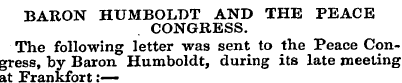
BARON HUMBOLDT AND THE PEACE CONGRESS . The following letter was sent to the Peace Congress , by Baron Humboldt , during its late meeting at Frankfort : —
" to the president and members of the peace congress . " I regret so much the more that my personal position and advanced age , which warns me to complete what work I have commenced , should hinder me from assisting at a meeting having so noble an aim in view , as it would have afforded me the gratification of coming into close contact with so many men distinguished for talent and humanity . I have already -verbally expressed this regret , a few weeks ago , when I had the pleasure to see Messrs . Henry Richard and Elihu Burritt , and Visschers , and to converse with them on the probable influence which your society may hope to exercise .
" The general peace which our Continent has now so long enjoyed , and the praiseworthy efforts of many governments to avert the oft-threatening dangers of a general European war , prove that the ideas which so prominently occupy your minds are in accordance with the sentiments called forth and diffused by the increased culture of humanity . It is a useful enterprize to inspire such sentiments in the commonwealth by public conferences , and at the same time to point out the way through which wise and sincere Governments may , by fostering the progressive and legitimate development and perfectibility of free institutions , weaken the long-accumulated elements of animosity .
" How much mildness of manners and an improved order in the organization of states have confined within narrower limits the wild outbursts of physical violence , may be seen by comparaing the first middle ages with modern times . The whole history of the past shows that , under the protection of a superior Power , a longnourished yearning after a noble aim in the life of nations will at length find its consummation . Has not the disgraceful legislation , conniving at , yea , encouraging the infamous system of slavery and the traffic in human beings , at least on our Continent , and in the independent states of former Spanish America , yielded to the united efforts of the better part of mankind ?
" We must not , then , relinquish the hope that a path will open by which all hostile divisions and contracting jealousies will gradually disappear . The whole history of the world teaches , to use the expression of a statesman long departed , ' that the idea of humanity becomes in the course of centuries ever more visible , in a more enlarged acceptation , and proclaims its animating power . ' " Inspired with these hopes and wishes , honoured men , I beg to commend myself to your kind remembrance , &c , "Alexander Von Humboldt . " Potsdam , August 20 . "
Untitled Article
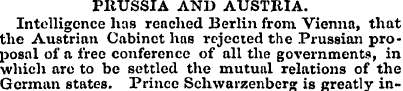
PRUSSIA AND AUSTRIA . Intelligence has reached Berlin from Vienna , that the Austrian Cabinet has rejected the Prussian proposal of a free conference of all the governments , in which arc to be settled the mutual relations of the German states . Prince Schwarzenberg is greatly indignant that his lost note has been regarded as a sign of the Austrian Government ' s return to reason and a conciliatory spirit , and intends , in his next letter , to give a signal proof that his cabinet is now as wise as it always was . He will insist upon referring the
affairs of Germany to a plenum , a project which cannot be carried out , partly because all the princes connected with the union , even Brunswick , have declined , with Prussia , the Austrian invitation to Frankfort ; and partly because France and England have declared that they cannot acknowledge any political body ns the central organ of Gormany in which Prussia is not represented . The Duke of Brunswick , whoso adherence to the union has hitherto been uncertain , has sent in a definite declaration of his faithfulness to the engagements of May liG ,
The Austrian Government has borrowed the small sum of £ 700 , 000 sterling of certain bankers at Hamburgh and in Berlin cm the security of the national domains *
Count Munster has left Berlin for St . Petersburg , on a special mission . The Prussian police are very active in finding out dangerous political persons , as the following instance will shew : —Towards the end of last month Herr von Lindenau , the Police-director at Treves , accompanied by another agent , proceeded to the summer residence of a veteran of the late grand army of Napoleon , who smilingly receivin g ^ them , said * 'I guess the purport of your visit , gentlemen . You are anxious to possess yourselves of M . Ledru Rollin . " ** Such indeed is the
object of our official visit to you , having been informed of that gentleman being in your house . " The old captain , scarcely master of his temper , told them that his barber having met at his residence a stranger , with whom he spoke French , and evincing great curiosity to know who he was , he ( the Captain ) wishing to mystify him , told him , in confidence , that the stranger was no other person than M . Ledru Hollin . We can easily guess the channel through which the Prussian police became acquainted with this state secret .
Untitled Article
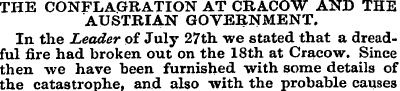
THE CONFLAGRATION AT CRACOW AND THE AUSTRIAN GOVERNMENT . In the Leader of July 27 th we stated that a dreadful fire had broken out on the 18 th at Cracow . Since then we have been furnished with some details of the catastrophe , and also with the probable causes of it . It appears that the fire broke out at one o ' clock p . m . in Krupnicza- street , situated in a northwestern suburb of Cracow , and , the wind being in the west , the lower mills and upwards of ten houses situated in the direction of the wind were burnt down . At half-past one the house of Mr . "Wysocki ,
situated at the corner of Glemboka-street and of the Plantations , * at a distance of 2000 paces from the seat of the first outbreak ( and in a southern direction from it ) , at once burst into flames . At a quarter to two flames were seen issuing from the Polytechnic Institution , situated in Golembia-street , as well as from the palace of the Archbishop in Francis-street , and Wielopolski ' s Palace , to the imminent danger of the University , the Jagellonian Library , and the newly-established Museum ; but , owing to the great courage and zeal of the students of the University and of the high school , headed by their professors , those
latter three noble edifices were saved , though at once on fire at four different points . At two o ' clock all the houses of Szeroka-street , with the Dominican Church , and Grodzka- street were in flames ; as also were several houses in an eastern direction between the plantations and the bridge , communicating with the suburb of Kazimierz . The fire at the Polytechnic Institution communicated itself to the buildings containing the printing-office and the lithographical establishment of the university , as well as the church of the United Greeks . At a quarter past two the Franciscan Church , with all its extensive buildings ,
took fire . The Dominican Library and the Convent were at the same moment a prey to the devouring element . At a quarter to three the butchers' stalls , situated behind the Dominican Church and Convent , caught fire ; so likewise did five streets , viz ., Bratskastreet , Grodzka-street , Vistula-street , Stolarskastreet , and Golembia-street . At three o ' clock every house in the last-meniioned street was the prey of the flames . The library of the University in St . Ann ' s-street was saved , but all the other houses in the same street were reduced to ashes . At that moment the confusion and the lamentations of the people at the sight of the churches being consumed element soul
by the raging were a -stirring spectacle . At the same hour St . Joseph ' s-street , and in it the church of the same name , as well as the cloister of the nuns of St . Francis , were in flames , At five o ' clock all the most costly shops in Grodzka-street were blazing . At seven o ' clock the students of the University were most zealously endeavouring to extinguish the fire of the palace of the Archbishop . At eight o ' clock in the evening all the houses and public edifices were burning without the slightest chance of being saved , presenting a perfect sea of flame . An unceasing and fearful cracking noise of the falling in of vaults of churches and other edifices was heard during the whole ensuing night .
The conflagration , which began on the 18 th at midday , raged , during three entire days ; it was only on the morning of the 21 st that the fire was almost entirely subdued . Eleven streets , four churches , and 227 houses , were reduced to ashes by the merciless element . The number of houseless families amounts to about 1500 . Now , if we bear in mind the striking fact , that tho
fire broke out almost instantaneously with the first , at a distance of 2000 paces , and not in the direction of the wind ( for in its direction not a single house was burnt ) , and that precisely in a quarter where all the monumental edifices and scientific establishments stood , we must naturally infer that the conflagration was the result of incendiarism , and that the insignificant mills and wooden houses which were first on fire was the work of some criminal hand , merely to
Untitled Article
* The plantations are a walk with four rows of trees ocoupying the ground on which once stood the towered wall surrounding the old city .
Untitled Article
580 C !) * 3 L $ aif * t . [ Saturday ,
-
-
Citation
-
Leader (1850-1860), Sept. 14, 1850, page 580, in the Nineteenth-Century Serials Edition (2008; 2018) ncse.ac.uk/periodicals/l/issues/vm2-ncseproduct1853/page/4/
-