On this page
-
Text (5)
-
Untitled Article
-

Untitled Article
-

Untitled Article
-
Untitled Article
-

Untitled Article
Note: This text has been automatically extracted via Optical Character Recognition (OCR) software. The text has not been manually corrected and should not be relied on to be an accurate representation of the item.
-
-
Transcript
-
Note: This text has been automatically extracted via Optical Character Recognition (OCR) software. The text has not been manually corrected and should not be relied on to be an accurate representation of the item.
Additionally, when viewing full transcripts, extracted text may not be in the same order as the original document.
Untitled Article
is uppermost in the hearts of Englishmen ^ I regard it as demonstrative evidence of that undying love of political and social liberty which is now parading every country , and which ultimately will sway almost every heart ! It illustrates , likewise , the pungent truth uttered by Wordsworth , that—•• He who would force the soul , tilts with a straw Against a champion cased in adamant I " I am willing to admit that there are many zealots both in the Church of England and out of it , who
strive to fan the flame of opposition to Catholicism , merely to advance the petty interests of their party , and to promote their own selfish ends . But let such learn a wise lesson from the present state of popular feeling . " Coming events cast their shadows before !" Reaction is a natural and easy transition . And public indignation , which now rises giant-like , and utters its denunciations with the sound of thunder , and as the voice of many waters , may , ere long , turn upon those who pander to and seek to enflarae it !
Popery , decaying everywhere else , seeks to find a healthy existence in this country . French , bayonets , shame upon the misnamed Republic ! are the only supporters of the Papacy in Italy ! The Italian mind has long since thrown away faith in a delusion which has held them and their country in bondage , darkness , and moral death ! Implicit faith in infallible pontiffs and haughty priests has all but
terminated in Italy , and will terminate everywhere . The axe is being laid to the root of the corruption . Mankind -will no longer be dictated to upon pain of damnation ! No longer will priests be suffered to think for the people . The masses have at length discovered that they have mind , and that it strengthens with exercise ! And they are resolved to put forth those latent energies so long pent-up within them , and search themselves for Truth and God !—" Prejudices must be vanquished . Tyrannies must be cast down ; Slavery and all oppressions Yield the sceptre and the crown ! Samuel Phillips Day , An Ex-Monk of the Catholic Church .
Untitled Article
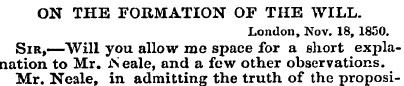
ON THE FORMATION OF THE WILL . London , Nov . 18 , 1850 . Sir , —" Will you allow me space for a short explanation to Mr . xSeale , and a few other observations . Mr . Neale , in admitting the truth of the propositions which I stated in reply to his remarks on the formation of the will , has admitted all that is contended for by those who understanding ^ assert that the will is in all cases an effect of antecedent causes ,
and is never an uncontrolled arbitrary determination . His remark that those propositions amount only to the statement " that man is not responsible for his original nature because he did not form himself , " is not just . In my reply to Mr . Neale I neither referred to the formation of man ' s original nature , nor to the question of responsibility ; but I confined myself strictly to tracing the process of the immediate causation of the will ; which was the point to which Mr . Neale had called attention in his previous letter .
Mr . Neale ' s last proposition is very different from the former one . He claims for some men , in his last letter , the power to deliberate , to resolve ; and to adhere to their resolutions in defiance of difficulties ; which is not questioned ; and this ho calls free will . But the will of an individual who is firm and persevering is no more a free will than the will of one who is weak and wavering . In all cases , as I before showed , the will is the effect or consequent of certain immediate antecedents , in part internal , and in part external , to the individual ; the internal or the external being the more influential in producing the result in proportion to the relative strength of each , in each particular instance .
thus matured , will possess the ascendant power in the productions of his thoughts and feelings , even under present influences of strong injurious tendency ; and in a rational state of society no influences of an injurious tendency which human power can control , will be permitted to exist . And to these propositions a knowledge of " the science of the influence of circumstances over human nature , " enables us to add the following : — and
4 th . That man will be made to acquire a wise good character and good health , when he shall be made to receive a good original physical and mental constitution , and to be acted upon from the commencement of his existence by favourable circumstances . Indeed , many facts , and especially the educational experiments of Mr . Owen , at New Lanark , have demonstrated that any original constitution , short of very great organic malformation or disease ,
may be matured into a wise , good , and healthy character , by the wise application of favourable circumstances , commenced at a sufficiently early period of life ; and that very much may be done even for those who are born with extremely defective organization . 5 th . That he will be caused to receive a good original physical and mental constitution , and to be acted upon from the commencement of his existence bv favourable circumstances or influences , when
society shall have acquired the knowledge requisite to produce these primary conditions for the creation of a wise , good , and happy ( or rational ) state of human
e . This most valuable knowledge is contained in " the Rational System of Society , " and is ready for immediate application to practice by the commencement of wisely regulated measures of transition , as soon as the ignorance and prejudice of the old irrational system can be sufficiently overcome , and it is the overwhelming interest of all individuals , in all classes and countries , that this change should be wisely commenced as early as possible . Henry Travis .
I will now state a series of propositions , showing the great practical importance of this question . 1 st . Man ' s character is the result of the series of modifications which have been produced in him by the mutual action and reaction of his physical and mental constitution , and the circumstunees which have been made to influence it from the commencement of his existence . 2 nd . His physical and mental feelings are produced on every occasion by his character , and bodily and mental condition or health , and the external circumstances by which ho is afl ' ueted at the time . 3 rd . His will is produced by the strongest physical or mental fooling by which it is immediately preceded .
4 th . His voluntary actions arc determined by his will . From these propositions tho following conclusions How , as necessary inferences : — 1 st . That man will be caused to act rightly , or wisely and well , at all times , when ho shall bo made to will rightly or wisely and well at all times . 2 nd . That ho will bo caused to will wisely and well at all times , when ho shall be made to think and foul wisely and well at all times .
Hrd . That ho will bo made to think and feel wisely and well tit nil times , when ho shall bo caused to acquire a truly wise and good character and good physical and mental health . ( For his constitution , when
Untitled Article
WANT OF A MONEY THE CAUSE OF WANT OF EMPLOYMENT , AND THE WANT OF E HPLOYMENT THE QUESTION OF THE DAY . Sir Robert Peel ( examining Mr . Salt before a committee of the House of Commons ) : — " Do you mean to say that you would issue money till every man in Eng-land was employed ? " —Mr . Salt : " 1 do . " 8 ir Robert : " You mean to assert that plenty of paper money would cause employment for all men out of work ? " —Mr . Salt : I do . " Faulkner-square , Liverpool , Oct . 27 , 1850 .
Sir , —" With every respect for the educationists with whose exertions I sympathize , I must still maintain that there is a previous question to be settled , and that is , " The Want of Employment Question ?" We have first to remove that most unaccountable and appalling sight which meets us at every turn—that sight which Carlyle states to be the saddest sight on the face of the earth— " A man willing to work and asking for leave to toil , and no one granting his request . " To set every man in England , who is willing to work , his task , this is tho question that must forthwith be settled , or it will settle itself in a manner that will make us , at some future day , bitterly repent that we did not apply a more severe logic to our philanthropic enthusiasm . I put it to the friends of
education , then , whether , in the present uncertain , perplexed , harassed state of working-men , who feel that employment is precarious , that at any moment they may be dismissed to utter ruin and privation , that even when in work their wages do not suffice to find them in the commonest decencies of life , and the most obvious requirements of civilization , —I say , whether to educate them to elevate their feelings and to refine their tastes , and to make their sense of their deficiencies in elegancies , luxuries , and comforts more acute , to sharpen their feeling of the debasement of long hours of labour , is not a refinement of cruelty . To set every man in England to work , willing or unwilling , that is the problem . Settle that and education comes of itself ; it would find its own funds .
of all things more ample ? Out of what fund , then do I propose this superabounding wealth ? What Aladdin ' s lamp have I discovered ? Simply this : to the immense stores of raw material , of which the earth under our feet is composed , I apply that inert and useless power now lying in the million of strong arms who are asking for work , and not getting work . The agent is paper money — an expansive currency , one which would encrease with an encreasing population , and an improving population , is the simple remedy .
To illustrate my meaning of applying labour to raw material to produce wealth let me take the case of the cottages in which working men live . They generally consist of two rooms below and two above , and the whole family sleep in two upper ones , and the consequences , need not be alluded to further . What is a cottage ? reduce it to its raw . material , and what do we come to ? Brick-clay , limestone , flagstone , roofing slate , and timber . Now , if we have brick-clay by the square mile , limestone in mountains , flagstone in millions of cubic yards , roofing-slate
stored up in the lofty ranges of Snowdon , and whole degrees of the earth s surface covered with timber , and if , in addition to this raw material we can count on millions of men , willing , for wages , to work this clay , flag , and slate , &c , into cottages twice the size of those now in use , I ask the educationists , and the Socialists , and the financial reformers , and the Chartists , why , if there is no want of raw material and no want of labour—are not working men lodged in more convenient and larger cottages ? What is true of lodging is equally applicable to fuel , raiment , furniture , and luxuries even of the highest
description . I must reiterate that it is the want of a circulating medium ; it is our foolish worship of gold , which we make , by foolish laws , the test of all value , that is at the root of our desperate condition . The symptoms that this is the cause are plainly shown to us in the panics which devastate our homes , and ruin ourselves and friends , and drive hundreds of thousands of working men into compelled idleness .
If this letter meets with approval , and I fear its length is getting beyond the limits you allow , I will write again and attempt to show the educationists , and the Socialists , and the emigrationists that money is the bridge over which they must pass to attain their objects ; that we must follow the example of physicians , -who , before they apply remedial , measures , first set themselves to resist the tendency to death . In our social condition the want of employment is the | moribund symptom . —I remain , Sir , your obedient servant , James Haiivey .
To bo brief , and to show your readers what I am aiming at , without further preface , I maintain that it is tho want of a money which lies at tho root of everything anomalous and unaccountable in our condition . To gold money , to money made of gold—the scarcest and most difficult to attain of all the products of the earth—I attribute the evils that oppress us , the leading symptom being the encreasing wealth of tho wealthy , and the encreasing poverty of the poor . The Socialists have set themselves to discover means how to distribute the wealth that society shall
muke , fairly and honestly , among its members ; but I maintain that the money reformers have an easier and less invidious task before them—namely , how to encreaso the fund of wealth—how to make tho rich richer , and tho poor less poor ; and this , not by interfering too much with the present arrangements of society , but merely by adding to the fund of wealth , out of which tho rich would take a larger share , and the poor a larger share also ; for , I suppose , we would none of us object to the working man having a larger cottage , better food , more leisure , and more enjoyments , upon the condition that the rich would be still richer , their luxuries more exalted , and their stores
Untitled Article
FUTURE RETRIBUTION-. Sandon Bury , Nov . 20 , 1850 . Sir , —A correspondent , styling himself an Unitarian , enquires where I found my " version of tho Unitarian view of future retribution ? " 2 n reply , I beg to inform him that my idea of their belief on this subject was gained from having heard Unitarians both avow and defend it , and from my never having known any other belief than that of remedial punishment either advocated by or attributed to them . They certainly do not as a sect recognize as part of their creed either eternal torments or eternal death . However , as my sphere of observation is
comparatively limited , as the doctrine of remedial punishment may be variously interpreted to a certain degree , though not to any great extent , and as the broad principle of ultimate bliss to all , secured in the case of the sinful by preparatory punishment , must form the basis , I should be happy to learn your correspondent's version of Unitarian belief respecting a future state , requesting , at the same time , that he will be more explicit when next he reserves a postcript for my especial benefit ; and trusting that , should he be one of those that think nobly of the soul , " he will also , at least , think wisely of the soul ' s destiny . I remain , Sir , yours , &c , Clara Walbey .
Untitled Article
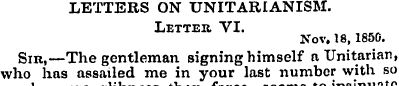
LETTERS ON UNITARIANISM . Letter VI . Nov . 18 , 1850 . Sir , —The gentleman signing himself a Unitarian , who has assailed me in your last number with so much more glibness than force , seems to insinuate that I am equally ignorant of the past history of Umtarianism , and of its present condition . Let him proveif he chooses , bv some quibble , my ignorance
, of its past history ; but let me tell him that it I am . to judge from his loud vaunts of the intellectual freedom which prevails among the Unitarians , it is he and not I that is ignorant of the present state of the sect . Is it not the habit in the Unitarian body to refuse to every man the name of Christian whodonies , or even who doubts the Christian miracles r Is this conducive to intellectual freedom ? But to my
subject . , . . „ As the spirit of mercy flows from the religious ino , so martyr and missionary heroism flows from the spirit of mercy . The spirit of mercy is the union and tho fruit of religion and love , in the sense in which St . John so frequently uses the latter word . But as
Untitled Article
902 &i ) V ybeatiiet ' . [ Saturday ,
-
-
Citation
-
Leader (1850-1860), Dec. 14, 1850, page 902, in the Nineteenth-Century Serials Edition (2008; 2018) ncse.ac.uk/periodicals/l/issues/vm2-ncseproduct1862/page/14/
-