
On this page
-
Text (2)
-
Untitled Article
-

Untitled Article
Note: This text has been automatically extracted via Optical Character Recognition (OCR) software. The text has not been manually corrected and should not be relied on to be an accurate representation of the item.
-
-
Transcript
-
Note: This text has been automatically extracted via Optical Character Recognition (OCR) software. The text has not been manually corrected and should not be relied on to be an accurate representation of the item.
Additionally, when viewing full transcripts, extracted text may not be in the same order as the original document.
Untitled Article
I do not know a spectacle more dismally absurd than that afforded by a number of poor persons coming up to be " excused" from paying their poor-rate . I have seen them waiting by scores . Living at the confines of " independent" industry and destitution , to pay their rates would just have tilted them over the e dge of that precipitous boundary . Make them pay their rates , and by that draft on their slender means you convert them into paupers , but you cannot entertain them as paupers until they have parted with all " property " —with any little freehold cottage , any humble heirloom , any stick of furniture ; and then you
qualify them to be permanent burdens on the rates . You forgive them their rates ; an act which is in itself a sort of negative " out-door relief . " So here the law that was to be so clear-working and so inexorable breaks down . Meanwhile , the crowd of applicants has been the living reductio ad absurdum , showing how we try to wring the funds for the poor out of the poor ! The incidence of our rate is manifestly unfit for a law which is to redress the alienation of our workers from the land . Let the worker come upon the land , or make him a composition for his exclusion : in other words , let the incidence of the rate fall primarily upon the land . But in the towns the land is artificially
shrunk to be a mere fraction of the available wealth : you , my most esteemed friend , have shown how the capitalist has his share of social duty in affording the means of employment : the te protection " of capital is not the sacred duty it has been thought ; the protection of natural right through the artificial arrangements of society , and the protection of social order through justice , are duties far more sacred and urgent , though late to be
recognized : in the towns , therefore , let the incidence of poor-rates fall upon the basis of wealth in such places- —upon capital or realized property of any kind . But to simplify this matter in the practical working we need make no distinction between rural and urban districts ; charge the rate indiscriminately upon land and property , and we should award tolerably even justice to the rural and urban districts—land being the grand contributor on the one , " property " of any kind on the other .
Various efforts have been made to devise some plan which may check the process of shifting the burden of pauperism from the districts which produce it , by throwing back the burden on the original defaulters ; and such a check is necessary both to a just and an effective law . No plan has yet been hit upon which could effect the desired object ; yet , in the meantime , many improvements are stopped by the want of such a check . Hitherto , however , it has been sought in too narrow a view ;
of others , would be placed so as to restrain the mischief of his example , his disorderly conduct , and his frauds , and to make some repayment ^ towards the state for the subsistence which is given to him . It is quite possible that if the provision of forced labour for the vagrant were perseveringly and judiciously applied , the state , in the long run , might derive full compensation for the cost : this part of the law , therefore , might be made to the community , as a whole , substantially self-supporting . The aid to the sick and incapable is a duty from
already fulfilled , with the disadvantages arising indifferent means among the poor and a grudging policy in the state : whenever it comes to pass that the poor suffer from bad methods of sustaining the burden , the state suffers from a disheartened condition of the industrial classes , tending to bad production , and from many unchecked sources of disease * tending to the worst sanitary regulation . All these social disadvantages , which make themselves felt throughout every class , would be superseded by a measure that should relieve ^ the poorer orders from the burden , and place it in a way to be most ably treated . In passing , I would would be
note that this portion of the Poor Law incomplete without a measure for which the recent Interments Act has admirably paved the way , rendering burial a public right . If this ^ portion of the Poor Law would not be self-supporting , there would at least be that ceconomy which consists in saving the waste of means , and the full attainment of the end proposed . In regard of the able-bodied , the law would repress mere idleness , while it would keep open for the indigent the path to subsistence through labour , without disgrace . In regard to cost , it is to be observed that such a law would be , to a great extent , self-supporting ; if , indeed , able administration could not render it entirely so .
The moral and material effects on the poor would be considerable—the poor , I mean , who do not come in their own persons under the immediate operation of the law . The poor man would be relieved , in the first place , from the payment of rates for others perhaps really less needy than himself , or from the humiliating alternative of attending before a magistrate to ask to be " forgiven " payment of rates . It would appear to be the object of the present law to multiply the occasions of shame to the poor ; the idea being , that the fear of
absolute want and disgrace are powerful incentives to industry ; but this is a fatal mistake . Nothing is so adverse to activity of any kind , including industrial activity , as the sense which popular language , with profound truth , calls being " disheartened , " and a chronic sense of shame , which is being disheartened morally , tends to lower all the standards and motives which regulate men ' s actions . The proposed law would relieve the poor man from the burden of maintaining helpless
dependents j it would free the honest man from the dread of being confounded with the vagrant ; it would free him from that necessity for parting with all his possessions—destitution being the present qualification for relief—which now makes him prefer to spend any surplus shillings , if they should accrue , than to invest them in a useful article which a fortnight ' s want of work may oblige him to sell for a song ; it would relieve him from that fear of disgrace or workhouse imprisonment which now induces him to abate his wages—dragging down
his fellows by the competition—or to engage in some of those little-needed employments which are multiplied to the ensnaring and destruction of the working classes . At the same time it would offer to him no alternative for honest individual labour as the means of subsistence , except public labour honestly executed . Public or private labour and livelihood would to him be ideas inseparably united : how little are they united under the starvation wages of agricultural districts , and the idle imprisonment of the workhouse !
pancy , the tax would operate to stimulate the production of the land , would enhance the landowner ' s property . I have said that poor-rates should be imposed on land , according to its extent in acres : the poor-rate , therefore , on waste lands would operate as a tax like the colonial waste-land tax It follows as a complement of justice that the poorrate should be payable in land itself exactly at the value of the rate per acre . If the landlord or landowner did not find it worth his while to retain the land , subject to the subsistence composition , he would have the option of releasing himself from his " trust , " by yielding the land to the State .
Upon labour , the influence of an effective Poor Law will be considerable . By offering a subsistence to the able-bodied in return for productive industry , while freely supporting the sick and physically incapable , the true Poor Law would necessarily prevent the existence of those classes of very partially productive employment , which may in the aggregate subserve the purpose of unscrupulous capitalists , but cannot return sufficient for the subsistence of the individual labourers .
Labour would . be thrown hack on useful and productive employments : the aggregate labour of the country , therefore , would produce more for distribution among the people of the country . But inasmuch as the scale of comfort must be raised , most especially among those classes that are now kept short of the necessaries of life , the encreased production would so far enhance the ratio of primary employment as compared with the secondary employment ; a much sounder and safer state of industry .
For capital such a regulation of industry would at once render the field of employment safer and more extensive . It is true that in the first instance the operation would be coercive , as upon land : it would force capitalists to promote and distribute employments , by fine on the neglect of a duty which you have so well explained ; but it would also offer the more pleasing incentive of encreased demand for manufacturing produce and for the
agencies of trade . The law would unite , and would manifestly unite , the interests of landlords , capitalists , and labourers ; it would relieve the towns of their slum populations , the fields of their vagrants and incendiaries ; it would sweep away idle tenures and antiquated covenants which debar the application of capital to land ; it would thus encrease the flow of capital on the land , with a new series of all the results previously indicated .
As the basis of social right and order , a true Poor Law would secure to every human being the right of subsistence , through labour guaranteed upon the land ; as a regulator of industry , it would prevent recourse to non-productive employment , which inveighs the poor into a delusive mockery of work , and diverts the industry of the country into fruitless toil : it would do what ' * the higgling of the market" would not do—prevent that state of things in which we see labour idle for want of work , while land is starved for want of labour , capital strays into bankruptcy for want of employment , and mouths are starved for want of food .
These considerations show the interest of me working classes in demanding a new Poor Law instead of an evasive one—of the other classes in granting it . I have not touched upon the Malthusian point ; an explanation of which I owe to another friend as well as to yourself ; but I have purposely kept that separate . Believe me , always yours most sincerely , Thornton Hunt .
Upon the land ^ the first effect of a real Poor Law would be , to restore the charge which lies upon the soil , of supporting the children of the soil ; the poor rate becoming the direct and recognized composition for that proper duty . But no duty of so primary and sacred a kind can be fulfilled without good redounding to him that fulfils it ; and in this case , we believe , speaking generally of the landlord
class , that the advantage would be not only moral but substantial . The necessity would no doubt operate as compulsion ; but by superseding the motives for removing the labourers to a distance from the land , by rendering the labourers more in heart with labour , by compelling better tenures and better systems of agriculture , by ; forcing attention to lands that lie waste or half waste under bad
occuso also has the subject of reconciling local checks with national supervision . You will not suspect me of any Absolutist inclinations , when I say , that we might take a hint from the Austrian method of levying taxes in Lombardy . The Imperial Government fixes the amount needed ; a provincial council ( at Milan ) apportions the quota to be furnished by each district ; and each district levies it according to certain fixed Jaws . Applying this plan to the Poor Fund , the Government of the country having declared the amount needed and obtained the
requisite authority from Parliament , a board in London ( which might be elected by the country ) would apportion the quota of each district according to the amount of pauperism originating in each district ; the district being charged , on the one hand , with the duty of seeing that the amount was equally levied on all descriptions of property legally liable ; and on the other hand , having the right to show cause against the amount claimed from the district , if that should exceed the fuir pro portion .
Whether such a plan were adopted , or whether the rate were merely levied at an equal level on all property according to its value , and pn land ( perhaps in different classes ) according to its extent in acres , the inducement to drive labourers away from the parish would be equally neutralized . I will now enumerate the effects which such a law , honestly and thoroughly carried out , might be made to produce , first , upon the working of the law itself ; secondly , upon the state of the poor ; and , thirdly , upon the great material sources of the social welfare—land , labour , and capital .
By the separation of the Vagrant Law it would become for the first time possible to treat the claims of the poor upon the community , and the claims of society against the vagrant , each according to its own exigencies . The vagrant , who perpetrates an offence ngainst natural as well as social law by wantonly junking himself a burden on thy industry
Untitled Article
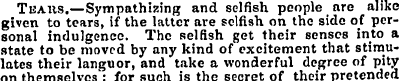
Tbaus . —Sympathizing and selfish people are alike given to tears , if the latter are selfish on the side of personal indulgence . The selfish get their senses into a state to be moved by any kind of excitement that stimulates their languor , and take a wonderful degree of pity on themselves : for such is the secret of their pretended pity for others . You may always know it by the fine things they say of their own sufferings on the occasion . Sensitive people , on the other hand , of a more generous sort , though they cannot always restrain their tears , are accustomed to do so , partly out of shame at being taken for the others , partly because they can less afford the
emotion . The sensitive selfish have the advantage m point of natural strength , being often as fat , jolly people as any , with a trick of longevity . George IV ., with all his tears , and the wear and tear of his dinners to boot , lasted to a reasonable old nge . If he had been shrewder , and taken more care of himself , he might have lived to a hundred . But it must be allowed , that he would then have been still more selfish than he was ; for these luxurious weepers are at least generous in imagination . They include a notion of other people somehow , / and aro more convertible into good people when young . — Leiyh Hunt ' s Tublo-Taik .
Untitled Article
948 2 Cf > £ & £ && ££ » [ Saturday ,
-
-
Citation
-
Leader (1850-1860), Dec. 28, 1850, page 948, in the Nineteenth-Century Serials Edition (2008; 2018) ncse.ac.uk/periodicals/l/issues/vm2-ncseproduct1863/page/12/
-