
On this page
-
Text (4)
-
Untitled Article
-

Untitled Article
-

Untitled Article
-

Untitled Article
Note: This text has been automatically extracted via Optical Character Recognition (OCR) software. The text has not been manually corrected and should not be relied on to be an accurate representation of the item.
-
-
Transcript
-
Note: This text has been automatically extracted via Optical Character Recognition (OCR) software. The text has not been manually corrected and should not be relied on to be an accurate representation of the item.
Additionally, when viewing full transcripts, extracted text may not be in the same order as the original document.
Untitled Article
disastrous to the country . Suppose the Queen were to " send for" Lord Stanley : well , he is pledged to try his hand at something for the agriculturists , labourers included , and it would not be Protection . Suppose it were the Duke of Newcastle , with such men as Gladstone , Graham , Adderley , and Cardwell : why then we should have a Government of men with some more statesmanlike aspirations . Suppose it were Cobden : we should have financial reform , extension of the suffrage , and public education . In any case , even if we did not attain at once the very beau ideal of Government , we should at least have movement , one step in the direction of nobler
statesmanship , some life , and a certain gain in the increased importance , because renewed activity , of the more popular public men . All parties spoil their own interest and defraud the public by tolerating a worthless quietism . Practically , the present Ministry is the great obstacle to all the large measures most desired by the public—amended taxation , extended suffrage , public education , poor law reform , every reform : it is true that * he next Ministry could not give us all those things ; but it could not , like the present , debar us from all . The first step in advance is to remove the universal obstacle .
Untitled Article
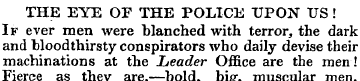
THE EYE OF THE POLICE "UPON US ! If ever men were blanched with terror , the dark and bloodthirsty conspirators who daily devise their machinations at the Leader Office are the men ! Fierce as they are , —bold , big , muscular men , armed to the teeth —( their very toothpicks are poignards)—who sleep upon cannohballs , ana squander no end of money on turpentine and vitriol—terrible as they are they tremble behind their barricade , and the muskets drop from their hands as the rumour flies tremulous from mouth to mouth " The Police has its eye upon us ! " The eye of the Police—you know what that is ? Imagine yourself furtively scaling the balcony which will lead you to your mistress ( or descending the area steps if your affections have a culinary bias ) , using the cloak of night to cover your designs—and a Policeman suddenly flashing his bull ' s eye upon you , thus " betraying your intent" while he remains all the while shrouded in mysterious darkness ! The situation is not enviable , but what are your sensations compared with ours ! When first we heard that the Police had sent for
a complete file of our journal , we were puzzled . Surely , we thought , they can't accuse us of not " moving on" ? The Austrian Embassy had also been so obliging as to send for our invaluable writing —probably with a view to the Emperor's making a grand Socialist experiment ! But this conjunction of the Austrian Embassy and Scotland-yard seemed to imply more than a calm philosophic desire to understand Socialism . We were not terrified , we were simply puzzled . At last the murder is out . In an article on the
WorWs Show and the World ' s Democracy , the last John Bull discloses all our conspiracy , and draws a picture such as must alarm even the stoical police . Our Readers are familiar with our department called " European Democracy , " wherein among other atrocities appeared Mazzini'h proposal for the Italian Loan—a proposal which has been heartily responded to . The John Bull says : — " Their note of preparation is not loud , their plan of action simple to a fault . While n portion of them , un-{ jcnerounly and ungratefully abusing the ri ghts of hoapitillity , arc labouring to disseminate their principles under the name of ' the Knropean Democracy' in this country
which lias too readily accorded them an asylum ; others have located themselves in defiance almost , of the feeble local authorities in the very centre of the Kuropcan Continent , und have established there a focus for their operations . Under the pretence of a national loan , they are levyiiitf black mail upon the inhabitants of the ' countries which they hope again to revolutionize , working upon the patriotic sympathies of some , and upon the Avholhonio fears of others , who by their contributions to the exchequer of the ' European Democracy , ' purchase security for themselves in the event , of another subversion of ihp established order of things . With the money
so obtained , which is said to amount to a largo sum a regular recruiting- service is carried on under the personal superintendence of M . tz / ini ; and , strange to say , the recruits , most of them political desperadoes are shipped off to England , where , they are to be provided witii arms , mid to be constituted into an invadint ; force . While this is going on in / Switzerland , another of the revolutionary chiefs , (» aribuldi , is collecting a legion of patriotic , kieroes on the other side of the Atlantic , consisting partl y ;\( European vagabonds like himself , and partly of freebooters ' , who have learned the art . of predatory warfare in the Mexican and Cuban expeditions . "
' 1 he mustering su < . ] j nu anny \ H of itHo ] f a portent of evil ; Iml how does it affect England ? At a first glance , the unsuspicious mind seen nothing ; those who—like the John Bull— have the tfi ent
Conservative interests to defend , see deeper , and say : — " But suppose , which is far from impossible or improbable , that , being aware of the defenceless state of Britain , ' having ascertained the chances of success from their confederates who have been residing amongst us for the last two or three years , and have actually been speculating upon * the decline of England / Mazzini and Garibaldi contemplate , as a primary object , the pillage of London , beginning with the World ' s Show in Hyde-park , where the work of riot and destruction may be commenced with the greatest ease in the confusion which awaits us—suppose that the revolutionary fraternity m Leicester-square and its purlieus have not been altogether idle among our own population , that they have the means , when the time shall have arrived , of calling to their standard the Chartist and Socialist rabble which houses in this metropolis , and the men—ay , and the women—capable of bearing arms , of the 150 , 000 or 200 , 000 Irish vagrants who , under the fostering care of the Catholic' Church , have nestled in London , being imported , it seems , in shiploads , at a shilling a-head , by ? charitable ' captains — suppose this to be the primary object of the European Democracy / what means , we desire to know , has our Governm ent taken to meet , or rather to prevent , so grave a danger ?" Ah ! Suppose ! .... The means taken by the Government to meet so great a danger are—First , a purchase , money down , of a complete set of the Leader ! By that bold stroke they mark their men . The bull ' s eye is flashed upon us , and we , who yesterday imagined our bloodthirsty schemes were maturing under the shadow of complete obscurity , suddenly find the Austrian Embassy watching us , and Colonel Mayne , from his castle in Scotland-yard , " has his eye upon us . " From this moment we eat our words ! Our language will become mild , urbane , official ; we shall tie up our arguments with red tape . We will take our view of the Condition of England through the Queen ' s Speech . The rabble-rousing words we have been accustomed to throw from behind our barricade—the vitriol of eloquence—will henceforth be exchanged for the genteelest words in the Dictionary , and the politest of statistics . Reader , you know what ruffians we have been ; henceforth see the effect of Colonel Mayne ' s bull ' s eve !
Untitled Article
THE PROTECTIONIST POLICY . Has Mr . Disraeli attained that time of life , when it becomes impossible to adapt oneself to the circumstances of the time , but one must continue to wear the costume , the thoughts , the conversation , and even the arrangements of a bygone day ? It would seem so . As the old beau believes that when the world grows wiser , it will arrive back at powder and knee breeches , so Mr . Disraeli hopes that political eeconomy of the old school is but the transition state to the older school of Protection ! And he aspires to be a leader of the nation ! Yet he is a
reader of history , and for all his gay versatility a philosopher ; and he knows that although fanciful disquisitionists have imagined cycles in the progress of the world , which bring it round to the same point , the repetition is always original ; as some singers , on being encored , give a new song . Now we do not desire to see any real principle die out , and therefore we regret to see Conservatism committing suicide in the person of Benjamin its ruler . Looking forward to the renewal of Protection in " the next Parliament , " Mr . Disraeli hints at certain provisional measures , and asks the present
Ministers to cook them up for him . He fancies that unbounded blessings would shower down upon the fanners if they were only permitted to cultivate tobacco . Under " protection" we should suppose . I '' or not to speak of the fiscal difficulties connected with a revenue of £ 4 , r >()() , ()() 0 a-year , it is obvioun that the cultivation of tobacco would be no source of proiit to the British grower . But why does the farmer not grow ilax ? That would yield a handsome profit , to the farmer , and afford liberal wages to the labourer without any disturbance to the revenue . Mr . Disraeli is indignant at the taxes on
malt , and spirits , which , no doubt , cheek the eonmimption of bailey in some degree ; but then they produce £ 1 (> , <)<)<) , <)()() a-year . For our own part , we would ratlier see those sixteen millions raised by a well-regulated Property tax ; but would the landlords prefer Unit ? Then there is the £ j ' 2 , 000 , 000 of local taxation and its unequal distribution ; but the fanner pays no more than his fair share of it in many cases not so much , through the cruel way in which the poor are driven off the land ; flooding tb (! towns with pauperism produced by land monopoly .
If Mr . Disraeli \ vishen to be a leader of Iuh < lny , he really must talus the trouble to investigate Jiving facts and convictions , and not continue to
write upon the facts and convictions of ten , twenty or thirty years back . The time is gone by for talking about war prices and protection , or even tobacco duties and the sacred oeconomy of rent . Rent is not a necessary consequence of oeconomy , but it is the consequence only of a perfectly artificial thing , —private property in land ; and a very embarrassing consequence it has become . But , to take the bearings of his position , the advocate of the agriculturists may ask a few very simple questions of Mr . Disraeli . We have free trade : Are the agriculturists content ? Are the working classes in any branch of industry content ?
If not , is it possible to go back to Protection ? Is there any prospect that a majority of the country will be won back to that conviction ? When ? Are the agriculturists , especially the farmers and labourers , to wait till Mr . Disraeli finds a Parliament ready to reenact Protection ? Are the working classes in field or shop to endure their grievances and hardships till that day , and only to " grin and bear it ? "
Is Mr . Disraeli really trying to do what he professes ? Has he taken any steps to prepare for the election of a Parliament which shall fairly represent the practical agriculturists , or any branch of industry ? Whether Mr . Disraeli understands the matter or not , we know that all these questions must be answered in the negative , and that if he is not prepared to help in solving the next question others will do it without him . Steps must be taken to secure a fair representation of industry , in all its
branches , not omitting the workers of the looms , nor the agriculturists , nor the labourers of the fields ; not omitting the innumerable traders of the middle class now hopelessly toiling against that bankruptcy which is certain for so many . A common want must unite all these classes . They will not for ever consent to " grin and bear it . " Agriculture cannot continue the struggle without some serious change for its benefit . Free trade has not sufficed , has not really affected the fundamental condition of industry . The wealth vaunted by Sir Charles Wood is true , of classes ; but it only the more
tantalizes the bulk of the nation , with the farmers and their labourers . At present there is mistrust between farmers and labourers ; and men like Mr . Disraeli , who think of elevating those two classes without removing that distrust by speaking the truth to them , are not doing the work of true Protectionists . They are dividing the bulls that the lions may continue to feed . But , as our own Fabulist said a year ago , the lions are growing old and toothless ; and some will be found to tell the fact to the bulls . Rent-receivers are not " agriculturists , " or " field cultivators , "—often the reverse ; for they are often exilers of labour and fieldscarers . Meanwhile the real agriculturists , the working farmers and the labourers , shall be told that their worst troubles are produced by artificial causes , by causes that can be prevented ; that ruinous farming and starvation wages continue by favour of causes that can be removed ; just as the working classes of towns are rapidly awakening to the same truth—that low wages , and the contest of class with class which beats down the profits of fair trade , are the fatal consequences of causes which can be removed . Once admit that fact , and they will unite to demand the removal of those causes . Having free trade we see more clearly that we do want Homething more—a something which Protection purported to furnish : will the Protectionists join in the search and the struggle for that next public good ?
Untitled Article
COMMERCIAL MORALITY . KN ( iAOKi ) in the struggle for duties gained or duties saved , the diatoms and the Dock Companies are trying to blast each other ' s character . The trial will probably not close before we go to prews , ho numerous i « the array of witnesses called on the side of the defence ; in any event , however , the spectacle is disgusting and even alarming . Say that the charge advanced by the Board of Customs is true—then we have a great trading corporation , governed by most honourable men , convicted of frauds at once petty and gigantic . If we seek to excuse hucIi practices , we must find the most valid excuse , in the present disposition of English society , to rely on mere trading motives . The question of questions in trade in , " Will it pay ? " ( min in the tent of all merit . Trading principled have avowedly become the paramount practical rule in statesmanship and in daily life . But the love of gain is not a noble motive : it can-
Untitled Article
150 sr&e ILtatjtt . Satdroav ,
-
-
Citation
-
Leader (1850-1860), Feb. 15, 1851, page 150, in the Nineteenth-Century Serials Edition (2008; 2018) ncse.ac.uk/periodicals/l/issues/vm2-ncseproduct1870/page/10/
-