
On this page
-
Text (5)
-

Untitled Article
-
Untitled Article
-

Untitled Article
-

Untitled Article
-

Untitled Article
Note: This text has been automatically extracted via Optical Character Recognition (OCR) software. The text has not been manually corrected and should not be relied on to be an accurate representation of the item.
-
-
Transcript
-
Note: This text has been automatically extracted via Optical Character Recognition (OCR) software. The text has not been manually corrected and should not be relied on to be an accurate representation of the item.
Additionally, when viewing full transcripts, extracted text may not be in the same order as the original document.
Untitled Article
classes , upon whose labours the Palace and its contents are based . One shilling is manifestly too high for vast numbers ; and as the Exposition is claimed as a national work , surely arrangements should be made that the most numerous class in the nation should participate in the enjoyments and the benefits which it offers on every hand .
Untitled Article
NATIONAL UNITY . National Unity , in its social and political consequences , is both problem and benefaction in its statement and results . George Dawson has rendered a public service by taking up this subject . * Since the days of Charles Reece Pemberton , no lecturer has combined so many qualities of oratorical excellence and intellectual attraction . Not only has George Dawson mastered that difficult artthe art of restating with popular power the deep truths of the recluse thinker ; also a thinker himself , he has not less felicity in reporting his own
discoveries . What such a man sees touching nationality—the salutary teacher to men of pride in public life—is worth pondering over . Nationality was , once , more a truth among us than now . But sick and disabled in these days , it is necessary that some authoritative man should say to this « ' bed-ridden truth , get up and walk . " Of nationality , meaning by it organization of action and sympathy of growth , interest , and progress , where do we find any in England ? Not in the Church , nor Dissent , nor corporations , nor guilds , nor schools ? Excellent Individualism may run us to death unless we wed it to a wise Unity . While we unite by accident we are like peas in a bushel held
together only by the sides of the measures . Instinctively we evoke national unity in public danger—we boast it in diplomacy—we thus recognise its merit and value ; we should therefore seek it in life . The germ of nationality is the family . Intense and enlarged family life is the type of nationality . Its organization of affection rises above individuality . As in the family we catch the accents of our parents and the temper of our relatives , so in the nation we catch the thoughts of our great men , and accumulate the powers of generations . Inherited and incommunicable traits belong to all peoples preaching the family nature of nations .
The problem George Dawson developed is one upon which the public may usefully pause—namely , to conceive the family idearightly , to realize it in the home and expand it in the nation—and to accept it , not as a fact merely , but a law of development . To this end all should study and work ; this end we must strive through nationalized land , a radically reconstituted Parliament and Universal secular education , and what else shall command it . We are but quoting scraps of our friend ' s excellent lecture ; and glad are we that the noblest of French modern ideas has an independent birth among us , and is being so ably translated into English public opinion .
Untitled Article
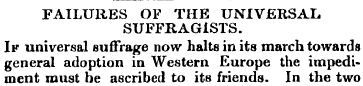
FAILURES OF THE UNIVERSAL SUFFRAGISTS . If universal suffrage now halts in its march towards general adoption in Western Europe the impediment must be ascribed to its friends . In the two leading countries universal suffrage meets with a reception which would insure for it perfect success if its friends knew , on the one hand , how to win for it the confidence and affection of the great body of the people , and on the other , how to concentrate their forces into one simple and practicable attack upon the opposing forces . In France the position of universal suffrage has become very remarkable . It has there been tried in the election both of National Parliament and of the chief magistrate ; and if , in neither case , its decision was not the best that might have been made , it did at least prove itself to be not hostile to order , nor dangerous ; on the contrary , if a fault is to be found , it was that in the working , universal suffrage proved to bo too negative and merely harmless . Acting upon a very common kind of presumption , not the less fondly embraced because it is unsupported either by argument or experience , the speculative adherents to the Government for the time being , conceived that they should strengthen their position if they could restrict the possession of the suffrage to the middle class and the portion of the working class more immediately connected with property or trade ; excluding as much as posnible the working men , properly so called . They succeeded in that restriction ; but now , even before
it has been practically tried for the first time , their hearts fail them ; they find that the mi ddle class offers a field more convenient for intrigues , and that instead of having the nobler , but comparatively easier , task of attempting to satisfy a nation , they have to fight as one amongst a number of contending factions which , different as their political faiths may be , are united against the republic and the Government created by that republic . The natural and effective way of meeting and overbearing those combined intrigues would be an appeal to the nation at large ; but the party of the Government has precluded itself from that appeal by disfranchising the nation at large . There can be no doubt that the party of the Government would give the world to recover that national sanction which it has
thrown away ; but probably a very serious difficulty presents itself towards recovering or exercising that sanction : it is not at all certain that the bulk of the people cares to use the franchise . Now , why is there that indifference ? The Times presumes the same difficulty to exist in England , and , it must be confessed , that the apathy so very generally exhibited by the great bulk of the working class towards the agitation for universal suffrage , goes far to confirm that presumption . If the millions excluded from the franchise in England , had been induced to feel
much interest in the matter , the numbers contributing their pence to the agitation would not be told by a few thousands . The Times , upon the whole , a tolerably correct reflex of the day , has , in its off-hand manner , virtually admitted the feasibility of universal suffrage , or " going to the circumference" in extending the franchise , so that the field would be open with no very obstinate resistance to any active and determined agitation of the subject . But while the universal suffragists are attempting to revive the movement , and are really making converts , the nation will stand by , passive and unconcerned .
The reason for that unconcern both in France and England we take to be th / same ; in both countries the leading advocates of a national franchise have neglected to associate with it the idea of material improvement for the people . In France the Social Reformers did not succeed in preventing M . Marie from palming off his dishonest juggle of those national workshops which must have been intended to bring Socialism and public work into discredit . He succeeded the more readily because the Socialists of France , each
section intent upon proposing some system , had not agreed upon any plan for applying the broad and simple principle , which is at the foundation of all their doctrines , that of concert in productive employments , to the immediate and material improvement of the national condition . Excepting for some remote and contingent future the French people had not been made to feel that it would be any the better for Socialism ; large numbers had that faith , but not the people . The people has been made to hope rather than feel that it is any better for the republic . If the Universal Suffragists of England have not had , as yet , so splendid an
opportunity as the Republicans in France , neither have they been exposed to such insidious hostilities , such treacherous alliances , and such embaraasing counterfeits of success . Thus far , with every prospect of advancement , their main difficulty appears to consist in that curse which hangs like a doom over all agitations—routine . Nothing would so far contribute to inspire , in the bulk of the people , a belief that the charter would promote their immediate and material benefit , as to see the Chartist machinery rendered practicably available in obtaining for the bulk of the working classes such material benefits as are attainable even before the enactment of the charter . The Social
Reformers , indeed , have been led to understand that such valuable help would be extended to them , and the augmenting interest felt , especially by the north , in the experiment of resuscitating ; Chartism , shown that they still watch with hopeful expectancy the attempt of the Universal Suffragists to extricate themselves from that spirit and habit of routine which has so greatly narrowed their sphere of influence and activity .
Untitled Article
THE PROGRESS OF ASSURANCE . THUS rilOFESHIONAL J-IFH AHHUUANCK COMPANY . " Wbke Life Associations more general in England there would be no workhouses ! " Such was the exclamation of an eminent London banker . It was a great recognition on the part of a commercialist of the advantages of concert and cooperation . An amount of poison which would inflict immediate
death becomes innocuous when administered in infinitesimal doses to a number of individuals ; and the ills and accidents , the risks and mischances of life may be rendered comparatively harmless if people would but seek to bear one another ' s burdens , to share the risk , and to spread the given amount of ill over a large surface of human beings . Competition makes one man and destroys another ; while Concert brings good without the alloy of evil . It was the partial recognition of this principle which originated the Tontine , and it was its further application which led to the most beneficent institutions of civilized life—Associations for
Assurance . The interests and welfare of the whole community are promoted by Life Assurance . Economy forethought , prudence , industry , perseverance , self-sacrifice , and all the qualities which most distinguish and ennoble a man , are called into action . An affectionate solicitude for wife and children is fostered and encouraged , a spirit of independence is evoked , and a freedom from galling humiliations is secured to the assured and his survivors .
We do not mean to say that a simple assurance for the purpose of securing the payment of a certain sum at the death of the assured is to procure all these advantages ; but the simple principle of Life Assurance was the practical commencement of all those blessings which concert and combined operation are capable of affording . Daily is the system becoming extended , and we have it now applied to ensure remuneration for loss by fire , life , hail , storm , and tempest , breaches of trust , railway or other accident , paralysis or any disease which incapacitates , the rent of houses and other property ; and even the collection of tithes is secured—one
society making it a feature in its business to take the disagreeable process out of the hands of the clergy . We have before remarked that the majority of assurances in this country are effected for temporary rather than prospective advantages—for a man ' s own immediate benefit rather than for that of his survivors . The unpopularity of whole-life assurance has arisen from two circumstances : the want of immediate advantage to the assured , and a
want of facility in the payment of the premiums . The old offices were exceedingly stubborn in this respect . They would admit of no modification . As long" as the premium was paid the consideration would hold good ; but when Fortune frowned , and you became a defaulter for one year , your whole interest ceased . It was evident the uncertainty of being able to keep up the premiums deterred many from assuring , and the old offices being forced to observe the letter of their deed of settlement , could offer no remedy .
We are speaking of what was , rather than what is . The time has gone by for objections of this nature . The Professional Life Assurance Association was the first to thoroughly popularize the subject of life assurance , and to bring its immediate and prospective advantages within the reach of every member of society . One of the first objects of this association is to protect not only the representatives of the assured , but also to assist and provide for the assured himself whilst living , should pecuniary difficulties and consequent indigence befall him . To enable the Company to do this , a fund is formed of one-tenth of the entire annual
profits of the association . But the advantages do not end with the life of the indigent assured , they extend also to the widows and orphans of all those who have paid five years' premiums on their policies but who may have been compelled to resign them from inability for further payment . There are , however , instances on record where assurers have done all in their power to provide for their families . They have even died with
their policy in full force . But , alas ! the assurance money as soon as paid by the company has gone to liquidate the debts and liabilities of the deceased , and the widow and orphans have been left penniless . For such the " Professional " especially provides . Independently of the assurance money due on the policy , the survivors of the assured are eligible candidates for the fund , and in their hour of need find a provision as beneficent as it is novel .
Another important and original advantage offered by this company is the formation of a Table , under which persons may be assured not only for their whole life , but for un annuity in the event of their being at ' any future time afflicted with paralysis , blindness , insanity , accidents , or any other bodily or mcntul visitation , which may render them permanently infirm and helplcsH .
Untitled Article
May 31 , 1851 . ] « tp * & * && * t + 513
Untitled Article
* In a lecture delivered on Thursday , at the Hums lavcrn , to an audience not confined to local hearers .
-
-
Citation
-
Leader (1850-1860), May 31, 1851, page 513, in the Nineteenth-Century Serials Edition (2008; 2018) ncse.ac.uk/periodicals/l/issues/vm2-ncseproduct1885/page/13/
-