
On this page
-
Text (3)
-
Untitled Article
-

Untitled Article
-

Untitled Article
Note: This text has been automatically extracted via Optical Character Recognition (OCR) software. The text has not been manually corrected and should not be relied on to be an accurate representation of the item.
-
-
Transcript
-
Note: This text has been automatically extracted via Optical Character Recognition (OCR) software. The text has not been manually corrected and should not be relied on to be an accurate representation of the item.
Additionally, when viewing full transcripts, extracted text may not be in the same order as the original document.
Untitled Article
The . financial results of this novel application of assurance are most cheering to every wellwisher of the cooperative cause . At the first meeting of the " Professional /* held in 1848 , it was announced that in eleven months from its commencement 101 policies had been effected , giving an annual income . of £ 1015 , By their second meeting , in 1849 , 171 additional policies had been granted , the income ?
having increased to £ 2403 , when it was also announced that the whole of their preliminary and other liabilities had been discharged , leaving the association only its current expenses to provide for . At the third annual meeting in 1860 it was announced that 82 policies had been granted in three months , producing an additional income of £ 1000 ; while at the fourth meeting , held in the
present year , it was announced that the total income of the Company derived from premiums , after deducting assurances lapsed by death , amounted to upwards of £ 1 J , 45 O ; that the total number of policies issued was 1155 , and the total sum assured £ 345 , 513 . It is but an act of justice to reiterate what has been stated b y the Directors at each of the meetings—that to tne indefatigable and wellaimed exertions of their resident manager and actuary , Mr . Edward Baylis , is the Company indebted for the elucidation of principles which have led to so great prosperity .
It was naturally to be supposed that the advances of the younger companies , with their immensely superior and popular advantages , would excite the ire of the ancient corporations ; and one of the most imposing arguments adduced against the juveniles was their want of paid-up capital . But nothing can be more absurd and untenable than such an objection . The want of paid-up capital is absolutely the secret of the power of conferring these popular advantages . Let us see the working of the " Professional . " It has 1400
shareholders ; its capital is £ 250 , 000 ; it calls for 10 s . per share only . Now for the result . The second year of its existence it pays off the whole of its liabilities . The third year—the year when the cholera held its devastating sway—• when life assurance offices were trembling in every direction — it announced that its total losses from the commencement of the company , amounted to £ 3272 19 s- lldf , which claims had all been met and satisfied , still leaving a large credit to the pre - mium account , exclusive of a sum accruing to the company by the death of an annuitant ; and in adtion to this a dividend of five percent , was declared
on the paid-up capital . We here see that not only would the subscription of the whole capita ] have been useless , but that not even that which was paid up \ yas required to liquidate the annual claims on the company . But the paying up the whole capital would have been worse than useless . The interest on £ 250 , 000 at five per cent , would be £ 12 , 500 , and this enormous sum would have to be annually provided for out of increased premiums charged to the assured , and before one atom of profit would have accrued . The " Professional " has , then , all the advantages of a large capital , without having to pay interest for it .
But the fallacy of a large paid-up capital is now placed beyond a doubt . One of the oldest companies in London even now groans under itH plethora in this particular , and is absolutely going to Par- ! liument for new powers to get rid of its surplus money . Six per cent , on a million wholly incapacitates it for competing with the popularised offices of modern times . The advantages of these new features of assurance
it is impossible to extol too highly . They disarm ever y objection which can possibly be urged against life assurance . When vve consider that the payment of Is . a week would insure £ 100 to n man ' s family , it is impossible to admit the objection that they cannot afford to ins are from any but the very poor . People are obliged to provide for their rent , and their tuxes are not to be readily evaded , A very little more perseverance iu economy would secure themselves and their families from absolutu
want . And yet bow many a man lit \ s down upon Him bed and dies , leaving his wife and children not only destitute , but absolutely entailing upon the penniloKH the charge , of his ( sepulture . Nothing than this oan be more horrible to hit ) survivors , nothing more dighonouriiblu and ignominious to himself , llcttoi- would it bis to train your family up to penury and want—bettor to inure thorn to the hitterncHH of povorty—better to treat them with uniform contumely , and let thorn become lined to the iriNiilt and scorn of the world—than to surround them with all thu anplianoeH of wealth , to
make them look upon luxuries as pecessary to their being , to hang their happiness on the slender thread of your own existence , and , when it snaps , to cast them upon the world as beggars !
Untitled Article
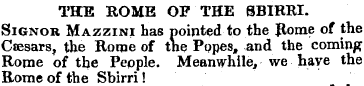
THE ROME OF THE SBIREI . Signor Mazzini has pointed to the Rome of the Caesars , the Rome of the Popes , and the coming Rome of the People . Meanwhile , we have the Rome of the Sbirri ! What a triumph for the Absolutist party and the French Conservatives ! They are the patrons of a wretched Government which is afraid of hats and beards ; and of an army of brave Frenchmen , whose chief ridiculously prohibits " sticks of suspicious forms . " They cannot govern unless their subjects shave smugly j unless " wide-awakes ' * be prohibited : unless the whole population be disarmed ; unless the press be utterly extinguished j unless the people smoke tobacco and dabble in lotteries ! They cannot exist without a strong force pf French janizaries ; and even then they work out their existence in fear and trembling . They declare themselves unable to keep the peace without sbirri or constables ; and the sbirri , by their provocations , are constantly breaking the peace . They and their satellites declare that" a faction * ' exercises a reign of terror over the peaceable population \ to wit , the faction is the Roman people j the peaceable population—the sbirri , t he spies , the Holy Office , and the holv French janizaries . The Unipers , papal organ
in chief , says , that the state pf things exjstipg before the publication of the edicts of Genieau and Antonelli , was " a secret society coming out from its dens , and governing , in the name of the poniard , a terrified population . " Shall we answer with a tu quoque ? Shall we say , that the present condition of things is a horde of public banditti , coming out from its strongholds , at Paris , Naples , and Vienna , and governing , in the name of the stick , the guillotine , and the ba yonet , an enraged , but long-suffering People ? It is so .
The Papal Government is detested at Rome . The fact is patent to all Europe . Smoking seems q small thing to abstain from , but it must be a powerful motive , a strong sense of the duty of de- > votedness , which will make a whole people submit to small inconveniences . Would the Romans cease to smoke if they loved the Pope and the Austrian ? Not a whit of it . The anti-smoking phenomenon is enough of itself to show that the people are hostile to the rule of the Lambruschini , and Antonelli , and Gemeau , and the whole governmental frame of things ; in fact , that the Roman nation has gone over to the Constitutional Opposition , and has reduced the de facto Government to a " faction . "
But they show their detestation in other and less unquestionable modes . The stiletto is a sure weapon , and that the French know by this time . The Roman is a stout antagonist , and he has proved it many a time within these two years . The whole under-current of social existence sets strongly against the Vatican , and down it must go , in spite of the hypocrisy of Palmerston , the faithlessness of Louis Napoleon , and the ruffianism of Austria . Mark ! it is the Papal Government , not the Catholic religion , the Lambruschini and Antonelli , of whom we write . The disenthralment of Rome
from the temporal rule of such men is a necessity for the advance and security of civil and religious liberty , and free and religious developr rnent all over JSurope , us well as all over Italy . The Cardinal party are doing all they can to der stroy the Popedom , as well as the territorial Papal Government . The state of things under their rule is an abomination in the eyes of man ; it must fall by its own weight ; and it j « a disgrace to Kngliuh statesmen that they tacitly tiutfer , —an infamy , if , u « we Huspect , they actively support , the occupation of Rome by the Cardinals and tho Africans oi France .
By their own acts—tho win of the Cardinal r Policemen , the Home of the Sbirri , u rank pago in the unnuls of the nineteenth century , munt moou have nn end . It will di « by its own luuul ; mu \ , like the King in UamM , drink of tl ) ut poison which it bad prepared for nn imsuUed undopprtwqed people .
OOFl'Mll ! AND TKA . What mysterious principle- is it which regulates tho conduct of Government towards the nhopkcepf ing interest ? Thin is a question which we have tried to solve , but hitherto our researches have been utterly ineffectual . To hoar Sir Chnr ]«» Wood or Karl Grey dilute upon the wisdom mid humanity of allowing 1 coffeo dealens to sell chioory or burnt
parsnips instead of the genuine berry , any one would fancy that Ministers had heartily adopted the laissez-faire principle , and that , henceforth , ho tradesman would be hindered from adulterating hjs wares as much as he could risk doing with impunity . " The buyer must protect himself , " aaid Earl Grey , a few days ago , when speaking of the chicory adulterations . "Of course he must , " said Mr . Edward South , of Clerkenwell-green , a public-spirited individual , who had s « en with 4 < Jlight the success which had attended the benevolent schemes pf enterprising ehopkaeper * for supplying the publiq with * ' Real Mpcha Coflfet >} at » lw price , manufactured from ehieory afld , other nameless substances ,
Unfortunately for Mr , South , the Excise authorities have net yet extended Earl Gtey ' fi rule to the tea ; trade . They allow any groear to sell any sort of poisonous rubbish he way choose under the name of coffee ; in the purchase of tkvt article •? the buyer must proteot himself ; " but , as regards tea , the Excise authorities are sternly opposed to the slightest attempt at adulteration . Having heard that Mr . South was engaged in manufacturing large quantities of cheap tea from sloe leaves , and used-up tea leaves purchased from coffee-house keepers , they took steps to have him apprehended ip the midst of his manufactory . The officer dispatched for that purpose found him and his wife busily at work :-r ™
? ' There was an extensive furnace , before which which was suspended an iron pan containing sloe leaves and tea leaves , which they were in the practice of purchasing from coffee ^ shop keepers , after being used , Qn searching the place they fou nd an immense quantity of used tea leaves , bay leaves , and every description of ppurious . ingredients for the purpose of manufacturing illicit tea , and they were mixed with a solution of gum and $ quantity of copperas . The heat of the place was so excessive that the officers could scarcely remain in it , but the prisoners did not seem at all oppressed by it . The woman was employed in stirring about the bay leaves and other compositions with the solution of gum in the pan , and in one part of the zoom there was a
large quantity of spurious stuff , the exact imitation of genuine tea , In a back room they found nearly J . QO lb . weight of xe-dried tea leaves , bay leaves , and . sloe leaves , all spread on the floor drying . The inspector told the prisoners that he was a police officer , and also an inland revenue officer , and he rnust teke them into custody , together with the whole of the ingredients and apparatus for making the spurious tea . Mr . Brennan added that the prisoners had pursued their nefarious traffic most extensively , and were in the habit of dealing largely with grooers , chandlers , and others , especially in the country . The various articles produced , prior to their completion , for disposal , had the most disgusting appearance , and were evidently prejudicial to health . "
And so Mr . South and his wife are to be visited with all the pains and penalties which the merciless Board of Kxcise can infliot for merely doing that with tea , which any man may do with coffee with the most perfect impunity . We have it—the moral ! If adulteration only poisons the sources of life , the buyer must " protect himself ; " but if it poisons the sources of
revenue , then there must be more formidable protection . For the Christian poisoned with * " coffee " Sir Charles has no bowels of compassion , but when herb " tea " makes Taxes poorly , he has a perfect stomachache of anxiety , and there is no more cool philosophy of laissez-faire . Yet the same thing ought to cause some anxiety for coffee drinkers , if not as Christians , yet as taxpayers . He cannot have viewed the subject in that light .
Untitled Article
K I H fl 8 I , !• : Y ' 8 IiBCT V Jt H . Ciiaiilkh KiNusXiRV delivered a gigantic lecture on Wednesday , to the Christian Socialists and others , —vast in extent , running- to the preposterous length of two hours and a half ; most Interesting from beginning to end—heard with unabated desire to lluten , down to tho last word . Its aubjeot was the application of the Associative principle to agriculture , —and of agriculture to the Associative princip le . We do not subscribe to all bin interpretations j but , umjueslionably , if landlords would act . an he advises , —be the exemplars and trainers
of the true " gentleman" ; if property , with its duties , were held as he advises , houently in trust 5 and H \ ull clergymen would teach thp law of God as he teachon , not to jar ngainat the law of Nature ; unquestionably then apme of our institutions would be all the n » frr . To his nuin to |> i « wo mu « t advert next week j only flaying now that ho it t'xoplk'nt for dealing with tho primotftfo M lh « essential thing , with the nvatem by winch it way l )
Untitled Article
614 fl&ft * ***••*? [ SAfUllDA * ,
-
-
Citation
-
Leader (1850-1860), May 31, 1851, page 514, in the Nineteenth-Century Serials Edition (2008; 2018) ncse.ac.uk/periodicals/l/issues/vm2-ncseproduct1885/page/14/
-