On this page
-
Text (3)
-

Untitled Article
-

Untitled Article
-

Untitled Article
Note: This text has been automatically extracted via Optical Character Recognition (OCR) software. The text has not been manually corrected and should not be relied on to be an accurate representation of the item.
-
-
Transcript
-
Note: This text has been automatically extracted via Optical Character Recognition (OCR) software. The text has not been manually corrected and should not be relied on to be an accurate representation of the item.
Additionally, when viewing full transcripts, extracted text may not be in the same order as the original document.
Untitled Article
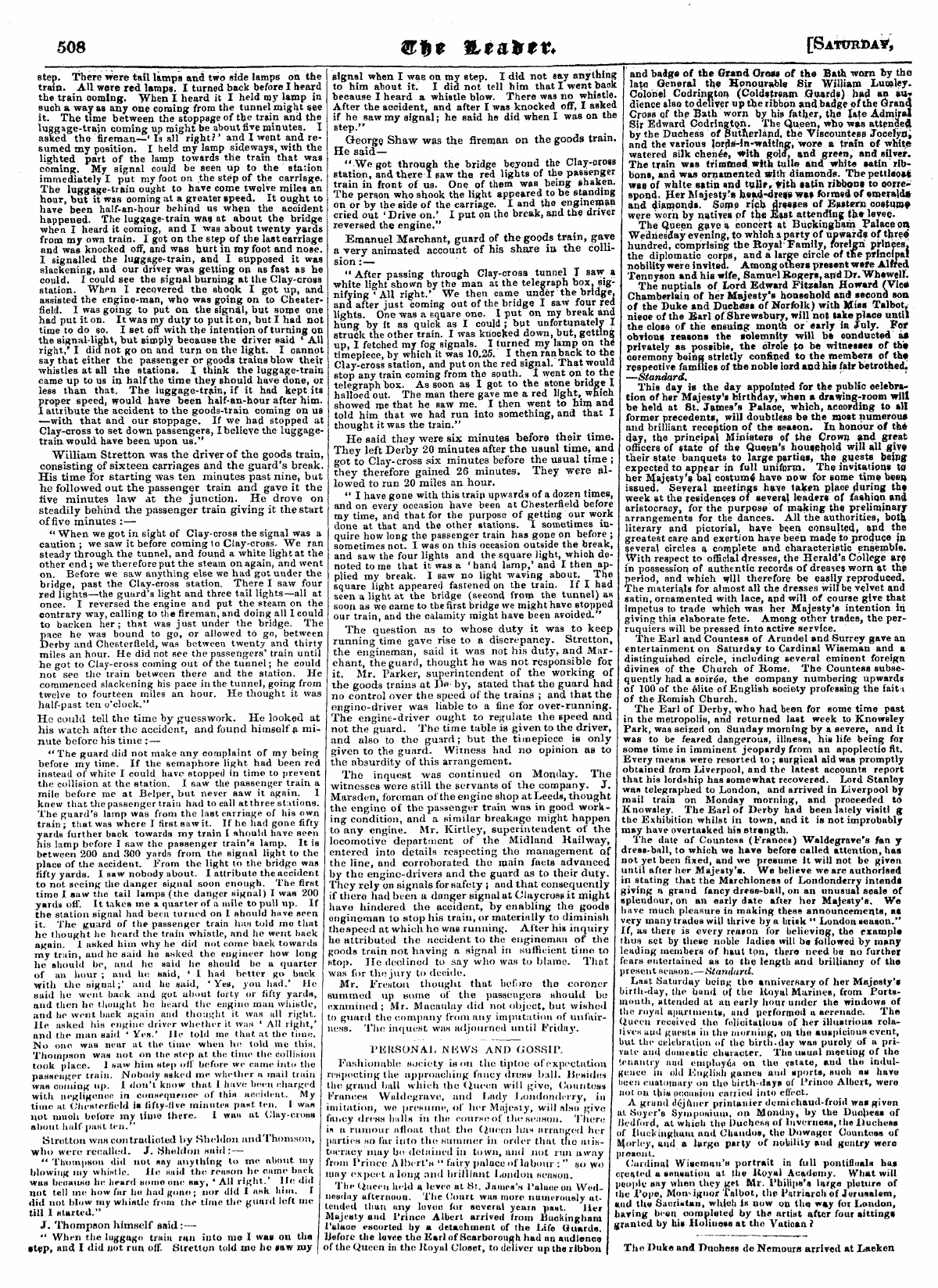
step . There were tail lamps and two side lamps on the train . All were red lamps . I turned back before I heard the train coming . When I heard it I held r » y lamp in such a way as any one coming from the tunnel might see it . The time between the stoppage of the train and the luggage-train coming up might be about five minutes . I asked the fireman— ' Is all right ? ' and I went and resumed my position . I held my lamp sideways , with the lighted part of the lamp towards the train that was coming . My signal could be seen up to the station immediately I put my foot on the step of the carriage . The luggage-train ought to have come twelve miles an hour , but it was ooming at a greater speed . It ought to have been half-an-hour behind us when the accident happened . The luggage-train was at about the bridge when I heard it coming , and I was about twenty yards from my own train . I got on the step of the last carriage and was knocked off , and was hurt in my foot and nose .
I signalled the luggage-train , and I supposed it was slackening , and our driver was getting on as fast as he could . I could see the signal burning at the Clay-cross station . When I recovered the shook I got up , and assisted the engine-man , who was going on to Chesterfield . I was going to put on the signal , but some one had put it on . It was my duty to put it on , but I had not time to do so . I set off with the intention of turning on the signal-light , but Bir oply because the driver said ' AU right , ' I did not go on and turn on the light . I cannot say that either the passenger or goods trains blow their whistles at all the stations . I think the luggage-train came up to us in half the time they should have done , or less than that . The luggage-train , if it had kept its proper speed , would have been half-an-hour after him . I attribute the accident to the goods-train coming on us —with that and our stoppage . If we had stopped at Clay-cross to set down passengers , I believe the luggagetrain would have been upon us . "
William Stretton was the driver of the goods tram , consisting of sixteen carriages and the guard ' s break . His time for starting was ten minutes past nine , but he followed out the passenger train and gave it the live minutes law at the junction . He drove on steadily behind the passenger train giving it the start of five minutes : — " When we got in sight of Clay-cross the signal was a caution ; we saw it before coming to Clay-cross . We ran steady through the tunnel , and found a white light at the other end ; we therefore put the steam on again , and went on . Before we saw anything else we had got under the bridge , past the Clay-cross station . There I saw four red lights—the guard ' s light and three tail lights—all at
once . I reversed the engine and put the steam on the contrary way , calling to the fireman , and doing all I could to backen her ; that was just under the bridge . The pace he was bound to go , or allowed to go , between Derby and Chesterfield , was between twenty and thirty miles an hour . He did not see the passengers' train until he got to Clay-cross coming out of the tunnel ; he could not see the train between there and the station . He commenced slackening his pace in the tunnel , going from twelve to fourteen miles an hour . He thought it was half-past ten o ' clock . " He could tell the time by guesswork . He looked at his watch after the accident , and found himself a minute before his time : —
" The guard did not make any complaint of my being before my time . If the semaphore light had been red instead of white I could have stopped in time to prevent the collision at the station . I saw the passenger train a mile before me at Belper , but never saw it again . I knew that the passenger train had to call at three stations . The guard ' s lamp was from the last carriage of his own train ; that was where I first saw it . If he had gone fifty yards further back towards my train I should have seen his lamp before I saw the passenger train ' s lamp . It is between 200 and 300 yards from the signal light to the place of the accident . From the light to the bridge was fifty yards . I saw nobody about . I attribute the accident to not seeing the danger signal soon enough . The first time I saw the tail lamps ( the danger signal ) I was 200
yards oft " . It takes me a quarter of a mile to pull up . If the station signal had been turned on 1 should have seen it . The guard of the passenger train has told me that he thought he heard the train whistle , and he went back again . I asked him why he did not come back towards my train , and he said he asked the engineer how long he should bo , and he said he should be a quarter of an hour ; and he said , ' I had better ro back with the signal ; ' and he said , ' Yes , you had . ' He said lie went , hack and got about forty or fifty yards , and then he thought he heard the engine man whistle , and he went back again and thought it was all right . lie asked his engine driver whether it was ' All ri ght ., ' and the man said * Yes . ' He told me that at the time .
No one was near at the time when he told me this . Thompson was not on the step at the time the collision took place . 1 saw him step off before we came into the passenger train . Nobody naked me whether a mail train was coining up . 1 don ' t know that I have been charged with negligenoo in coiiHPnumoe of this accident . My time at . Chesterfield is fifty-live minutes past ten . I wus not much before my lime there . 1 was at Cluy-crosa about half-past ten . " Stretton wnn contradicted by Sheldon juidThomnon , who were recalled . J . Sheldon said : — " Thompson did not say anything to me about my blowing my whistle . He said the reason he came back was hcoHUHO he heard Homo one say , " All right . ' lie did not tell me how far ho hadgono ; nor did 1 « sk him . I did not blow my whistle from the time the guurd left me till 1 started . "
J . Thompson himself said : —¦ " When the luggage train run into me I wa » on tha step , and I did not run off . Stretton told me he Daw my
signal when I wae on my step . I did not say anything to him about it . I did not tell him that I went baok because I heard a whistle blow . There was no whistle . After the accident , and after I was knocked off , I asked if he saw my signal ; he said he did when I was on the step . " George Shaw was the fireman on the goods train . He said" We got through the bridge beyond the Clay-crow station , and there I saw the red lights of the passenger train in front of us . One of them was being shaken . The person who shook the light appeared to be standing on or by the side of the carriage . I and the engineman cried out 'Drive on . ' I put on the break , and the driver reversed the engine , "
Emanuel Marchant , guard of the goods tram , gave a very animated account of his share in the collision : — " After passing through Clay-cross tunnel I saw a white light shown by the man at the telegraph box , signifying ' All right . ' We then came under the bridge , and after just coming out of the bridge I saw four red lights . One was a square one . X put on my break and huns bv It as quick as I could ; but unfortunately I
struck the other train . I was knocked down , but , getting tip , I fetched my fog signals . I turned my lamp on ihi timepiece , by which it was 10 . 25 . I then ran back to the Clay-cross station , and put on the red signal . That would stop any train coming from the south . I went on Jo the telegraph l > ox . As soon as I got to the stone bridge I halloed out . The man there gave me a red light , which showed me that he saw me . I then went to him and told him that we had run into something , and that I thought it was the train . "
He said they were six minutes before their time . They left Derby 20 minutes after the usual time , and got to Clay-cross six minutes before the usual time ; they therefore gained 26 minutes . They were allowed to run 20 miles an hour . " I have gone with this train upwards of a dozen times , and on every occasion have been at Chesterfield before my time , and that for the purpose of getting our work done at that and the other stations . I sometimes
inquire how long the passenger train has gone on before ; sometimes not . I was on this occasion outside the break , and saw the four lights and the square light , which denoted to me that it was a ' hand lamp , ' and I then applied my break . I saw no light waving about . The square light appeared fastened on the train . If I had seen a light at the bridge ( second from the tunnel ) as soon as we came to the first bridge we might have stopped our train , and the calamity might have been avoided . "
The question as to whose duty it was to keep running time gave rise to a discrepancy . Stretton , the engineman , said it was not his duty , and Marchant , the guard , thought he was not responsible for it . Mr . Parker , superintendent of the working of the goods trains at I )« by , stated that the guard had no control over the speed of the trains ; and that the engine-driver was liable to a fine for over-running . The engine-driver ought to regulate the speed and not the guard . The time table is given to the driver , and also to the guard ; but the timepiece is only given to the guard . Witness had no opinion as to the absurdity of this arrangement .
The inquest was continued on Monday . Ihe witnesses were still the servants of the company . J . Marsden , foreman of the engine shop at Leeds , thought the engine of the passenger train was in good working condition , and a similar breakage might happen to any engine . Mr . Kirtley , superintendent of the locomotive department of the Midland Kailway , entered into details respecting the management of the line , and corroborated the main facts advanced
by the engine-drivers and the guard as to their duty . They rely on signals for safety j and that consequently if there had been a danger signal at Claycross it might have hindered the accident , by enabling the goods ongineman to stop his train , or materially to diminish the speed at which ho was running . After his inquiry he attributed the accident to the enginemiiii of the goods train not having a signal in sufficient time to stop . He declined to say who was to blame . That was for the jury to decide . Mr . JfreHtou thought that before the coroner summed up Home of the passengers should be examined ; Mr . Macaulay did not object , but wished to guard the company from any imputation of unfairness . The inquest was adjourned until Fri < lii 3 .
Untitled Article
The Duke and Dtic-heiM de Nemours arrived at Laeken
Untitled Article
508 3 C |> * ItraJrrt . [ Saturday ,
Untitled Article
PERSONAL JNHWS AND GOSSIP . Fashionable society ia on the tiptoe of expectation rcHpeeting the approaching fancy druHu bull . JJt >» idttn the grand bull which the Queen will give , Countess Frances Witldegrave , and Lady Londonderry , in imitation , we presume , of her Majesty , will nl . so give fuiicy dreHM bulls in the course of the sc ; ihoii . There in a rumour afloat that the Queen has arranged her parties ho far into the summer in order that tuo aiintocracy may b <; detained in town , and not run uway from Prince Albcifw " fairy pulacc of labour : " so wo may expect along : ind brilliant London nennon .
1 he Queen held « leveo at 8 t . James's Puluoe on Wedlmsduy afternoon . The Court was more numerously attended than any lovet ) for several years past . Her Majesty and Prince Albert arrived from Buckingham Palace esaortod by a detachment of the Life Guards , liofore the lovee the Earl of Scarborough had an nudlenco of the Queen in the Itoyal Closet , to deliver up the ribbon
and badge of the Grand OroM of the Bath worn by the late General the Honourable Sir William Lumley . Colonel Codrington ( Coidstream Guards ) bad an au * dience also to deliver up the ribbon and badge qi the Grand Cross of the Bath worn by his father , the l&fe Admiral Sir Edward Codrington . The Queen , who waa attended , by the Duchess of Sutherland , the " Viscountess Jocelyfl , and the various Iorda-in ^ waitmjjr .,-wore a train of white watered silk ehene > , -with gold , and green , and silver . The train was trimmed with tulle and white gatin ribbons , and was ornamented with diamonds . The pettlrioti was of white satin and tullr , > ith satin ribbons to correspond . Her Majesty ?* hend-dre ** w »* formed of emerald * and diamonds . Some rich dresses of Eastern costuw * were worn by natives of the East attending the levee . The Queen gave a concert at Buckingham Palace on
Wednesday evening , to which a party of upwards of tared hundred , comprising the Royal Family , foreign princes , the diplomatic corps , and a large circle of the principal nobility were invited . Among others present tvefe Alfred Tennyson and his wife , Samuel Rogers , and Dr . Whewelf . The nuptials of Lord Edward Fitzalan Howard ( Vic * Chamberlain of her Majesty ' s household and second son of the Duke and Duchess of Norfolk ) with Miss Talbot , niece of the Earl of Shrewsbury , will not take place until the close of the ensuing month or early ia July . For obvious reasons the solemnity will b * conducted at privately as possible , the olrole to be witnesses of the ceremony being strictly confined to the members of the respective families of the noble lord and his fair betrothed .
—Standard . This day is the day appointed for the public celebration of h « r Majesty ' s birthday , when a drawing-room will be held at St . James ' s Palace , which , acoording to ftlt former precedents , will doubtless be the most numerous and brilliant reception of the season . In honour of the day , the principal Ministers of the Crown and great officers of state of the Ouepn ' s household wjll all give their state banquets to large parties , the guests being expected to appear in full uniform . The invitations to her Majesty ' s bal costume * have now for some time been issued . Several meetings have taken place during the week at the residence ? of several leaders of fashion and
aristocracy , for the purpose of making the preliminary arrangements for the dances . All the authorities , botjjk literary and pictorial , have been consulted , and the greatest care and exertion have been made to produce in several circles a complete and characteristic ensemble . With respect to official dresses , the Herald's College are in possession of authentic records of dresses worn at the period , and which will therefore be easily reproduced . The materials for almost all the dresses willbe velvet and satin , ornamented with lace , and will of course give that Impetus to trade which was her Majesty ' s intention hi giving this elaborate fete . Among other trades , the perruquiers will be pressed into active service .
The Earl and Countess of Arundel and Surrey gave an entertainment on Saturday to Cardinal Wiseman and a distinguished circle , including several eminent foreign divines of the Church of Home . The Countess subsequently had a soiree , the company numbering upwards of 100 of the 61 ite of English society professing the faiti of the Romish Church . The Earl of Derby , who had been for some time past in the metropolis , and returned last week to KnowBley Park , was seized on Sunday morning by a severe , and It
was to be feared dangerous , illness , his life being for some time in imminent jeopardy from an apoplectic fit . Every means were resorted to ; surgical aid was promptly obtained from Liverpool , and the latest accounts report that his lordship has somewhat recovered . Lord Stanley wan telegraphed to London , and arrived in Liverpool by mail train on Monday morning , and proceeded to Knowsley . The Earl of Derby had been lately visitl g the Exhibition whilst in town , and it is not improbably may have overtasked his strength .
Ihe date of Countess ( Frances ) Waldegrave ' s fan y dress-ball , to which we have before called attention , has not yet been fixed , and we presume it will not be given until after her Majesty ' s . We believe we are authorised in stating that the Marchioness of Londonderry intends giving ft grand fancy dress-ball , on an unusual scale of splendour , on an early date after her Majesty ' s . We have much pleasure in making these announcements , a * very many trades will thrive by a brisk " London season . " If , as there is every reason for believing , the example thus set by these noble ladies will be followed by many leading members of h » ut ton , there need be no further fears entertained aa to the length and brilliancy of the present Reason . —Standard .
Last Saturday beinK the anniversary of her Majesty ' s birth-day , the band of the Itoyo . 1 Marines , from Portsmouth , attended at au early hour under the windows of the royal apartment * , and performed a serenade . The Queen received the folioitulloua of her illustrious relatives mid { jucBtH in the morning , on tha auspicious event , but the celebration of the birth-day wan purely of a privute and domestic character . The uttual meeting of the tenantry and employed on the estate , and the indulgence in old Englitsli gained and sports , Buoh an have been ouatonmry on the birth-days of Princo Albert , were not on this pe < mnjon carried into effect . A grund <)< Jjuuer printanier demichaud-froirl was given at Soyer'a SymnoHiuw , on Monday , by the Duoheas of ' Ik d turd , at which the Ouches ^ of Inverness , the Duchess of liuckiiiftluiiu and Chaiitlos , the Uowuger Countess of Morley , and a largo p « r | y of nobility and gentry were
present ,. Cardinal Wiseman ' s portrait in full pontifluala has created a solution at tlitt Hoval Academy . What will people any when they get Mr . Philips ' * large picture of the Pope , Monviguor Talbot , the Patriarch of Juruaalem , » nd the Sacristan , which in now ou the way for London , having been completed by the artiat after four sittings grunted by his Holiness at the Vatican r
-
-
Citation
-
Leader (1850-1860), May 31, 1851, page 508, in the Nineteenth-Century Serials Edition (2008; 2018) ncse.ac.uk/periodicals/l/issues/vm2-ncseproduct1885/page/8/
-