
On this page
-
Text (4)
-

Untitled Article
-

Untitled Article
-
Untitled Article
-

Untitled Article
Note: This text has been automatically extracted via Optical Character Recognition (OCR) software. The text has not been manually corrected and should not be relied on to be an accurate representation of the item.
-
-
Transcript
-
Note: This text has been automatically extracted via Optical Character Recognition (OCR) software. The text has not been manually corrected and should not be relied on to be an accurate representation of the item.
Additionally, when viewing full transcripts, extracted text may not be in the same order as the original document.
Untitled Article
' * better the paternal severities of the Empire than the fraternity of anarchists /* Now , what is the journal that speaks in this style of presumption towards the Hero of Hungary ? The Morning Post has ever been a Tory organ . Some time since it was prominent in stating and defending the case of Russia against the Constitutionalists as well as the Democratists of Europe : it was notorious that the Editor of that day , not long past , was appointed
to be Consul-General at St . Petersburg . By whom was he , that Tory journalist , that defender of Russia—by whom was he appointed ? By Lord Palmerston . And now the Morning Post has so frequently been the first to receive intelligence within the department of our Foreign-office , and speaks with so much authority on affairs within that department , that it is generally regarded as the organ of the Foreign-office . That is the journal that lectures and threatens Kossuth .
But the enemies of Kossuth did not stop even there . The Globe made its seductive advances on Friday ; on the following Thursday , the Times astounded the Liberal watchers of foreign affairs with a burst of calumny , outrage , and insult against the Hungarian . It sneered at his * ' passage from his Turkish prison to his Transatlantic retreat" where he will be " consigned to Mr . Barnum ; " declared that he—ket the Bampden-Cromwell of Hungary , " annihilated " the
constitution and liberties of his country ; raked up old exploded calumnies against his private character ; and threatened , " that if the people of this country receive Kossuth as a hero and a patriot , they will render themselves an object of derision in those countries where his conduct is more correctly appreciated and his character more accurately known . " We recognize this tirade ; it is circulated in private society , and pains are taken to spread it . But is it conceivable that it should be printed and published in the face of living history ?
The Times anticipates that its remarks will be received with " dissatisfaction " ! Dissatisfaction ! The word is wrongly selected . Now what is this Times that speaks thus . It is the journal that defended Haynau . Who expressed English feeling at that time—the studied Times , or Barclay and Perkins ' s all-unpremeditating Brewers ! It is also the journal which most skilfully and effectively defends and aids the present English Government . Why does it insult Kossuth and threaten the English People with derision if they speak to him . The motive appears in this sentence : —
" All such public marks of attention to the sworn enemies of States with , which we are at peace is an unusual and inconvenient interference in . the affairs of foreign countries . " " Interference in the affairs of foreign countries " —to such fineness is the doctrine of non-intervention stretched . " States with which we are at peace "— " inconvenient interference "—one almost seems to knpw the hand ; it reads so like a paragraph in the Queen ' s speech . And with these threats the . English People , the countrymen of Hampden and of Cromwell , are to be frightened from showing fellowship with the Tell of Hungary I
< Jne suggestion , skilfully thrown out in parenthesis amid the easy flow of seemingly unstudied vituperation , would be too useful for it to have been unintentional : the phrase " his Transatlantic retreat" implies that he will stop in America : the implication in false—Kossuth visits the # reat republic to thank its citizens for their noble assistance , but he returns to England . The style of the Globe might have seduced the patriot into a delusion that his friends would be found in the polite regions of the West-end , his sanctuary in Downing-street ; hut that is not the authorized style : the Post , will show him where inn enemies are , the Times will show him the atrocious Hiiirit that animates them .
But he will not come amongHt us either 1 / 1 ind or deaf . The English people is not invisible or inaudible , any more than the French . And if it was reserved for the American Government to he foremost in giving him practical aid , in body and "jeans , to Biiaieh him from eantivity and restore J > "n to action in the cause of the [' copies of Uurope , •|««' t :, too , he will find sympathy among the People . A y > and help too , if that people prove worthy of ' well , of its history , of its guest .
Untitled Article
MANCHESTER IN TIIK FLOWER . Mam < : i ( khtku i , ha ( 1 itfJ ( lay . QUO ( . Victoria n » shone upon the town , its aoul haa undergone l "c rupture of the visitation .
It would be difficult for any one at a distance to imagine the tumult of preparation . Homely manufacturers grew enthusiastic ; business men left business to sit in committee on decoration and costume ; staid fathers of families wandered about , revelling in the sight of illuminations that were to be , then sketched out only in the dull dark outline of gas-pipery ; hoarding and builded seats ; invaded market-place and chapel-yard ; arches " triumphed" over the thoroughfares of trade ; the great volcano of industry , still rumbling and
thrilling with its myriads of engines , still casting up its countless ledgers , smiled at the coming holiday , and concentrated its vast energies on making itself handsome , glad , resplendent , for twenty-four hours . Now , why ? Where was the " use" ? Where was the profit ? The whole show would be over in one turn of the globe . The work is " unproductive . " Excepting a few who profit by "the job , " Manchester and Manchester men will be only poorer after the pageant . Why then did Manchester labour to that useless end ?
Was it for respect to " our most gracious Soveverink" ? Scarcely ; since nobody doubted ^ Manchester ' s loyalty , or its appreciation of the Monarchy at the true value ; for a most useful thing to trade is limited Monarchy . But grave respect does not require gold collars , triumphal arches , foliage , and fountains . Why these , then ? Because Manchester has a soul . Manchester has within it that which is not
content with cotton nor iron ; which cannot finally repose on coal ; which is not satisfied with the handsomest balance in the ledger ; which is not expressed in borough records , or the most sensible of political speeches ; which , in short , is not content without foliage and fountains , triumphs and pageants ; and which , to be satiated , must declare itself , be known , and recognized . Manchester , the hardest head in the country , has the wildest fit of this ornamental self-assertion ; Manchester , the most calculating , has the maddest convulsion of spending . Once a year , the aloe flowers : Manchester has been in full flower once .
Untitled Article
GRAHAM ON ABERDEEN . How comes it , we have heard it asked , that Lord Aberdeen , the Minister of all others the most acceptable to Foreign Courts , should have been " unsuccessful as a diplomatist" ? The continual taunt , and , perhaps , the solitary joke , of journals devoted to Palmerstonian Liberalism , is the friendly word of patronage bestowed upon our late Foreign Minister by Louis Philippe , alluding to him as " co cher Aberdeen "—" that dear Aberdeen . " Upon this almost involuntary tribute of the Royal Macaire to Scottish honesty , the dithyrambic organs of that distinguished patriot , Palmerston , are for ever chanting the praises of their idol ; and the burden of their tune is that Aberdeen was sold to
despotism , and the creature of Continental powers ; whereas , the hero of Tiverton ovations ia to be esteemed the dashing champion of constitutional freedom , and , proportionally , the sworn foe , the terror , the detestation , the nightmare of all the tyrannies that take refuge under the wings of the Kaiser and the Czar . * ' How ce cher Palmerston must laugh in his sleeve at these his friends and adversaries , who evidently know him better than he does himself .
Let ub hear how Sir James Graham describes his colleague , in a speech which may be considered a sort of prefatory Programme of an advanced Liberal Ministry , tempered by Toryism , to come into power when we shall have once more got rid of " the Family" : — " The reputation of my noble friend , " says Sir Jumes , " i , s European . Ho conducted tho idreign diplomacy of thiu country in diilicult times , and throughout the world Ihh integrity , fidelity to his engagements , love of neuee , and . straightforward love of truth , which at all times characterized his conduct , have won for Uiiu tho esteem of Kurope . "
Now , making all allowances for the influence of long official connection and warm personal friendship , we do not believe tiv . it Sir James Graham haa in these words advanced more than the consent of all but a i ' v . w blind Whig partisans would concede to the colleague of Sir Kobei t L'cel . We shall not l ) o suspected of any allection for the foreign policy of Lord Aberdeen in its tendencies or in its alliances . Hj H respect for the " Balance of power / the status quo , and other comfortable European arrangements , doen not altogether appeal to our wannest sympathies . But we respect honesty , —conscientious , Htruightibrwunl sincerity , even in an adversary . Wo believe Lord
Aberdeen to have been an honest gentleman—even in the Foreign Office . A man of limited professions , he acted up to all he professed , without vainglory , as without disguise . He never betrayed for he never pretended to lead , the Liberal cause . He never bore the mask of liberty to gamble away the cause of Peoples on the table of oppressors . He was not an adept at the mysteries of loaded dice and secret cards , and unconfessed accomplices , which in polite circles we call diplomatic experience . He was not , we believe , initiated into that Inner Circle which , throughout all phases of Revolution and Reaction , plays its ambiguous game . It is because he was not a member of this Inner
Circle that he was ( in the cant phrase of the " Coventry" ) an unsuccessful Diplomatist . But it is to him , and with his express consent , that Mr . Gladstone ' letters on the atrocities of Naples were addrsssed . It is left to Palmerston , the Liberal , to hawk about ia antechambers the honest indignation of the Tory statesman . We pause to inquire whether Palmerston ' s successes are to be preferred to Aberdeen ' s complacencies . But honesty is not the best policy , according to the gospel of the Inner Circle , of which the distinguished Whig patriot is not one of the least successful members !
Untitled Article
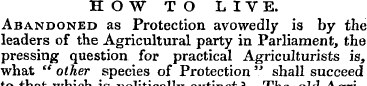
HOW TO LIVE . Abandoned as Protection avowedly is by the leaders of the Agricultural party in Parliament , the pressing question for practical Agriculturists is , what " other species of Protection " shall succeed to that which is politically extinct ? The old Agricultural maxim , " Live and let live , " has been for a time superseded by that of " Kill and let kill " :
the landlords are abandoned by the Members , the farmers by the landlords , the labourers by the farmers . Go to ruin , is the cry ; for nothing can help you . " Uaga famos' a Dm , " as the inexorable Genoese says to the beggar— "Go hungry to God . " But living men will not be content with that heartless decree . c < What are we to do ? " is their question to the leaders ; the urge it at country dinners ; and they will not be content until they get a practical
answer . Meanwhile they have already been turning their attention to a spontaneous organization . We are aware that the idea of some new combination is existing in more than one part of the country ; Mr . Milner Gibson ' s plan of providing- agricultural statistics is a step in that direction j but the most comprehensive that we have met is that of Mr . George Pelsant Dawson . Mr . Dawson is a landed proprietor of Yorkshire ; his pamphlet , a letter addressed to his brother Agriculturists , is dated from Osgodby Hall , the patrimonial estate near Selby . He finds that the want of his class is that of " controul or self-government "; and " the other species of Protection" which he proposes is a very extensive scheme of organization : —
" Let associations for the protection of native industry be formed through the length and breadth of thw land . The nucleus and materials of Buck associations exist in every market town , and the district whose inhabitants frequent the market . In many places , farmers' clubs and agricultural associations for the discussion of the scientific points of farming already exist . These could readily be converted into politica l associations ; and then there is the machinery of tho New Poor-law . The Legislature itself hus presented us with a principle of centralization , apt and ready for our purpose . Let each guardian and ex-oflicio guardian become the guardian
and protector of his townshi p , in the most comprehensive sense of the word . Every boardroom throughout the agricultural districts may resolve itself into a Protection committee for its own-union . Kach rural district , thus organized under its local committee of maimgeiuent , must be under the general control and direction of n . county committee of management ; and each county committee of management must bo subordinate- to the policy and general directions of a great central committee of management in London . So that there may bo throughout tho whole country a completely organized system of uniform and concentrated action . * * *
lict the committee-of management of each county , in conference with the great , central committee in London , from time to time , and iib often as iumI be , fix and promulgate what the minimum price of tho di He-rent species of grain is to lm at the next ensuing markets . Tho committees , constituted as they will be of the most moderate , well-informed , and practical men aniongHt , u « , in fixing the minimum prices , will , of course , take into consideration the seasons , yield , stock in hand , pruuent and anticipated importations , and other cm : iiiiiHtui » cen which should regulate their judgment . Their object and care bhould be to wecure , as fur ns powaible , to tho producer , a reasonable und
Untitled Article
Oct . 11 , 1851 . ] H , % t 1 Lt& * tX * 965
-
-
Citation
-
Leader (1850-1860), Oct. 11, 1851, page 965, in the Nineteenth-Century Serials Edition (2008; 2018) ncse.ac.uk/periodicals/l/issues/vm2-ncseproduct1904/page/9/
-