On this page
-
Departments (1)
-
Text (3)
-

Untitled Article
-

<Citf Irk
-

Untitled Article
Note: This text has been automatically extracted via Optical Character Recognition (OCR) software. The text has not been manually corrected and should not be relied on to be an accurate representation of the item.
-
-
Transcript
-
Note: This text has been automatically extracted via Optical Character Recognition (OCR) software. The text has not been manually corrected and should not be relied on to be an accurate representation of the item.
Additionally, when viewing full transcripts, extracted text may not be in the same order as the original document.
Untitled Article
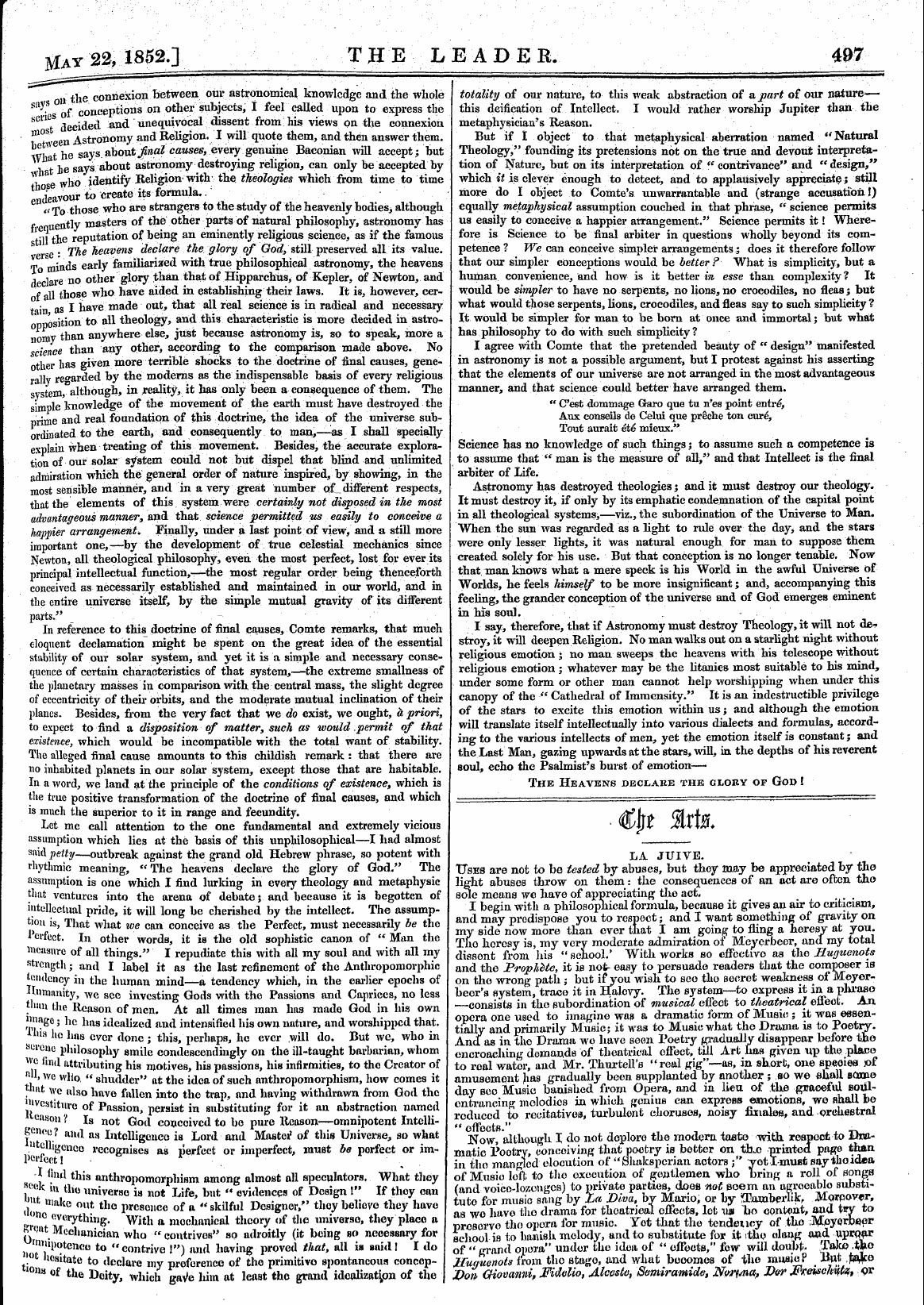
on the connexion between our astronomical knowledge and the whole Sfl of conceptions on other subjects , I feel called upon to express the ^ "T decided and unequivocal dissent from his views on the connexion "T een Astronomy and Religion . I will quote them , and then answer them . w / Vhe says about final causes , every genuine Baconian will accept ; but hat lie says about astronomy destroying religion , can only be accepted by ^ a who identify Religion with the , theologies which from time to time endeavour to create its formula .. « To those who are strangers to the study of the heavenly bodies , although t < neatly masters of the other parts of natural philosophy , astronomy has til the reputation of being an eminently religious science , as if the famous . The heavens declare the glory of Gorf , still preserved all its value . T mittds early familiarised with true philosophical astronomy , the heavens
declare no other glory than that of Hipparchus , of Kepler , of Newton , and f all those who have aided in establishing their laws . It is , however , cert n as I have made out , that all real science is in radical and necessary no ' osition to all theology , and this characteristic is more decided in astroomv than anywhere else , just because astronomy is , so to speak , more a science than any other , according to the comparison made above . No other has given more terrible shocks to the doctrine of final causes , generally regarded by the moderns as the indispensable basis of every religious
system , although , in reality , it has only been a consequence of them . The simple knowledge of the movement of the earth must have destroyed the prime and real foundation of this doctrine , the idea of the universe subordinated to the earth , and consequently to man , —as I shall specially explain when treating of this movement . Besides , the accurate exploration of our solar system could not but dispel that blind and unlimited admiration which the general order of nature inspired , by showing , in the most sensible manner , and in a very great number of different respects ,
that the elements of this system were certainly not disposed in the most advantageous manner , and that science permitted us easily to conceive a happier arrangement * Finally , under a last point of view , and a still more important one , — -by the development of true celestial mechanics since Newtoa , all theological philosophy , even the most perfect , lost for ever its principal intellectual function , — -the most regular order being thenceforth conceived as necessarily established and maintained in our world , and in the entire universe itself , by the simple mutual gravity of its different parts . " ' . - In reference to this doctrine of final causes , Comte remarks , that much
eloquent declamation might be spent on the great idea of the essential stability of our solar system , and yet it is a simple and necessary consequence of certain characteristics of that system , —the extreme smallness of the planetary masses in comparison with the central mass , the slight degree of eccentricity of their orbits , and the moderate mutual inclination of their planes . Besides , from the very fact that we do exist , we ought , a priori , to expect to find a disposition of matter , such as would permit of that existence , which would be incompatible with the total want of stability . The alleged final cause amounts to this childish remark : that there are no inhabited planets in our solar system , except those that are habitable . In a word , we land at the principle of the conditions of existence , which is the true positive transformation of the doctrine of final causes , and which is much the superior to it in range and fecundity . Let me call attention to the one fundamental and extremely vicious assumption which lies at the basis of this unphilosophical—I had almost said petty —outbreak against the grand old Hebrew phrase , so potent with rh ythmic meaning , " The heavens declare the glory of God . " The assumption is one which I find lurking in every theology and metaphysic that ventures into the arena of debate ; and because it is begotten of intellectual pride , it will long be cherished by the intellect . The assumption is , That what we can conceive as the Perfect , must necessarily be the Perfect . In other words , it is the old sophistic canon of " Man the measure of all things . " I repudiate this with all my soul and with all my stren gth ; and I label it as the last refinement of the Anthropomorphic tendency in the human mind—a tendency which , in the earlier epochs of J Iumanity , we see investing Gods with the Passions and Caprices , no less than the Reason of men . At all times man has made God in his own linage ; he has idealized and intensified his own nature , and worshipped that . llia helms ever done ; this , perhaps , he ever will do . But we , who in serene philosophy smile condescendingly on the ill-taught barbarian , whom w « fi nd attributing his motives , his passions , his infirmities , to the Creator of nil , we who " shudder" at the idea of such anthropomorphism , how comes it hat we nlso have fallen into the trap , and having withdrawn from God the "ivestiture of Passion , persist in substituting for it an abstraction named eason ? Js not qO ( j conceived to be pure Reason—omnipotent Intelligence ? and as Intelligence is Lord and Master * of this Universe , so what "telligenco recognises as perfect or imperfect , must be porfect or im ~ Perfect ! ¦
"I *) m * this anthropomorphism among almost all speculators , What they j c lXi tn « universe ia not Life , but " evidences of Design ! " If they can mt make out the presence of a " skilful Designer / ' they believe they have "no everything . With a mechanical theory of the universe , they place a MMt Mechanician who " contrives" so adroitly ( it being so necessary for not ? " '* 01100 * ° contrive '" ) an < * having P r 0 VC ( 1 t ^ at > a 11 ** Bni < 1 ' * ° 0 hesitate to declare my preference of the primitive spontaneous concep-10118 of ^» e Deity , which gave him at least the grand idealization of the
totality of our nature , to this weak abstraction of apart of our nature *—this deification of Intellect . I would rather worship Jupiter than the metaphysician ' s Reason . But if I object to that metaphysical aberration named " Natural Theology , " founding its pretensions not on the true and devout interpretation of Nature , but on its interpretation of " contrivance" and " design , " which it is clever enough to detect , and to applausively appreciate ; still more do I object to Comte ' s unwarrantable and ( strange accusation !) equally metaphysical assumption couched in that phrase , " science permits us easily to conceive a happier arrangement . " Science permits it ! Wherefore is Science to be final arbiter in questions wholly beyond its
competence ? We can conceive simpler arrangements ; does it therefore follow that our simpler conceptions would be better ? What is simplicity , but a human convenience , and how is it better in esse than complexity ? It would be simpler to have no serpents , no lions , no crocodiles , no fleas ; but what would those serpents , lions , crocodiles , and fleas say to such simplicity ? It would be simpler for man to be born at once and immortal ; but what has philosophy to do with such simplicity ? I agree with Comte that the pretended beauty of " design" manifested in astronomy is not a possible argument , but I protest against his asserting that the elements of our universe are not arranged in the most advantageous manner , and that science could better have arranged them .
" C est dommage Garo que tu n es point entre , Aux conseils de Celui que preche ton cure , Tout aurait ete mieux . " Science has no knowledge of such things ; to assume such a competence is to assume that " is the measure of all , " and that Intellect is the final arbiter of Life . Astronomy has destroyed theologies ; and it must destroy our theology . It must destroy it , if only by its emphatic condemnation of the capital point
in all theological systems , —viz ., the subordination of the Universe to Man . When the sun was regarded as a light to rule over the day , and the stars were only lesser lights , it was natural enough for man to suppose them created solely for his use . But that conception is no longer tenable . Now that man knows what a mere speck is his World in the awful Universe of Worlds , he feels himself to be more insignificant ; and , accompanying this feeling , the grander conception of the universe and of God emerges eminent in his soul . -.. '¦ ¦
I say , therefore , that if Astronomy must destroy Theology , it will not de * stroy , it will deepen Religion . No man walks out on a starlight night without religious emotion ; no man sweeps the heavens with his telescope without religious emotion ; whatever may be the litanies most suitable to his mind , under some form or other man cannot help worshipping when under this canopy of the " Cathedral of Immensity . " It is an indestructible privilege of the stars to excite this emotion within us ; and although the emotion will translate itself intellectually into various dialects and formulas , according to the various intellects of men , yet the emotion itself is constant ; and the Last Man , gazing upwards at the stars , will , in the depths of his reverent soul , echo the Psalmist ' s burst of emotion—The Heavens declare the glory of God !
Untitled Article
LA JUIVE . Uses are not to bo tested by abuses , but they may be appreciated by the light abuses throw on them : the consequences of an act are often . tho sole means we have of appreciating the act . # I begin with a philosophical formula , because it gives an air to criticism , and may predispose you to respect ; and I want something of gravity on my side now more than over that I am going to fling a heresy at you . The horoay is , my very moderate admiration of Meyerbeer , and my total dissent from his " school . ' With works so effective as the Jlugicenots and the JPropBte , it is not- easy to persuade readers that the composer is on the wrong path ; but ifyou wish to see tho secret weakness of Meyerbeer's system , trace it in Ifalovy . The system—to express it in a phrase —consists in tho subordination of musical effect to theatrical effect . An . opera one used to imagine was a dramatic form of Music ; it was essentially and primarily Music ; it was to Music what tho Drama is to Poetry . And as in tho Drama wo have seen Poetry gradually disappear before the encroaching domands of theatrical effect , till Art has given up the place to roal water , and Mr . Thurtell ' s " real gig "—as , in short , one speoies » f amusement jias gradually been supplanted by another ; so we shall some day seo Music banished from Opera , and in lieu of the graceful soulentrancing melodies in which genius can express © motions , wo flhall bo reduced to recitatives , turbulent choruses , noisy fisialea , and orchestral ( t oflfoctlS . " How , although I do not deplore the modern taste with , respect ; to Dmmatic Poetry , conceiving that pootry is better on tko printed page than in tho mangled elocution of " Shaksporian actors ; " yotl-muBt saytboidea of Music lof | i to tho execution of gentlemen who bring a roll of flongs ( and voico-lozonges ) to private parties , does not soem an agreeable substitute for music sung by . £ « Diva , by Mario , or by 3 Pomberlik , Morpover , as wo have tho drama for theatrical effects , lot u » bo qpntent , and trv to preserve tho opora for music . Yot that the tendency of tho Meyerbeer school is to banish melody , and to substitute for it ; itbo olang and uprqar of " grand opera" under tho idea of " effects , " &w will doubt ; . Tola ? , % ko JFuquenots from tho stage , and what becomes of tho muaioP But pFW Don Giovanni , Mfolio , Alcesio , Semiramide , XfyrtAia , Bw JPmtoJtMe , or
≪Citf Irk
< Citf Irk
Untitled Article
May 22 , 1852 ] T H E L E A D E R . 497 ¦ ¦ - ____ j = ^^ ri ^ . ' n '' - ' ¦ - - ' ¦'¦ "¦¦ . ' ' ' ¦ ¦ ' . . ; .. , ¦ - i „ ¦ . ¦ . ' ¦ . , ,., ¦ •¦ i ¦ ¦ ' ¦ . - . __^___^—^——;
-
-
Citation
-
Leader (1850-1860), May 22, 1852, page 497, in the Nineteenth-Century Serials Edition (2008; 2018) ncse.ac.uk/periodicals/l/issues/vm2-ncseproduct1936/page/21/
-