On this page
-
Text (4)
-

Untitled Article
-

Untitled Article
-

Untitled Article
-

Untitled Article
Note: This text has been automatically extracted via Optical Character Recognition (OCR) software. The text has not been manually corrected and should not be relied on to be an accurate representation of the item.
-
-
Transcript
-
Note: This text has been automatically extracted via Optical Character Recognition (OCR) software. The text has not been manually corrected and should not be relied on to be an accurate representation of the item.
Additionally, when viewing full transcripts, extracted text may not be in the same order as the original document.
Untitled Article
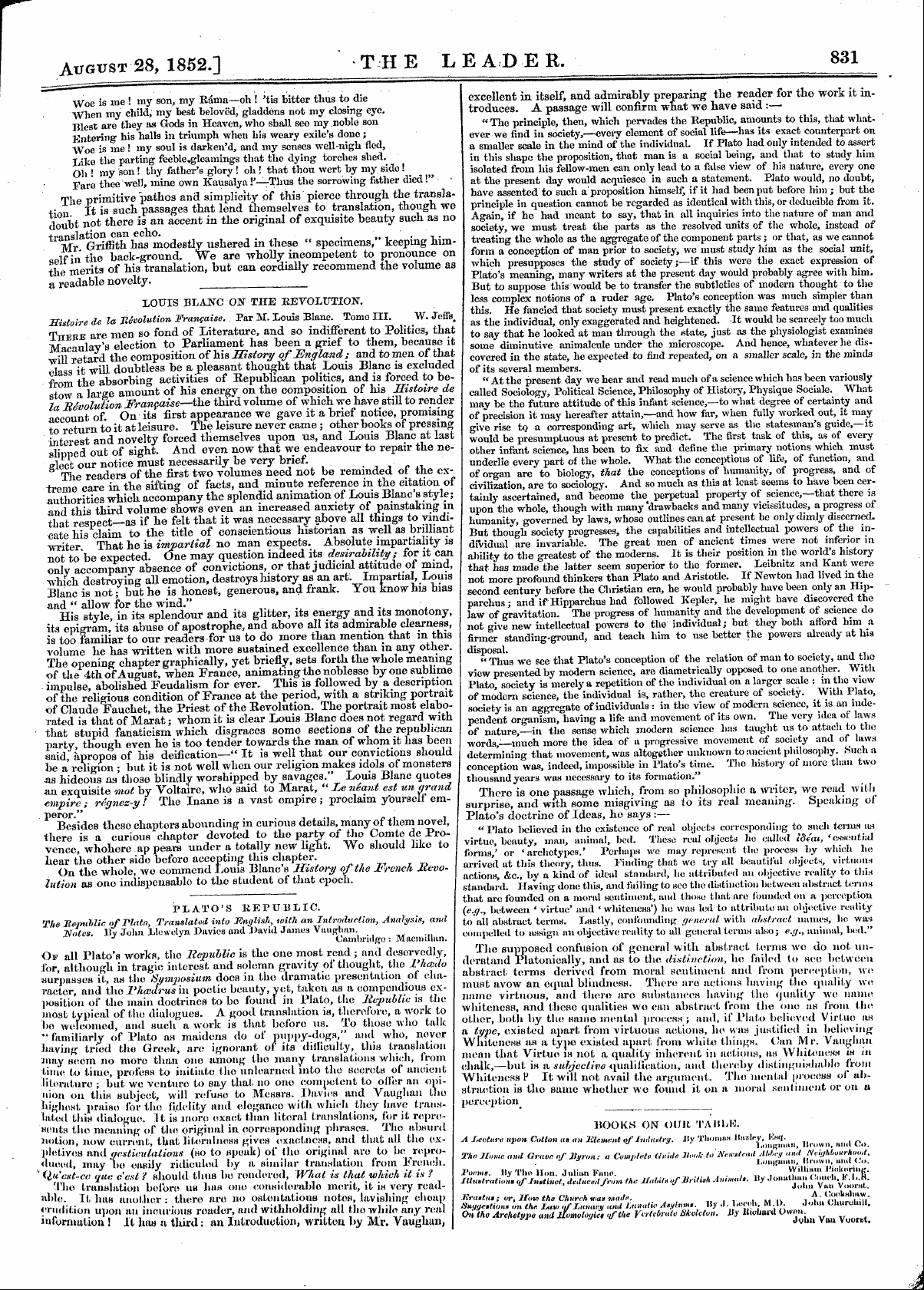
\\ rOe is me ! my son , my Rama—oh ! 'tis bitter thus to die When my child , my best beloved , gladdens not my closing eye . Blest are they as Gods in Heaven , who shall see my noble son Entering his halls in triumph when his weary exile ' s done ; Woe is me ! my soul is darken'd , and my senses well-nigh fled , Like the parting feeblcgleamings that the dying torches shed . Oh ! my son ! thy father ' s glory ! oh ! that thou wert by my side ! Fare thee well , mine own Kausalya !'—Thus the sorrowing father died !" The primitive pathos and simplicity of this pierce through the transla-Vrtn It is such passages that lend themselves to translation , though we doubt not there is an accent in the original of exquisite beauty such as no translation can echo . ¦
M Mr Griffith has modestly ushered in these " specimens , " keeping himlfin ' the back-ground . We are wholly incompetent to pronounce on the merits of his translation , but can cordially recommend the volume as a readable novelty .
Untitled Article
LOUIS BLANC ON THE DEVOLUTION . Sistoire de la revolution Franfaise . Par M . Louis Blanc . Tome III . W . Jeffs Ttteke are men so fond of Literature , and so indifferent to Politics , that TVrLaulav's election to Parliament has been a grief to them , because it will retard the composition of his History of England ; and to men of that rlass it will doubtless be a pleasant thought that Louis Blanc is excluded from the absorbing activities of Republican pohtics , and is forced to bestow a large amount of his energy on the composition of his Sistoire de Ja BSvolution Frangaise—the third volume of which we have still to render a ( lwmnt of On its first appearance we gave it a brief notice , promising
to return to it at leisure . The leisure never came ; other books ot pressing interest and novelty forced themselves upon us , and Louis Blanc at last slipped out of sight . And even now that we endeavour to repair the neglect our notice must necessarily be very brief . The readers of the first two volumes need not be reminded of the extreme care in the sifting of facts , and minute reference in the citation of authorities which accompany the splendid animation of Louis Blanc s style ; and this third volume shows even an increased anxiety of painstaking m that respect—as if he felt that it was necessary above all things to vindicate his claim to the title of conscientious historian as well as brilliant writer That he is impartial no man expects . Absolute impartiality is not to ' be expected . One may question indeed its desirability ; for it can onlv accompany absence of convictions , or that judicial attitude of mind , which destroying all emotion , destroys history as an art . Impartial , Louis Blanc is not ; but he is honest , generous , and frank . You know his bias
and " allow for the wind . # . His style , in its splendour and its glitter , its energy and its monotony , its epigram , its abuse of apostrophe , and above all its admirable clearness , is too familiar to our readers for us to do more than mention that m this volume he has written with more sustained excellence than in any other . The opening chapter graphically , yet briefly , sets forth the whole meaning of the 4 th of August , when France , animating the noblesse by one sublime impulse , abolished Feudalism for ever . This is followed by a description of the religious condition of France at the period , with a striking portrait of Claude Fauchet , the Priest of the Revolution . The portrait most elaborated is that of Marat ; whom it is clear Louis Blanc does not regard with that stupid fanaticism which disgraces some sections of the republican party , though even he is too tender towards the man of whom it has been said apropos of his deification— " It is well that our convictions should
be a religion but it is not well when our religion makes idols ot monsters as hideous as those blindly worshipped by savages . " Louis Blanc quotes an exquisite mot by Voltaire , who said to Marat , " Le n&ant est un grand empire ; regnez-y ! The Inane is a vast empire ; proclaim yourself
em-Besides these chapters abounding in curious details , many of them novel , there is a curious chapter devoted to the party of the Comte de Provence , whohere ap pears under a totally new light . Wo should like to hear the other side before accepting this chapter . On the whole , we commend Louis Blanc s History of the Jbrenc / t lievolution as ono indispensablo to the student of that epoch .
Untitled Article
PLATO'S REPUBLIC . The Jtemiblie of Plato , Translated into Bnr / lish , with an Introduction , Analysis , and Notes . Bv John Llewelyn Davies and J ) avid James Vauglmii . ^ Cambridge : Macmillan . Op all Plato's works , the Republic is the one most read ; and deservedly , for , although in tragic interest and solemn gravity of thought , the 1 'hailo surpasses it , as the Symposium docs in the dramatic presentation of character , and the Pluedrus in poetic beauty , yet , taken as a compendious exposition of the main doctrines to be found in Plato , the Republic is the most typical of the dialogues . A good translation is , therefore , a work to be welcomed , and such a work is that before us . To those who talk "' familiarly of Plato as maidens do of puppy-dogs , " and who , never having tried the Greek , arc ignorant of its dilliculty , this translation may Beem no more than ono among the many translations which , from time to time , profess to initiate the unlearned into the secrets of ancient literature ; but we venture to say that no ono competent to offer an opinion on thiH subject , will refuHO to Messrs . Pavies and Vaughau the highest praise for the fidelity and elegance with which they have translated this dialogue . It in more exact than literal translations , for it represents the meaning of the original in corresponding phrases . The absurd notion , now current , that litornlness gives exactness , and that all the
expletives * and qestunilalions ( ho to spoak ) of ( ho original are to be reproduced , may bo easily ridiculed by a similar transition from French . Qiiest-ce qua e ' est / should thus bo rendered , What is that which it is / The translation before us has ono considerable merit , it iH very readable . It has another : there arc no ostentatious notes , lavishing cheap erudition upon an incurious reader , and withholding all the while any real information ! It has a third : an Introduction , written by Mr . Vaughan ,
excellent in itself , and admirably preparing the reader for the work it introduces . A passage will confirm what we have said : — " The principle , then , which pervades the Republic , amounts to this , that whatever we find in society , —every element of social life—ha 3 its exact counterpart on a smaller scale in the mind of the individual . If Plato had only intended to assert in this shape the proposition , that man is a social being , and that to study him isolated from his fellow-inen can only lead to a false view of his nature , every one at the present day would acquiesce in such a statement . Plato would , no doubt , have assented to such a proposition himself , if it had been put before him ; but the principle in question cannot be regarded as identical with this , or deducible from it . A <> ain , if he had meant to say , that in all inquiries into the nature of man and
society , we must treat the parts as the resolved units of the whole , instead of treating the whole as the aggregate of the component parts j or that , as we cannot form a conception of man prior to society , we must study him as the social unit , which presupposes the study of society;—if this were the exact expression of Plato's meaning , many writers at the present day would probably agree with him . But to suppose this would be to transfer the subtleties of modern thought to the less complex notions of a ruder age . Plato ' s conception was much simpler than this . He fancied that society must present exactly the same features and qualities as the individual , only exaggerated and heightened . It would be scarcely too much to say that he looked at man through the state , just as the physiologist examines some diminutive animalcule under the microscope . And hence , whatever he discovered in the state , he expected to find repeated , on a smaller scale , in the minds
of its several members . " At the present day we hear and read much of a science which has been variously called Sociology , Political Science , Philosophy of History , Physique Sociale . What may be the future attitude of this infant science , —to what degree of certainty and of precision it may hereafter attain , —and how far , when fully worked out , it may give rise to . a corresponding art , which may serve the statesman ' s guide , —it would be presumptuous at present to predict . The first task of this , as of every other infant science , has been to fix and define the primary notions which must underlie every part of the whole . "What the conceptions of life , of function , and of organ are to biology , that the conceptions of humanity , of progress , and of civilization , are to sociology . And so much as this at least seems to have been certainly ascertained , and become the perpetual property of science , —that there is vicissitudes of
upon the whole , though with many ' drawbacks and many , a progress humanity , governed by laws , whose outlines can at present be only dimly discerned . But though society progresses , the capabilities and intellectual powers of the indfvidual are invariable . The great men of ancient times were not inferior in ability to the greatest of the moderns . It is their position in the world ' s history that has made the latter seem superior to the former . Leibnitz and Kant were not more profound thinkers than Plato and Aristotle . If Newton had lived in the second century before the Christian era , he would probably have been only an Hipparchus ; and if Hipparchus had followed Kepler , he might have discovered the law of gravitation . The progress of humanity and the development of science do not « ive new intellectual powers to the individual ; but they both afford him a firmer standing-ground , and teach him to use better the powers already at his
disposal . , . " Thus we see that Plato ' s conception of the relation of man to society , and the view presented by modern science , are diametrically opposed to one another . With Plato , society is merely a repetition of the individual on a larger scale : in the vaew of modern science , the individual is , rather , the creature of society . With Plato , society is an aggregate of individuals : in the view of modern science , it is an independent organism , having a life and movement of its own . The very idea of laws of nature , in the sense whicli modern science has taught us to attach to the words , —much more the idea of a progressive movement of society and of laws determining that movement , was altogether unknown to ancient philosophy . Such a conception was , indeed , impossible in Plato ' s time . The history of more than two thousand years was necessary to its formation . " There is one passage which , from so philosophic a writer , we read with surprise , and wfth some misgiving as to its real meaning . Speaking of Plato's doctrine of Ideas , he says : —
" Plato believed in the existence of real objects corresponding to such terms us virtue , beauty , man , animal , bed . These real objects lie culled Idem , ' essential forms / or ' archetypes . ' Perhaps wo may represent the process by which he arrived at this theory , thus , rinding that we try nil beautiful objects , virtuous actions , &c , by a kind of ideal standard , be attributed mi objective reality to this standard . Having done this , and failing to see the distinction between abstract term * that are founded on a moral sentiment , and those that are founded on a perception { e . g ., between « virtue' and whiteness' ) he was led to attribute an objective reality to all abstract terms . Lastly , confounding general with abstract names , he was compelled to lussign an objective reality to all general terms also ; e . g ., animal , l > ed . " The supposed confusion of general with abstract terms we do not understand Platonically , and as to the distinction , he failed to see between abstract terms derived from moral sentiment and from perception , we
must avow an equal blindness . There are actions having the quality we name virtuous , and there are substance *) having the quality we name whiteness , and these qualities wo can abstract from the one as from the other , both by the same mental process ; and , if Pinto believed Virtue aw a type , existed apart from virtuous actions , he was justified in believing WliiteneHB as a typo existed apart , from white things . Can Mr . Viuiglmu mean that Virtue is not a quality inherent in actions , as Whiteness is in chalk , —but is a subjective qualification , and thereby distinguishable from Whiteness F It will not avail the argument . The mental process of abstraction is the same whether wo found it on a moral sentiment or on u perception
Untitled Article
BOOKS ON OUR TAHLK . A Lecture upon Cotton ub an Element of Jnduttry . Uy TIiohkih lUizley , K » H-* " l , <) ii £ iiiun , Hi-own , iiiul Co Tho Homo and Grave <> f Huron : a Complete Guide Hook to Nvwttcad Abbey and'Neighbourhood u * * Lon |» iiiiiii , IJrown , uiul < - <> Vocm » . lly Tim Uon . Julian Fun * . , „ , Willi ... » i I * ioU .. rii , g Illmtration * tf InUinct , deduced from the Habits ofXrituh Animal * . By Joimthai . Coiurh . ^ . I ^ H Kramtut ; or , How the Church wa » made . , v . .... ¦ , *¦ ( ; V | " Y ' -Yi 8 u ,, ge , Hon * on the Xmw rfLunacy and Lunatic A * ,, linn : l * y . 1 J' «™" . »)¦ Johu < 1 " »™ 1 h 11 On tho Archetype and Jlomvloyiet qfthe Y <* tvbrut « 8 k « M < m . Vy Uwluud Ow j " ym VoofBt
Untitled Article
August 28 , 1852 . ] THE LEADER . 831
-
-
Citation
-
Leader (1850-1860), Aug. 28, 1852, page 831, in the Nineteenth-Century Serials Edition (2008; 2018) ncse.ac.uk/periodicals/l/issues/vm2-ncseproduct1949/page/19/
-