On this page
-
Text (1)
-

Untitled Article
Note: This text has been automatically extracted via Optical Character Recognition (OCR) software. The text has not been manually corrected and should not be relied on to be an accurate representation of the item.
-
-
Transcript
-
Note: This text has been automatically extracted via Optical Character Recognition (OCR) software. The text has not been manually corrected and should not be relied on to be an accurate representation of the item.
Additionally, when viewing full transcripts, extracted text may not be in the same order as the original document.
Untitled Article
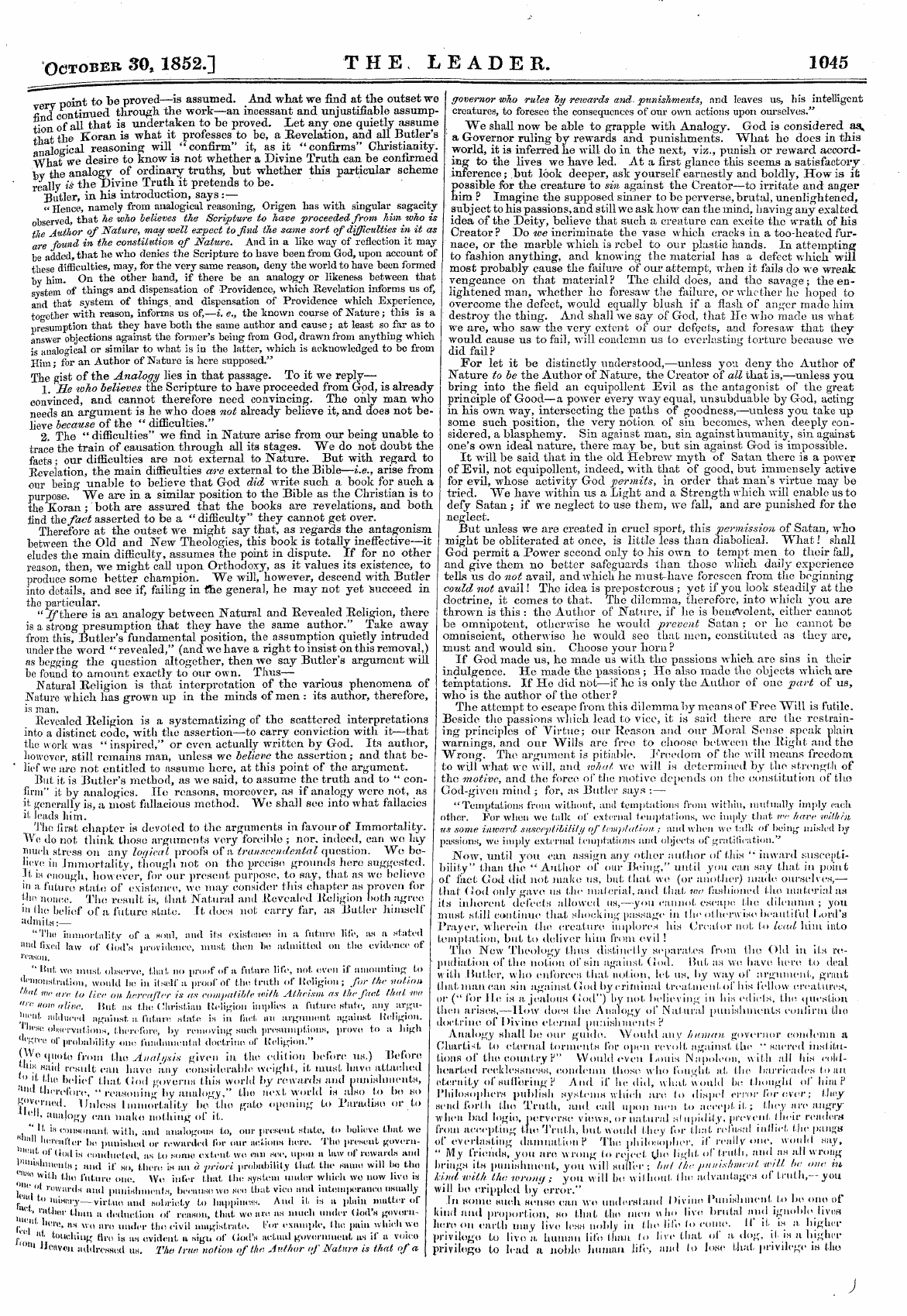
rv point to be proved—is assumed . And what we find at the outset we fl ^ continued throug h , the work—an incessant and unjustifiable assumpf of all that is undertaken to be proved . JLet any one quietly assume tfat the Koran is what it professes to be , a Uevelation , and all Butler ' s alogical reasoning will " confirm" it , as it " confirms" Christianity . What we desire to know is not whether a Divine Truth can be confirmed i the analogy of ordinary truths , but whether this particular scheme really i& the Xjivine Truth it pretends to be . Butler , in his introduction , says : — „ jience , namely from analogical reasoning , Origen Las with singular sagacity observed , that he who believes the Scripture to have proceeded from him who is flie Author of Nature , may well expect to find , the same sort of difficulties in it as
are found in the constitution of Nature . And in a like way of reflection it may be added , that he who denies the Scripture to have been . from God , upon account of these difficulties , may , for the very same reason , deny the world to have been formed by him- On the other hand , if there be an analogy or likeness between that system of things and dispensation of Providence , which Revelation informs us of , and that system of things and dispensation of Providence which Experience , together with reason , informs us of , —i . e ., the known course of Nature ; this is a presumption that they have both the same author and cause ; at least so far as to answer objections against the former ' s being from God , drawn from anything which is ana log ical or similar to what is in the latter , which is acknowledged to be from Him ; for an Author of Nature is here supposed . "
The gist of the Analogy lies in that passage . To it we reply—1 . He who believes the Scripture to have proceeded from God , is already convinced , and cannot therefore need convincing . The only man who needs an argument is he who does not already believe it , and does not believe because of the " difficulties . " 2 . The " difficulties" we find in Nature arise from our being unable to trace the train of causation through all its stages . We do not doubt the facts ; our difficulties are not external to Nature . But with regard to Hevelation , the main difficulties are external to the Bible- —i . e ., arise from our being unable to believe that God did write such a book for such a purpose . We are in a similar position to the Bible as the Christian is to the Koran ; both are assured that the books are revelations , and both find the fact asserted to be a " difficulty" they cannot get over .
Therefore at the outset we might say that , as regards the antagonism between the Old and New Theologies , this book is totally ineffective—it eludes the main difficulty , assumes the point in dispute . If for no other reason , then , we might call upon Orthodoxy , as it values its existence , to produce some better champion . We will , however , descend with Butler into details , and see if , failing in the general , he may not yet Succeed in the particular . "If there is an analogy between Natural and Revealed Religion , there is a strong presumption that they have the same author . " Take away from this , Butler's fundamental position , the assumption quietly intruded under the word " revealed , " ( and we have a right to insist on this removal , ) as begging the question altogether , then we say Butler ' s argument will be found to amount exactly to our own . Thus—Natural Religion is that interpretation of the various phenomena of Nature which has grown up in the minds of men : its author , therefore ,
man . Eevcaled Religion is a systematizing of the scattered interpretations into a distinct code , with the assertion—to carry conviction with it—that the work was " inspired , " or even actuall y written by God . Its author , however , still remains man , unless we believe the assertion ; and that belief we are not entitled to assume here , at this point of the argument . But it is Butler ' s method , as we said , to assume the truth and to " confirm" it by analogies . He reasons , moreover , as if analogy were not , as it generally is , a most fallacious method . Wo shall see into what fallacies it leads him .
The first chapter is devoted to the arguments in favour of Immortality . We do not think tlio . se arguments very forcible ; nor , indeed , can wo lay much stress on any logical proofs of a transcendental question . We bolieve in Immortality , though not on the precise ; grounds here suggested . It i « enough , however , for our present purpose , to say , that as we believe ' » a future state of existence , we may consider this chapter aH proven for the nonce . The result is , that Natural and lie veal ed Relig ion both agree in the belief of a future state . It docs not carry far , as Butler himself admits : — "Tho immortality of a houI , and its existence in a future life , as ji stated ! l » d fixed law of VhkVh providence , must then l > e admitted on tho evidence of 'VilSOll .
' » ut we must observe , that no proof of a future life , not even if amounting to demons tration , would be in ilself a proof of the truth of Keligion ; for the notion that we ara io tire on hereafter is- as compatible with Atheism as the fact that we "i '< - now alive . Hut , as tins Christian Religion implies a future state , any argu-^ "' ¦ if' adduced agains t a , future state is in fuel , nn argument sigiiinst Keligion . ' liese observations , therefore , by removing such presumptions , prove to a high '' t' ^ reij of probability one fundmucntul doctrine of Keligion . " ( Wo quote from the Analysis given in the edition before us . ) Before Uuh H ; u , ( ,. < , „ ,, !(; ( .. ] 1 . . j * , y considerable weight , it must have attached ' ° it tho belief tli .-it God governs this world by rewards and punishments , ! l » ul therefore , " reasoning by analogy , " tbo next , world is also to bo no ^> veni (> l . Unless Immortality be tho gale- opening to Paradise or to ll'h \ analogy ( . JU 1 niiiko nothing of it .
" 't in consonant , with , and analogous to , our present state , to bolicve Mint , we 11111 I'enmHo ,. l , , pU ,, iHlu . ivwnrded for our actions here . The present governll |(! 'i t . of Uodis conducted , as to some extent we can wee , upon a law of rewards and | Mi ! n . sl ,,, , | ltiH . un < 1 ; t - H (( ) j i 1 ( V | . . j H ) lu ^ , orl probability tbut the snnio will bo tho ( ltStl VVl'li the future one . We infer that , the system under which wo now live ia j ' " <> f inward * and puni . sbmeiits , because wo see iliat vico and intoinixinmcu usually fu !/ 1 UIHI ! 1 T—virtue and ( sobriety to bappincHH . And it is a plain mutter of i ! u l "' " " " ''"' "K't ion <» '' reason , that we arc as much under Uod ' s govern-|; ' i ' U ! l < 0 > as U ( l " > ' > under the civil magistrate . For example , Ihe pain which wo i > U ! u << touching tU-o ih as evident u sign of ( iod'n iictuul government us if a voico " ) n > iJoiivon addressed us . Tho true notion of the Author of Nature is that of a
governor who rules by reioards and- punishments , and leaves us , his intelligent creatures , to foresee the consequences of our own actions upon ourselves /' W ^ e shall now be able to grapple with Analogy . God is considered aaj , a Governor ruling by rewards and punishments . What he does in this world , it is inferred he will do in the next , viz ., punish or rewai'd according to the lives we have led . At a first glance this seems a satisfactory inference ; but look deeper , ask yourself earnestly and boldly , How is ife possible for the creature to sin against the Creator—to irritate and anger him ? Imagine the supposed sinner to be perverse , brutal , unenlightened , subject to his passions , and still we ask how can the mind , having any exalted idea of the Deity , believe that such a creature can excite the wrath of his
Creator ? Do we incriminate the vase which cracks in a too-heated furnace , or the marble which is rebel to our plastic hands . In attempting to fashion anything , and knowing the material has a defect which will most probably cause the failure of our attempt , when it fails do we wreak vengeance on that material ? The child does , and the savage ; the enlightened man , whether he foresaw the failure , or whether he hoped to overcome the defect , would equally blush if a flash , of anger made him . destroy the thing . And shall we say of God , that He who made us what we are , who saw the very extent of our defects , and foresaw that they would cause us to fail , will condemn us to everlasting torture because we did fail ?
For let it be distinctly understood , —unless you deny the Author of Nature to be the Author of Nature , the Creator of all that is , —unless you bring into the field an equipollent Evil as the antagonist of the great principle of Good—a power every way equal , unsubduable by God , acting in his own way , intersecting the paths of goodness , —unless you take up some such position , the very notion of sin becomes , when deeply considered , a blasphemy . Sin against nian , sin against humanity , sin . against one ' s own ideal nature , there may be , but sin against God is impossible . It will be said that in the old Hebrew myth of Satan there is a power of Evil , not equipollent , indeed , with that of good , but immensely active for evil , whose activity God permits , in order that man ' s virtue may be tried . We have within us a Light and a Strength which will enable us to defy Satan ; if we neglect to use them , we fall , and are punished for the neglect .
But unless we are created in cruel sport , this permission of Satan , who might be obliterated at once , is little less than diabolical . What ! shall God permit a Power second only to his own to tempt men to their fall , and give them no better safeguards than those which , daily experience tells us do not avail , and which he must-have foreseen from the beginning could not avail ! The idea is preposterous ; yet if you look steadily at the doctrine , it comes to that . The dilemma , therefore , into which you are thrown is this : the Author of Nature , if he is benevolent , either cannot be omnipotent , otherwise he would prevent Satan ; or he cannot be omniscient , otherwise he would see that men , constituted as they arc , must and would sin . Choose your horn ? If God made us , he made us with the passions which are sins in their indulgence . He made the passions ; He also made the objects which are temptations . If He did not—if he is only the Author of one part of ua , who is the author of the other ?
The attempt to escape from this dilemma by means of Free Will is futile . Beside the passions which lead to vice , it is said there are the restraining principles of Virtue ; our Reason and our Moral Sense speak plain warnings , and our Wills are free to choose between the lfcight and the Wrong . The argument is pitiable . Freedom of the will means freedom to will what we will , and what we will is determined by the strength of the motive , and the force of the motive depends on the constitution of tho God-given mind ; for , as Butler says : — " Temptations from without , and temptations from within , mutually imply <> : u : h other . For when we talk of external temptations , we imply that -ire have within us some inward susceptibility of temptation ; and when we talk of being misled by passions , wo imply external temptations and objects of gratification . "
Now , until you can assign any other author of this " inward susceptibility" than the " Author of our Being , " until you can say that in point of fact God did not make us , but ( hat we ( or another ) made ourselves , — that God only gave us the material , and that we , fashioned tho material us its inherent defects allowed iih , —you cannot escape the dilemma ; you must still continue that shocking passage in I he otherwise beautiful Lord ' s Prayer , wherein the creature implores his (/ realor not to lead him into temptation , but to deliver him from evil ! Tho New Theology thus distinctly separates from the Old in its repudiation of the ; notion of sin against God . But as we have here to deal with I hitler , who enforces that notion , let us , by way ol' argument , grant that , man can . sin against God by criminal treatment of bis fellow creatures , or ( " for . He is a , jealous God" ) by not believing in bis edicts , the question then arises , — How does the Analogy of Natural punishments confirm the doctrine of Divine- eternal punishments ?
Analogy shall be our guide . Would any human governor condemn a Chartist to eternal tormentN for open revolt against the " sacred institutions of the counl . ry h " Would even Louis 'Napoleon , with all bis coldhearted recklessness , condemn those who fought , at the barricades to uu eternity ofmilToring P And if he did , what would be thought of him F . Philosophers publish systems which are- Io dispel error for over ; thuy Heiid forth tho Truth , and call upon men to accept if- ; they are angry when bad logio , perverse views , or natural si upulUy , prevent their readers from accepting the Truth , but would they for flint refusril in / lict I he panga of everlasting damnation ? The philosopher , if really one , would say , " My friends , you are wrong to reject U 1 'g ht of truth , and as all wrong brings its punishment , you will sulTer ; but the punishment will be one in kind with the wroiuj ; you will be without the advantages of truth , —you will be crippled by ' error . "
In some such sense ea , n we understand Divine Punishment to be one o ( kind and proportion , so that tho men w ho live brutal nnd ignoble liven hero on earth may live less nobly in the life Io come . II" it is a higher privilege to livoa human life than Io live ( hat of n dog , if is n higher privilege to lead u noble human life , and Io Jose that privilege ih ( he
Untitled Article
October SO , 1852 . ] THE LEADER . 1045
-
-
Citation
-
Leader (1850-1860), Oct. 30, 1852, page 1045, in the Nineteenth-Century Serials Edition (2008; 2018) ncse.ac.uk/periodicals/l/issues/vm2-ncseproduct1958/page/17/
-