On this page
- Departments (2)
-
Text (7)
-

Untitled Article
-
Mtms m tte Wnk.
-
Untitled Article
-
Untitled Article
-
Contntte:
-
Untitled Article
-
Untitled Article
Note: This text has been automatically extracted via Optical Character Recognition (OCR) software. The text has not been manually corrected and should not be relied on to be an accurate representation of the item.
-
-
Transcript
-
Note: This text has been automatically extracted via Optical Character Recognition (OCR) software. The text has not been manually corrected and should not be relied on to be an accurate representation of the item.
Additionally, when viewing full transcripts, extracted text may not be in the same order as the original document.
Untitled Article
Z-, O ~ ' ' - - ¦ ' ¦ - ¦ ¦•¦ ¦•• --.... . .., ; . ,. .., ,... . . ; ,. . •; .. ., , .. .., . . . .,,-. ¦ ¦ J ^ t&QZX .
Mtms M Tte Wnk.
Mtms m tte Wnk .
Untitled Article
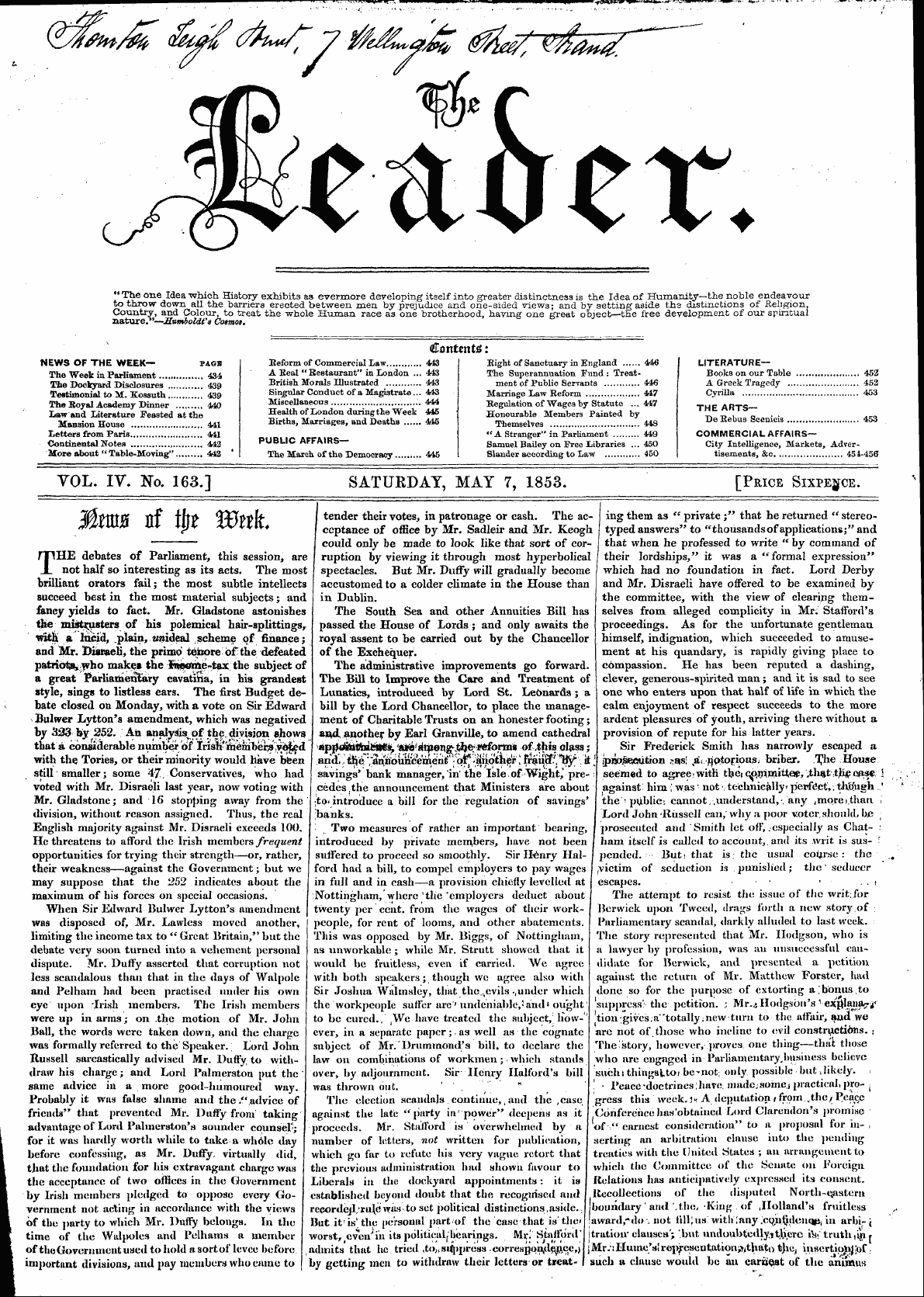
THE debates of Parliament , this session , are not half so interesting as its acts . The most brilliant orators fail ; the most subtle intellects succeed best in the most material subjects ; and faney yields to fact . Mr . Gladstone astonishes the mistrusters of his polemical hair-splittings , with a lucid , , plain , # nideal scheme of finance ; and Mr . Disraeli , the primo tenore of the defeated patriots , jvho make * the Income-tax tbe subject of a great Parliamentary cavatitia , in his grandest
style , sings to listless ears . The first Budget debate closed on Monday , with a vote on Sir Edward Bulvver Lytton ' s amendment , which was negatived by & 33 by 252 . Ananalysl is ^ p f the division shows that a considerable number of Irish ' members vo | ed with the Tories , or their minority would have been still smaller ; some 47 . Conservatives , who had voted with Mr . Disraeli last year , now voting with
Mr . Gladstone ; and 16 stopping away from the division , without reason assigned . Thus , the real English majority against Mr . Disraeli exceeds 100 . He threatens to afford the Irish members frequent opportunities for trying their strength—or , rather , their weakness—against the Government ; but we may suppose that the 252 indicates about the maximum of his forces on special occasions .
When Sir Edward Bulwer Lytton ' s amendment was disposed of , Mr . Lawless moved another , limiting the income tax to " Great Britain , " but the debate very soon turned into a vehement personal dispute . Mr . Duffy asserted that corruption not less scandalous than that in the days of Walpole and Pelham had been practised under his own eye upon 'Irish members . The Irish members were up in arms ; on the motion of Mr . John Ball , the words were taken down , and the charge
was formally referred to the Speaker . Lord John Russell sarcastically advised Mr . Duffy to withdraw his charge ; and Lord Palmerston put the same advice in a more good-humoured way . Probably it was false shame and the - " advice of friends" that prevented Mr . Duffy from taking advantage of Lord Palmerston ' s sounder counsel ' '; for it was hardly worth while to take a whole day
before confessing , as Mr . Duffy , virtually did , that the foundation for his extravagant charge was the acceptance of two offices in the Government by Irish members pledged to oppose every Government not acting in accordance with the views of the party to which Mr . Duffy belongs . In the time of the Walpoles and Pelhams a member of the Government used to hold a sort of levee before important divisions , and pay members who cmne to
tender their votes , in patronage or cash . The acceptance of office by Mr . Sadleir and Mr . Keogh could only be made to look like that sort of corruption by viewing it through most hyperbolical spectacles . But Mr . Duffy will gradually become accustomed to a colder climate in the House than in Dublin . The South Sea and other Annuities Bill has passed the House of Lords ; and only awaits the royal assent to be carried out by the Chancellor of the Exchequer .
The administrative improvements go forward . The Bill to Improve the Care and Treatment of Lunatics , introduced by Lord St . Leonards ; a bill by the Lord Chancellor , to place the management of Charitable Trusts on an honester footing ; and . another by Earl Granville , to amend cathedral appdtetfatemit , < a * el « meijg-. tfae ;** fortn « of , this olass ; and , tlie announcement joF ^ -a ^ other . frau ^ a . jTjy ^ & savings' bank manager , in the Isle of Wight , ' precedes f the announcement that Ministers are about to . introduce a bill for the regulation of savings ' banks .
Two measures of rather an important bearing , introduced by private members , have not been suffered to proceed so smoothly . Sir H ^ nry Halford had a bill , to compel employers to pay wages in full and in cash—a provision chiefly levelled at Nottingham , where'the " employers deduct about twenty per cent , from the wages of their workpeople , for rent of looms , and other abatements . This was opposed by Mr . Biggs , of Nottingham ,
as unworkable ; while Mr . Strutt showed that it would be fruitless , even if carried . We agree with both speakers ; though we agree also with Sir Joshua Walmsley , that the ^ evils . . under which the workpeople suffer are' undeniable , and * ought to be cured ., , We have treated the subject , how- ' ever , in a separate paper ; . as well as the cognate subject of Mr . Drummond ' s bill , to declare the law on combinations of workmen :-which stands
over , by adjournment . Sir Henry Halford ' s bill was thrown out . . " The election scandals continue ,, and the , cuse against the lute " party in " power" deepens as it proceeds . Mr . Stafford is overwhelmed by a number of letters , not written for publication , which go far to refute his very vague retort that
the previous administration had shown favour to Liberals in the dockyard appointments : it is established beyond doubt that the recogiriscd and reeordejl . TuUi wiw to set political distinctions , aside . But it'is'the personal part of the case that is ' thei worst , even' in its political , gearings . Mr ! 'Stafford ' admits that he tried M , sujppress correspondence , ) by getting men to withdraw their letters or
treating them as " private ; " that he returned " stereotyped answers" to "thousands of applications ; " and that when he professed to write " by command of their lordships , " it was a " formal expression " which had no foundation in fact . Lord Derby and Mr . Disraeli have offered to be examined by the committee , with the view of clearing themselves from alleged complicity in Mr ; Stafford ' s
proceedings . As for the unfortunate gentleman himself , indignation , which succeeded to amusement at his quandary , is rapidly giving place to compassion . He has been reputed a dashing , clever , generous-spirited man ; and it is sad to see one who enters upon that half of life in which the calm enjoyment of respect succeeds to the more ardent pleasures of youth , arriving there without a provision of repute for his latter years .
Sir Frederick Smith has narrowly escaped a ipDo . &eoution j- « s ! a , notorious , briber . . TJie House seemed to agree ; with thd c ^ nimitteje , . that th > o » seagainst : him ; ' was' not technicall y ¦» perfect ' ,. though the '* public . cannot / . understand , . any jinorei . than . Lord John-Russell can , why a poor voter , should , be prosecuted and Smith let off , . especially as Chatbam itself is called to account ,, and its writ is suspended . But ; that is . the usual course : the ^ victim of seduction is punished ; the' seducer escapes . • . .
The attempt to resist the issue of the writ ; . Berwick upon Tweed , drags forth a new story of Parliamentary scandal , darkly alluded to last week . The story represented that Mr . Hodgson , who is a lawyer by profession , was sin unsuccessful candidate for Berwick , and presented a petition against the return of Mr . Matthew Forster , had done so for the purpose of extorting a . bonus to suppress" the petition . ; Mr . < Hodgson ' s exj $ ma &i tion ¦ gives ; a"totally ; new turn to the affair , and we are not of those who incline to evil constructions . f
The story , however , proves one thing—that those who are engaged in-Parliamentary , business believe ' such Jthingattoi be-not ; only possible but ^ likely . ! Peace -doctrines . 'have . inade ; sorne , j practical , pro- gress this week . 1 * A deputation / from ., the / Peaqe Conference has " obtained Lord Clarendon ' s promise of--. " earnest consideration" to a proposal for in- , serting an arbitration clause into the pending treaties with the United States ; an arrangement to
which the Committee of the Senate on Foreign Relations has nntieipatively expressed its consent . Recollections of the disputed North-Eastern boundary' and ' , the , King of . Holland ' s fruitless award , * do - ; not fill ; us withlany . eonfidenoji , in arbi- J tratioir clauses '; ' . but undoubtedlyitjiere is ? truth , i | i < j Mr . ! Hume ' s ! rcpjresentatKm ^ ithato the , inscrtipjkij ; pf : such a clause would be au earnest of the animus
Untitled Article
YOL . IV . No . 163 . ] SATURDAY , MAY 7 , 1853 . [ Price Sixpence .
Contntte:
Contntte :
Untitled Article
NEWS OF THE WEEK— PAGB Reform of Commercial Law 443 Eight of Sanctuary in England 446 LITERATUREThe Week in Parliament 434 A Eeal " Restaurant" in London ... 443 The Superannuation Fund : Treat- Books on our Table 452 The Dockyard Disclosures' !!!!! . " . " . ' ! .. ' British Morals Illustrated 443 ment of Public Servants 446 A Greek Tragedy 452 Testimonial to M . Kossuth !!!!!!!!!!! . 439 Singular Conduct of a Magistrate ... 443 Marriage Law Reform 447 Cyrilla 453 The Royal Academy Dinner '"!! . ' !!!!!! 440 Miscellaneous 444 Regulation of Wages by Statute ... 447 THE ARTSLaw and Literature Feasted at the Health of London during the Week 445 Honourable Members Painted by n % « K % < t « Mansion House 441 Births , Maxriages , and Deaths 445 Themselves 448 De Rebus Scemcis 453 Letters from Paris 441 ni n a cm " A . Stranger" in Parliament 449 COMMERCIAL AFFAIRSContinental Notes 442 PUBLIC AFFAIRS— Samuel Bailey on Free Libraries ... 450 City Intelligence , Markets , Adver-More about " Table-Moving" 442 ' The March of the Democracy 445 Slander according to Law 450 tisements , &c 454-456
Untitled Article
" The one Idea which History exhibits as evermore developing itself into greater distinctness is the Idea of Humanity—the noble endeavour to throw down all the barriers erected between men by prejudice and one-sided views ; and by setting aside the distinctions of Religion , Country , and Colour , to treat the whole Human race as one brotherhood , having one # reat object—the free development of our spiritual nature . "—Humboldt ' s Cosmos .
-
-
Citation
-
Leader (1850-1860), May 7, 1853, page unpag., in the Nineteenth-Century Serials Edition (2008; 2018) ncse.ac.uk/periodicals/l/issues/vm2-ncseproduct1985/page/1/
-