On this page
-
Departments (1)
-
Text (5)
-

Untitled Article
-

Untitled Article
-

Untitled Article
-

tf >riTtttrtV jHUIr U4-UI *- ?
-

Untitled Article
Note: This text has been automatically extracted via Optical Character Recognition (OCR) software. The text has not been manually corrected and should not be relied on to be an accurate representation of the item.
-
-
Transcript
-
Note: This text has been automatically extracted via Optical Character Recognition (OCR) software. The text has not been manually corrected and should not be relied on to be an accurate representation of the item.
Additionally, when viewing full transcripts, extracted text may not be in the same order as the original document.
Untitled Article
Critics are not th . e legislators , "but the judges and police of literature . . They do not make laws—tfciey interpret and try to enforce them . —Edinburgh Review .
Untitled Article
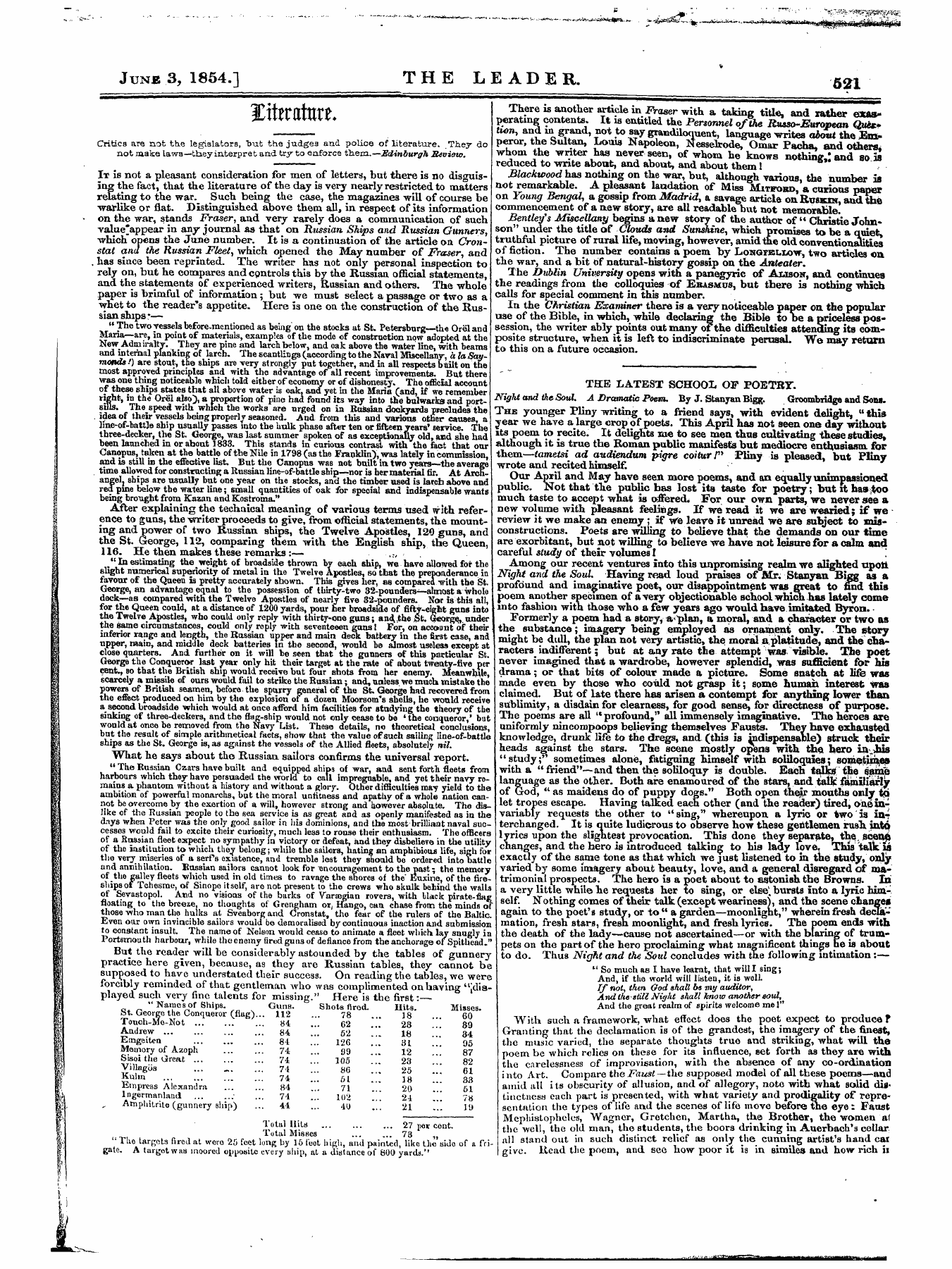
It is not a pleasant consideration for men of letters , but there is no disguising the fact , that the literature of the day is very nearly restricted to matters relating to the war . Such being the case , the magazines will of course be warlike or flat . Distinguished above them all , in respect of its information on the war , stands Fraser , and very rarely does a communication of such value ' appear in any journal as that on Russian Ships and Russian Gunners , which" opens the Jane number . It is a continuation of the article on Cronstat and the Russian Fleet , which opened the May number of Fraser , and has since been reprinted . The writer hias not only personal inspection to rely on , but he compares and controls this by the Russian official statements , and the statements of experienced writers , Russian and others . The whole paper is brimful of information ; but we must select a passage or two as a whet to the reader ' s appetite . Here is one on the construction of the Russian ships *—
" The two vessels before-mentioned as being on the stocks at St . Petersburg—th « Orel and Maria—are , in point of materials , examples of the mode of construction now adopted at the New Admiralty . They are pine and larch below , and oak above the water line , with beams and mterhal planking of larch . The scantlings ( according to the Naval Miscellany , a la Sau ~ monds !) are stout , the ships are very strongly put together , and in all respects btiilt on the most approved principles and with the advantage of all recent improvements . But there was one thing noticeable which told either of economy or of dishonesty . The official account of these sli ps states that all above water is oak , and yet in the Maria ( and , if we remember right , in the Orel also } , a proportion of pine had found its way into the bulwarks and port-? j . . P eedwitb - which the works are urged on in Russian dockyards precludes the idea of theur vessels being properly seasoned . And from this and various other causes , a line-of-battje ship usually passes into the hulk phase after ten or fifteen years * service . The three-decker , the St . George , was last summer spoken of as exceptionally old , and she had been lannclied in or about 1833 . This stands in curious contrast with the fact that our
Canopus , taken at the battle of trie Nile in 1798 ( as the Franklin ) , was lately in commission , and is still in the effective list . But the Canopus was not built in . two years—the average time allowed for constructing a Russian line-of-battle shipr—nor is her material fir . At Arcnangel j ships are usually but one year on the stocks , and the timber used is larch above and red pine below the water line ; small qnantities of oak for special and indispensable wants being brought from Kazan and Kostroma . " After explaining the technical meaning of various terms used with reference to guns , the vrriter proceeds to give , from official statements , the mounting and power of two Russian ships , the Twelve Apostles , 120 guns , and the St . George , 112 , comparing them with the English ship , the Queen , 116 . He then makes these remarks : — i :, "In estimating the weight of broadside thrown by each ship , we have allowed for the slight numerical superiority of metal in the Twelve Apostles , so that the preponderance in favour of the Queen is pretty accurately shown . This gives her , as compared -with the St . George , an advantage equal to the possession of thirty-two 32-pounders—almost a whole deck—as compared with the Twelve Apostles of nearly five 32-pounders . Nor is this all .
tor the Queen could , at a distance of 1200 yards , pour her broadside of fifty-eight guns into the Twelve Apostles , who could only reply with thirty-one guns ; and , the St . George ,, under the same circumstances , could only reply with seventeeen guns ! For , on account of their inferior range and length , the Russian upper and main deck battery in the first case , and upper , main , and middle deck batteries in the second , would be almost useless except at close quarters . And further on it will be seen that the gunners of this particular St . George the Conqueror last year only hit their target at the rate of about twenty-five per cent ., so that the British ship would receive but four shots from her enemy . Meanwhile , ecarcely a missile of ours would fail to strike the Russian ; and , unless we much mistake the powers of British seamen , before the spurry general of the St . George had recovered from , the effect produced on him by the explosion of a dozen Moorsom's shells , he would receive a second broadside which would at once afford him facilities for stud ying the theory of the sinking of three-deckers , and the flag-ship would not only cease to be * the conqueror , ' but would at once be removed from the Navy List . These details , no theoretical conclusions , but the result of simple arithmetical facts , show that the value of such sailing line-of-battle ships as the St . George is , as against tho vessels of the Allied fleets , absolutely nil . What he says about tho Russian sailors confirms the universal report .
" The Russian Czars have built and equipped shi ps of war , and sent forth fleets from harbours which they have persuaded the world to call impregnable , and yet their navy remains a phantom without a history and without a glory . Other difficulties ma-y yield to the ambition of powerful monarchs , but the moral untitness and apathy of a whole nation cannot be overcome by the exertion of a will , however strong and however absolute . The dislike of the Russian people to the sea service is as great and as openly manifested as in the days when Peter was the only good sailor in his dominions , and the most brilliant naval successes would fail to excite their curiosity , much less to rouse their enthusiasm . The officers of a Russian fleet expect no sympathy in victory or defeat , and they disbelieve in the utility of the institution to which they belong ; while the sailors , hating an' amphibious life , sigh for the very miseries of a serf ' s existence , nnd tremble lest they should be ordered into battle and annihilation . Iiussian sailors cannot look for encouragement to the past ; the memory of the galley fleets which used in old times to ravage the shores of the' Euxine . of the
fireships of Tchesme , of Sinopo itself , are not present to the crews who skulk behind the walb of Sevastopol . Atid no visions of the barks of Varaegian rovers , with black pirate-flag floating to the breeze , no thoughts of Grengham or , Hango , can chase from the minds of thoso -who man the hulks at Sveaborg and Cronatat , the fear of the rulers of the Baltic . Even oar own invincible sailors would be demoralised by continuous inaction and submission to constant insult . The name of Nelson would cease to animate a fleet which lay snugly in Portsmouth harbour , while the enem y tir « d guns of defiance from the anchorage of Spithead . " But the reader will be considerably astounded by the tables of gunnery practice here given , because , as they are Russian tables , they cannot be supposed to have understated their success . On reading the tables , we were forcibly reminded of that gentleman who was complimented on having u ! displayed such very fine talents for missing . " Here is the first : — " Names of Ships . Guns . Shots ftrod . Hits . Misses , bt . George the Conqueror ( flag ) ... 112 ... 78 ... 18 ... 60 Toxich-Me-Not 84 ... 62 ... 23 89 Andrew 84 ... 52 ... 18 . ' . ' . 34 krageiten 84 ... 126 ... 81 ... 95 Memory of Azoph ... ... 74 ... gg __ 12 87 Sisoi the Great ... 74 ... 105 * 23 82 Villages ... „ . ... 74 ... 80 ' . " . " . 25 ' . ' . ' . 61 £ uliri 74 ... 61 ... 18 ... 33 Jirnpress Alexandra ... ... 84 ... 71 ... 20 . 61 1 ngermanland ... 74 ... 1 () 2 ... 24 ... 78 Amplntrite ( gunnery ship ) ... 44 ... 40 ... 21 ... 19 Total Hits 27 per cent . Total Misses ... ... 73 1 t " Tlio targets fired at were 25 foet long by 15 f ' eot high , and pointed , like U 10 side of a frigate . A turgot wna moored opposite every ship , at a . distance of 800 yards . "
There is another article in Fraser with a taking title , and rather exasperating contents . It is entitled the Personnel of the . Russo-European Qute * twn , and in grand , not to say grandiloquent , language writes ob £ it the Emperor , the Sultan , Louis Napoleon , Nesselrode , Omar Pacha * and others * whom the writer has never seen , of whom he knows nothing ' and so as reduced to write about , and about , and about them 1 Blackwooa [ has nothing on the war , but , although various , the number is not remarkable . A pleasant laudation of Miss Mitford , a curious paper on Young Bengal , a gossip from Madrid , a savage article on Buskin , and the commencement of a new story , are all readable but not memorable . Bentley ' s Miscellany begins a new story of the author of " Christie Johnson" under the title of Clouds and Sunshine , which promises to be a quiet .
truthful picture of rural life , moving , however , amid the old conventionalities of fiction . The number contains a poem , by Lonqtellow , two articles on the war , and a bit of natural-history gossip on the Anteater . The Dublin University opens with a panegyric of Alison , and continues the readings from the colloquies of Ebasmcs , but there is nothing which calls for special comment in this number . In the Christian Examiner there is a very noticeable paper on the popular use of the Bible , in which , while declaring the Bible to he a priceless possession , the writer ably points out many of the difficulties attending its composite structure , when it is left to indiscriminate perusal . We may return to this on a future occasion .
Untitled Article
TffB LATEST SCHOOL OF POETRY . Night and the Soul . A Dramatic Po&n . By J . Stanyan Bigg . Groombridge and Sons . The younger Pliny writing to a friend says , with evident delight , " tbia year we have a large crop of poets . This April has not seen one day without its poem to recite . It delights me to see men thus cultivating these studies , although it is true the Roman public manifests but mediocre enthusiasm , for them—tametsi ad audiendum pigre coitur / " Pliny is pleased , but Pliny wrote and recited himself .
Our April and May have seen more poems , and an equally unimpassioned public . Not that the public bas lost its taste for poetry ; but it has too much taste to accept what is offered . "For our own parts , we never see a new volume with pleasant feelings . If we read it we are wearied ; if we review it we make an enemy ; if we leave it unread we are subject to misconstructions . Poets are willing to believe that the demands on our time are exorbitant , but not willing to believe we have not leisure for a calm and careful study of their volumes ! !
Among our recent ventures into this unpromising realm we alighted upon Night and the Soul . Having read loud praises of Mr , Stanyan Bigg as a profound and imaginative poet , our disappointment was great to nnd this poem another specimen of a very objectionable school which has lately come into fashion with those who a few years ago would have imitated Byron . - Formerly a poem had a story , a plan , a moral , and a character or two as the substance ; imagery being employed as ornament only . The story might be dull , the plan not very artistic , the moral a platitude , and the characters indifferent ; but at any rate the attempt was visible . The poet never imagined that a wardrobe , however splendid , was sufficient for his drama ; or that bits of colour made a picture . Some snatch at life was
made even by those who could not grasp it ; some human interest was claimed . But of late there has arisen a contempt for anything lower than sublimity , a disdain for clearness , for good sense , for directness of purpose . The poems are all " profound , " all immensely imaginative . The heroes are uniformly nincompoops believing themselves Fausts . They have exhausted knowledge , drunk life to the dregs , and ( this is uidispensable ) struck their heads against the stars . The scene mostly opens with the hero in Jbis " study ;' sometimes alone , fatiguing himself with soliloquies ; sometimes with a " friend "—and then the soliloquy is double . Each talks the samfe language as the other . Both are enamoured of the stars , and talk' familiarly of God , " as maidens do of puppy dogs . " Both open their mouths only to let tropes escape . Having talked each other ( and the reader ) tired , one invariably requests the other to " sing , " whereupon a lyric or two is in-f
terchanged . It is quite ludicrous to observe how these gentlemen rusli intq lyrics upon the slightest provocation . This done they separate , the scen £ changes , and the hero is introduced talking to his lady love . This talk ia exactly of the same tone as that which we just listened to in the study * only varied by some imagery about beauty , love , and a general disregard of matrimonial prospects . The hero is a poet about to astonish the Browns . In a very little while he requests her to sing , or else ' , bursts into a lyric himself . Nothing comes of their talk ( except weariness ) , and the scene changes again to the poet ' s study , or to" a garden—moonlight , " wherein fresh declamation , fresh stars , fresh moonlight , and fresh lyrics . The poem ends with the death of the lady- —cause not ascertained—or with the blaring of trumpets on the part of the hero proclaiming what magnificent things he is about to do . Thus Night and the Soul concludes with the following intimation : —
So much as I have learnt , that will I sing ; And , if tho world will listen , it is well . If not , then God shall ba my auditor , And the-still Night shall know another soul , And the great realm of spirits welcome me 1 " With such a framework , what effect does the poet expect to produce F Granting that the declamation is of the grandest , the imagery of the finest , the music varied , the separate thoughts true and striking , what will the poem be which relics on these for its influence , set forth as they are with with the absence of ordinati
the carelessness of improvisation , any co- on into Art . Compare the Faust—the supposed model of all these poems—and amid all its obscurity of allusion , and of allegory , note with what solid distinctness each part is presented , with what variety and prodigality of representation the types of life and the scenes of life move before the eye : Faust Mcphistopheles , Wagner , Gretchen , Martha , the Brother , the women at the well , the old man , the students , the boors drinking in Auerbach ' s cellar , nil stand out in such distinct relief as only the cunning artist ' s hand cat give . Head the poem , and sec how poor it is in similes and how rich ii
Tf ≫Rittttrtv Jhuir U4-Ui *- ?
literature .
Untitled Article
Jtjnjs 3 , 1854 . ] THE LEADER . 521
-
-
Citation
-
Leader (1850-1860), June 3, 1854, page 521, in the Nineteenth-Century Serials Edition (2008; 2018) ncse.ac.uk/periodicals/l/issues/vm2-ncseproduct2041/page/17/
-