On this page
-
Text (1)
-

Untitled Article
Note: This text has been automatically extracted via Optical Character Recognition (OCR) software. The text has not been manually corrected and should not be relied on to be an accurate representation of the item.
-
-
Transcript
-
Note: This text has been automatically extracted via Optical Character Recognition (OCR) software. The text has not been manually corrected and should not be relied on to be an accurate representation of the item.
Additionally, when viewing full transcripts, extracted text may not be in the same order as the original document.
Untitled Article
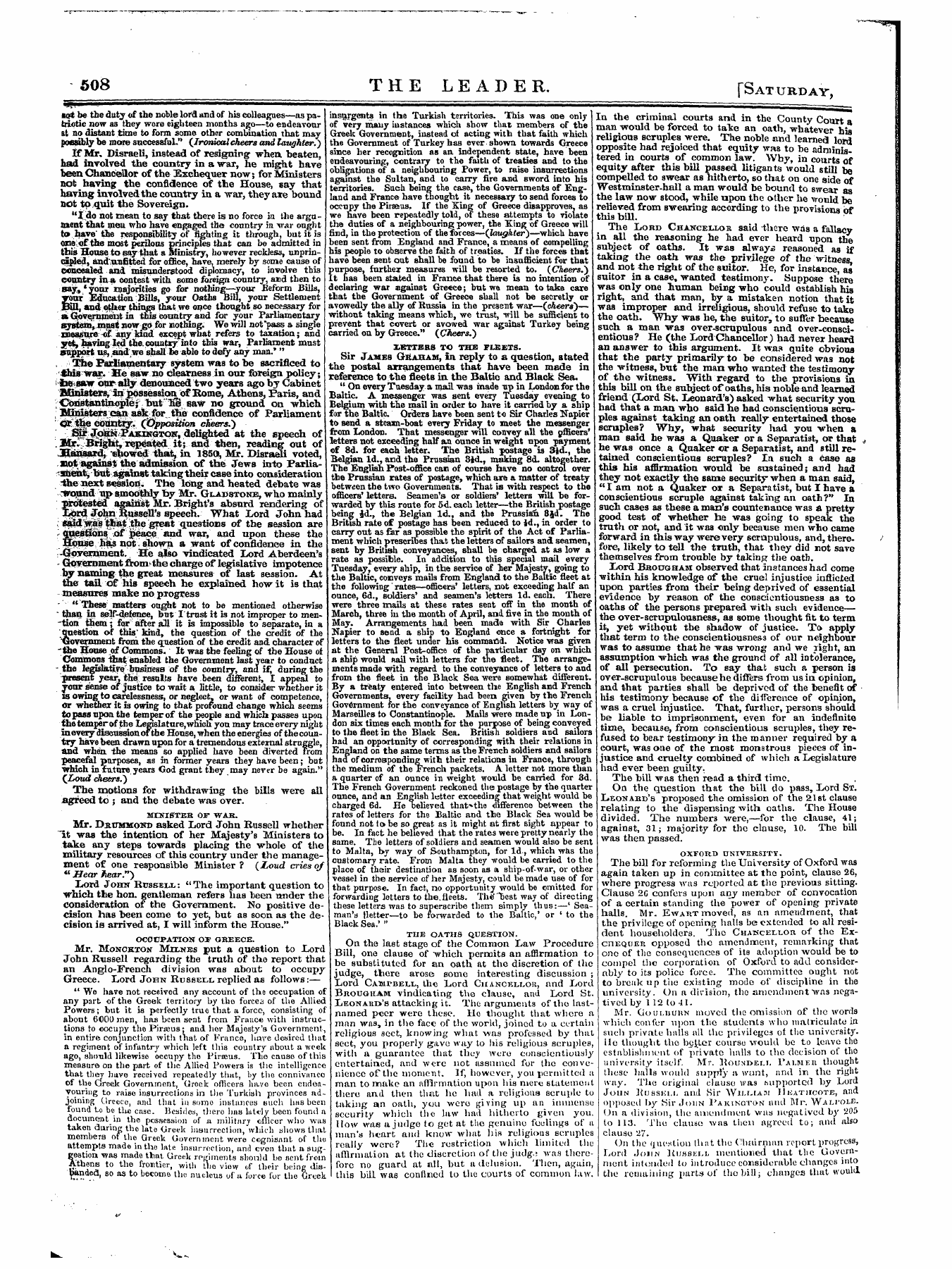
iq $ be the duty of the noble lord and of his colleagues—as patriotic now as they were eighteen months ago—to endeavour at no distant time to form some other combination that may possibly be more successful . " ( Ironical cheers and laughter / If Mr , Disraeli , instead of resigning when "beaten , had involved the country in a war , he might have been Chancellor of the Exchequer now ; for Ministers not having the confidence of the House , say that having involved the country in a war , they axe bound not to quit the Sovereign .
"I . do not mean to say that there is no force in the argument that mem . who have engaged the country in w \ ar ought to have' the responsibility of fighting it through , but it is one of the most perilous principles that can be admitted in this House to say that a Ministry , however reckless , unprincipled , and ' xmfitted for office , have , merely by some cause of concealed and misunderstood diplomacy , to involve this country in a contest with some foreign country , and then to Bay , * your majorities go for nothing—your Beform Bilk , your " Education Bills , your Oaths Bill , yonr Settlement Bill , and other things that we once thought so necessary for a Government in this country and for your Parliamentary system , most now go for nothing . We will not ' pass a single measure of any kind except what refers to taxation ; and
yet , having l « d the country into this war , Parliament must vappprt us , and we shall lie able to defy any man . * " The Parliamentary system was to he sacrificed to this war . fie saw no clearness in our foreign policy ; tie saw our ally denounced two years ago by Cabinet fiBnistere , Tinpossession , of Borne , Athens , Paris , and ¦ Cbristantinople ; hut lie saw no ground on which Bfiniaters can ask for the confidence of Parliament ^ t the country . (^ O pposition cheers . " ) Stt J [ oHisrPAKiNGTON , delighted at the speech of Mr . Bright , repeated it ; and then , reading out of . Hansard , -showed that , in 1850 , Mr . Disraeli voted ,
not against the admission of the Jews into Parhashent , but against talcing their case into consideration -the next session . The long and heated debate was Wound up smoothly by Mr . Gladstone , who mainly protested against Mr . Bright ' s absurd rendering of Iford John Russell ' s speech . What Lord John had « aid > va % that the great questions of the session are qnestions of peace and war , and upon these the House lias not shown a want of confidence in the -Government . BCe also vindicated Lord Aberdeen's Government fronvthe charge of legislative impotence by naming the great measures of hist session . At the tail of his speech he explained how it is that measures make no progress
' * These matters ought not to be mentioned otherwise than in self-defence , but I trust it is not improper to mention them ; for after all it is impossible to separate , in a Question of this' kmd , the question of the credit of the "Government from the question of the credit and character of the House of Commons . It was the feeling of the House of Commons that enabled the Government last year to conduct the legislative business of the country , and if , during the present year , the results have been different , I appeal to
your sense of justice to wait a little , to consider whether it is owing to carelessness , or neglect , or want of competence , or whether it is owing to that profound change which seems to pass upon the temper of the people and which passes upon the temper of the Legislature , which , you may trace every night in every discussion of the House , when the energies of the country have b « en drawn upon for a tremendous external straggle , and when the means so applied have been diverted from peacefal purposes , as in former years they hare been ; but which in future years < Jod grant they may never be again . " ( Loud cheers . )
The motions for withdrawing the bills were all Agreed to j and the debate was over .
MTMTBTEB OK WAK . Mr . Djittmmond asked Lord John Kussell whether it was the intention of her Majesty ' s Ministers to take any steps towards placing the whole of the military resources of this country under the management of one responsible Minister ? ( Loud cries of « Hear hear . " ) Lord John Russell : " The important question to which the hon . gentleman refers has been under the consideration of the Government . No positive decision has been come to yet , but as soon as the decision is arrived at , I will inform the House . "
OCCUPATION OT GREECE . Mr . Monckton Mixnks put a question to Lord John Russell regarding the truth of the report that an Anglo-French division was about to occupy Greece . Lord John Russell replied as follows : — " We have not received any account of the occupation of any part of the Greek territory by the forces of the Allied Powers ; but it is perfectly tuuo that a force , consisting of about 6000 men , has been sent from Franco with instructions to cocupy the Piraeus : and her Majesty ' s Government , in entire conjunction with that of France , hare dchircd that a regiment of infantry which left this country about a week ago , should likewise occupy the Pincus . Tlie cause of this
measure on the part of tho Allied Powers is the intelligence that they have received repeatedly that , by the connivanco Of the Greek Government , Greek officers hitve been endeavouring to raise insurrections in the Turkish provinces adjoining Greece , and that in some instances such hits been found to be tlw ; case . Besides , there has latel y been found a document in the possession of a military ofiiccr who wiih taken daring the late Greek insurrection , which shows that members of the Greek Government were cognisant of the attempts mado in the late insurrection , anil even that a suggestion was mado that Greek regiments should bo sent from Athens to the frontier , with the view of their being disbandea , bo as to become the nucleus of a force for the Greek
land and France have thought it necessary to send forces to occupy the Piraaus , If the King of Greece disapproves , as we have been repeatedly told , of these attempts to violate the duties of a neighbouring power , the King of Greece will find , in the protection of the forces—( laughter )—which have been sent from [ England and France , a means of compelling his people to observe the faith of treaties . If the forces that have been sent out shall be found to be insufficient for that purpose , further measures will be resorted to . { Cheers . ) t has been stated in France that there is no intention of
insurgents in the Turkish territories . This was one only of very many instances which show that members of the Greek Government , instead of acting with that faith which the Government of Turkey has ever shown towards Greece since her recognition as an independent state , have been endeavouring , contrary to the faith of treaties and to the obli g ations of a neighbouring Power , to raise insurrections against the Sultan , and to carry fire and sword into his territories . Such being the case , the Governments of
Engdeclaring war against Greece ; but we mean to taka care that the Government of Greece shall not be secretly or avowedly the aUy of Russia in the present war—( cheers ) - — without taking means whicl ) , we trust , -will be sufficient to prevent that covert or avowed war against Turkey being carried on by Greece . " ( Cheers . )
XETTBBS TO THE FLEETS . Sir James Gbaham , in . reply to a question , stated the postal arrangements that have been made in reference to the fleets in the Baltic and Black Sea . " On every Tuesday a mail was made up in London for the Baltic . A messenger was sent every Tuesday eveuing to Belgium with the mail in order to have it earned by a ship for the Baltic . Orders have been sent to Sir Charles Napier to send a steam-boat every Friday to meet the messenger from London . That messenger will convey all the officers ' letters not exceeding half an ounce in weight upon payment of 8 d . for each letter . The British postage is 3 jd-, the Belgian Id ., and the Prussian 3 Jd ., making 8 d . altogether . The English Post-office can of course bave no control over the Prussian rates of postage , which are a matter of treaty between the two Governments . That is with respect to the officers' letters . Seamen ' s ox soldiers' letters will be forwarded by this route for 5 d . each letter—the British postage
being id ., the Belgian Id ., and the Prussian 8 | d . The British rate of postage has been reduced to id ., in order to carry out as Car as possible the spirit of the Act of Parliament which prescribes tha > t the letters of sailors and seamen , sent by British conveyances , shall be charged at as low a rate as possible . In addition to this special mail every Tuesday , every ship , in the service of ler Majesty , going to the Baltic , conveys mails from England to the Baltic fleet at the following' rates—officers' letters , not exceeding half an ounce , 6 d ., soldiers' and seamen ' s letters Id . each . There were three mails at these rates sent off in the month of March , three in the month of April , and five in the mouth of May . Arrangements had been made with Sir Charles
Napier to send a ship to England once a fortnight for letters to the fleet under his command . Notice was given at the General Post-office of the particular day on which a ship would nail with letters for the fleet . The arrangements made with regard to the conveyance of letters to and from the fleet in the Black Sea were somewhat different . By a treaty entered into between the English and French Governments , every facility had been given by the French Government for the conveyance of English letters by way of Marseilles to Constantinople . Mails were made up in London six times each month for the purpose of being conveyed to the fleet in the Black Sea . British soldiers and sailors had an opportunity of corresponding with their relations in England on the same terms as the French soldiers and sailors had of corresponding with their relations in France , through the medium of the French packets . A letter not more than
a quarter of an ounce in weight would be carried for 3 d . The French Government reckoned the postage by the quarter ounce , and an English letter exceeding that weicht would be charged 6 d . He oelieved that ^ the difference between the rates of letters for the Baltic and the Black Sea would be found not to > be so great as it might at first sight appear to be . In fact he believed that the rates were pretty nearly the same . The letters of soldiers and seamen would also be sent to Malta , by way of Southampton , for Id-, which was the customary rate . From Malta they would be carried to the place of their destination as soon as a ship-of-war , or other vessel in the service of her Majesty , could be made use of for that purpose . In fact , no opportunity would be omitted for forwarding letters to the . fleets . ThtTtjest way of directing these letters was to superscribe them simply thus : — ' Seaman s lletter—to be forwarded to the Baltic , ' ' to the Black Sea . ' "
THE OATHS QUESTION . On the last stage of the Common Law Procedure Bill , one clause of vhich permits an affirmation to be substituted for an oath at the discretion of the judge , tliere arose some interesting discussion ; Lord Campbell , the Lord Chancellor , and Lord Brougham vindicating the clause , and Lord St . Leonaiuo ' s attacking it . The arguments of the lastnamed peer were these . He thought that where a man was , in the face of the world , joined to a certain religious sect , knowing what was professed by that sect , you properly gave way to his religious scruples ,
with a guarantee that they were conscientiously entertained , and were not assumed for the convenience of the moment . If , however , you permitted : i man to make an affirmation upon his mero statement there and then that he had a religious scruple to taking an oath , you were giving up an immense security which the law hail hitherto given you . How was a judge to get at the genuine feelings of a man ' s heart and know what his religious scruples really were ? The restriction which limited the affirmation at the discretion of the judg . j was therefore no guard at all , hut a delusion . Then , again , this bill was confined to the courts of common law .
In the criminal courts and in the County Court a man would be forced to taTce an oath , -whatever hia religions scruples were . The noble and learned lord opposite had rejoiced that equity was to be administered in courts of common law . Why , in courts of equity after this bill passed litigants would still be compelled to swear as hitherto , so that on one side of Westminster-hall a man would be bound to swear as the law now stood , while upon the other he would be relieved from swearing according to the provisions of ; his bill .
The Lord Chancellor said there was a fallacy in all the reasoning he had ever heard upon the subject of oaths . It was always reasoned as if taking the oath was the privilege of the witness and not the right of the suitor . He , for instance , as suitor in a case , wanted testimony . Suppose there was only one human being who could establish his right , and that man , by a mistaken notion that it was improper and irreligious , should refuse to take the oath . "Why was he , the suitor , to suffer because such , a man was over-scrupulous and over-conscientious ? He ( the Lord Chancellor ) had never heard an answer to this argument . It was quite obvious
that the party primarily to be considered was not the -witness , but the man who wanted the testimony of the witness . With regard to the provisions in this bill on th . e subject of oaths , his noble and learned friend ( Lord St . Leonard ' s ) asked what security you had that a man who said he had conscientious scruples against taking an oath really entertained those scruples ? Why , what security had you when a man said he was a Quaker or a Separatist , or that he was once a Quaker or a Separatist , and still
retained conscientious scruples ? la such a case as this his affirmation would be sustained ; and had they not exactly the same security when a man said , " I am not a Quaker ox a Separatist , but I have a conscientious scruple against taking an oath ? " In such cases as these a man ' s countenance was a pretty good test of whether he was going to speak the truth or not , and it was only because men who came forward in this way were very scrupulous , and , therefore , likely to tell the truth , that they did mot save themselves from trouble by taking the oath .
. Lord Bjbotjghabi observed that instances had come ¦ within his knowledge of the cruel injustice inflicted upon parties from their being deprived of essential evidence by reason of the conscientiousness as to oaths of the persons prepared with such evidence- ^ - the over-scrupulousness , as some thought fit to term it , yet without the shadow of justice . To apply that term to the conscientiousness of our neighbour was to assume that he was wrong and we light , an assumption -which was the ground of all intolerance , of all persecution . To say that such a person is
over-scrupulous because he differs from us in opinion , and that parties shall be deprived of the benefit of Ids testimony because of the difference of opinion , was a cruel injustice . That , further , persons should be liable to imprisonment , even for an indefinite time , because , from conscientious scruples , they refused to bear testimony in the manner required by a court , was oue of the most monstrous pieces of injustice and cruelty combined of which a Legislature had ever been guilty . The bill was then read a third time .
On the question that the bill do pass , Lord Sx . Leonabd ' s proposed the omission of the 21 st clause relating to the dispensing witn oaths . The House divided . The numbers were , —for the clause , 41 ; against , 31 ; majority for the clause , 10 . The bill was then passed .
OXFORD UNIVERSITY . The bill for reforming the University of Oxford was again taken up in committee at the point , clause 26 , where progress was reported at the previous sitting . Clause 20 confers upon any member of convocation of a certain standing the power of opening private hails . Mr . Ewart moved , as an amendment , that the privilege of opening halls be extended to all resident householders . The Chancellor of the Exchequer opposed the amendment , remarking that one of the consequences of its adoption would be to compel the corporation of Oxford to add considerably to its police force . The committee ought not to break up the existing mode of discipline in the university . On a division , the amendment "was negatived by 1 12 to 41 .
Mr . Goui . nuiw moved the omission of the words which confer upon tlie students who matriculate in such private halls all the privileges of the university . lie thought the better course would be to leave the establishment of private halls to the decision of the university itself . Mr . Housdeli . Palmer , thought these halls would supply a want , and in the right way . The original clause was supported by Lord John Kusskll and Sir Will-iam IIisathcote , and opposed by Sir John 1 ' akington and Mr . Waltole . On a division , the amendment was negatived by 205 to 113 . The clause was then agreed to ; and also clause 27 .
On the question that the Chairman report progress , Lord John Hijbskll mentioned that tlie Government intended to introduce considerable changes into tlie remaining parts of the bill ; changes that would
Untitled Article
508 THE LEADER . [ Saturday ,
-
-
Citation
-
Leader (1850-1860), June 3, 1854, page 508, in the Nineteenth-Century Serials Edition (2008; 2018) ncse.ac.uk/periodicals/l/issues/vm2-ncseproduct2041/page/4/
-