On this page
-
Text (2)
-

Untitled Article
-

Untitled Article
Note: This text has been automatically extracted via Optical Character Recognition (OCR) software. The text has not been manually corrected and should not be relied on to be an accurate representation of the item.
-
-
Transcript
-
Note: This text has been automatically extracted via Optical Character Recognition (OCR) software. The text has not been manually corrected and should not be relied on to be an accurate representation of the item.
Additionally, when viewing full transcripts, extracted text may not be in the same order as the original document.
Untitled Article
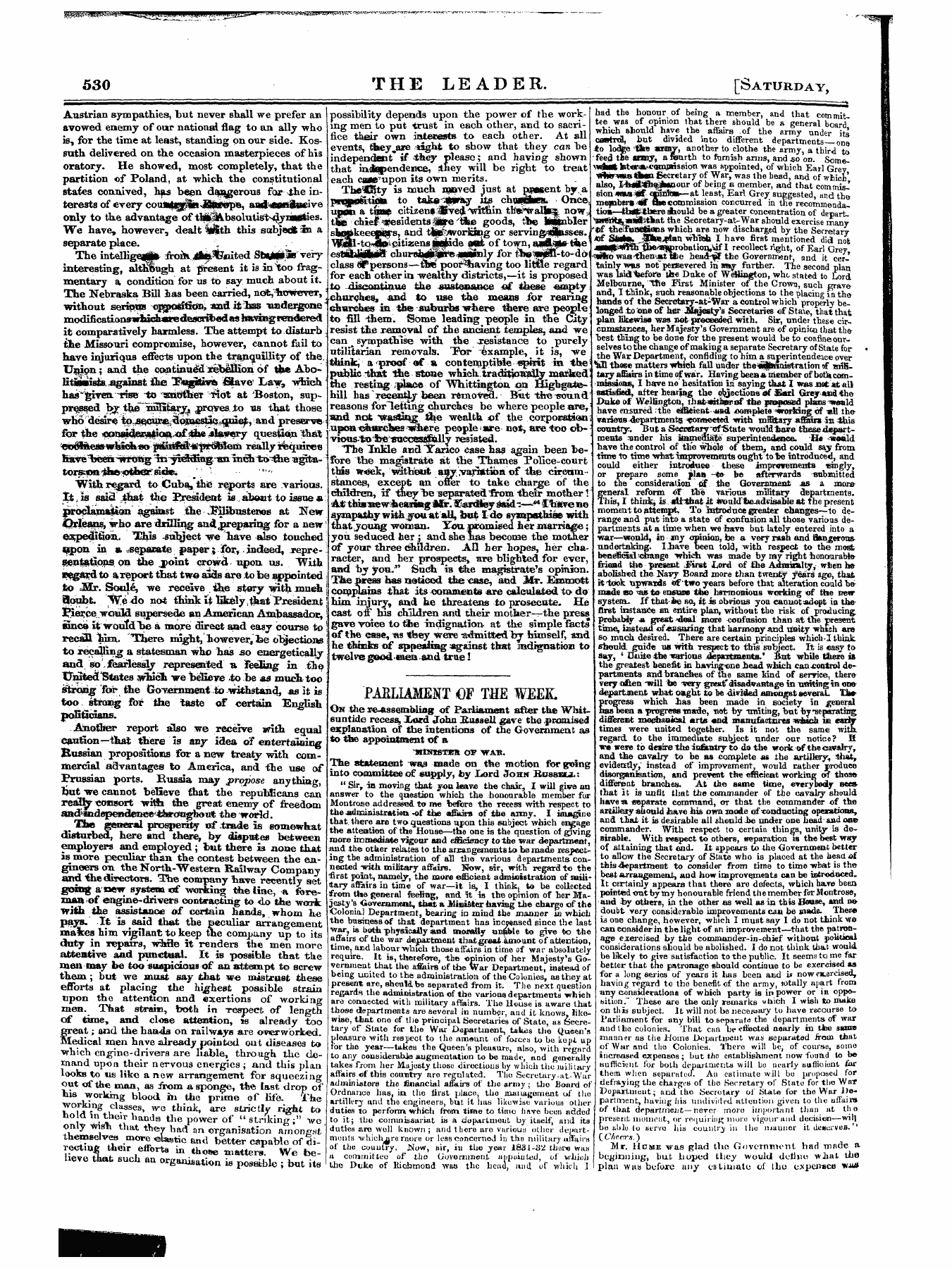
Austrian sympathies , but never shall we prefer an avowed enemy of our national flag to an ally -who is , for the time at least , standing on our side . Kossuth delivered on the occasion masterpieces of his oratory . He showed , most completely , that the partition of Poland , at which the constitutional sta g es connived , has been dangerous for the interests of every coui ^ CT ^ M > JQ | af >© p < 8 , a » d *« i « £ » cive only to the advantage of thi ( mbsolutist ^ dynavies We have , however , dealt With this subjodt in a separate place . , . . ¦
The intelligeA A-odv iketfoited Stt ^ m ' m very interesting , altnlugh at present it is in too fragmentary a . condition for us to say much about it . The Nebraska Bill las been carried , ndt ^ wywever , without serious opposition , and it has "undergone modificationffwi » idi « redeiicril ) edas batvingpendered it comparatively harmless . The attempt to disturb the Missouri compromise , however , cannot fail to have injurious effects upon the tranquillity of the
Union ; and the continued rebjellion of the Abolitiawipjio against the T < ugittyft fiiave Lay , which has ' "given , -rise * to wnothet i 8 ot at Boston , suppressed by the " military , jprovesjio us that those who desire torfie ^^ % ^ oiuestac ^ ue |; , and preserve for the « paw 4 erj »| ioa ^ of * he slavery question that fettfliteaswlsickao pgsififlii ^ r ^ fem really requires KaveTjceu "wrong " te y unuuigfcn . lkich "tt >" nie a git » - tor&pnitbeiothdrside . ' ¦ .
With regard to Cuba , the reports are various . It , is said ihat the President is .. about to issue « proclamation against the JBilibiistenog at 2 tfew iDrleans , who are drilling and ^ eparing for a new expedifioii . This -subject we have also touched appon in * separate paper ; for , indeed , repr « - sentatipns on the point crowd , upon . us . "With eegard to a report that two aids are to be appointed
to Mx . Soule , we receive . ihe story with much doubt . tV ! e ^ o no * think it likely that President tierce would supersede an American Ambassador , tonce it would T > e a more direct and easy course to recall him . There nught , however , be objections to recalling a statesman who has so energetically and so fearlessly represented a feeling in the iTnlted States whicli we believe to be &a much too
strong for the GoTernment to withstand , as It is too strong for the taste of certain English politicians . Another report also we receive srifli equal caution—that there is any idea of entertaining Russian propositions for a new treaty with commercial advantages to America , and ihe use of Prussian ports . Russia may propose anything , tut we cannot believe that the republicans can really tsonsort with the great enemy of freedom and'indepefidence ^ throtig'bout the world .
^ The general prosperity uf . trade is somewhat disturbed , here and there , by dispute * between employers and employed ; but there is none that is more peculiar than the contest between the engineers on . the North-Western Railway Company and ihe directors . The company have recently set going a new system of working the line , a foreman of engine-drivers contracting to < Lo the work with the assistance of certain hands , whom he pays . It is said that the peculiar arrangement ma Ices him vigilant to keep the company up to its duty in repairs , wifle it renders the men more
attentive and punctual . It is possible that the men may be too auspicious of an attempt to screw them ; but we must say that we mistrust these efforts at placing the highest possible strain upon the attention and exertions of working men . Tnat strain , both in -respect of length of time , and close attention , is already too great ; and the hands on railways are overworked . Medical men have already pointed out diseases to
which engine-drivers are liable , through the demand upon their nervous energies ; and this plan looks to us lik « a new arrangement for squeezing out of the man , as from a sponge , the laBt drop of his working blood hi the prime of life . The working classes , wo thioJc , are strictly right to ! ln . Jr haods tlie power of " striking ; " we only wiifli that tW had an organisation amongst themselvea more oUtic and better capable of direct , ™ their efforta in those matter * We believe that Buch an organisation is possible ; but its
possibility depends upon the power of the working men to put trust in each other , and to sacrifice their own interests to each other . At all
events , tfcey ^ are -tight to show that they can be independent if $ hey p lease ; and having shoven that independence , lliey will be right to treat each case upon its own merits . The ^ Sty is much m&ved just at ptpa&ent by . a pro ^ celtion to tak * ¦***? its chomea * Once upon a twae citizen *^ jSve ^^ witnin thw \ vaU » $ now , tliechiel ^ residents iHare ^ e goods , the lUipabler sbfflikeeepiiefs , and t || pfVWorlci > Dg or servin ^ opisses . ^ P ^ -to ^ icitizensJielkide cMfcfc of towri , a *| p # tfce i TiliMhilTT churohmiwr ^ -mmnly for t ^ iBpK-to-da
class ( ilPpersons—the poor ^ aving too little regard for eacn other in wealthy districts , —it is proposed to diffcontimift the -sustenance -of these -empty churches , and to use the means for rearing churches in the suburbs where there are people to nil -them . Some leading people in the City resist the removal of the wicient temples , and we can sympathise with the aresistance to purely utilitarian removals . T ? or example , it is , yre think , a proof « f a contemptible -spirit in the public-that the stone which . traditioTCauy marked t&e resting / place of Whittington on Highgaiehill has recently been removed . But the-sound reasons for ~ lettiiitg churches be where people are ,
and not "Wastkyr * Me wealth of the corporation upon Starches iimere people are not , are too obvious ^ b > t > e « uccesfifially resisted . The Inkle and "ITarico case has again been before the magistrate at the Thames Police-court this w « ek , without any variittibn of the circani " stances , except an oner to take charge of the children , if they Tie separated "from their mother 1 A * thia » ewheaT « agMf . Skrdley said- —** C % « ve no sympathy wfthjrou » t aU , but I do sympathise with that voune woman . You nromised her marriage ;
you seduced her , ; and she has become the mother of your three duldren . All her hopes , her character ^ and her prospects , are blighted for ever , and by you . * ' Such is Che magistrate ' s opinion . The press has noticed the case , and Mr . Emmott complains that its oonunents are calculated to do him injury , and he threatens to prosecute . He cast off his children and their mother—the press gave voice to the indignation- at the simple facts of the case , as Ifeey were twhnitted by himself , and he thinks of appealing against that indignation to twelve good « aea and true !
Untitled Article
PARLIAMEMT € F THE WEEK . Ok tiie re-assembling of Parliament after the Whitsuntide recess , Xord John Russell gave the promised explanation of the intentions of the Government as to the appointment of a
-M INISTER OP WAT * . The statement was made on the motion forgoing into committee of supply , by JLord John Bossbu .: " Sir , in moving that you leave the chair ., I will give an answer to the question which the honourable member for Montrose addressed to me fcefcre the recess with respect to the JMlnouustratiou -of the affairs of the army . I imagine that there are two questions ujpon this subject which engage the attention of the House—the one is the question of gjving more immediate vigour and efficiency to the war department , and the other relates to the arrangements to be made respecting the administration of all tlie various departments connected -with military affaire . Now , sir , with regard to the ¦ first point , namely , the more efficient administration of miliattan
tary s in time ot war—it is , I think , to be collected from the general feeling , and It is the opmion of her Majesty ' s Government , ihat a Hiuister having the charge of the Colonial Department , bearing in mind the manner w which the business of that department has increased since th « last war is botb physically and morally un&ble to give to the affairs of the war department that great amount of attention , time , and labour which those affairs in time of war absolutely require . It is , therefore , the opinion of her Majesty ' s Government that the affairs of tie War Department , ineteu . d of being united to the administration of the Colonies , as they at present tire , should bo Beparatcd from it . The next question regards the administration of the various departments which are connected with military affairs . The House is aware that those departments are several in number , and it knows , likewise , that one of the principal Secretaries of State , as Secreof State for
tary the War Department , takes the Queen ' s pleasure with respect to the am « unt of forces to be koj > 4 , up for the year—Ukes the Queen's pleasure , also , with regard to any considcruLks augmentation to be mu < k > , and g « n « rally takes from her Majesty those directions by -which the military affairs of this country are regnlated . The Secretary-iit- "V \ adiniimtera the financial aiwurs of the army ; tho Board of Ordnance has , in the first place , tho management uf the artillery and the engineers , but it bus likewise vurioun other duties to perform which from time to time have been added to it ; the commissariat is a department by itself , and its duties sire well Icjiown ; and there are various other ileimrtments whichnro rnore or less concerned in ttio military unuirs of the country . Now , sir , in the your I 8 fll-ii 2 thur « wns ii committee of tho Government uppoiuted , of wliioh tho Duke of ltichmond was the head , and of which 1
had the honour of being a member , and that committee was of opinion that there should be & general board ' which should have the afiairs of the army under its control , but divided into different departments one * o lodge <« fcte « mv , another to clothe the army , a third to ' feed tie miry , a fourth to famish anus , and . so on . Scmewft « t bt «** ecHiymssion was appointed , of vrhich Earl Grey * Vihu wwsIUmp S ecretary of War , was the head , and of which also , IfeilSih ^ iMPOur of being a member , and that commission * W 3 ' * ff ojjainfo * - — at least , Earl Grey suggested , and the members « f nw commission concurred in the recommendatiom—ttud ; there Should be a greater concentration of departT ^ antfrita , »»* it ¥ at the Secretary-at-War should exercise many 'Df theffuoiliODS which are now discharged by the Secretary Of State whiefa h first mentioned
. jSBwi ^ Aan I ave did not —ljl wnh ^ be « nprobation » \ df I recollect right , of Earl Grey 'Wfco was then = * t tie head- ^ F the Goyernment , and it cer- * tainl y w&s not ^ pexsevered in a « y further . The second plan was laid toefore the Duke of Wettiogton , who stated to Lord Melbourne , tfie First Minister of the Crowa , such graveand , 1 think , such reasonable objections to the placing in the hands of the Secretary-at-War a control which properly belonged to one of her JUaJesty ' s Secretaries of Stale , that that plan likewise was not proceeded with . Sir , undei these circninstances , her Majesty ' s Government are of opinicu that the"best fhiag to be done for the present would be to confine ourselves to the change of making a separate Secretary of State for the War Department , confiding to him a superintendeice over of
% H those matters wtjieh fall under tfae ^ pHinistration military affairs in time of war . Having bees a member of botk commiasioBe , I have no hesitation in saying tkat I was jMtatall satisfied , after hearing the objections of 3 £ arl Grey « ad 4 he Duke of Wellington , that « hheriif the jsofosed pbois ^ nmild have ensured the effieicnt -wtd joomplete = ^ rorking of all IhevarimiB departments ^ on&eeted with military amnrs 131 this country : . But a Secrttary-tffState would hare these departments ninder his komediate superintendence . H « -maid have thte control of tlie whole of them , and could say from , time to tune what , Ttnyrotements ought to he introduced , and could either introduce these improvements singly or prepare some plaa -to be afterwards submitted to the consideration of the Government jis a
moregeneral reform © F ttie various military departments . This , I think , is . aii'that it * rould be-advisable at the present moment to attempt . To introduce greater changes—to derange and put into a state of confusion all those various departments at a time when we have but lately entered into a war—wonld , in my opinion , be a . very rash and Sfcn ^ eronsundertaking . IJhare been told , with respect to the most beneficial change which was made by my right honourable-&iead the present Jftrst < Lord of { he AdtmtSilty , when he abolished the Navy Board more than twenty years ago , that it look " upwards « f two years before that alteration could hfr made so va » to ensone tbe harmonious working of the newsy stem . If that ie so , it is obvious you canuot adopt in the flret instance an entire plan , without the risk of producing
probaWy « great > deal more confusion than at the present time , instead of . ensuring that harmony and unity wrmh are so much desired . There are certain principles whicli-I think should guide tm with Teq « ctto this subject . It is « asy to say , ' Duite the - » arions depaitments . ^ But while tiiere is the greatest benefit in havingene head which canxoatrol departments and branches of the Bame kind , of service , there very often -will be 'very great ' disadvantage in uniting in onedepartment what oaght to be divided amcn ^ etseveraL tW progress which has been made in society in general has been a progress made , tiot by imitiug , but by-separathig different mechanical arts « nd manufactures wiuch in each / times were united together . Is it not the same with regard to the immediate subject under our notice ? IX we were to deiire the infantry to do the work of theoavalrv ,
and the cavalry to be as complete as the artillery , that , evidently , instead of improvement , -would rather produce disorganisation , and prevent the efficient working orf thosedifferent branches . At the same time , everybody Bees that it is unfit that the commander of the cavalry should have a separate command , or that the commander of the artillery should iaave his own mode of « onducting operationa , and that it is desirable all should be under one head and one commander . With respect to certain things , unity is desirable . With respect to others , eeparation is the b « et way of attaining that end . It appears to -the Government better to allow the Secretary of State who is placed at the bead ot this -department to consider from time to time wbat is the best arrangement , and how improvements can be introduced
It certainly appears that there are defects , which ha . ve been pointed out by my honourable friend the member for Montrose , and Jby others , in the other as well as in this Bouse , and do doubt very considerable improvements can be made . There id one change , however , which I must say I do not think wo can consider in the light of nn improvement—that the patronage exercised by the commander-in-chief without political considerations should be abolished . I do not think that would be likely to give satisfaction to the public . It seems to me far better that tlie patronage should continue to bo exercised as for a long series of years it has been and is now exercised , having regard to the benefit of the army , totally apart from any considerations of which party is in power or in opposition . " These are the only remarks which I wish to make on this subject . It will not be Decenary to have recourse to
Parliament for « ny bill to separata the departments of war and the colonies . That can be effected nearly in tlie same manner as tlie Homo Departinent was separated from that of War and tho Colonies . 1 'here will be , of course , some increased expenses ; but the establishment now found to be Bufficient for both departments will bo nearly buflioiunt for them when separated . An estimate will bo proposed for defraying the charges of tlie Secretary of Statu for the War Department ; and the Secretary of State for tho War Department , having his undivided attention given to tho tiffuira of that department— never jnoro important than ut tho present moment , or r «(| uiriiiK more vigour mid decision—will bo ablo lo hcrvo hia country in tho muniier it deserves . '' CC ^ err * . )
Mr . Howie was glad tho CJovemnvont had Tnnde n . beginning , but Loped tliey would define what ihe plan who before uny estimate of tho expcw * C 8 ffuA
Untitled Article
530 THE LEADER . [ Saturday ,
-
-
Citation
-
Leader (1850-1860), June 10, 1854, page 530, in the Nineteenth-Century Serials Edition (2008; 2018) ncse.ac.uk/periodicals/l/issues/vm2-ncseproduct2042/page/2/
-