On this page
-
Text (3)
-
Untitled Article
-
Untitled Article
-

Untitled Article
Note: This text has been automatically extracted via Optical Character Recognition (OCR) software. The text has not been manually corrected and should not be relied on to be an accurate representation of the item.
-
-
Transcript
-
Note: This text has been automatically extracted via Optical Character Recognition (OCR) software. The text has not been manually corrected and should not be relied on to be an accurate representation of the item.
Additionally, when viewing full transcripts, extracted text may not be in the same order as the original document.
Untitled Article
derky diplomatists out of the traditions of his race : and war was declared . Declared amid valiant speeches from our Ministers , that the Czar had exhausted every variety of falsehood ( as though young girls had been bewildered ) , and that Russia was an aggressive power ( singular discovery for statesmen of half a century's experience , and who had smiled on the Czar even up to the moment of Menschilcoff ' s mission ) whose career it was high time to arrest . But , in the meantime , the genius of our
statesmen had been developed in thenfinancial preparations . When negotiations were still in progress , and Russia had not yet been found out b y these colossal-minded Englishmen , Mr . Gladstone , Chancellor of the Exchequer , hurried , in the month of April , to present a war budget . We were entering on a great crisis ; so he doubled the Income Tax for half a year . A few months passed : we were in the crisis : there was a
second budget : it was a European convulsion : so he asked for 10 , 000 , 000 / . He entreated the nation , eager to give , to believe that this was sufficient | he ridiculed the idea of a loan ; and , under his auspices , a new political idea set in—that a war must be paid for in ready money . And what were the military preparations ? Two great fleets were equipped which have been of comparatively no use ; and one small army was sent out—which has now to be reinforced . In all the details of the war the
petty conception of the struggle has been , painfully illustrated . At Varna , the commissariat arrangements were criminally incomplete ; before Sebastopol , within a few hours' . sail , of Constantinople , they are still so ; and after Alma , and at Scutari , the sick and wounded have died b y dozens—from neglect . The neglect arose from a clerky economy of . moneyeconomy of money when the richest of peoples were clamouring to pay !
The war by degrees is developing itself ; week by week and month by month we find that the Government ' s conception of the war is enlarging . In time we shall have great armies , and , we venture to assure Mr . Gladstone , as we assured him at the commencement of last session , a great loan . What the Government could not , or would not , see at first , they are seeing- at last ; what they would not do , in the
pettiness and pedantry of routine , they will have to do in the end . For a great war we must have great measures ; and we see no signs of great resolves , arisin g from statesmanlike foresight , in giving Lord Raglan a small reinforcement of 50 , 000 or 60 , 000 men—only 7000 of these being English . The -war will not end in the Crimea : and it is this winter we should see some preparations for next spring .
. Now , as we have in the present Government the very best men that the governing class can produce , and as no other Government is possible , all wo can hope is that the Coalition may see reason to include tho House of Commons and expand its views of the war by contact with the collective representation of the nation . When thoro is no great man , the next best thing is a groat assembly ; we may have faith in the House of Commons as regards the war because , from tho first , it has been in advance of tho Government .
Untitled Article
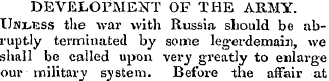
DEVELOPMENT OF THE ARMY . Unxjsss the war with Russia should be abruptly terminated by some legerdemain , we shall be called upon very greatly to enlarge our military system . Before the affair at Balaklava it was calculated that our effective force was reduced to 15 , 000 men ; subsequently there have been that affair , the affair of -the 26 th , and the general engagement of the 5 th instant , with others , of course , unreported : —the 15 , 000 must have been reduced
to a much greater extent than can be compensated by the British reinforcements that have arrived or are on their way . Whatover then may bo the result of the present stage of tho contest , a much larger increase is inevitable . Even if we are to seize Sebastopol , raze 3 t , and embark , that cannot be tho last of the struggle with Russia j wo must strike- yet another blow , must strike that more effectually , and must put greater strength into tho meuuri of striking ' . Oi » the other hand , if we are to retain possession of the Crimea we must imipnle with
Mensclnkofl ' , nnd wo must exceed him in power , notwithstanding his continual recruitments . There seems , however , little probability that tho war can bo limited to tho Crimea . If Austria is with us , Russia will ntutick that power ; if Austria forsakes us , we must attack hw ; nnd , in cither ease , force nlouo can secure either tho fidelity or tho submission of Prussia . With a large army in tho Crimea , we shall require other wniios towards the contro of the Continent .
Untitled Article
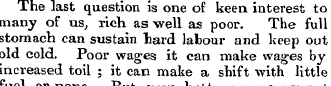
The last question is one of keen interest to many of us , rich as well as poor . The full stomach can sustain "hard labour and keep out old cold . Poor wages it can make wages by increased toil ; it can make a shift with little fuel , or none . But even better wages cannot sustain the empty stomach for work , and coals cannot warm it . The stomach will not be empty , although we may perhaps stint outfeasting . Let us at once admit that the prospect for the -winter is neither brilliant nor of the darkest ; it is sombre , but not more than sombre .
The fluctuations in the corn-market need alarm none , but the creditors of the corndealers . The price is evidently kept up by artificial means . One more series of fluctuations has yet to come—that which will mark the ebbing tide . While corn has been going up and down in London , it has been going- down and up in country districts and Ireland ; and on the Continent , where they
have not had a universal abtmdazice , and where some alarm has been felt at the px * ospect of deficiency , —the French Government , for instance , has forbidden deportation or distillation of grain , — the markets are quiet , with increased supplies reported at Dantzic , and every prospect that the granaries in the chief centres will be fairly stocked . We have already alluded to the prospect of short supplies in America — those accounts of universal
drought which seemed to affect cereals alone ; for we had no reports of starving beasts , or plains strewed with the dead bodies of those that were killed by thirst . The want of rain has checked the corn in many districts , but the higher prices of last year , the known shallowness of the stocks all over Europe , and the certainty of a good consumption during the current year , have encouraged that spread of land devoted to corn culture which had already been facilitated by the return of many farmers from speculations in railways and other jointstock enterprises to their own legitimate industry .
Setting increase against deficiency , we fully reckon on a fair supply from America . But in the meanwhile it is the interest of the dealer to make the most of the deficiency . Mr . Caird , than whom , we have no higher authority , has shown , in a letter to the Times , that our own production on the known acreage would be sufficient to equal the produce and the importation of last year taken altogether ; added to which the excellent quality of the corn must have increased its weight , and better
THE FIRST WAR WINTER . Tuk ovoning-s aro drawing in ; the fire begins to grow pleasant ; and tho young ; people arc looking- to tho Christmas holidays . But the careful housewife asks what i « liUoly to bo the price of coals and provisions j tho ninn of business notes with anxiety tho contracting index of his day-book ; and the statesman asks , not without apprehensions , what will bo thu price of bread lor tho poor ?
modes of culture must have increased the proportionate return per acre . We may reckon , therefore , on 16 , 550 , 000 quarters against a consumption of 18 , 000 , 000 quarters , leaving only a deficiency of 1 , 450 , 000 against 6 , 000 , 000 last year , now to be made good , the average importation being 4 , 500 , 000 quarters . During the last month an unprccedentedly small quantity of wheat or flour was taken for consumption ; a fact which proves that the fluctuations and enhancement of prices arose
from tho speculation of tho dealers , not from the pressure of demand . When we look to the comparatively quiet state of the Continental markets , and the probability tl iafc tho American return will not bo so much below previous shipments , , wo may sco how completely the movements in tlie Corn-market have been speculative . Upon tho whole , therefore , we may
reckon that there will be a fair avemg-o supply of corn for this country , and as the price here is usually higher than it ia elsewhere , wo may also calculate with somo confidence , that the Continental demand -will not very seriously enhance tho cost of tho loaf here . Ultimately it will settle at its level for the twelve months , and that level will not bo beyond reason . What , however , will bo our means for
purchasing bread during these same twelve months , and particularly during the winter season ? Here we cannot speak quite so confidently . We are apt to overdo our " prosperity . " Some twelve months back there was a great demand for British manufactures in America , in India , and in Australia ; but we can manufacture faster than others can want , especially cotton goods . If the fair lady of an Australian digger wanted one cotton gown of the best manufacture , we sent her two . We calculated the Indian
consumption at the rate which it might show , if reforms had already emancipated Indian industry and endowed it with a purchasing power such as it ought to possess . We have so overstocked American warehouses that bills could not be drawn against any further consignmesits . Manufacturers are keeping down their work ; merchants must do the same . Merchants deal with retail traders , and retail traders will find their orders contracted . Merchants' clerks imitate their masters , and another class of retail dealers find their " little bills" smaller than
they could wish them to be , except in cases where the little bills are not met . Here is a general disposition to retrenchment , not violent nor excessive , but wide-spread , steady , and decided . The labouring class have less to do . As employment is contracted wages sink a little ; but the decline is chiefly in the amount of work done . It is nearly the same thing ; the purse , from that of the lordly merchant to the humblest working- man , has less in it ; and thus the somewhat high price of bread is rendered a heavier burden to a lighter purse .
One fear suggested by the war is spared us for the winter . Parliament can sometimes tax us retrospectively , but it cannot meet in February to make us pay in Korember , December , and January . That is one consolation for not having a winter session . Another consolation lies in the certainty that , American disasters notwithstanding , our trade is more generally based on real business than ever ; its scale was never so great ; there is every prospect of a renewed expansion , with'the spring' . We may therefore cheer ourselves , in the dull interval before the returning 1 sun , with the proper sun of the Christmas season—Hope .
Untitled Article
1092 THE LEADER . [ Saturday , - ~ - ~ - ———^ - ^ - — ¦ " ¦¦ ¦ ¦ - ¦ _ _ ,
-
-
Citation
-
Leader (1850-1860), Nov. 18, 1854, page 1092, in the Nineteenth-Century Serials Edition (2008; 2018) ncse.ac.uk/periodicals/l/issues/vm2-ncseproduct2065/page/12/
-