On this page
-
Text (2)
-

Untitled Article
-

Untitled Article
Note: This text has been automatically extracted via Optical Character Recognition (OCR) software. The text has not been manually corrected and should not be relied on to be an accurate representation of the item.
-
-
Transcript
-
Note: This text has been automatically extracted via Optical Character Recognition (OCR) software. The text has not been manually corrected and should not be relied on to be an accurate representation of the item.
Additionally, when viewing full transcripts, extracted text may not be in the same order as the original document.
Untitled Article
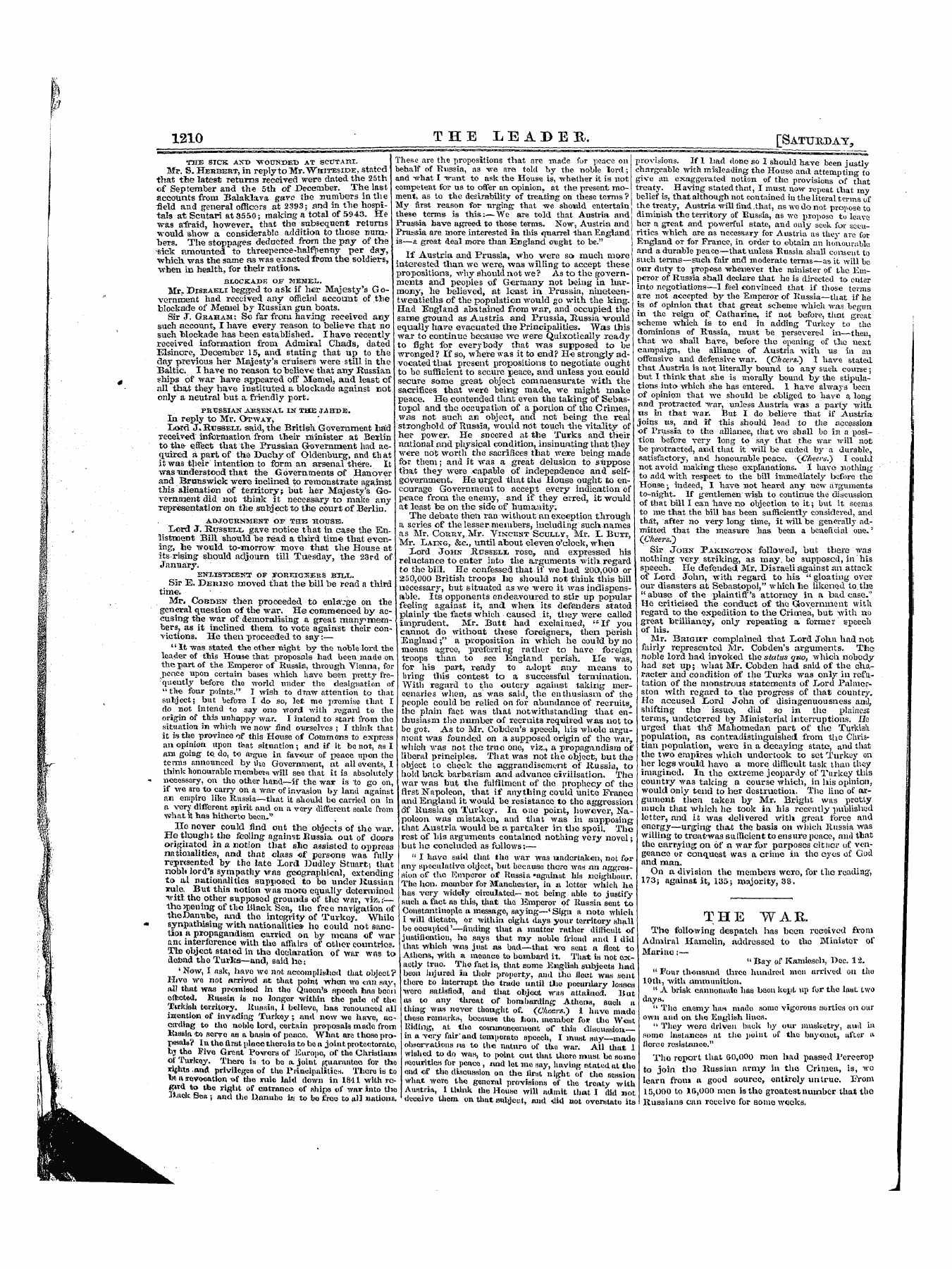
THE STCK ANTD "WOUNDED AT SCUTARI . Mr . S . Hekbert , in replytoMr . WuiTEsiDE , stated that the latest returns received were dated the 25 th of September and the 5 th of December . The last accotints from Balaklava gave the numbers in the fleld and general officers at 2393 ; and in the hospitals at Scutari at 3550 ; making a total of 5943 . He was afraid , however , that the subsequent returns would show a considerable addition to those numbers . The stoppages deducted from the psiy of the 'sick amounted to threepence-halfpenny per day , ¦ which , was the same as was exacted from the soldiers , when in health , for their rations .
BI . 0 CKA . DE OE MEMEL . Mr- Diskaeli begged to ask if her Majesty's Government had received any official account of the blockade of Meniel by Russian gun boats . Sir < T . Gkaham : So far from having received any such account , I have every reason to believe that no such blockade has been established- I have recently received information from Admiral Chads , dated Elsinore , December 15 , and stating that up to the day previous her Majesty ' s cruisers were still in the Baltic . I have no reason to believe that any Russian ships of war have appeared off Meniel , and least o all that they have instituted a blockade against not only a neutral but a friendly port .
PRUSSIAN A 3 RSENAL IN CHE JAHBE . In reply to Mr . Otway , ' Ixwrd J . Rijsseli , said , the British Government liad received information from their minister at Berlin to _ tli& effect that the Prussian Government had . acquired a part of the Duchy of Oldenburg , and that it was their intention to form an arsenal there . It was understood that the Governments o Hanover and Brunswick were inclined to remonstrate against this alienation of territory ; but her Majesty's Grovernment did uofc -think it necessary to make any representation on tie subject to tiie court of Berlin .
ADJOURNMENT OjF THE SOtTSB . Lord J . Russell gave notice that in case the Enlistment Bill should "be read a third time that evening , he would to-morrow move that the House at its rising should adjourn till Tuesday , the 23 rd of January .
ENXIST 3 IEKT OF 3 FOREIG : N : ERS BTLX . Sir E . Dering moved that the bill be read a third time . Mr . Cobden then proceeded to enlarge on the general question of the war . He commenced by accusing the war of demoralising a great manymembers , as it inclined them to vote against their convictions . He then proceeded to say : — " It was stated the other night by the noble lord the leader of this House that proposals had been made on the part of the Emperor of Russia , through Vienna , for peace upon certain bases which have been pretty frequently before the world under the designation of " tlie four points . " I wish to draw attention to that
subject ; but before I do so , let mo premise tliat I do not intend to say one word with a'egard to the origin of this unhappy war . I intend to start from the situation in whioh we now find ourselves ; I think that it is the province of this House of Commons to express an opinion , upon that situation ; and if it be not , as I atn going to . , to avguo in favour of peace upon the terrris announced by vho Government , at all events , I think honourable rnembots will seo that it is absolutely necessary , on the other hand— if the war is to go on , if we are to carry on a war of invasion l > y land against an empire like Russia—that it should be carried on in a very different spirit and on a very different scale from what it has hitherto been . "
Ho never could find out the objects of tho war . He thought the feeling- against . Russia , out of doors origirated in a notion that slie assisted to oppress nationalities , and that class of persons was fully represented by the late Lord Dudley Stuart ; that nobU lord ' s sympathy was geographical , extending to al nationalities supposed to be under Russian rule . But this notion vas mo > re equally determined ¦ v- itt the other supposed grounds of the war , viz .: '—1 he > pening of tlio lilack Son , tlio free navigation of the Danube , and tho integrity of Turkey . While sympathising with nationalities- ho could not sanctioi a piopaganilism carried on by means of war am interference with tho affairs of other countrios . Tho objcot stated in the declaration of war wns to dofcnd tho Turlcs—and , said he ;
Now , I ask , hftvo wo not accomplished that object ? I-I » ve we not rtrxived sit that point whan we oan say , all that was promised in tho Quean ' s speech has boon olfceted . Russia ia no longor within tho palo of thej Turkish territory . Itusfiin , I bclievo , has ronouneod nil iniontion of invading Turkey ; and now wo have , according to tho , noble lord , certain proposals made from Kiasia to Borvo us a ba » ia of peace . Wliat are thoso propnalaV In tho urst plaoe there is to bo a joint protectorate , bj tho Five Great Powera of Europe , of tlio CliriatianH of Turkey . There ia to bo a . joint guarantee for the rtyhta and privileges of tho Prindpaliticri . Tlioro is to 1 >< I a revocation-of fcho rule laid down in 1841 with re gnd to tho right of entrance of ohipa of war into tho Jiuok Boa ; and the Danube is to bo free to all imtioixfl .
These arc the propositions that are made for peace on behalf of Russia , as we are told by the noble lord ; and -what I -want to ask the House is , what her it is not competent for us to offer an opinion , at the present moment , as to the desirability of treating on these terms ? My first reason for urging- that we should entertain these terms is this : —We are told that Austria and Prussda have agreed to those terms . Now , Austria and Prussia are more interested in this quarrel than England is—a great deal more than England ought to be . " If Austria and Prussia , who were so much more interested than we were , was willing to accept these propositions , why should not we ? As to the governments and peoples of Germany not being in
harmony , he believed , at least ia Prussia , niueteentweatieths of the population would go with the king . Had England abstained from war , and occupied the same ground as Austria and Prussia , Hussia -would equally have evacuated the Principalities . Was this war to continue because we were Quixotically ready to fi ght f or everybody that was supposed to be wronged ? I so , where was it to end ? H-e strongly advocated that present propositions to negotiate ought to be sufficient to secure peace , and unless you could secure some great object commensurate with the sacrifices that were being made , we might make
peace . He contended that even the taking of Sebastojol and the occupation of a portion of the Crimea , was not such an object , ancf not being the real stronghold of Russia , would not touch -the vitality of her power . He sneered at the Turks and their national arid physical condition , insinuating that they were not worth y the sacrifices that were being made for them ; and it was a great delusion to suppose that they were capable of independence and selfgovernment . He urged -that the House ought to encourage Government to accept every indication of peace froni the enemy , and if they erred , it would at least be on the side of humanity .
The debate then ran without an exception through a series of the lesser me tubers , including such names as Mr . Corry , Mr . Vincent Scully , Mr . I . Burr , Mr . Laikg , &c , until about eleven o ' clock , wlien Lord . iToHN JIusselx , rose , and expressed his reluctance to enter into the arguments with regard to the bill . He confessed that if we liad 200 , 000 or 250 , 000 British troops he should not think this bill necessary , but situated as we were it was indispensable . Its opponents endeavoured to stir Up popular feeling against it , and when its defenders stated plainly the facts which caused it , they were called imprudent . Mr . Butt had exclaimed , ts If you cannot do without these foreigners , then perish
England ; " a proposition in which he could bj r no means agree , preferring rather to have foreign troops than to see England perish . He was , for his part , ready to adopt any means to bring tins contest to a successful termination . With regard to the outcry against taking mercenaries when , as was said , the enthusiasm of the people could be relied on for abundance of recruits , the p lain fact was that notwithstanding that enthusiasm the number of recruits required was not to be got . As to Mr . Cobden ' s speech , his whole argument was fo unded on a supposed origin of the war
which yras not the true one , viz ,, a propagandism of liberal principles . That was not tho object , but the object to check tho aggrandisement of Russia , to hold brick barbarism and advance civilisation . The war was but the fulfilment of the prophecy of the f irst Napoleon , that if anything could unite France and England it would be resistance to the aggression 6 T liussia on Turkey . In one point , however , Napoleon was mistaken , and that was in supposing that Austria would be a partaker in the spoil . The rest of his arguments contained nothing very novel ; but he concluded as follows : —
" I liave siiul that tho war was undertaken , not for any speculative object , "but because there wa « an aggression of tho Emperor of Russia "against his neighbour . Tlio hon . member for Manchester , in a , letter which lie has very widely circulated— not being able to justify such a fact aa this , that tho Emperor of Russia sent to Constantinople a message , saying— 'Sign a note which I will dictate , or within eight days your territory shall bo occupied' —finding that a matter rather difficult of justifixation , ho nays that my noble friond and I did that which was just as bad—that -wo Bent a Hoot to Athena , with a monaco to bombard it . That ia not exactly true . Tho fact is , that some English subjects had boon injured in thoir property , and tho ( lccst wuh sent
there to interrupt the trudo until tlio pecuniary losses were satisfied , and that object vriia attained . But an to any threat of bombarding : Athene , such a thing wum never thought of . ( Cheers . ') I have made theso remarks , because tho lion , member for the W «» t Riding , « t tho commencement of this dincusHiouin a very fair" and temperate speech , I must Bay—made observations na to tho naturo of Umj war . All that 1 wished to do wan , to point out , that thoro m » ut »| , bo some HOourltics for pence , « nd let me nay , having stated at tho end of tho cUflouBrtion on tho urwt night of tho Honaion what wore tho general provisions of tho treaty with Austria , 1 think tho Houho will admit that I did not deceive thorn on that Bnlrfect , and < M not ovonitato its
provisions . If I had done so I should have been justly chargeable with misleading the House and attempting to give an exaggerated notion of the provisions of that treaty . Having stated that , I must now Tepeat that ray belief is , that although not contained in the literal twins of the treaty , Austria will find . that , as we do not propose to diminish the territory of Russia , as we propose to leave her a great and powerful state , and only souk for securities which are as necessary for Austria as they are for England ot for France , in order to obtain an hon . ourii . blo and a durable peace—that unless Eussia shall consent to ueh terms—such , fair ana moderate terms—as it will be our duty to propose whenever the minister of tie Emperor of Russia shall declare that he is directed to enter
into negotiations—I feel convinced that if those terms are not accepted by the Emperor of liussia—that if he is of opinion that that great scheme which was begun in the reign of . Catharine , if not before , that great scheme which is to end in adding Turkey to the dominions of Russia , must be persevered in—then , that we shall have , before the opening of the next campaign , the alliance of Austria with us in an offensive and defensive war . ( Cheers . ') 1 have stated that Austria is not literally bound to any such , course ; but I think that she is morally bound by the stipulations into which she has entered . 1 have always been of opinion that we should be obliged to have a long and protracted "vrar , unless Austria was a party with us in that war . But I do believe that if Austria
joins us , and if this should lead to the accession of Prussia to the alliance , that we shall be in a position before very long to say that the war will not be protracted , and that it will be ended by a durable , satisfactory , an < l honourable peace . ( Cheers . ') I could not avoid making these explanations . I have nothing to add with respect to the bill immediately before the House ; indeed , I have not heard any new arguments to-nignt- If gentlemen wish to continue the discussion of that bill I eaii have no objection to it ; but it seems to me that the bill has been sufficiently considered , and that , after no very long time , it will be generally admitted that the measure has been a beneficial one . ( Cheers . ")
Sir John Pakistgton followed , but there was nothing very striking , as may . be supposed , in his speech . He defended Mr . Disraeli against fin attack of Lord John , with regard to his " gloating over our disasters at Sebastopol , " w Inch he likened to the " abuse of the ¦ ¦ p laintiff's attorney in a bad case . ' He criticised the conduct of the Government with . regard to the expedition to the Crimea , but with no great brilliancy , only repeating a , former speed ) of his . Mr . Bright complained that Lord John had not fairl y represented Mr . Cobden ' s arguments . The noble lord had invoked the status quo , which nobody had set up ; what Mr . Cobden had said of the
character and condition of the Turks was only in refutation of the monstrous statements of Lord Pahne-rston with regard to the progress of that country . He accused Lord John of dismgenuousness am ) , shifting the issue , did so in the plainest terms , undeterred by Ministerial interruptions , Ho urged that the" Mahornedan part of the Turkish . population , as contradistinguished from the Christian population , were in a decaying state , and that the two empires which undertook to set Turkey on her legs would have a more difficult task than they
imagined . In the extreme jeopardy of Turkey this country was taking a course which , in his opinion , would only tend to her destruction . The line of argument then taken by Mr . Bright wns pretty much that which he took in his recently published letter , and it was delivered with great force and energy—urging that the basis on which Russia , was willing to treat-was sufficient to ensure peace , and that tho carrying on of a war for purposes either of vengeance or conquest was a crime ia the eyes of God and man . On a division the members were , for the reading , 173 ; against it , 135 ; majority , 38 .
Untitled Article
THE "WAR . The following despatch has been received from Admiral Ilamclin , addressed to tho Minister of Marine : — " Bay of Kamiosch , Doc . 12 . " Four thousand three hundred nion arrived on tho 10 th , with ammunition . " A brisk cannonudo has been kej , ) t up for tho lant two days . " Tho ouomy ham made some vigorous sorties on our own and on . tho English lincw . " They wore driven buck by our muakutry , aud ii » Homo iiiutancoH at tho point of tho bayouot , ai'Lor n Uorco rosiatnnco . " Tho report that 00 , 000 men had passed 1 ' erecrop to join tho llussiun army hi tlio Crimea , is , wo loarn from a Rood source , entirely \ mtrue . From
15 , 000 to 10 , 000 men istho greatest number that tho Russians can receive for somu wccjIch .
Untitled Article
1210 ^ £ H ^ JL E fr ^ ^ Satuhdat ,
-
-
Citation
-
Leader (1850-1860), Dec. 23, 1854, page 1210, in the Nineteenth-Century Serials Edition (2008; 2018) ncse.ac.uk/periodicals/l/issues/vm2-ncseproduct2070/page/10/
-