On this page
-
Departments (1)
-
Text (4)
-

~4 Ijv (? 40 0TIIH "" ? I
-

Untitled Article
-

Untitled Article
-

Untitled Article
Note: This text has been automatically extracted via Optical Character Recognition (OCR) software. The text has not been manually corrected and should not be relied on to be an accurate representation of the item.
-
-
Transcript
-
Note: This text has been automatically extracted via Optical Character Recognition (OCR) software. The text has not been manually corrected and should not be relied on to be an accurate representation of the item.
Additionally, when viewing full transcripts, extracted text may not be in the same order as the original document.
~4 Ijv (? 40 0tiih "" ? I
^ nxthim
Untitled Article
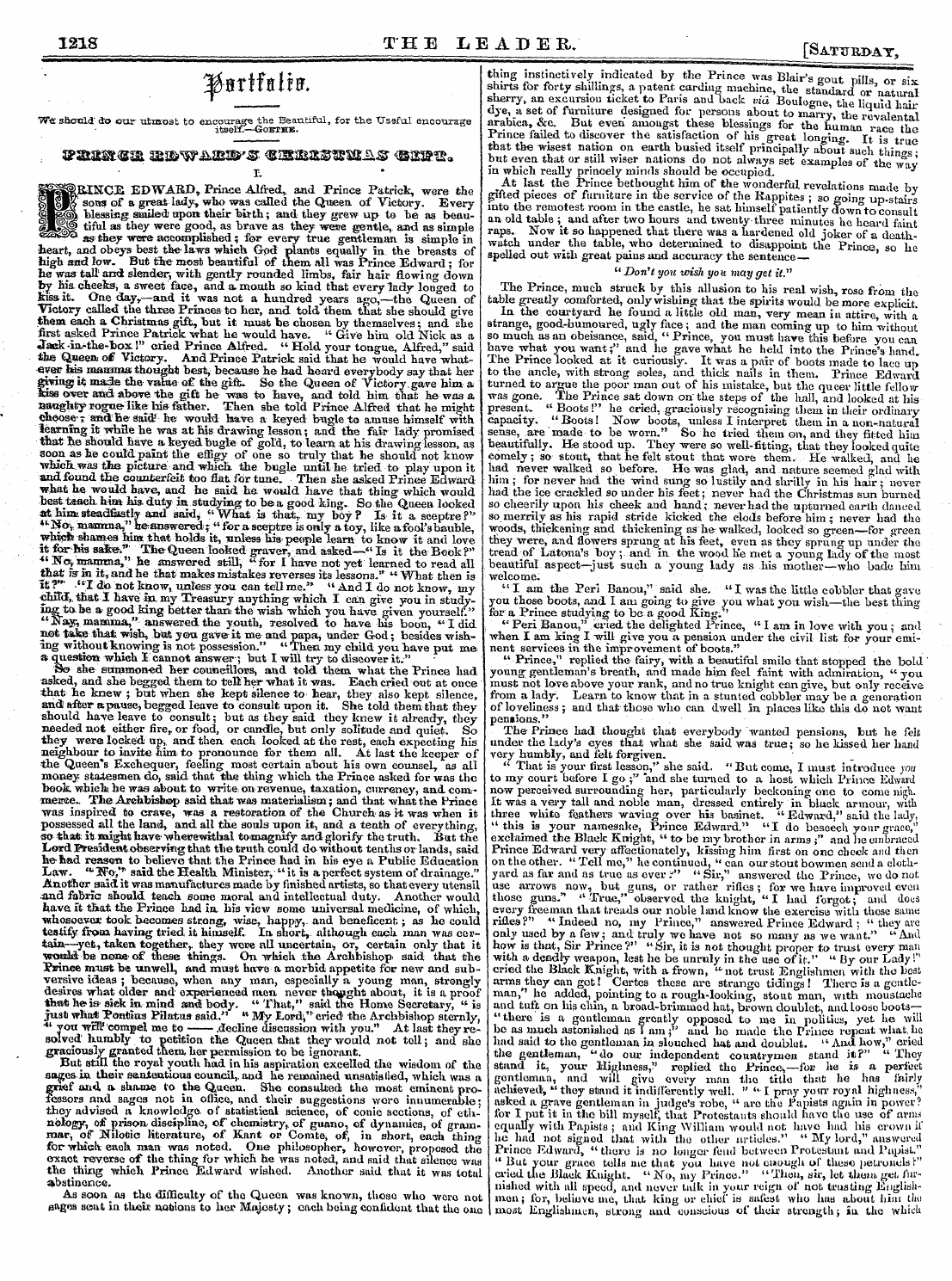
i . SglgmjNCE EDWARD , Prince Alfred ,, and Prince Patrick , were the lHec SOX 3 ® P ^ g ^ at lady , wno wa 3 called the Queen of Victory . Every « Bj » % "blessifig smiled ) upon their "birth ; and they grew up to "be as beau-( Uy | j || tiful as they were good , as "brave as they wese gentle , and as simple G * s ^ & ay they were accomplished ; for every true gentleman is simple in heart , and obeys best the laws which God plants equally in the breasts of high and low . But the most beautiful of them all was Prince Edward ; for he was tall ' and slender , with gently rounded limbs , fair hair flowing down by Ms . cheeks , a sweet face , and a . mouth so kind that every lady longed to fciss it . One day ,, —and it was not a hundred years ago , —the Queen of Victory called the thiee Princes to her , and told them that she should give them each a Christmas gift , "but it must fee chosen by themselves ; and she
first asked Prince Patrick -what he would have . " Give him old Nick as a Jaek-ia-the-box ! " cried Prince Alfred . " Hold your tongue , Alfred , " said £ he Queen ; of Victory . And Prince Patrick said that he would have what-• eyer las mamma thought best , because he bad heard everybody say that her giving it made the value of the gtfL So the Queen of Victory . gave him a Mss over and above-the gift he -was to have , and told him that he was a oaoghty logne like bis father . Then she told Prince-Alfred that he might < jhdose- r and Be aaid ? he would have a keyed bugle to amuse himself with learning it while he was at his drawing lesson ; and : the fair lady promised that he should have a keyed bugle of gold , to learn at his drawing lesson , as soon as he couldjpaint the emgy of one so truly that he should not know which , was the picture and which , the bugle until he tried to play upon it and , found the counterfeit too flat for tune . Then she asked Prinze Edward
what he would have , and he said he would have that thing which would heat teach , him his . duty ia studying to bea good -king- So the Queen looked athint steadfastly and said ^ " What is that r my boy ? Is it a sceptre ?" * ' KoV mamrc ^ " beanswered ; " for a sceptre is only a toy , like a fool ' s bauble , whichshames hinatbat holds it , unless hi * people learn to know it and love it for lib sate . " The Queen looted graver , and asked— " Is it the Book ?" * " No , uoamrna , " he answered still , " for I have not yet learned to read all that is in it , and he that makes mistakes reverses its lessons . ' * ** What then is it ?'" "I dk * not know , unless you can tell me . " " And I do not know , my cHTJ ,, that I have In . my Treasury anything which , I can give you in studying . tabe a good king better than the wish which you have given yourself . " " Nay , mamma , " answered the youth , resolved to have his boon , " I did not take that wish , but you gave it me and papa , under God ; besides
wishing without knowing is not possession . " " Then , my child you have put me a question which I cannot answer ; but I will try to discover it . " Su she summoned her couineillous 4 and told , them what the Prince had asked , and she begged them to teBher what it was . Each cried out at once that he knew ; but when she kept silence to hear , they also kept silence , mid ? after a , pause , begged leave to consult upon it . She told them that they should have leave to consult ; but as they said they knew it already , they needed not either fire * or food , or candle , but only solitude and quiet . So they were locked upj . and then each looked , at the rest , each expecting his neighbour to invite him to pronounce for them all . At last the keeper of the Queen ' s Exchequer , feeling most certain a"bout his own counsel ^ as all money statesmen , do , said that the thing which the Prince asked for was the book whick he was about to write : on revenue , taxation , currency , and coin .-
xnerce .. The Archbishop aaid that was materialism ; and that what the Prince was inspired ta crave , w-aa a restoration of the Church a& vt was when it possessed all the land , and all the souls upon it , and a tenth of everything aa that : it might have' wherewithal tomagnify and g lorify the truth . But tn * e Lord Itesidentobeerviag that the truth could do without tenths or lands , said , he-had reason to "believe that the Prince had in his eye a Public Education Law . < 4 i UTo , ' * said the Health Minister ; , " it is «• perfect system of drainage . " Another jaaid it was manufactures made by finished artists , so that every utensil And fobric should teach some moral and intellectual duty . Another would have it that the Prince had in . his view some universal medicine , of which , whosoever took , becomes strong , wise , happy , , and beneficent , ; as he could testify from having tried it himself . In short , although each man was ce » - taia— -yet , taken together ,, they wore all uncertain-, or , certain only that it would , be none of these things . On which the Archbishop 1 said that the Prince moist be unwell , and must hare a morbid appetite foe new and subversive ideas ; because , when any man , especially a young man , strongly desires what older and experienced nton never th ^ g ht about , it is a proof
that h « is sick in . mind and body . " That , " said the Homo Secretary , " is juab who * Pontius Pilatua aaid . " " Lord 1 , ' cried the Archbishop sternly , " you wrfl ? compel me ( Jo . decline discussion with you . " At last they resolved'humbly to petition the Queen that they would not toll ; and she graciously granted them , her permission to bo ignorant . But still the royal youth had in his aspiration excelled tlio wisdom of the sapes in their sententious council ,, and he remained unsatisfied , which was u gruef an 4 a shaana to the Queen . She consulted the most eminent professors aad sages not in office , and their suggestions woro innumerable ; they advised a knowledge , of statistical science , of conic sections , of ethnology , o £ prison , discipline , of chemistry , of guano , of dynamics , of grammar , of Nilotic literature , of Kant or Comte ^ of , in short , each thing for which each man was noted . One philosopher , however , proposed the e-xact reverse of the tliingfor which lie waa noted , and said that silence was the thing which PrincQ Edward wished . Another aaid that it was total abstinence . Aa aaonaa the difficulty of the Queen , was known , those who were not gages seat in thxju : uobioua to her Mnyeaty ; oach being coniiUout that the ona
thing instinctively indicated by the Prince was Blair's gout t ills or six shirts for forty shillings , a patent carding machine , the standard or ' natural sherry , &n excursion ticket to Paris and back ma Boulogne , the liciuid hair dye , a set of furniture designed for persons about to marry the revalental arabioa , &c . But even amongst these blessings for the human race the Prince failed to discover the satisfaction of his great lono-inw . it j s tr " Z that the wisest nation on earth busied itself principally aoouYsuch things but even that or still wiser nations do not always set examples of the way in which really princely minds should be occupied . ' At last the Prince bethought him of the wonderful revelations made by gifted pieces of furniture in tbe service of the Rappites ; so goin < r up-stairs into the remotest room in the castle , he sat himself patiently dowiftoeonsult an old table ; and after two hours and twenty three minutes he heard faint raps . Now it so happened that there was a hardened old joker of a deathwatch under the tahle , who determined to disappoint the Prince so he spelled out with great pains and accuracy the sentence '
" Don't you wish you may get it . " The Prince , much struck by this allusion to his real wish , rose from the table greatly comforted , only wishing that the spirits would be more explicit . In the courtyard he found a little old man , very mean in attire , with a strange , good-humoured , ugly face ; and the man coming up to him without so much as an obeisance , said , " Prince , you must have this before you can . have what you want ; " and lie gave what he held into the Prinee ' a hand . The Prince looked at it curiously . It was a pair of boots made to lace ur > to the ancle , with strong soles , and thick nails in them . Prince Edward turned to argue the poor man out of his mistake , but the queer little fellow was gone . The Prince sat down on the steps of the hall , and looked at bis present . " Boots ! " he cried , graciously recognising them iu their ordinary capacity . " Boots ! Now boots , unless I interpret them in a non-natural
sense , are made to be worn . " So he tried them on , and they fitted him beautifully . He stood up . They were so well-fitting , that they looked quite comely ; so stout , that he felt stout that wore them . He walked , and lie had never walked so before . He was glad , and nature seemed glad with him ; for never had the "wind sung so lustily and shrilly in his hair ; never had the ice crackled so under his feet ; never had the Christmas sun burned so cheerily upon his cheek and hand ; never had the upturned earth danced so merrily as his rapid stride kicked the clods before him ; never had the woods , thickening and thickening as-he-walked , looked so green—for « reen they were , and flowers sprung at his feet , even as they sprung up under the tread-of Latona ' s boy ; and in . the wood lie met a young lady of . the most beautiful aspect—just such a young lady as his mother—who bade him welcome .
"I am the Pen Banou , " said she . " I was the little coVbler that gave you those boots , and I ana going to give you what you wisk—the best thing for a Prince studying to be a good King . " * ' Peri Banou , " cried the delighted Prince , " I am in love with you ; and when I am king I will give you a pension under the civil list for your eminent services in the improvement of boots . " " Prince , " replied the fairy , with a beautiful smile that stopped the bold young ; gentleman ' s breath , and made him feel faint with admiration , " you must not love above your rank , and no true knight can give , but only receive from a lady . Learn to know that in a stunted cobbler may be a ge n eration of loveliness ; and that those who can dwell in places like this do not want pensions . " The Prince had thought that everybody -wanted pensions , but he Mt under the lady ' s eyes that what she said was true ; so he kissed her hand very humbly , and felt forgiven .
" That is your first lesson , " she said . " But come , I must introduce you to my court before I go ; " " and she turned to a host which Priiirce' Edward now perceived surrounding her , particularly beckoning one to come niglv . It was a very tall and noble man , dressed entirely in black armour , with . three white feathers waving over his baainet . " ¦ Edward , " said the lady , u this is your namesake , Prince Edward , " "I do beseech your grace , " exclaimed the Blaek Knight , " to be my brother in arms ; ' * and he embraced Prince Edward very affectionately , kissing him first on one chock and then on the other . " Tell me , " he continued , " can our stout bowmen send a clotliyard as far and as true as over : " " Sir , " answered the Prince , we do not use arrows now , but guns , or rather rifles ; for we have improved cvou those guns . " " True , " observed the knight , " I had forgot ; and does every freeman that treads our noble land know the exercise with these same
rifles ? " " Indeed no , my Prince , " answered Prince Edward ; " they are only uaed by a few ; and bruly wo have not so many as we want . " " Anil how is that , Sir Prince ? " " sir , it is not thought proper to trust every mun with » deadly weapon , lest he be unruly in the use of it . '' " By our Lady !" cried the Black Knight , ivith a frown , " not trust Englishmen with the best arms ^ they can get ! Certcs these are strange tidings I There is a gentleman , " he added , pointing to a rough-looking , stout man , with moustache and tuft on his cliin , a broad-brimmed hat , brown doublet , andLooso boots" there is a gentleman greatly opposed to me in politics , yet he will bo as ljuicb . astonished us T am ; " and ho made the Prince repeat what , he luid said to the gentleman in slouched hat aaid doublet . " And . how , " cried the gentleman , "do our independent countrymen stand i * P" " They
stand it , your Highness , ? ' replied the Princci , —for- he is a perfect gentleman , and will givo every man tlio title tluife he has fairly achieved ' , " they stand it indifferently well . " " I pray your royal highness , " asked a grave gentleman iu judge ' s robe , " iu'o the Papists again in power ? for I put it in the bill myself , that Protestants should havo tlio use of anus equally with Papists ; and King William would not have had hia crown it ho ^ hud not signed that with the other articles . " " My lord , " answeroil Prince Edward , " thoro is no longer feud between Protestant and Papist . " " But your grace tolla me that you have not enough of these petromilal " cried the Black Knight . " No , my Pi-inco . " " Thou , air , lot them g « l , Jurni » hcd with all speed , and never talk in your reign of not trusting Englishmen ; for , boliiivo me , that king or chief it ) aafeut wbo hna about hint tlui moat Englishmen , strong and conscious of their strength ; hi the which
Untitled Article
We siiarcld' do our Ta £ m-O 3 t to encourage the Beautiful , for tlie Ussful encourage itseEf—Goethjs .
Untitled Article
MM THE DEADER . rSAwm ^^ r .
-
-
Citation
-
Leader (1850-1860), Dec. 23, 1854, page 1218, in the Nineteenth-Century Serials Edition (2008; 2018) ncse.ac.uk/periodicals/l/issues/vm2-ncseproduct2070/page/18/
-