On this page
-
Text (5)
-
Untitled Article
-
Untitled Article
-
Untitled Article
-
Untitled Article
-
Untitled Article
Note: This text has been automatically extracted via Optical Character Recognition (OCR) software. The text has not been manually corrected and should not be relied on to be an accurate representation of the item.
-
-
Transcript
-
Note: This text has been automatically extracted via Optical Character Recognition (OCR) software. The text has not been manually corrected and should not be relied on to be an accurate representation of the item.
Additionally, when viewing full transcripts, extracted text may not be in the same order as the original document.
Untitled Article
giilt beiiig many . Lands- out of work ,- and lavrer wagQS . ~< How-was it that the manufacturera 'were « betrayedr -into that' erroneous niiticipatibn of business ? It arose from the fnfet'th ' at each man tried to anticipate the market , and kept his movements secret from hiafellott-s , although he might have known beforehand that the same impulses would be influencing others equall y with himself . So it proved , every man making as much as he could , sending out as much as he could . All made too much , and bankruptcy came home to the manufacturers—want of work to the
men . ] NTbw the working hands themselves assist in piling up this evil . If the cottontrade can be rescued from that condition in which its producing power exceeds the consuming power of foreign markets , it must be by rendering its products yet cheaper , and thus spreading to wider markets ^ and at the same time by so improving its methods as to require less ^ hand labour . The working classes will assist in this reform by withdrawing their labour from the factories ; and hence their advantage and safety in that
process which we have already recommended to them as the true substitute for the suffrage at home—it was Mahomet ' s process- ^ -to go to the suffrage if the suffrage would not come to them . Let them emigrate . Every man who goes to America or Australia may , after a first trial of difficulties , become a landowner himself , or the father of landowners , and see his family continually rising in wealth , comfort , and intelligence . He ceases to become the half-pauperised maker , and becomes the consumer ; thus helping the fellows whom he left behind .
Those who remain at home , however , would still need something to strengthen them against the overwhelming power which wealth _» nd combination amongst similar numbers places at the command of the millowners ; and it is to be found , we believe , in the same thing that is wanting throughout all English public action just now—a stronger regard for each other ; a greater fidelity to the interests of class , a great firmness in combining , a more powerful feeling of personal regard for their fellows and their leaders .
Untitled Article
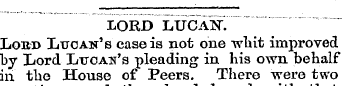
LORD LUCA 1 SL Loed Luoan ' s ease is not one whit improved by Xiord I / Oman ' s pleading in his own behalf in the House of Peers . There were two questions : whether he behaved with that judgment which should characterise an officer in command of cavalry ; and next , whether he
deserved a court-martial ? "With the latter point we shall not trouble ourselves , as the obstacle was the military law ordaining that no officer or soldier shall be tried upon any charge if he served after that charge should have been made . Upon the first question we may add a few words to our former statement .
There are ' several minor questions in Lord Lucan ' s defence , but the turning point of the whole affair rests upon his interview with Captain Noj ^ an . According to Lord Lucan ' s own statement , Captain Nolan brought him the written order which we placed before our readers a fortnight ago . That ordor , as we concoivo , and our opinion is sustained by Lord Cardigan , Lord Hahdinge , and the Duke of Richmond , directed the commander of cavalry to malco a tentative advance to test the practicability of saving the guns which Lord Ragljiit believed the liussians were
removing from the redoubts . Captain Noian delivered the order , and went beyond his duty in accompanying it with a verbal explanation , that it meant Lord Luc an should attack immediately . Hero lies the pith of the case . Should Lord Xtjcan have obeyed Captain
ISToiiAN ' s interpretation , or Lord Emian's written order ? There can be no doubt that when an aide-de-camp brings a verbal order from the commander-in-chief , the officer to whom it is addressed is bound to obey it , quite as much as if he had it from the lips of the commander himself . But military authorities and common sense agree that when a written order is sent , the writing , not the
speaking , is to be < followed . Lord Lucan lost his temper ; obeyed Captain NoiLAN , and justified Lord Rage an ' s rebuke to him on the evening of the day , when "he said , " Why , you have lost the Light Brigade . " " Wio may say , with the Duke of Richmond , that if verbal interpretations are to be regarded , " what , in Heaven ' s name , is the use of a written order ?"
As we have said before , the order was eminently discretionary . And the minor questions introduced by Lord Lttcaist only sei * ve to show that he lost his discretion . He says the guns were not being carried away * that Lord Raglan was mistaken in thinking they were . Well , if that is so , was it not stronger ground for a discretionary execution of the order ? Lord Raglan informed him
that the French cavalry were on the left : As he had interpreted the order , or rather as he had adopted Captain Nolan ' s interpretation , he thought that the information about the French cavalry did not mean that he might combine his operation with theirs , but that the French cavalry , had been already ordered to advance . Therefore , he says , he had no time to communicate with them , and had-he not charged he would have
left them unsupported before the enemy . This" was another ^ blunder . It is clear , that the intimation given by Lord Raglan , as to the French cavalry , related solely to their position in any combined movement . The fact is the French cavalry ^ did not take part in the charge of the Light Brigade , but charged afterwards , in order to silence a portion of the Russian fire , so fatal to the Light Brigade .
Lord Litcan made an ex parte statement of the events of the day ; and we are not in a position to test its accuracy . But one fact , not an unimportant fact , comes under the test . In his speech Lord Lxjcan said that Lord" 0 abdigan had sent him . a message to say that he found the enemy so numerous as to make it difficult for
him to hold his ground . Lord Cardigan promptly supplies the correction . He sent no such message ; the message he did send was sound information , to the effect that the hills on both sides of the valley were occupied by Russian artillery and riflemen , with cavalry drawn up behind . That is the information ¦ which should have prevented Lord Lucan from ordering 700 horsemen to attack the Russian army . AVe see no reason to alter our opinion that Lord Lucatst alone is responsible for the loss of the Light Brigade .
Untitled Article
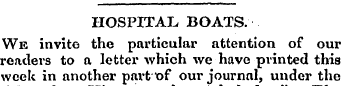
HOSPITAL BOATS . We invite the particular attention of our readers to a letter which we have printed this week in another pavt"of our journal , under the title of " Hints to the Admiralty . " The letter proceeds from a gentleman whose statements ai'e in the highest degree deserving- of our respect and confidence . While we are horrified at the revelations before the Crimean Committee as to the transport of the sick and wounded at Scutari and Balaklavn , it is important that the public , should be aware that at this very time , and upon our own shores , the sick are conveyed from our ships to the hospital , * in the most cruel , and careless manner . Even at Spithead wo
find the alternative of Imen belng ^ . laid -up in a confined cockpit . and spreading " , infection through a ship , perhaps through a , fleet , , at a moment when neither ^ , ship nor a man can be - spared , or of their being , pulled on shore > - , fever-stricken and exhausted , in open boats . - Surely , at each of our great , naval ports there' ? should be a service of hospital-boats . Toarrest the chances of infection in-the ships / « and to convey the sick to the hospital « witb f as much ease * comfort , and .- celerity as pos- * - sible , seems to' us to be a question of the ** - simplest duty and of the first necessity .
Untitled Article
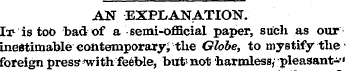
AN EXPLANATION . Ir is too bad of a -semi-official paper , such as our inestimable contemporary ; the Globe , to mystify the foreign press with feeble , but ' not 'harmless ; pleasant- *' ries . A journal that enjoys the happy privilege of > seeing that everything is good in every possible act ; of every possible ministry , on thiB side Toryism , hasno business -with joking . It is expected '' to be 'at least decency dull . What shall we ^ thinkbfa journal which is supposed to represent with due" * decorum the policy of the Whig Cabinet , placing at the&ead of a column usually devoted to the scrapings of
Dovrn-ing-street , a conspicuous paragraph in leaded type , tatheeffect that *« we have been requested to'state thatpthei King of Prussia was accidentally shut out from- ' the division at the Conferences of Vienna . " We quote the sense , if not the exact words , of the paragraph . This unseemly and not brilliant burlesque of parliamentary slang is an unpardonable indis- ' cretion at such a crisis . It ia not only a clumsy an « fr misplaced insult to that king , who , however weaky is still strong enough to be courted by the Western - Powers , it is an unjustifiable deception practised - upon the good faith and simplicity of the continental " journals , who have reasonable grounds for consider- '* ing a journal- like the Globe to be serious andJ ;
circumspect . What would be thought of the Moniteur inserting-a paragraph , a la Charivari , ' -at the head of its " Partie rion qfficielle" immediately under a batch of Napoleonic decrees , or a state paper of M . Drouyn de Lhuys ? Why , it would throw ' every Bourse of Europe into hysterics , and frighten even Powning-street from its propriety- Here is the careful and judicious Debats gravely accepting this paragraph of the Globe aa if it were a sort of semi-official sop to the dignity of his Prussian Majesty , who is still to be coaxed . Here is La Pr ' esse , habitually keen and wide awake , - solemnly taking note of this- paragraph in the Globe , as an unaccountable postscript to Lord
Lyndhurstfs debate , which defies explanation , and which it does not pretend to solve . We can only request our French contemporaries to believethat the Globe is an after-dinner organ of the-Ministry . Unfortunately this paragraph was perpetrated on the "Day ' of Humiliationr Perhaps a fastday for the Globe is a day of fast writing . We would , however , suggest to our semi-official friend to desist from this species of " fast" paragraphs in future . They belong to the facetious columns of young Toryjournals , to whom is permitted the desolate liofficeNevertheless
cence of Disraelites out of . , we cannot help suggesting , that if the Debats had called iu . M . John Lemoinne , and if La Presse had consulted At . Alphonse Pcyrat , this ridiculous mystification ( the King of Prussia at the Vienna Conference !) would have been , impossible . Either of these distinguished journalists would have easily seen through , the Parliamentary slang pf this sorry nonsense . But French journalists have , we fear , forgotten even the blague of Parliamentary institutions .-
Untitled Article
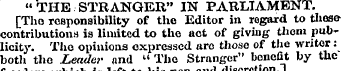
" THE STRANGER" IN PARLIAMENT . [ Tho responsibility of the Editor in regard to these contributions is limited to the act of giving thorn publicity . Tho opinions expressed are those of the writer : both tho Leader « nd " Tho Stranger" benefit by the freedom which is loft to his pen and discretion . ] The nation seems quite proud of its Day of Humiliation , in the belief that tho sitting of Parliament down at St . Margaret ' s , on last Wednesday , has placated Providence and induced tho favourable turn now visible in the news both from Balaklava and Vienna * It is such a struggle for that highly practical assembly , tho House of Commons , to put on a pious air , that
one may naturally look for surprising consequences , once the operation of going to church has been 4 W * . complishcd . Lord Palmerston , with hie views about tho Kcdctnption—which ho think * the Home Minister of tho period ought to have discouraged—could not . bo expected to seo with any great . acutwiess the-necessity of his spending a . mominff'AnMtbijtJud « ou
Untitled Article
MabCh ^^ 1855 . J THE JfJ $ A * D ® lL 2 im
-
-
Citation
-
Leader (1850-1860), March 24, 1855, page 279, in the Nineteenth-Century Serials Edition (2008; 2018) ncse.ac.uk/periodicals/l/issues/vm2-ncseproduct2083/page/15/
-