
On this page
-
Text (2)
-
Untitled Article
-

Untitled Article
Note: This text has been automatically extracted via Optical Character Recognition (OCR) software. The text has not been manually corrected and should not be relied on to be an accurate representation of the item.
-
-
Transcript
-
Note: This text has been automatically extracted via Optical Character Recognition (OCR) software. The text has not been manually corrected and should not be relied on to be an accurate representation of the item.
Additionally, when viewing full transcripts, extracted text may not be in the same order as the original document.
Untitled Article
appropriated securities ; and the case does not involve that only young commission house , but is the subject of an action at law , in which the house of Overend , G-ttrney , and Co . are defendants . Banks , at all events , were supposed to be immaculate ; but in one at least , outwardly and undistinguished from many other private banks , we find that the partners themselves have been carrying away the
property of the customers that trusted them ; have been using expedients of that kind to keep up an appearance of means that did not exist , and leave their creditors to divide enormous losses . As the mustard you buy is turmeric , the pickles are seasoned with poisons , so the securities are vitiated , and in the strong-box of the bank there is the lawless hand of the banker .
What guarantees can be a protection where the criminal law itself is insufficient ? Those who object to limited liability in partnership do so because they say the property of the partner should justly be surrendered to the creditors of the firm , and the possibility of losing it is the best of checks upon reckless trading . A fortune of 180 , 000 Z . would generally be thought a sufficient caution-money ; yet Mr . Stbahan , a man personally esteemed , allows that money to be invested in the bank , and is not prevented by his own liability from letting the firm to which he has belonged eventful into bank
drift through an course - ruptcy and the criminal court . In fact , all liability is limited ; a man cannot be liable for more property than he possesses , except by his body , aid we are not aware that any dissecting academy would give sufficient for the bodies of the three partners to make up the balance of 400 , 000 ? . and odd for their creditors . The liability of banks , then , is limited to their means of meeting it . The second partner must virtually have made away with a fortune not less considerable : he now has to face the consequences ; and we see that these outside checks—this
forfeiture of property , this prospective penalty of the criminal law—are of no avail when the very life-blood of commercial integrity is vitiated . Commerce , we say , has drawn the disaster upon itself . The grandfather of the present tradesman , the plain man who paid his way and was proud not to possess a house at the
West-end , laid down the law in commerce , that that is right which " pays . " This has been taken as the grand test of commercial correctness . Any transaction which would pay was thought to be right . By a perfectly consistent application of the rule , that which would pay on the books was correct . Hence , if on the books a merchant can calculate
that he has only incurred certain liabilities within a given time , and that returns will accrue within a given time , the whole is correct , though no allowance be made for friction in demurrage of ships , failure of sale , or delays of payments . Hence many a house is bankrupt in fact , though not in the theory . The pmjmcf rule having become the sole test and guide , no moral check is offered to expedients for securing payment ; hence speculations upon the very subject of
bankruptcy , and we find some houses which are ranked with others of high character dealing in securities of doubtful liabilitythat is , trading in the bankruptcy of their fellows . It is but one more step to trade in one s own bankruptcy—only a stop further to the embezzlement of securities . Indeed , if once absolute personal integrity bo abandoned , there ia no control or guide for * the trader . All is confusion ; bankruptcy becomea one of the normal attendants of
commerce . Now , the whole mass of property forfeited in consequence is an aggregate loss to trade . It is the penalty imposed upon
commerce for its own moral depreciation . men are too lax or too lazy to look after their own characters , they will scarcely look after the character of their customers . Even commerce , therefore , cannot give up that high feeling of honour , that sentiment , which in any one transaction may appear as if it would not pay ; in the aggregate it is , we see , the great safeguard , the sacred fire without which British commerce would die out . The plain man ' s father knew as much in his day , three generations back ; but the march of intellect has made us wiser !
Untitled Article
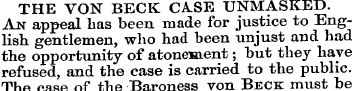
THE VON BECK CASE UNMASKED . An appeal has been made for justice to English gentlemen , who had been unjust and had the opportunity of atonement ; but they haye refused , and the case is carried to the public . The case of the Baroness von Beck must be in every reader ' s recollection ; she appeared before the public as a victim to patriotism ; she sought assistance from Englishmen on that ground ; travelled about the country accompanied by a Polish gentleman , and . thrust herself upon the hospitality of those who had sympathy for Poland and means to spare . It came to the knowledge of Mr . TouxMisr Smith that this woman was an impostor , and that she had , in fact , acted as a spy upon refugees , under the foreign department of the English police . She visited Birmingham , her imposture was stated to persons there , and it will be remembered that Mr . Geohge Dawson was one of those consulted as to the propriety of bringing her to justice . Anxious to save her from any undue vexation , he used some pains to ascertain her identity . That ascertained , justice took its course . It was an accident that the woman died in the custody of the police , and while a very piteous case was made out on her behalf , those who
had exposed her infamous function were represented as her traducers , if not as her assassins . An appea ] . was made by Mr . Tottlmin Smith to Lord Paxmerston , who declined to interfere , and the course taken by Government , was such as to make the public believe that the Baroness Von Beck had been , wronged . It now turns out that Lord Pai / meiiston had written the following letter in reply to a qfuestion from Mr . Ironside , of Sheffield , who has published the fact in his vigorous newspaper , the Sheffield Free Press : " Broadlands , 3 rdJanuary , 1852 .
Ct G £ « T waamw-i . ^ ¦¦ rj-fcvi'M int-tAt * svf * f-li'i 1 af . inafonf " Sir , —I received your letter of the 1 st instant , and can reply to the question put in your missing letter , as now restated by you . When I saw , some months ago , a statement in the newspaper that the person who called herself the Baroness Von Beck had been employed by the police in this country , I made inquiry upon the subject , and I ascertained that she had offered her services to the Government , but that her offer had been declined , and that Bhe never had been bo employed . I state this for your own information , but X do not wish to be brought into the controversy by the publication of this letter , or by having my name quoted in regard to the matter . " I am , Sir , yours faithfully , —Palmeuston . " To this Mr . TouiiMiN Smith adds : —
The following written testimony , by an employe" of the English Police , is in my possession . It now acquires an importance which cannot be exaggerated : —" I beg to inform you that the person styling herself 'Baroness do Beck , ' is the same who , accompanied by Dr . II , offered personally her services as a spy and informer to the recently established ( 1851 ) foreign branch of the English police force . / know likewise that for a fortnight or three weeks she has obtained for such services the sum of 51 . 1 Os . 8 d . per week . " - To what foreign sum 5 / . lCs . 8 d . corresponds , is a question not difficult to solve . The sum , however , proves the complicity between , tho English and Fo * roign Police . —T . S .
Mr . IitONsroR is tho friend of tho gentlemen who wore so slandered at tho time of Von Beck ' s death . Ho felt himself , however , under an obligation not to publish Lord PaiiMEKston ' s letter .
HOW TO ORGANISE AN ARMY . The folio-wing remarks were made during a conversation held in Paris in 1853 : — " A military nation , " said M . Tb . s , " can without much preparation , invade an unwarlike neighbour . It would not take us long to make a rush on Belgium . But if a serious invasion is to be attempted , if good troops are to be encountered , and an army is to be got ready to which the honour of the country can be trusted , six months is a very short period . First , the different regiments must be sifted , to get from each of them two bataillons ( Telite for foreign service . ^ r-w s ~ +. "w-wT- w-n j"v j ~^ T ~* ^* 4 A . " * T ¦ fi T ^ A TL . T * A "w ^ "m » . _
These battalions must be united m brigades , and the capacity of the regimental officers tested by the chef de brigade , in the same way in which those officers tested that of their own privates and sous-ofjiciers . The brigades again must be united in a division . They must be accustomed to act together , and to know how far one regiment and one brigade can rely on another . The general of division has to do only with the colonels . He sends away all those whom he finds too old , or too negligent , or too ignorant , or too dull for real fighting : and the comparatively low social position of our regimental officers—more than two-thirds of whom have risen from the ranks—enables him to do so without mercy . It is thus by a long-continued process of selecting ,
and training , and changing , and promoting , and discharging , tMfet a division is moulded and welded into one mass of homogeneous materials , the efficiency of which can be relied on , as we rely on that of a well-constructed machine . If any one step in the process be omitted , or even hurried over , the machine becomes imperfect , and , if it be opposed to one that has been properly prepared , it will break in the general ' s hands . But this takes time : six months is too little . The army that won the battle of Austerlitz had been subjected to this training for more than two years . " The army of the Hundred Days , which gained the battle of Ligny , was raised by Napoleon in less than six -weeks ; but you must recollect what were his materials . More than 180 , 000
veteransmen who , though young , had passed years under fire , whom he had scattered over all Europe , from Dantzig to Alexandria , were restored to France by the peace . He bad only to stamp and the legions sprang up . And , after all , what was the result ? This hastily-collected army was broken , was scattered , was actually dissolved as no French army ever was before in a single battle . Would the army of Austerlitz have thus fallen to pieces ? I will not say that that army would have gained the battle of Waterloo ; though . if it had been ready , as it would have been , to attack at eight in the morning instead of at eleven , the chances would have been in its favour ; but I affirm that it would not have been ignominiously beaten . It might have failed , but it would not have been destroyed .
" Now , nothing but a first-rate army could invade England . They must be men , like those of Cortez , whoso courage would not flinch when they saw nothing but the enemy before and the sea behind them . Napoleon thought 180 , 000 men necessary—and 180 , 000 of his men were worth 300 , 000 of ours . AVhere can a double fleet be found , one to carry the troops , the other to defend them ? For the transports , even if ships of war , could not fight : the soldiers would rise on the crews . No men could bear to stand or be inactive behind a ship ' s sides through which shots were driving . It is difficult to keep them nteady under a cannonade in tho field when they are
encouraged by the constant hope of attacking in their turn . The transports must be kept out oj fire , and how is this to be done unless a fleet large enough to keep yours at bay—that is to say , larger than yours—accompanies them . We have no such fleet , and it would take nt least a year to form one . Therefore , I repent , you will have a year ' s warning . " London could not bo entered by less than 25 , 000 men—and to bring 25 , 000 men to London , 50 , 000 must bo landed in Kent or Dorsetshire . Such an army and the fleets that would have to carry and protect them could not be' got ready m six months . Tho idea , however , -of a diiah on London is preposterous . Fifty thousand men thrown on your shores might , indocd , do you __ . ... r i /• i j . . i .. 1 , 1 !¦ »<» iiltminXOlV niisumeiuui j « - •¦
i unormous , lhuj w »««»* " » - r . sacrificed , and such a sacrifice would bo fatal to the best-established government . . Depend on it , that if he attacks , and I still bohevo
Untitled Article
If 624 t ^ THE LEADER . [ Saturday , M ^^^^—i ^^ E ^^^ W ^^^^^^^^^^^^ ^^^^^^^^^^^^^ . ¦ i T ( % ¦ _ ¥
-
-
Citation
-
Leader (1850-1860), June 30, 1855, page 624, in the Nineteenth-Century Serials Edition (2008; 2018) ncse.ac.uk/periodicals/l/issues/vm2-ncseproduct2097/page/12/
-