On this page
- Departments (3)
-
Text (7)
-
Untitled Article
-

Untitled Article
-

(Contents
-
Untitled Article
-

Untitled Article
-
20)VmVt irf" "fftl> QXYa^ U. P/21U}aI Di IIJF X-UFEiV *
-
ojp ^ ^ r ^y ^r^^^ ^^ Vv ~VJ ^ v- -v ? A POLITICAL AND LITERARY EEYIEW.
Note: This text has been automatically extracted via Optical Character Recognition (OCR) software. The text has not been manually corrected and should not be relied on to be an accurate representation of the item.
-
-
Transcript
-
Note: This text has been automatically extracted via Optical Character Recognition (OCR) software. The text has not been manually corrected and should not be relied on to be an accurate representation of the item.
Additionally, when viewing full transcripts, extracted text may not be in the same order as the original document.
Untitled Article
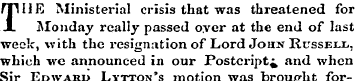
T HE Ministerial crisis that was threatened for Monday really passed oyer at the end of last week , with the resignation of Lord John Russeix , which we announced in our Postcript ^ and when Sir Edward Lytton ' s motion was brought forward for discussion on Monday , the question was so . completely settled , that he did not" venture to carry it to a division . Before Sir Edward moved , Lord John stood up and made an explanation . His statement really added nothing to the information conveyed in the Fifteenth Part of Eastern
papers , " communications with the Austrian Government , " which the public had been perusing for the two previous days " with all the interest of a novel . " Dut his explanation was not without interest as another chapter in the analysis of a public man—the dissection of an eminent nobleman after political suicide , with a clinical lecture by the subject himself lying on the dissectingtable . Lord John told us , as any reader could have gathered from his despatches , that he went to Vienna impressed with the duty of laying before the Austrian Government that which was
virtually an ultimatum from this country , requiring either the " neutralisation" of the Black Sea , by excluding all war ships , or the u limitation" of the Russian naval forced to four ships of the line with other vessels in proportion . But after he arrived at Vienna he underwent Beveral conversations with Count Bvou—one of them four hours in length—and began to perceive practicability in the Austrian plan of " equipoise , " lotting the other powers counterbalance the force
of Russia if they pleased ; so he promised , in Count Buojl ' s official chambers , to support , in London , the very counsels that he was commissioned to oppose in Vienna . Yet again , after hid teTurn to London and much talk with his colleagues—events meanwhile pursuing their course rapidl y—ho began toporceivc the t / wpraoticability of the Austrian plan . Ho assures us that he was
perfectl y honest in all these opinions ; and what is more wonderful , if tlio report of his speech be carefull y read , it will be found that he is of all these opinions still—that ho is in ' favour of peace on tho Austrian plan of equipoise , but sees that lt is impossible . There was nothing in all this that ought to have surprised tho House of Comwona ; they had become familiar with tho impartial opinions of tho Hamlet of tho House of
Bedford—with " Finality John , " who insisted that we need no more reform , and opposed Mr . Locke King ' s 10 / . franchise as a preface for proposing a 5 / . franchise of his own—who resisted the reduction of the sugar duties , and then proposed a reduction , in order to prevent Sir Robert Peel from beginning his great career in carrying the Whig doctrines of free-trade . But it was one thing to find excuse for Xord John personally , and another to tolerate the representation of this country abroad by a Minister who was for a vigorous prosecution of the war while accepting a compromise , and backed the demands of his own
Government with promises to back the demands of the opposite side . Lord John ' s proverbial impulses have led him alternately with the popular party , and then the popular party has used the Lord for its instrument , or against the popular party , and then Lord John always " retires to a backbench . " He has done so just now , and the country is very much inclined to leave him there The ' explanation enabled us to understand Lord John better , and enabled the country to understand its own comprehensive reasons why it was tired of being represented by such a Lord , either in the Cabinet or in Count Buor / s official
chambers . Sir Edward Lvtton was to have moved " That the conduct of our Minister in the recent negotiations at Vienna has , in the opinion of this House , shaken the confidence of the country in those to whom its allairs are entrusted "that is , a censure on the Ministry because such a man as Lord John Russell remained in it . TJut Lord John did not remain in it : and how could
Sir Edward ask the House ot Commons to censure the Cabinet for having in it the man who is not there ? No doubt , by a kind of ingenious twist , it was possible ; still to apply to the Government a certain censure for having had in it such a man as Lord John ; but the English Parliament id not good at following refinements of that kind ; from tho very first the position was one that implied that most harassing kind of defeat in
the House of Commons , an indiflorent reception throughout . It would have ] been hotter to drop it ; but Sir Edwabi > had made up his mind to associate his name with tho train of events that drove Lord John Russmxl from power , tho speech was ready , audit was notia his heart to lay it on the shelf . Ho persevered . It has beeu observed , however , that no pains in editing the composition so aa to bring it to tho
present day could rescue it from its posthumous character . In the very petty and mechanical matter of tenses , Sir Edward found it impossible to reconcile the present with the past . He was continually speaking in the present tense when he should have spoken in the preterpluperfect ; speaking in the positive mood , when it should have been in the conditional . Occasionally the polished phrases became a little damaged in imparting the due antiquity of colour . Oonceived as a diatribe , the composition had to be converted into an historical essay ; and when the orator int ended to denounce the Government for
insincerity ia its warlike language while the plenipotentiary at Vienna " sits on that bench , " he had to turn his denunciations into the complaint that the Ministry was insincere in its patriotism so long as the Minister sat . on that bench " up to Thursday last . " Dates and emotion do not go well together . Sir Edward ' s doleful tragedy sounded like the celebrated song of Guy Fawkes , where the singer tells us how the conspirators
blew up the King and all his Ministers— " that is how they would have done it , " if everything had not happened otherwise . No studied " quousque tandem" could tell upoix an audience , when it had thus to be delivered at every sentence with an " if , " " while ; " and the anachronism of the invective told fatally upon the remainder of the debate . The rescue lay in the fact that Lord Palmerston had been made angry . Sir Edward had endeavoured to draw a distinction between
Lord Clarendon , whose language , written and spoken , happens to bo singularly lucid and unmistakable , and Lord Palmerston , maintaining that while Lord Clarkndon deserved credit for the patriotism and stubbornness of his bearing , Lord Palmekston , who ruled over the Cabinet as a whole , was responsible for tho recreant Lord John . Lord Palmerston did not take time to reflect upon the exact meaning of Sir Edwahd's studied distinction ; ho Jiccused him
of ignorance , if he did not know that the language of the Foreign Secretary must be the language of tho Cabinet and of the Premier , and of malignity if ho did know it . Tho reason for Sir Row aw * distinction came out afterwards , when Mr . Visuaeli insisted that for a . time tho whole Cabinet agreed with Lord John ; and when Mr . Rohbuck , anticipating his own dobuto on the next night , roundly declared that there were " traitors in tfie Cabinet . In tho course of tho debate some of tho traitors wore named as being Sir Chakms
Untitled Article
VCXL . VI . No . 278 . ] SATURDAY , JULY 21 , 1855 . Price { SS 3 !? ::: SK 5 S »
(Contents
( Contents
Untitled Article
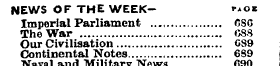
NEWS OF THE WEEK- " « Imperial Parliament fiSG The War CSS Our Civilisation 089 Continental Notes 6 S 9 Naval and Military News C 90 Miscellaneous 690 Postscript 691 PUBLIC AFFAIRSThc Despatches and the Debates ... 692 Modern Fortification 692
: The War in Asia 603 I General Guyon 694 . > Coming Repeal of the Beer I Act 694 Government and Civil Service of India 695 ChanderaaRore 696 Wife and no Wife 697 The Conduct of the War 697 Professor Faraday and the Thames 69 S What they are Saying in Paris ... 698
OPEN ! COU . MCILSuggestioiis for Consciencestricken Shopkeepers 699 LITERATURESummary 700 The Spanish Conquest in America 700 Morality of Willielm Meister ... 703 Twenty Years Conflict in the I Church 703 The Custom of Dixamow 703
THE ARTSL'Etoile du Nord 704 Births , Marriages , and Deaths .,. 705 COMMERCIAL AFFAIRSCity Intelligence , Markets , Advertisements , &c T 705-70
Untitled Article
" The one Idea which History exhibits as evermore developing itself into greater distinctness is the Idea of Humanity—the noble endeavour to throw down all the barriers erected between men by prejudice and one-aided view 3 ; and by setting aside the distinctions of Religion , Country , and Colour , to treat the whole Human race as one brotherhood , having one great object—the free development of our spiritual nature . "—Httmboldt ' s Cosmos .
20)Vmvt Irf" "Fftl≫ Qxya^ U. P/21u}Ai Di Iijf X-Ufeiv *
3 fam nf ffje Wttk .
Ojp ^ ^ R ^Y ^R^^^ ^^ Vv ~Vj ^ V- -V ? A Political And Literary Eeyiew.
afp ^ ^ r ^ y ^ T ^^ ^^^ Vv ~\ r ^ V- --V ? A POLITICAL AND LITERARY EEYIEW .
-
-
Citation
-
Leader (1850-1860), July 21, 1855, page unpag., in the Nineteenth-Century Serials Edition (2008; 2018) ncse.ac.uk/periodicals/l/issues/vm2-ncseproduct2100/page/1/
-