On this page
-
Text (2)
-

Untitled Article
-

Untitled Article
Note: This text has been automatically extracted via Optical Character Recognition (OCR) software. The text has not been manually corrected and should not be relied on to be an accurate representation of the item.
-
-
Transcript
-
Note: This text has been automatically extracted via Optical Character Recognition (OCR) software. The text has not been manually corrected and should not be relied on to be an accurate representation of the item.
Additionally, when viewing full transcripts, extracted text may not be in the same order as the original document.
Untitled Article
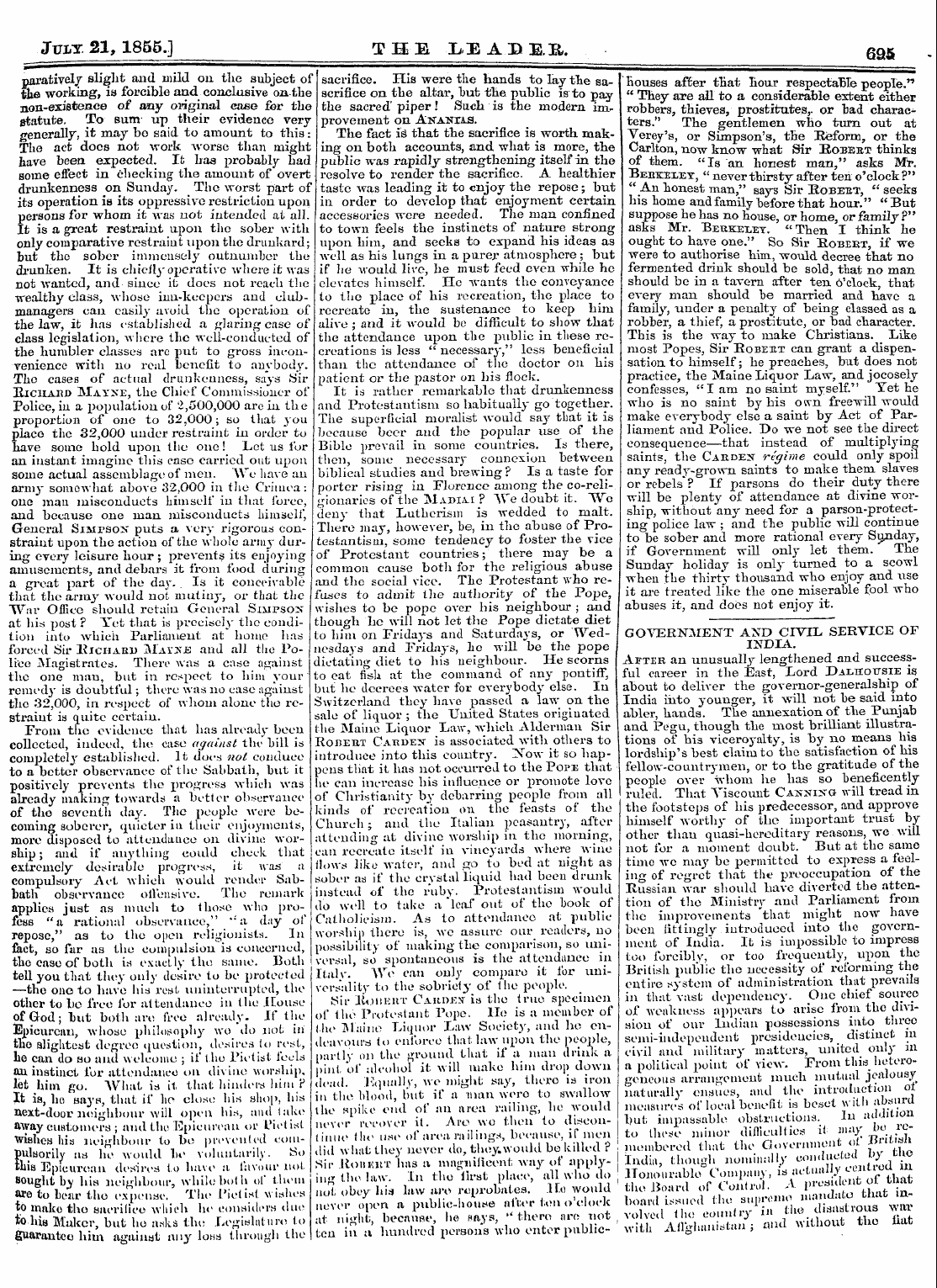
parativelj slight and mild on the subject of the working , is forcible and conclusive on . the non-existence of any original ease for the statute . To sum up their evidence very generally , it may be said to amount to this : The act does not work worse than might have been expected . It has probably had some effect in checking the amount of overt drunkenness on Sunday . The worst part of its operation is its oppressive restriction upon persons for whom it was not intended at all .
It is a great restraint upon the sober with only comparative restraint upon the drunkard ; but the sober immensely outnumber the drunken . It is chicily operative where it was not wanted , and since it does not reach the wealthy class , whose Lni-keepcrs and clubmanagers can easily avoid the operation of the law , ifc has established a glaring case of class legislation , where the well-conducted of
the humbler classes arc put to gross inconvenience with no real benefit to anybody . The cases of actual drunkenness , says Sir KiciiAim Maine , the Chief Commissioner of Police , in a population of 2 , 500 , 000 are in . the proportion of one to 32 , 000 ; so that you place the 32 , 000 under restraint in order to have some hold upon the one ! Let us for an instant imagine this case carried out upon some actual assemblage of men . ~\ Ve have an
army somewhat above 32 , 000 m the Crimea one man misconducts himself in that 1 ' orce , and because one man misconducts himself , General Simpson puts a very rigorous constraint upon the action of the whole army during every leisure hour ; prevents its enjoying amusements , and debars it from food during a groat part of the day . . Is it conceivable that the array would not mutiny , or that the " War Office should retain General Simpson at his post ? Yet that is precisely the condition into which Parliament at home has
forced Sir Richard Mavjtjb and all the Police Magistrates . There was a case against the one man , but in respect to him your remedy is doubtful ; there was no case against the 32 , 000 , in respect of whom alone the restraint is quite certain . From the evidence that has already been collected , indeed , the case against the hill is completely established . It does not conduce
to a better observance of the Sabbath , but it positively prevents the progress which was already making towards : i better observance of the seventh day . The people were becoming soberer , quieter in their enjoyments , more disposed to attendance on divine worship ; and . if anything coidd cheek that extremely desirable progress , it was' a compulsory Act which would render Sabbath observance offensive . The remark
applies just as much to those who profess " a rational observance , " " a day of repose , " as to the open religionists . In fact , so fur as the compulsion is concerned , the case of both is exactly the same . Both tell you that they only desire to be protected —the one to have his rest uninterrupted , the other to be free for attendance in the House of God ; but both are free already- Xf the Epicurean , whose philosophy wo do not in the slightest degree question , desires to rest , lie can do ao and welcome ; if the Pietist feels
an . instinct for attendance on divine worship , let him go . " What ia it that hinders him ? It is , ho says , that if ho close his shop , his next-door neighbour will open his , and take away customers ; and the Epicurean or I'irtisl wishes lua neighbour to be prevented coiupnlaorily as he would lie voluntarily . t 3 o this Epicurean desires to have a favour not . Bought by his neighbour , while both of them We to Lour tho expense . The Pietist wishes to make tho sacrifice which he considers due to his Maker , but ho naks the Legislat uro to guarantee him against any loss through the
sacrifice . His were the hands to lay the sascrifice on the altar , "bub the public is to pay the sacred' piper ! Such is the modern , improvement On AtXATSTLS . The fact is that the sacrifice is worth , making on both accounts , and what is more , the public was rapidly strengthening itself in the resolve to render the sacrifice . A healthier taste was leading it to enjoy the repose ; but iu order to develop that enjoyment certain accessories were needed . The man confined
to town feels the instincts of nature strong upon him , and seeks to expand his ideas as well as his lungs in a purer atmosphere ; but if he would live , he must feed even while he elevates himself . He -wants the conveyance to the place of his recreation , the place to recreate in , the sustenance to keep him alive ; arid it would bo difficult to show that the attendance upon the public in these recreations is less " necessary , " less beneficial than the attendance of the doctor on his patient or the pastor on bis flock . Ifc is rather remarkable that drunkenness
and Protestantism so habitually go together . The superficial moralist would sa } r that it is because beer and the popular use of the Bible prevail in some countries . Is there , then , some necessary connexion between biblical studies and brewing ? Is a taste for porter rising in Florence among the co-religionaries of the Madri ? ~ VTe doubt it . We deny that Lutherism is wedded to malt . There may , however , be , in the abuse of Protestantism , some tendency to foster the vice
of Protestant countries ; there may be a common cause both for the religious abuse and the social vice . Tlie Protestant who refuses to admit the authority of the Pope , wishes to be pope OA'er his neighbour ; and though he will not let the Pope dictate diet to him on Fridays and Saturdays , or 'Wednesdays and Fridays , he will be the pope dictating diet to his neighbour . He scorns to eat fish , at the command of any pontiff , but he decrees water for every bod v else . In
Switzerland they have passed a law on the sale of liquor ; the United States originated the Maine Liquor Law , which Alderman Sir Robert Caedex is associated with others to introduce into this country . Xow it so happens that it has not occurred to the Pope that he can increase his influence or promote love of Christianity by debarring people from all kinds of recreation on the feasts of the Church ; and the Italian peasantry , after attending at divine worship in the morning ,
can recreate itself iu vineyards where wine flows like water , and go to bed at night as sober as if the crystal liquid had been drunk instead of the ruby . Protestantism would do well to take a " leaf out of the book of Catholicism . As to attendance , at public worship there is , we assure our readers , no possibility of making the comparison , so universal , so spontaneous is the attendance in Italv . We can only compare it for univers ' ality to the sobriety of the people .
Sir liouKirr Cardejt is the true specimen of the Protestant Pope . Ho is a member of ( he Maine Liquor Law Society , and he endeavours to enforce that law upon the people , partly on the ground that if a man drink a pint of nlcohol it will make him drop down dead . Equally , we might say , there is iron in the blood , but if a man were to swallow the spike end of an area railing , he would
never recover it . Are wo then to discontinue the use of area rail ings , because , if men did what they never do , they . would be killed ? Sir KoiiKiiT has iv magnificent way of applying the law . In the first ; place , all who do not obey hia law are reprobates . Ho would never open a public-house after ten o ' clock at night , because , ho f * n . ys , "there are not ten in a hundred persons who enter
publichouses after that hour respectaBIe people . " " They are all to a considerable extent either robbers , thieves , prostitutes ,, or bad characters . " The gentlemen who turn out at Verey ' s , or Simpson ' s , the Hieform , or the Carlton , now know what Sir Eobebt thinks of them . " Is an honest man , " asks Mr . Beetcexey , " never thirsty after ten o ' clock ?" " An honest man , " says Sir Hobebt , " seeks his home and family "before that hour . " "But suppose he has no house , or homeor family ?"
, asks Mr . Berkeley . " Then I think he ought to have one . " So Sir Hobeet , if we were to authorise him ., would decree that no fermented drink should be sold , that no man should be in a tavern after ten o ' clock , that every man should be married and "have a family , under a penalty of being classed as a robber , a thief , a prostitute , or bad character . This is the way to make Christians . Like most Popes , Sir Robeut can grant a dispensation to himself ; he preaches , but does not
practice , the Maine Liquor Law , and jocosely confesses , "lam no saint myself . " Yet he who is no saint by his own freewill would make everybody else a saint by Act of Parliament and Police . Do we not see the direct consequence—that instead of multiplying saints , the Caedex regime could only spoil any ready-grown saints to make them , slaves *
or rebels ? If parsons do their duty there will be plenty of attendance at divine worship , without any need for a parson-protecting police law ; and the public will continue to be sober and more rational every Sunday , if Government will only let them . The Sunday holiday is only turned to a scowl when the thirty thousand who enjoy and iise it are treated like the one miserable fool who abuses it , and does not enjoy it .
Untitled Article
GOVERNMENT AXD CIVIL SERVICE OF INDIA . After an unusually lengthened and successful career in the East , Lord Dalhottsie is about to deliver the governor-generalship of India into younger , it will not be said into abler , hands . The annexation of the Punjab and Pegu , though the most brilliant illustrations of his viceroyalty , is by no means hia lordship ' s best claim to the satisfaction of his fellow-countrymen , or to the gratitude of the people over whom he has so beneficently ruled . That Viscount C assist G- will tread in
the footsteps of his predecessor , and approve himself worthy of tho important trust by other than quasi-hereditary reasons , we will not for a moment doubt . But at the same time we may be permitted to express a feeling of regret that the preoccupation of the Russian war should have diverted the attention of the Ministry and Parliament from
the improvements that might now have been fittinglv introduced into the government of India . It is impossible to impress too forcibly , or too frequently , upon the British public the necessity of reforming the entire system of administration that prevails in that vast dependency . Ouc chief source of Aveakness appears to arise from tho
division of our Indian possessions into three semi-independent presidencies , distinct in civil and military matters , united only m a political point of view . From this heterogeneous arrangement much mutual jealousy naturally ensues , and the introduction ol measures of local benefit ; is beset with absurd addition
but impassable obstructions . In to these minor difficulties it «>«>; * . ? Y membered that the Government of ^ »?" India , though nominnlly conduced by" tuo Honourable Company , is actually ecmtred m the Board of Control . A president o III iat board issued tho supreme mandate that nvolvocl the country in the d . auj trouB war with Aflglumiatim ; * without tho nat
Untitled Article
July : 21 , 1855 . ] THE LEABE . E , 695
-
-
Citation
-
Leader (1850-1860), July 21, 1855, page 695, in the Nineteenth-Century Serials Edition (2008; 2018) ncse.ac.uk/periodicals/l/issues/vm2-ncseproduct2100/page/11/
-