
On this page
-
Text (2)
-
Untitled Article
-

Untitled Article
Note: This text has been automatically extracted via Optical Character Recognition (OCR) software. The text has not been manually corrected and should not be relied on to be an accurate representation of the item.
-
-
Transcript
-
Note: This text has been automatically extracted via Optical Character Recognition (OCR) software. The text has not been manually corrected and should not be relied on to be an accurate representation of the item.
Additionally, when viewing full transcripts, extracted text may not be in the same order as the original document.
Untitled Article
offer was made to him , it was to exclude from the public service a man who had a right to take a leading post , and to deprive the public of one of those servants whose value has been attested . We do not know by what Tule Lord Elgin was excluded from office ; for there is some rule , though ib is not stated in any statute , and is perhaps nowhere to be found in words . It is an understanding that certain men who agree together shall assist each other in turn to take the governingplaees ,
rights by the mere force of writing on parchment . While the English people leave it all to official managers , official . managers will exclude the people , and , laugh at any individuals who pretend to intrude upon , the authorised departments . While the different classes and circles of the English ? people remain separate , there will be no means
of recovering the control that a constitutional state ought to possess over its own public servants ; and nothing , we are convinced , will be done in this country , nntil individuals , who feel thab they have the interest of their country at heart , who are conscious of the courage to begin a great action , confer with eaeb . other and act in concert- Until that time we shall drift on at the mercy of chance , of departments , and of foreign schemers , like Waljswski .
and keep out those who are not initiated in their freemasonry . The effect is , that at the present day some of the most useful men are kept out of the public service , and appear to be altogether thrust aside from politics . Men who give voice to the strongest opinions , the most distinct wishes , and the keenest anxieties of the public , are exactly those who are not
permitted to take charge of the public interests . " We might run up a long list of those who have evinced the strongest sincerity in their convictions- —IElgin to begin with , Newcastle , Cobden , Roebuck , Layabb , and others , who would make a list at least as various as this . To > think of any of these men coming into office juat now would be almost a ioke .
The ignorance is not quite reciprocal . If the English people are totally ignorant what their official governors are doing , the official governors are not altogether ignorant of the movements of the English people ; they industriously know th& worsts Por again their channels of information are those by which they obtain information of foreign * affairs . They know nothing about the people from the people . They are perfectly informed of the movements of their own class in foreign countries and in this . Tne MAXMESBTraYS or PaTiMEbstqns know what -the
Mettebnichs or BuoL-SoHAUENSTEiNS , the Nessei .-B . ODES or GOBTSCH AUDITS , the BoTJBqueneys or Walewskis are doing . They also have a machinery by -which they learn what a particular class of men can observe . The leaders of the Republican party are in the habit of comforting themselves with tile idea that they succeed in Evading the spies of Governments , foreign and domestic ; we believe that there is no delusion greater . We have strong reasons for supposing that the chief heads of the [ Republican party are known , are watched , are permitted to pass unmolested by the spies of Austria , Bussia ,
Jnrance , and of Governments supposed to be more constitutional , for the very purpose of concealing the fact of the espionage , and of keeping up those little republican irritations which justify Austrian occupational The bureaucratic order ; therefore , on the Continent and in England , is perfectly informed on all movements that . spies can observe . But what do spies ever learn ? What ' they capable of learning respecting the opinions , the feelings , the purpose of' people ? It is the same at home . There is not a
meeting of the people which is held at which numbers of the police are not present in plain clothes , taking notes of the proceedings . The professional statesmen , therefore , know as much as they can ' lea ^ n through policeinen and qpics , respecting the c 6 nduct of the people . All this , we repeat , is strictly by the sufferance of the people themselves . " The people never possess any immunities which they do
not take . When they waited for " tho Charter" to give them the suffrage , thby reversed every proceeding by which ouv national constitution was framed . The Tights which were recorded in Magna Charta were ta'ken by the people , before they were recorded ; and they were retaken by the people , because that Charter wns powerless itself to maintain
Untitled Article
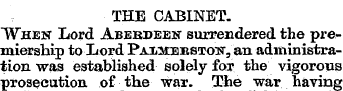
THE CABINET . When Lord Abebdeest surrendered the pre ^ miership to Lord PAXMEESTOisr , an administration was established solely fox the vigorous prosecution of the war . The war having been prosecuted to anend , the Cabinet is in the position of being without a policy . It is an indescribable Cabinet . It is not Whig , or Toiyy or Illiberal . It takes neither name Hor colour from its measures . It is simply Lor 4 . Paimeestok ' s Catoinetj and whenever it attempts to carry out a home measure , the
jneasure almost invariably falls through . The few useful reform s of last year , with the exception , of some important administrative improvements , were inheritances from the Coalitionw , All that it endeavours * and all that the nation seems to eare for , is simply to " get along . ' * ., There are some motions on the papers of the two Houses , which may force the Government to take up some intelligible position . That relating to America would be the most formidable were Lord Palmebstox to
absolution that must follow a defeat of Ministers ; Lord Palmebston resolved . last year to adopt this alternative , ? rather :, ; than be driven from office ; but he was ,, unwitting to disperse a Parliament only three sessions old . The traders in disclosure and mystery , to astonish the wide-eyed populace , pretended that an influence at the Palace deterred the Premier from the dissolution . But it is certain that Lord PaiiMebstoh would not
have hesitated to take the step had it been necessary ; and in all probability , this being the fourth year of Lord Debby ' s Parliament , he would have no aversion whatever to an electoral conflict to pass judgment on the war and the peace . Ifc would , at least , give him the Ministerial boroughs filled under the influence of the Tory Premier . But there is a difference between a defeat on a measjare of policy and a defeat carrying with it the reprobation of the Legislature .
The Opposition , if cast upon the " country , " i . e . the irregularly scattered minority vested with electoral privileges , would go to the hustings flushed with ' political success , pointing to a censured Government , and enabled to claim the credit of having averted an American war , or punished the authors of the disaster at Kars . The Tories , however 3 no less than the Whigs , shrink from the enormous expenditure which , in . spifce of the purity laws , is implied by a general election . Besides , what are to be the rallying cries ? Peace with America would be , at best , the
negation of an evil not very probable under any circumstances . Lord Bebby exhausted his programme in 1852 , and Iris administration was a ridiculous failure ; not—as it is pretended in the factious Conservative print which , writes weekly a panegyric upon itself —because the Irish members we ^ but because the country woulcl not put confi- ' dence in Lord I ) eb , by , or tolerate llr . Diseaeli . Is Conservatism more enlight ^ ened or liberal now ? Has it gained any accession of talent or popularity ? . It seenis to have forgotten , that it ever had a policy for ita organs find nothing ; to write except feeble and malevolent personalities . .. " ,
If the Government were prepared with a policy , the nation might be stimulated to support the Government ; but Lord Palmejkston was called iu as " the pilot to weather the storm" at a time when " vigour" was the one thing needful . That crisis being past , what does he claim to be ? A reformer in . the right direction , his apologists say . In . administrative reform , it is easy to allow that he has superseded the popular associations . But his proposals in Parliament on other
subjects of domestic interest , have for the most part been abandoned or defeated . The Conservatives , in anticipation of a dissolution , have worked with energy to obtain a popular vote on the Maynooth endowment , and have won many suffrages by their policy on the balloting system . Government , on the othefc hand , acts with all the hesitation of insjn , ; - cerity ; allows bills to be introduced , debated and withdrawn j suffers adverse , majorities ; to accumulate on the Opposition benches , without being stimulated to energy or eloquence ,
and seems to reckon upon . the ., perpetual apathy of the nation . The nation , however , is not altogether apa ! thetic . Ifc is absurd to deduce from the collapse of the Administrative Reform * Association , that the people at large are lenient ; to administrative corruption . It is absurd , also , to argue from the blackness of darkness that descended on Sir JoshIja . Wajmb * lex ' s motion , that thei -people at large- arc satisfied with their parliamentary system , No rational man could have expected that 8 subject of that importance would be enter ? tained by the Government or by tho Mouse
sume a tone of defiance and bluster , which lie will not do * unless under tlie influence of some inconceivable feeling . - The forces of the Conservative opposition , and of the indepen-, dent Liberals are likely to "be combined in this debate . The only reply on the part of Ministers likely to quiet the public apprehensions and . conciliate Parliament , would be an assurance that the American difficulty is in a fair way of settlement , and an appeal to the Legislature not to risk a change of Government in the midst of complex and delicate negotiations .
The Kars debate will try the Btrength of the Government . Nothing in the official correspondence explains , to the exoneration of the Cabinet , why that important position waa sacrificed—why the sixty-one despatches addressed by General Wijexiams to the British Ambassador in Constantinople were unanswered- ^ -why no timely relief was sent to Kars . There must have been neglect , or there must have been interference . If there
lias been neglect , the House of Commons is not likely to let it pass without censure ; if there has been interference , no public explanations can be given ; but , in either case , the debate may produce a parliamentary crisis ., The elder and younger schools of Conservatives are agreed to act against the Government ; tho more imnetsuous of the independent members will join them . Nor doea the
Premier enjoy any longer . the advantage of being allowed to appeal to the situation of tho country in , deprecation of party attacks . At the signal of the Treaty of Peace , party politics return to tho arena . The contingency that mitigates the enthusiasm of ' tho Conservative party , . and keeps eve » its most eager followers ailont-on the subject of ' a , strong government , " ia the dis-
Untitled Article
Apko , 26 , 1856 J THE KIAHIB . , mi ?
-
-
Citation
-
Leader (1850-1860), April 26, 1856, page 397, in the Nineteenth-Century Serials Edition (2008; 2018) ncse.ac.uk/periodicals/l/issues/vm2-ncseproduct2138/page/13/
-