On this page
-
Text (3)
-

Untitled Article
-

Untitled Article
-

Untitled Article
Note: This text has been automatically extracted via Optical Character Recognition (OCR) software. The text has not been manually corrected and should not be relied on to be an accurate representation of the item.
-
-
Transcript
-
Note: This text has been automatically extracted via Optical Character Recognition (OCR) software. The text has not been manually corrected and should not be relied on to be an accurate representation of the item.
Additionally, when viewing full transcripts, extracted text may not be in the same order as the original document.
Untitled Article
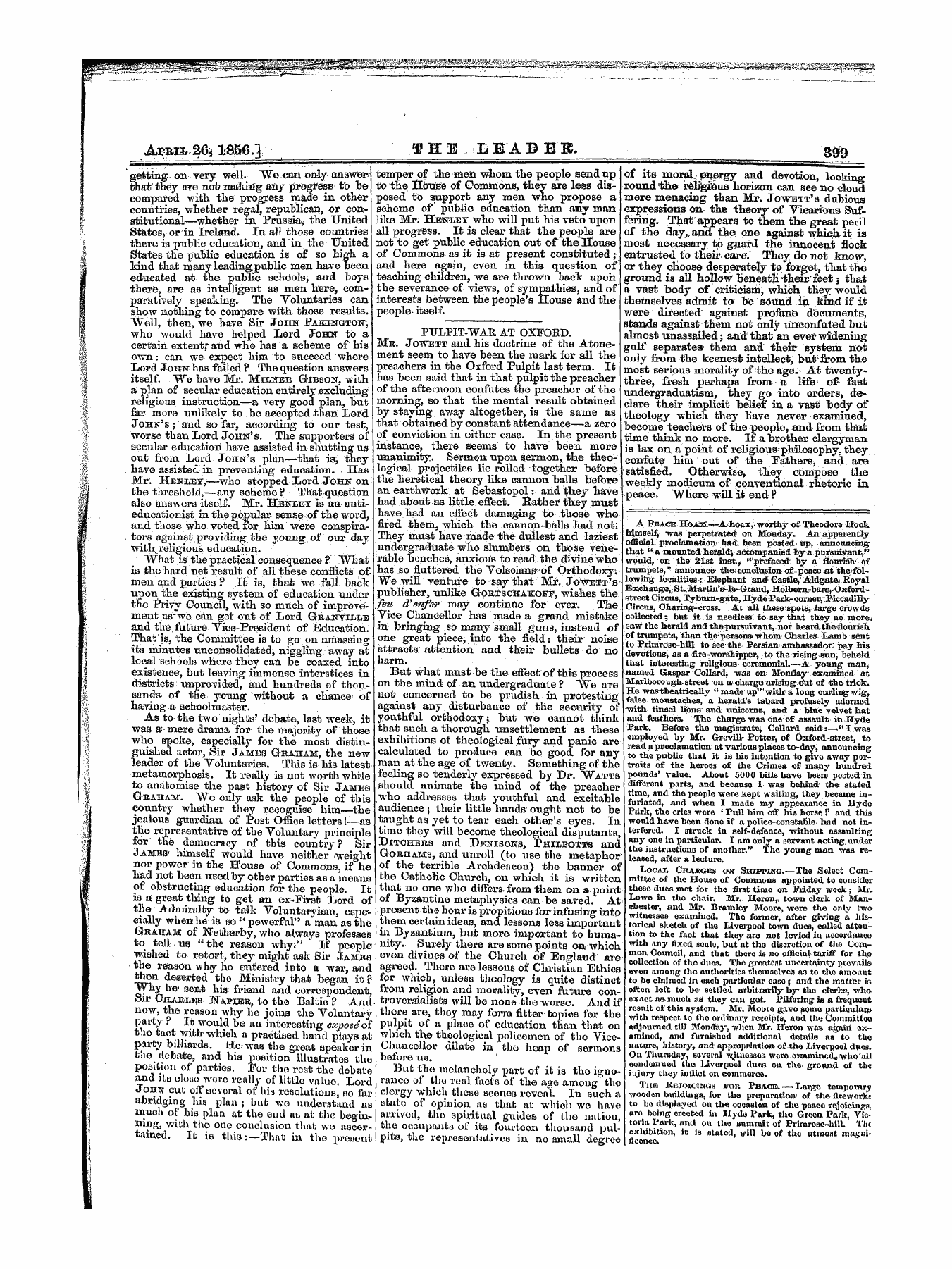
getting , oil very well . " We cad . only answer that they are nob makitfg any progress to be coi&pared with , the progress made in other countries , whether regal , republican , or constitutional—whether in Prussia , the United States , or in Ireland . In all those countries there is public education , and in the " United States the public education is of so high a ] dnd that many leading public men have been educated at the public schools , and boys there , are as intelligent as men here ,
comparatively speaking . The " Voluntaries can show nothing to compare with those results "Well , then , we have Sir John Faeinqtoit , who would have helped Lord John to a certain extent ^ and who has a scheme of" his own : can we expect him to succeed where IJord John has failed ? The question answers itself . "We have Mr . Miltsteb G-ibson , with a plan of secular education entirely excluding
religious instruction—a very good plan , but far more unlikely to be accepted than Lord John ' s ; and so far , according to our test , worse than Lord John ' s . The supporters of secular education have assisted in shutting us out from Lord John ' s plan—that is , they have assisted in preventing education . Has Mr . Heiniey ,- —who stopped Lord John on the threshold , — -any scheme ? That question also answers itself . Mr . Henxet is an
antitemper of tliemeii whom the people send up to the fifcraSe of Commons , they are less disposed to support any men who propose a scheme of public education than any man like Mr . Hbniet who will put his veto upon all progress . It is clear that the people are not to get public education out of the House of Commons as it is at present constituted ; and here again , even in this question of teaching children , we are thrown bad upon the severance of views , of sympathies , and of interests between the people ' s House and the people itself .
educationist in the popular sense of the word , and those who voted for him were conspirators against providing the young of our day w-ith religious , education . " What is the practical , consequence ? " What is the hard net result of all these conflicts of men and parties ? It is , that we fall back upon the existing system of education under the Privy Council , with so much of
improvement as ^ we can get out of Lord GuAirviiiLE and the future "Vice-President of Education . That'is , the Committee is to go on amassing its minutes uneonsolidated , niggling away at local schools where they can be coaxed into existence , but leaving immense interstices in districts unprovided , and hundreds of thousands- of the young without a chance of having a schoolmaster .
As to the two nights' debate , last week , it was a mere drama for the majority of those who spoke , especially for the most distinguished actor , Sir James Q-baham , the new leader of the Voluntaries . This is his latest metamorphosis . It really is not worth while to anatomise the past history of Sir Jamiss G-haham . We only ask the people of this country whether they recognise him—the jealous guardian of Post Oifice letters !—as the representative of the Voluntary principle for the democracy of this country ? Sir himself
James- would have neither weight nor power' in the House of Commons , if he had notbeen usedby other parties as a means of obstructing education for the people . It is a great thing to get an er-First Lord of the Admiralty to talk Voluntaryism , especially when he if * so " powerful" man as the GJ-kaiiam : of JNFetherby , who always professes to tell us " the reason why . " It * people wished to retort , they might ask Sir James the reason why ho entered into a war , and then deserted tho Ministry that began it ? hhesent
Vy y ' hisj fW < md and correspondent , Sir OnAXti ^ s JNTapier , to tho Baltic P And now , the reason why he joius tho Voluntary party ? It would bo an interesting expo $ < $ o the tact with whioh a practised hand plays at party billiards . He ; was the great speaker in the debate , and his position illustrates the position of parties . For tho rest tho debate and its clo « o woro really of littlo value . Lord John cut off soveral oiMiia resolutions , so far abridging his plan ; but wo understand ns much of bis plan at the end as at the beginning , with the one conclusion that wo ascertained . It is this : —That in tho present
Untitled Article
of its mpraL energy and devotion , looking round the ? religious horizon can see no cloud more menacing than Mr . Jowett ' s dubious expressions on . the theory of Vicarious Suffering . That appears to them the great peril of the day ,, and the ) one against which ,-it is most necessary to gjiard the innocent flock entrusted to their care . They do not know-, or they choose desperately to forget , that tne ground is all hollow beneath-their-feet ; that a vast body of criticism , which they would themselves admit to fre ' sdund ih kind if it were directed against profanes documents , stands against them not only urtconfuted but
PTJLPIT-WAU AT OXFOBD . BIb . Jowett and his doctrine of the Atonement seem to have been the mark for all the preachers in the Oxford Pulpit last term . It has been said that in that pulpit the preacher of the afternoon confutes the preacher of the morning , so that the mental result obtained by staying away altogether , is the same as that obtained by constant attendance—a zero of conviction in either case . In the present instance , there seems to have been , more
unanimity . Sermon upon sermon , the theological projectiles lie rolled together before the heretical theory like cannon balls before an earthwork at Sebastopol : and they have had about as little effect . Rather they must have had an effect damaging to those who fired them , which the cannon , balls had not ; They must have made the dullest and laziest undergraduate who slumbers on those
venerable benches , anxious to read the divine who has so fluttered the Volscians of Orthodoxy ; We will venture to say that Mr . Jowett ' s publisher , unlike GtOBTschakoff , wishes the feu d * enfer may continue for ever . The Viee Chancellor has made a grand mistake in bringing so many small guns , instead of one great piece , into the field : their noise attracts attention and their bullets do no
harm . But what must be the effect of this process on the mind of an undergraduate ? " We are not concerned to be prudish in protesting against any disturbance of the security of youthful orthodoxy ; but we cannot think that such a thorough unsettlement as these exhibitions of theological fury and panic are calculated to produce can be good for any man at the age of twenty . Something of the feeling so tenderly expressed by Dr . "Watts
should animate the mind of the preacher who addresses that youthful and excitable audience 5 their little hands ought not to be taught as yet to tear each other ' s eyes . In time they will become theological disputants , Ditchers and Denisons , Philpotiis and Gtokhams , and unroll ( to use the metaphor of the terrible Archdeacon" ) the banner oi the Catholic Church , on which it is written that no one who differs , from them on a point of Byzantine metaphysics can be saved . At present the hour is propitious for infusing into
them certain ideas , and lessons less important in Byzantium , but more important to humanity . Surely there are some points on which even divines of the Church of England are agreed . Theue are lessons of Christian Ethics for which , unless theology is quite distinct from religion and morality , even future controversialists will be none the worse . And if there are , they may form fitter topics for the pulpit of a place of education than that on which tl \ e theological policemen of tho Vice-Chancellor dilate in the heap of sermons before us .
But the melancholy part of it is tho ignoranco of the real fuels of the age among the clergy which theae scenes reveal . In such a state of opinion as that at which we have arrived , tho spiritual guides of the nation , tho oocupanta of its fourteen thousand pulpits , the representatives in no small degree
almost unassailed ; and that an ever widening gulf separates' them and their system not only from the keenest intellect ; but from the most serious morality of i ; he age . At twentythree , fresh perhaps from a life of fesfc undergraduatism , they go into orders ^ declare their implicit belief in a vast tody of theology which they have never examined , become teachers of the people , and from that time think no more . If a brother clergyman is lax on a point of xeligious ? philosophy , they confute him out of the leathers , and are satisfied . Otherwise , they compose the weekly inodicxim of conventional rhetoric in peace . "Where will it end ?
Untitled Article
Aero , 26 i 1856 . ] IHIjB IT A B B B ) . -gfe
Untitled Article
A Peace HoA 3 £ .- ~ A hoax , worthy of Theodore Hook himself * was perpetrated on . Monday . An apparently official proclamation had been posted , tip , announcing that " a mountedheraldyaccompanied Tby a pursuivant , " would , op the 21 st inert ., " prefaced by a flourish' of trumpets , ' announce the ; conclusion of peace at the ^ following localities : Elephant and Gastle , Aldgate , Royal Exchange , St . Martui ' s < -Ie < -Grand v Holbornrbars ,-Oxfordstreet Circus , Tyburn-gate , Hyde Park-corner , iPiccadilly Circus , Ciaring-cross ; At all these / spots ^ large crowds collected ; but it is needless to say that they no more , saw the herald and thepursuivant , nor heard tlie flourish of trumpets , than the-persons whom- Charles Lamb sent
to Primrose-hill to see the Persian ; ambassador : pay his devotions , as a fixe ^ wor&hipper , to the rising sun , beheld that interesting religiou s' ceremonial . —> Jk . yoting man , named Gaspar Collard , was on- Monday examined" Marlborough-street on a charge arising out of the trick . He was theatrically " made up" ' with a long curling wig , false moustaches , a herald ' s tabard profusely adorned ¦ with tinsel lions and unicorns , and a blue -velvet hat and feathers . The charge-was one of assault in Hyde Park . Before the magistrate ^ C ollard said : — . "I was employed by Mr . Grevillr Potter , of Oxford-street , to read a proclamation at various places to-day , announcing
to the public that it is his intention to give away portraits of the heroes of the Crimea of many hundred pounds' value ; About 5000 tills ha ^ e beeni posted in different parts , and' because I was behind the stated time , and the people were kept waiting , they became infuriated , and when I made my appearance in Hyde Park , the cries -were ' Pull him off his horse ! ' and this would have been done if a police-constable had not interfered . I struck in self-defence , without assaulting any one in particular . I am only a servant acting under the instructions of another . " Tho young man was released , after a lecture .
Local Chakgbs < wr Shipping , —Tho Select Committee of the House of Commons appointed to consider these dues met for tho first time on Friday week ; Mr-Lowe in tho chair . Sir . Heron ,, town clerk of Manchester , and Mr . Bramley Moore , were the only two witnessea examined . The former , after giving a historical sketch of tho Liverpool town dues , called attention to the fact that they are not levied in accordance with any fixed soale , but at tho discretion of tho Common Council , and that there is no official tariff for tho collection of the duos . Tho greatest uncertainty prevails
even among the authorities themselves as to the amount to bo claimed in each particular case ; and tho matter ia often left to b « ' settled arbitrarily by tho clerks , who . exact as much a 8 they can got . Piltforing ia » frequent result of this system . Mr . Mooro . gave some particulars with respect to tho ordiniuy receipts , And the Committee adjourned till Monday , when Mr . Heron was again examined , and furnished additional < lotnila as to tho nature , history , and appropriation of tho Liverpool dues . On Thursday , several ^ ituessos wore oxnmincd ,, who ' all condemned tho Liverpool duos on the ground of the injury they inflict on commerce . Turn RrcjoicraoB je-on Pjsacki . — . Largo temporary wooden buildings , for the preparation 1 of the Aveworke to bo displayed on tho occasion of tlvo peace rejoicings , aro being erected i n Hydo Park , tho Green Park , Victoria Park , nnd on tho summit of Primroao-hUl . The exhibition , it is stated , will bo of tnq utmost mnguificonoo .
-
-
Citation
-
Leader (1850-1860), April 26, 1856, page 399, in the Nineteenth-Century Serials Edition (2008; 2018) ncse.ac.uk/periodicals/l/issues/vm2-ncseproduct2138/page/15/
-