On this page
- Departments (1)
-
Text (5)
-
Untitled Article
-
™-—
-

Untitled Article
-

—™-—- . ---- _ ,. , i, irftgrfltltr^ i r - t- - 3LW*itt«U*« l. ¦•¦ . ¦ j .> -
-
Untitled Article
Note: This text has been automatically extracted via Optical Character Recognition (OCR) software. The text has not been manually corrected and should not be relied on to be an accurate representation of the item.
-
-
Transcript
-
Note: This text has been automatically extracted via Optical Character Recognition (OCR) software. The text has not been manually corrected and should not be relied on to be an accurate representation of the item.
Additionally, when viewing full transcripts, extracted text may not be in the same order as the original document.
Untitled Article
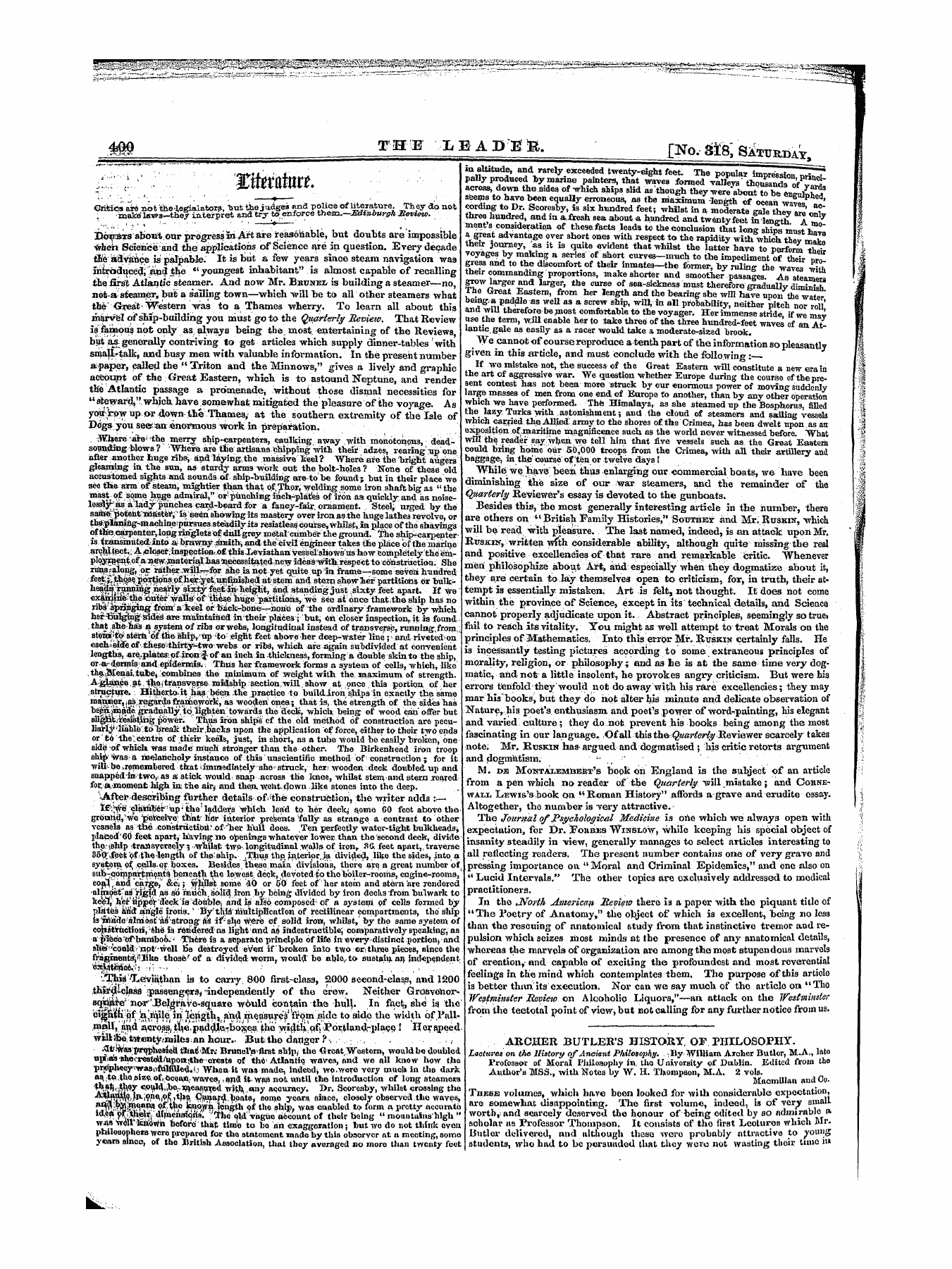
ARCHER BUTLER'S HISTORY , OP PHILOSOPHY . Lectures on the Uiatort / of Ancient Philosophy , : l ) y William Archer Butlor , M . A ., Into Professor of Moral Philosophy in , tho University of Dublin . Edited from tho Author '* MS 3 ., with Notes by W . H . Thompson , M . A . 2 vola . MacmiHan and Co . Tijksjb volumes , which have boon looked for with considerable expectation , are somewhat disappointing . The first volume , indeed , is of very small worth , ' and scarcely deserved the honour of being edited by so admirable » scholar na IVofessor Thompson . It consists of the first Lectures which Mr . Butler delivered , and although these -were probably attractive to young students , who had to bo persuaded thnt they were not wasting their tune w
™-—
in altitude , and rarely exceeded twenty-eight feet . The populai imnression ™* " ^ pally produced by marine painters , that waves formed vallW thSnS of S " T ^™ ^ SideS ° ^ ^ Slid as '« " «« * they were ' abtmTbfi £ fiS aee ^ s to ^ have been equally erroaeous , as the nia ^ imum-length « f ocean wave / a , ' cording to Dr . Scoresby , is six hundred feet ; whilst in a moderate gatethS 15 Zl three hundred , and iu a . fresh sea about a hundred and twenty feet HeneSf A ™ ments consideration of these facts leads to the conclusion that long ships must W a great advantage over short ones with respect to the rapidity with which SS their journey , as it is quite evident that whilst the latter have to perfXTS voyages by making a series of short curves—nruch to the impediment of thet ^ Z gress and to the discomfort of their inmates-the former , by ruling the wave £ % & their commanding proportions , make shorter and smoother passafes . AalSaleS grow larger and larger , the curse of sea-sickness must therefore gradually dimS The Great Eastern , from her length and the bearing she will hive upo / thTW being , * paddle as well as a screw ship , will , in all probability , neither pitch nor r 3 ? and mil therefore be most comfortable to the voyager . Her immense stride , if we mav use the term , wall enable her to take three of the three hundred-feet waves of an At lantic . gale as easily as a racer would take a moderate-sized brook .
the Great "Western -was to a Thames -wherry . To learn all about this iniiryel of ship-building you niust go to the Quarterly Review . That Review is famous not only as always being the ; most entertaining of the Reviews , but as generally contriving to get articles which supply dinner-tables with sraallrtalk , and busy men with valuable information . In the preseht number avpaper , called the ¦ " Triton and the Minnows , " gives a lively and graphic account of the Great Eastern , which is to astound Neptune , and render the Atlantic passage a promenade , without those dismal necessities for " steward , " which . have somewhat mitigated the pleasure of the voyage . As vo ^ rpw up or ^ own the Thames , at the southern , extremity of the Isle of Dogs you see ? an enotfjnous work in preparation .
X ) 6 tebts about our progress In Art are reasonable , but doubts are impossible Wheh Science and the applications of Science are in question . Every decade tn ' e advance is palpable . It is but a few years since steam navigation was iniroducedVftndthe " youngest inhabitant" is almost capable of recalling the first Atlantic steamer . And now Mr ; Bkunei- is building a steamer—no , not a steamer , but a sailing town—which -will be to all other steamers what
adhere arethe merry ship-carpenters , caulking away with monotonous , deadsoundong blows ? "Where are tie artisans chipping with their adzes , rearing Tip one after another huge ribs ; and laying the massive keel ? Where are the bright augers gleaming in the sun , as sturdy arms-work out the bolt-holes ? None of these old accustomed sights and sounds af ship-buildirig are to be found ; but in their place we see tbie arm of steam , mightier than that of Thor , welding some iron shaft big as " the mast ^ of sonae huge admiral , " 1 ^ unchi » ginch-plsities of iion as quickly and asi noiselessljr ; as a ladypunches car 4-beard for a fancy-fair , ornament . Steel ; urged by the santft p otent -saalsterj is se € Sn showing its mastery over iron as the huge lathes revolve , or th 8 . planing-machine ? pursues steadily-its resistless ; Cpur ^ e , whflst , iap ^ ce of the sha ^ uigs ofth " e . carpenter r long ringlets of di& grey me"tarcumbe ¥ & is iransroutediinto * bravmysM ct cl of this
a ^ Mte , ; - A oser inspection * Xeviathanvesselshio > ws ' us how completely the e ^^ ploifine ^ of a ii « w mat erialias fce ceasitated new ideas with ; respect to construction . She ^ gr ^ oSg * 05 ^^ rathW . waijlTTrfor she is , not-yet quite tip ia frames—some seven hundred ^§ fefc $ N | i ^ 'i ^^^ stein showier partitions or bulkhea ^ ruju ^ gfrai ^ ^ If ^ ex ^ miitiie ; ti ^ e cuter " JwaTtef ; of th ^ e huge ' -partitions , we s « e at once that the ship has no ribs jsprjnging from a keel or : back-bone—none of the ordinary framework by which her ^ ul ^ ng isideS are m aint ained in th eir places ; but , on closer inspection ^ it is found that she has a system of ribs or webs , longitudinal instead of transverse , running v frpm s te ^^ st ^ JA '' j ^ .. flie . lhr ^/ tip ' 'i ; to ' eight feet above her deep-water line ; ' and riveted 1 on eaclnBicle of . these thirty-two webs or ribd , which are again subdivided at convenient lengths , are . plates ^ of iron > J of an inch in thickness , forming a double skin to the ship , or-a-derrois and epidermis . Thus her framework forms a system of cells , which , like
the , Alenai . tufeej . combines the minimum of weight with the maximum of strength . Ajglanpe at . i ^ ie { transverse . midship section . will show at once this portion , of her sja ^ ejajre . , Hitherto ' it has been the practice to buildjlron ships in exactly the * same manner , ^ r ^ w ooden ones ; that is , the strength of the side 8 haa bepa-ioade gradually , tp , lighten towards the deck , which being of wood can offer but sli ^ tresfeting powers Thus iron ships cf the old method of construction are peculiarly liable to break their . backs upon the application of force , either to their two ends or " to -the : centre of their keels , just , in short , as a tube would be easily broken , one sldij of which was made much stronger than the other . The Birkenhead iron troop ship Was a melancholy instance of this unscientific method of construction ; for it will be . remembered that immediately she struck , hen wooden deck doubled up and snapped in two , as a ; stick would snap across the knee , whilst stem and stern reared for / ia moment high ia the air ; and then . went , down . likfi stones into the deep .
sAfter describing further details of'the construction , the writer adds :. — If ' : ^ , clflitfib'er up' the ladders Which lead to her decfy ^ ome 60 feet above tho gr 6 andj we ^ peWseive ! tfelat' tier interior presents 'fully as strange a contrast to other vessels as the constnictipii of " her liull does . Ten perfectly water-tight bulkhea ds * placed 60 feet apart , h ' aving no openings whatever lower than the second decfe , divide the iship ^ transversely 3 whilat two , longitudinal wajls of iron ,. sc feet apatt ,, traverse 35 Ct » feet f the length of the ship . . Tlius thft jait . eripr ,. ia divided , like tho sjideEi , into a ayetcm of , cetlls-qr boxes . Besides iheao maia divisions , thero ajr ^ a great number of aui > -cornpartjn nta beneath l f h « lowest deck , devoted to the bbilor-rooihs , engin « -rooms , coa ^ l' and ca ^ go , ' &c ;; ^^ . nst some 40 or § 0 ' feet of ^ her stem and stern are Tendered ¦ alrn o ' " a 8 rijgia as so much , solid iron by being divided by iron decks from bulwark to iceeJ , her upjpeV deck is double , and is also composed-of a system of cells formed by plrites and aiiglo irons . By this' multiplication of rectilinear compartments , the ship 13 ftiaVle almost' a ^ strong na ifv sl ^ q ^ ere Of solid irott . whilst , by thp same system of co | ifltrnctior » ,- < ihe is renaercdoa light and as ittdestructlblei comparativelyBpoaUing , as a p'ieco of bamboo . Thfere is a separate principle of life in « v « ry distinct portion , and alifef * conidvnpt '> well 6 e destroyed eVen if broken into two © r three pieces , ainco tho fVagment ^^ Jiko those . ' of a divided woTm would bo ablo . to- sust&iu . an jndopendent ' eje . fcitJBftce . ;; r ,, ''; -.,. ¦ , . ¦ . ¦ ' . ' ,.,-.. "' ' ^ hk OCeiyiathan is to cany , 800 first-class , 2000 second-class , and 1200 therdl-clnss ; pasqeng < jT 3 , independently of the crew , Neither Gr 0 svenor > sqWji ^ e ' moo : ' . ^ elgrave-squatiB w 6 uld contain the hull . In fact , she is . tho
ei ghth ' . jc | f : ^ . ^ ilei " ifi leri ^ tt > , ( and ijaeasurQ ^ ' fr ( j > m side to side the width of Pnllm ^ U , ni ^ d across , t ^« Vp ^ Ef or speed waiibe twenty-miltiann hour .. iButi the dodger P , ; , . ( J ^ t /^ AspT 4 ^ pheaj « attmtJ'Mr ; Brunol ^ nret ship , tho drcat Wofltem , wouldb « doubled upfiaiiBhevrcstcfcl / uponsthe crcats of the Atlantic waves , and we all know how tho pwiplwcy waa ^ uilfiUed * 1 Wlnon it w »» mftde , indeod k wp , wore very niacU in tho dark a ^ . ; $ Mhe »»«« , of ( OcqoAj waves , , ond it wap not until tl » e introduction of long steamers flWtfil ^ hoy « puld ( lbo , on >« a ^ i ^ e < l wi ^ any accuracy . ]> r , Scorosby , whilst crossing the ^ aWty ^ WM ^ frttfcft CJ ^ naT ^ , , boats , eotne yoar « siaqe , closely observed tine wavc ^ ? 9 ^; ffl [ ltWW $ W ° W ^ 'Pld ^ S ^ 9 * ^ 10 ship , woa enoblcd to form a protty nccurnto iO , s » i offm $ & dtnxehsioria . Tflie old vbgiie account of thoir boing " mountains high " w ^ s woU kno ^ h before that time to bo an oxaggoration ; lmt wo do not tlifnk oven philosophora wore prepared for the Btotomont made by this observer at a mooting , eomo yewra since , of tho British Association , that they averaged mo more than twenty foot
VVe cannot of course reproduce a tenth part of the information so pleasantly given in this article , and must conclude with the following : If we mistake not , the success of the Great Eastern -will constitute a new era in the art of aggressive war . We question whether Europe during the course of the present contest has not been more struck by our enormous power of moving suddenly large masses o f men from one end of Eur ope to another , than by any other operation which we have performed . The Himalaya , as she steamed up the Bosphorus , filled the lazy Turks with astonishment ; and the cloud of steamers and sailing vessels which carried the ) Allied : army to the shores of the Crimea , has been dwelt upon as an exposition of . maritinae magnificence such as the world never witnessed before . "WTiat will the reader say when we tell him that five vessels such as the Great Eastern could bung home our 50 , 000 troops from the Crimea , with ail their artillery and baggage , in the' course often or twelve davs I
While ^ w ; e ^ have beeix thus enlarging our commercial boats , we have been diminishing the size of our war steamers , and the remainder of the Quarterly Reviewer ' s essay is devoted to the gunboats . Besides this , the most generally Iriterestang article in the number , there are others on " ^ British Family Histories , " iSotJTHEr and Mr . Ritskiit , which will be read with pleasure . The last named , indeed , is an attack upon Mr . Ruskin , written wfth considerable ability , although quite missing the real and positive excellencies of that rare and remarkable britic . "Whenever men philosophize about Ari , and especially when they dogmatize about it , they are certain to lay themselves open to criticism , forj in truth s their attempt is essentially mistaken . Art is felt , not thought . It does not come within the province of Science , except in its technical details , and Science
cannot properly adjudicate upon it . Abstract principles , seemingly so true > fail to reach its vitality . You might as well attempt to treat Morals on the principles of Mathematics . Into this error Mi * . RysKiN certainly falls . He is incessantly testing pictures according to some extraaeous principles of morality , religion , or philosophy ; and as he is at the same time very dogmatic , and not a little insolent , he provokes angry criticism . But were his errors tenfold they would not do away with his rare excellencies ; they may mar his' books , but they do not alter his minute and delicate observation of Nature ,-his poet ' s enthusiasm , and poet ' s power of word-painting , his elegant and varied culture ; they do hot prevent his books being among the most fascinating in our language . Of all this th& Quarterly Reviewer scarcely takes note . Mr . Huskin has- argued and dogmatised ; his critic retorts argument and dogmatism . ' - ¦ " ¦
M . des MouTAXEMBEiiT ' s bopk on England is the subject of an article from a pen which no reader of the Quarterly : will mistake ; and Cobnewaix Lewis ' s , book on V Roman History" affords a gtave and erudite essay . Altogether , the number is very attractive . The Journal of Psychological Medicine is one which we always open with expectation , for I ) r . ) Fohbks Winslow , -while keeping his special object of insanity steadily in view , generally manages to select articles interesting to all reflecting readers . The present number contains one of very grave and pressing importance 011 " Moral and Criminal Epidemics , " and one also on ?• Lucid Intervals . " The other topics are exclusively addressed to medical practitioners . is
Jn the , North America- ^ Review there a paper with the piquant title of " The Poetry of Anatomy , " the object of which is excellent , t > eing no less thaii the rescuing of anatomical study from that instinctive tremor and repulsion which seizes most minds at the presence of any anatomical details , whereas the marvels of organization arc among tine most stupendous marvels of creation , and capable of exciting the profoundest and most reverential feelings in the mind which contemplates them . The purpose of this article ia better than its execution . Nor can we say much of tho article on \ " Tho We ^ tniinster Review on Alooholic Liquors , "—an attack on the Westminster from the teetotal point of view , but not calling for any further notice from us .
Untitled Article
. j - - y . Critics are not the'legislators , "but tlie judges and police of literature . They do not make' l * s » -s—the / interpret and try to enforce them . —JSfcfekdwj ^ A 22 e »* ew . *
—™-—- . ---- _ ,. , I, Irftgrfltltr^ I R - T- - 3lw*Itt«U*« L. ¦•¦ . ¦ J .≫ -
y , ^ . ^ -. yny ^^ f i # « .- _ -4- ¦—* T- " " - ,:: ¦ : '! : ' Wiwfatt ' ' ¦' . I . .. - ¦'¦¦ __ - ;
Untitled Article
^ ggg IBAB'E B . PTo .-tflfa ' S&mtnAV
-
-
Citation
-
Leader (1850-1860), April 26, 1856, page 400, in the Nineteenth-Century Serials Edition (2008; 2018) ncse.ac.uk/periodicals/l/issues/vm2-ncseproduct2138/page/16/
-