On this page
- Departments (2)
-
Text (7)
-
Untitled Article
-
Untitled Article
-
Untitled Article
-
SA^TTJjBDAX, MAT 3, 1856.
-
, ....,,. , ' ' ¦•¦*&&. l*f* (iA(£ * te -¦ ' . ' -^Pltultt JXU(l|, 1^8f» ...: ' -. r ' ' ! ' ' ' ¦ '"' t " ' ' ¦ -• ¦
-

Untitled Article
-

Untitled Article
Note: This text has been automatically extracted via Optical Character Recognition (OCR) software. The text has not been manually corrected and should not be relied on to be an accurate representation of the item.
-
-
Transcript
-
Note: This text has been automatically extracted via Optical Character Recognition (OCR) software. The text has not been manually corrected and should not be relied on to be an accurate representation of the item.
Additionally, when viewing full transcripts, extracted text may not be in the same order as the original document.
Untitled Article
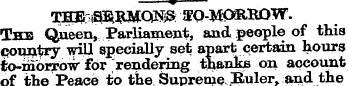
THE iS ^ ilMQNiS a ? O-MC ® . KOW . The Qaeen , Parliament , and people of this country wiU specially set apart certain hours to-morrow - for rendering tibiankB on account of the Peace to the Supreme Boiler , and the clergy of the land will be . called , tipon . tQ moralize the war and its conclusion , for . our instruction . The subject is vast , and its treatment may vary "without blame to the
teachers for enforcing special portions of the moral ; and we may expect that if some moralists are too narrow in their view , it will be corrected by the broad instinctive feeling of the . great section of mankind peopling these Islands . Assuredly , the lesson drawn from partial issues , and strained to enforce partial truths , will not be respected by the resistless course of future events . As little as the course of the torrent respects the barjt of the boatman who has derived his wisdom
from man-made canals and aqueducts , and shapes his navigation according to the course which rivets ottijiit , to pursue inthe judgment of the pedatii , not , acpprding tQ the seemingly wild courses into which they are impelled by ibhe . force < j resistless antf Tirierring l&ws . Bo soiritp-of us witl be doonhed to hear td-riiorrbw / of the special favour H-ihowir : to ' * ' ; thifr' Protestant country , " by preachers who will find it convenient to forget , who * will fjerhaias be' too blind to see ,
that a larger share of immediate benefits has bcea vouchaafed to the child " of the Roman Church , and of the G ^ eek Church ? One ' sect may be riurei than anothe ' bec&us ' e'it is less trammelled by humaadOgfrtotisnf ^ i ' and' therefbfce ¦ lessprevei ! it »«( l * oti ( l'B ^ a * c hinig' and obeying the laws which rule us all ; butfWhetf tjje purest of faiths tuina from iithplvcit / i-eliarice on ! the-source ofiall Mth ' atod :. j > oWer , to contemplate iin vainglorious pride some supposed merit tdx preference for the human part of the
faith , tbfe sect , ; the sight is iihne'd , the sense is ^ evtterted , tnlth id lost ) iri' error ; p ' ride becoweft , humiliation ^ and I the ' faroiir , Which mtebt / jhav&rbeen > « oimed- by ' faithful service , is bestowed , elsewhere^—the . ¦ ¦ ' * choSefa . ' * ' ¦ are no ^ l QhoeeD , but pafased by . ; > H 1 i i ' £ ojne ,. of . ua will , be doomed to hoar that wra jUh&in . iJti&d tlnat ^ we v hai ^ e' / only now
returtt ^ d ,. tp a , fltete of virtue :- bifli * the victory ia ^ Jftjrus . * - * b » idefttot i .-with ) tiie people dn ' wh # fip wa , d # 4 la 3 e 4 iwftnj it&e . blessings which tto 4-I > ft w ^ && " 8 efWe 'jbho I diredtJ frui ^ > of the etrjgiMl ^^^ fy ^ tUore jbalveH ^ broii ^ houtiibOBn preff ^ ra | lf&tau » i # & Mj&iwloqumMfe iwho ftave C € ^^ red ^ he > w iftrna ^ ari > pwteat' Kvfi ^ ed im dei-^ Wi ^ fA ^^^« WBa ^ i » Cb | r ^< j ii »( oit ^ df ; the Qttf& ^ jiM&mti $ m < finwi \ t& <** nvq * vB » a * ct * W ^^»» ff iJ B ^ siJ ^ Pf ^^ V ^ Ap ^ aMivp trujgj ^ agqtygfj ^ hrjffciajMty aqdl itel < tokirodard u > i \ ti * . > hh \ M ,: n ( i ! i ]>« * nf ! . . tj ; M . » jii' . r > u < r . i T > il (((<
So perilous is it for finite human wisdom if we anticipate the judgment of Providence ; so misleading to weak human reason if We substitute the symbols of a faith for the iiving virtue of a faith , and imagine that we are quit of our duty , when we are faithful to our livery , though heedless of the principles whose champions that livery should array . If these Christians were right , they must confess that the divine judgment has been given against Christianity—a blasphemous r # diwiio ad absurd-urn which shows < that their doctrine was false . ' ^^
"We forget the source of our strength , if we forget to return thanks for . the glory . that has been vouchsafed to our arms , and , forgetting , we forfeit the hope of-strength hereafter ; yet it is no sectarian victory which Protestant and Catholic have achieved in ; defence of Mussulman . We return thanks ^ for peace , -rr-butinot with a grudging mistrust ¦* because that peace is w . QU , in , <«»» - ' . ^ ogony and bloody sweat , ' . ' or . verily we forfeit the power to bless the earth from time to time with fruitful peace , even as life alternates with death . It is our privilege to walk to life through the valley of death , and do we fulfil our duty , or
increase our life , by grudging the terms of our privilege ? It is our blessing to live in a worm peopled by many faiths , some wiser , some less wise , but none so wise as we may all become by fidelity to the Power that rules all , wise and simple . Thanks for victory and glory will be tempered by the memory of those of our brethren whom we have lost—those whose death are the wounds of the nation . But not for them need we mourn . -Love must feel the severance , or it would not be love ; without that bitterest sense of death , life would be without its dearest sweet . But the soldier
mourns not his own wounds ; and the monuments of the fallen are the scars of which a nation iajustly proud . Nor did they fall in vain . Whatever of earthly blessing has been purchased by this country , they paid the largest part of the ; sacrifice . Blessed * jndeed , in the sense . of life ' s sweets ,, is . the life of that mail who is capable of dying for his country . Patriotism has no honorary , ranks ; ^ and tfie man wljq jrieans to , . b ^ esteettie ' d , j ( or ( $ li $ nojp le ^ ness o £ the patriot and thesoj ^ r ^ musfo mean to dip i £ he lbe summoned ; anct bless . ed i i s'he ^ we say , ' who hastfyat " gh ^ ious , great dptent , "' Shall we mourn , "because we nffl ^ knftw what he was ? Because he has pc «| Sft ^ u ^ wba $
virtues of * old days . stjll \ fiy ^ , amongst u ^ ? Because we fi 11 ^ ^ P ® xxobjrest qualities , among the humblest as well aa the highest ? The tears' of ' widow , tnotlier , and sister may fal \ to-fl > prrow ^ an | d not a few ^ a . nly eyes , will be' moistened ; but the nation wjl , l rejpjce at the tibought that such as they ^—the . lost ones —were amongst us , and that there are more amongst' us still ; and in the heart of grief itself will rise a just and gratefuVpride that the death which awaits us all , was for tjiose . —nth e chosen—an imperishable test of their WQr | b . b , A lasting badge of honour to their kith and , kin . And so amongst us , by the ' dea | bh of piur representatives in the tomb , shall a n ^ Wer spirjjb survive ; ren'dering the sum of life rjipuer ! and
mc / re"Assured . . . k . , , ; ,. , ! BliU'trhere is a great arid Ohristm ^ xnorp , ! to be taught out Sf , the lesspp . ' tljat wp ^ ve , undergone , arid it must find bold and eloquent enfbrceirient iri riot a few of our cliurcljie ^ . It is riot given to iia' to determine ' wf ) at is truth ' : ' at & b ^ fl « , ' any hii ^ ii'fee ' ct' jls ^ fa , Society " 6 f studerits' who jbu ^ ve ' ^ nia ^ fe , mor QV , 1 ! esd 'i > rd ^ feBS WUk bthj 6 r ' sets " of men . bq I banded together iri thb' pvti ' f hiih of truth but ; we'oaii &t ^ W ^ 6 tk ^ WWtQ !> uL ^ . W aw ^ , ( ibodience td'fhe Dlvlile'lawi WHef V ' e " do our bost « to ! ' u'ph' 6 ldius ^ e HnH ^ to Ti ^ tp owe renow-^ reft <« refa'l ^ hd' ^ ' tirt ' 8 ^ d . Who told / t he
parable of the Good Samaritan ? "When a Christian inflicts injustice upon a Museulntan , do we extend Christianity by abetting the oppressor , or by defending the oppressed ? In the East we stdod up for nb claims of the Turk , for no principle of Islam , but for the claim of man and the principle of Christianity ; ' and what have been the practical results ^ regarded even from a doctrinal point of viewP We hanfe obtained from the Mussuhnan a reeognition , n 6 t of one Christian 4 ^ ^ V b ^ ^^^ A ^ B ^^ J ¦ _ . ^ b . ^^^^^^^^^^
sect , but of all ;• we have won over the descendant of Mahomet , and of Mahomet mie Second , to permit the building of an English church at Constantinople , as a monument of the joint victory ; and we have placed Isla ^ i itseljt" in the way to that more developed civilization which is one-of the preliminaries of Christianity . Christian powers , in short ; , 1
threw their . bi&ad > vepoit tttewtvte ^ s , ar id it hafe been returned to them . There is our true glory ; the Crescent begins to do homage te the Cross , because we treated Islam in tlie spirit , not of another Islam , but of Christianity ; and the result , humbly practical as our purpose was , is something like a miracle at which Constantine would hare started , and Peteb the Hebmit would have ex *>
ulted . But the war has seen our shame as well as our glory , and it is for the preacher to improve that bitterer moral for our health , so that our shame may be the seed of higher glory . Will this duty be performed tomorrow ? In some pulpits . In the pride of peace we suffered the art of war so to sink amongst us that we could not rightly perform the meanest offices in the camp ; and our own bad scavenging , neglecting the plainest laws of nature , did a deadly work that the enemy was powerless to do . These are the deaths that have to be redeemed by
amended diligence among the responsible stewards . We sacrificed our men in divided councils ; and because a cold indifferentism had replaced a nobler ambitiori among our public men , or because favouritism set incapacity ( above capacity , we wasted' life and risked our mission . The Spirit of chivalry has not departed , for at Balaklava and at fnlt ^ nwm-rifcf . ' wwia . found-, resurgent in the humblest blanks jubut a tbe ¦/ nffi&t Itoiw—of the b * d ges ;!© fr aa ^ ftodiettt jchrralry nittV ask themsel ^ a . wKefcheE'tiJByrbaTri 4 po ® iM that they mfehfc to , keep . 4 he . foxieimwfciBlawiwfciifef they or iworkm
possessed ^> whether ^ TOhitei'the g chivalry earned iits bloody-uis ^ inS ' ' in the dopmod ; charge at / 3 Balakl » vaii the ! patetft chivalpy has not voluntarily seleeted its own lists for the swaggering- charge against public opinion , ; among the pensibners ; \ n ' <¦ Chelsea Hospital ; where a XitiOAN > browtoeat » the public servants amid the gay ladies of ; the West , in the asylum -bequeathed' ; by the thpughtfulneas , of NtoLii Gwyknb > and the gallantry-of CijAB-iiEs to the working veterans of the English army ? This is tax exhibition which warns us to put . our house in order ; arid ' .. $ tliko Church ( do , itsi duty in rebuking the vices and follies of thei day ^ where vico the
and foUy . do most pregnant mischief— iri high ,, places- —the ( serraom" twill J not fail to scourge thosp unfaithful servant who have done Xese than their share to earn , moro than ^ thqir share , tp ., tarnish , , the glory for whicli we roturn tliaai , l < , a , to-morrow . ¦¦¦¦*¦¦ ' ' ¦'
Untitled Article
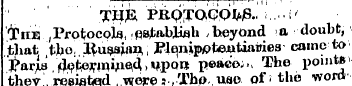
. TH ^ PRp ^ QCJQlAiS .. i .... i ' ' The ( Protocols , . pajbabXiah , beyond a doubt , that tho I ^ usaian ,, Pl ^ nipotautiamea came to Paris ' defcermi » ei 4 uppr » peace ; ., The point *> they r re ei flt ^ d ( , were 5 , Thp , uao of ; the word '' prptc , 9 fpraj ;© »' , to , describe , tho privilego siir * ' r " pnd (? red , tbvi # ua 8 Ji % in ( tlwj Piii « cipalitie& ; th © 1 pre ^ e » ce , of . w 4 i vee ^ eU . Of war under tho ^ lags " p ( , j ^ V / natt 9 . , M , thfc' mouths of tno
Untitled Article
420 THE XOE ^ A . P IB . [ No . 319 , Saturday , ^^^^^^^^^^^^^^^^^^^^^^^^^^^^^^^^^^^^^^^^^ ^ _ _» _ .
Sa^Ttjjbdax, Mat 3, 1856.
SA ^ TTJjBDAX , MAT 3 , 1856 .
, ....,,. , ' ' ¦•¦*&&. L*F* (Ia(£ * Te -¦ ' . ' -^Pltultt Jxu(L|, 1^8f» ...: ' -. R ' ' ! ' ' ' ¦ '"' T " ' ' ¦ -• ¦
^ ^ J-z ' - 'i ^ Ifei . ^ lB fta . -
Untitled Article
-. j-r . ¦ . -- ¦ - - , ¦>• • - ; 9 t ' , ¦ - - ' ¦ ¦¦ i ¦ _ ¦ . ¦ , >¦¦¦ - There id notoing so . revolutionarj ^ beo&uao : tberei ¦ & ^^ Qiiritf . BcTtoaatxiJrfia . dH& convulsive , as the strati . tokeepthiiigs fixed when all the -wcsrldixartoy thia Verylaw of its creation m eternal progress . —Db . ABnoij ) .
Untitled Article
^^^^^^^^^^ N ^^ P ^^ M ^—^^^¦^^¦^^ U ^ l ^^ . ^^ i ^^^ l ^^ i ^ P ^^^^ M ^ M ^ fcJ . M ^*^^™^^ " *^^*^^™^^ , ^^^ ' ^*^^^^^^*^^*^''^ " ^^ , ^ " ^^^^^^^^^^^^ - - M ^ M ^^^ BJ ^^ fc ^ M ^^^ B ^^^^ M — . .. - , — — . — .-.., ¦¦¦ , — .. — ¦ .,. — - ¦— .-. i . _ ¦¦ . ¦ : _! 1 j- __ 2 ^ / NO'MOES TO CORBESPpirDBNTSvV- ¦ ¦ ¦ ¦ ¦¦ Ko notice can be taken pf anonymous oopamu 4 io » tiona Wbttteter is intended for insertion mnbt be authentlcatea by the name and address of the writer ; not necessoruy - -for publication , but as a guarantee of his ^ oaj ^ : ^ vi It ia imw ) 8 sibl » to aeknbirtedatfthe iWlffli of letters we receive . ^ rheir insertion is often delayed . owin » to _ a press Of Matter ; and when omitted , it is . frequently from reasons « uitQ independent of the merits ofJ . be . communica-. WSnnot undertake to * ettirn rejected cbmmunJcatipns : © uring the Saseion of BarliameBt . it iai oftenf . imnoBsibleto find room tor correspondence , eyen ^ he biiefes f ; . ; . ..
-
-
Citation
-
Leader (1850-1860), May 3, 1856, page 420, in the Nineteenth-Century Serials Edition (2008; 2018) ncse.ac.uk/periodicals/l/issues/vm2-ncseproduct2139/page/12/
-