On this page
-
Text (3)
-

Untitled Article
-

Untitled Article
-

Untitled Article
Note: This text has been automatically extracted via Optical Character Recognition (OCR) software. The text has not been manually corrected and should not be relied on to be an accurate representation of the item.
-
-
Transcript
-
Note: This text has been automatically extracted via Optical Character Recognition (OCR) software. The text has not been manually corrected and should not be relied on to be an accurate representation of the item.
Additionally, when viewing full transcripts, extracted text may not be in the same order as the original document.
Untitled Article
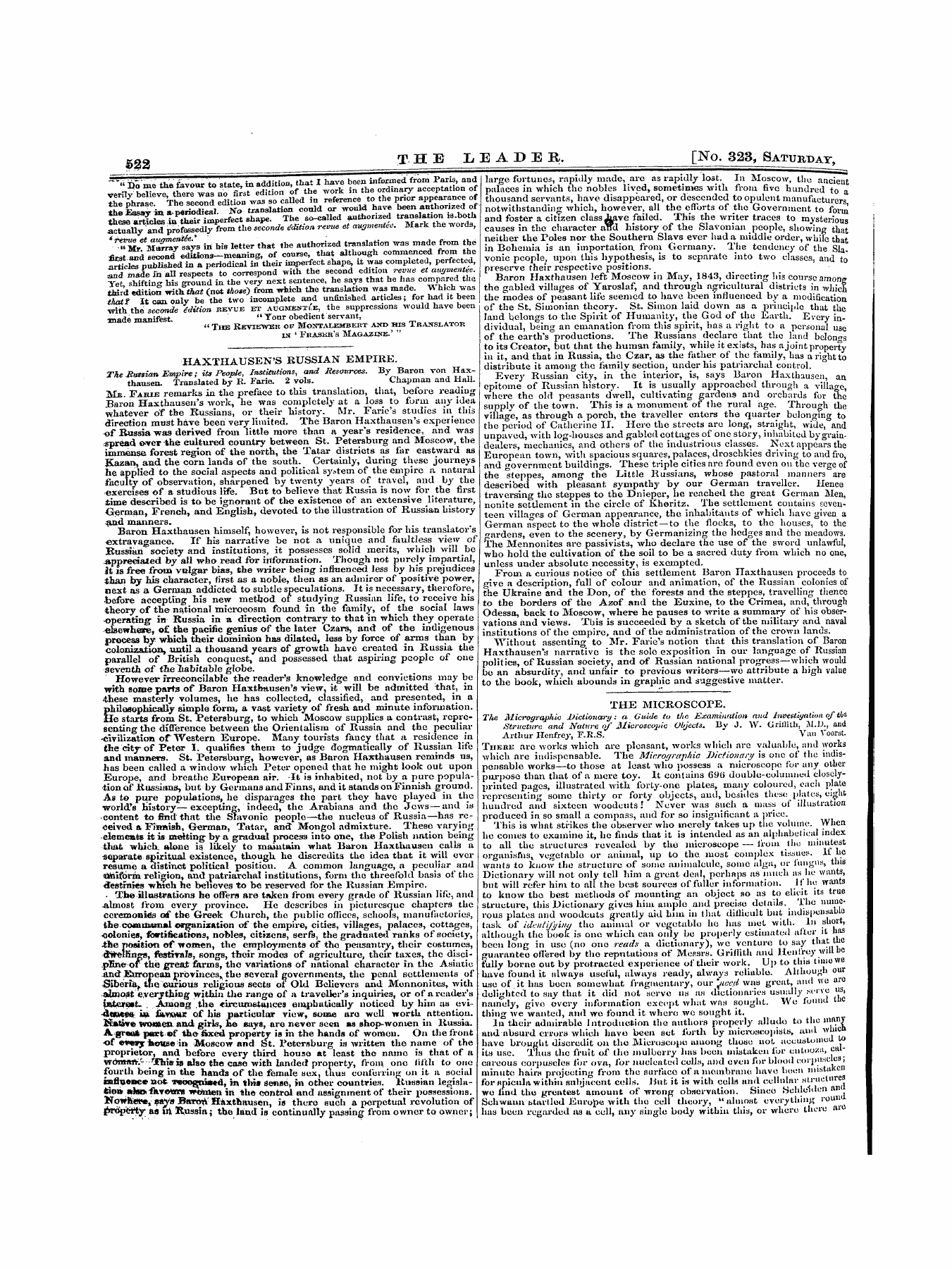
S ^ e ^ icl ^ tu ^ S S ^ rfect shape . The so-called authorized translation . both aS ^ Sd profS ?? om the « £ > < 7 e * ffft *» re ™ e * a ^ ento . Mark the words , ' re ? £ r MS / says in his tetter that the authorized translation was made from the iWa * d secondI editions-meaning , of course , that althoug h commenced from the fScS puSished in a periodical in their imperfect shape , it was completed , perfected , 2 nd made fn aU respects to correspond with the second edition revue et autjinentee . Yet , shifting his ground in the very next sentence , he says that he has compared the third editioS witkW * ( not those ) from which the translation was made \ A hl ? . that ? It can only be the two incomplete and unfinished articles ; for had it been with the seconde edition revue et augment ^ :, the suppressions would have been made manifest . » Your obedient servant , " The Reviewer of Moxtalembert and bis Translator in ' Fkaskk ' s Magazine . ' "
Untitled Article
HAXTHAUSEN'S RUSSIAN EMPIRE . Tie JRmsian Empire ; its People , Institutions , and Resources . By Baron von Haxthausen . Translated by K . Farie . 2 vols . Chapman and Hall . Mb . Fame remarks in the preface to this translation , that , before reading Baron Haxthausen ' s work , lie was completely at a loss to form any idea whatever of the Russians , or their history . Mr . Farie ' s studies in this direction , must have been very limited . The Baron Haxthausen's experience -of Russia was derived from little more than a year ' s residence , and was spread over the cultured country between St . Petersburg and Moscow , the immense forest region of the north , the Tatar districts as far eastward as Jlazan ., aad the corn lands of the south . Certainly , during these journeys he applied to the social aspects and political sy . ^ tem of the empire a natural faculty of observation , sharpened by twenty years of travel , and by the exercises of a studious life . But to believe that Russia is now for the first time described is to be ignorant of the existence of an extensive literature , German , French , and English , devoted to the illustration of Russian history
and manners . Baron Haxthausen himself , however , is not responsible for his translators extravagance . If his narrative be not a unique and faultless view of Bussiari society and institutions , it possesses solid merits , which will be Appreciated by all who read for information . Though not purely impartial , it i& free from vulgar bias , the writer being influenced less by his prejudices than by his character , first as a noble , then as an admirer of positive power , next as a German addicted to subtle speculations . It is necessary , therefore , before accepting his new method of studying Russian life , to receive his theory of the national microcosm found in the family , of the social laws -operating in Russia in a direction contrary to that in which they operate elsewhere , of the pacific genius of the later Czars , and of the indigenous process by which their dominion has dilated , less by force of arms than by colonization , until a thousand years of growth Lave created in . Russia the parallel of British conquest , and possessed that aspiring people of one seventh of toe habitable globe .
However irreconcilable the reader ' s knowledge and convictions may be with some parts of Baron Haxthausen ' s view , it will be admitted that , in 4 hese masterly volumes , he has collected , classified , and presented , in a philosophically simple form , a vast variety of fresh and minute information . He starts from St . Petersburg , to which Moscow supplies a contrast , representing the difference between the Orientalism of Russia and the peculiar civilization of ' Western Europe . Many tourists fancy that a residence in the city-of Peter I . qualifies them to judge dogmatically of Russian life and manners . St . Petersburg , however , as Baron Haxthausen reminds us , has been called a window which Peter opened that he might look out upon Europe , and breathe European air . Ifc is inhabited , not by a pure
population of Russians , but by Germans and Finns , and it stands on Finnish ground . As to pure populations , he disparages the part they have played in the world's history—excepting , indeed , the Arabians and the Jews—and is content to find that the Slavonic people—the nucleus of Russia—has received a Finnish , German , Tatar , and Mongol admixture . These varying elements it is melting by a gradual process into one , the Polish nation being tliat which , alone is likely to maintain what Baron Haxthausen calls a -separate spiritual existence , though he discredits the Idea that it will ever resume a distinct political position . A common language , a peculiar and ottuform religion , and patriarchal institutions , form the threefold basis of the dtestrnies winch he believes to be reserved for the Russian Empire .
- The illustrations he offers are taken from every grade of Russian life , and -almost from every province . He describes in picturesque chapters the ceremonies o £ the Greek Church , the public offices , schools , manufactories , the comiiniUTial organization of the empire , cities , villages , palaces , cottages , oolonies , fortifications , nobles , citizens , serfs , the graduated ranks of society , -tbe position of women , the employments of the peasantry , their costumes , tW-elKngs , festivals , songs , their modes of agriculture , their taxes , the disci-. pfine or the great farms , the variations of national character in the Asiatic and European provinces ,, the several governments , the penal settlements of -Siberia ^ tli Q curious religious sects of Old Believers and Mennonites , with almost everything within the range of a traveller ' s inquiries , or of a reader ' s iA&urfXt . Among the circumstuiices emphatically noticed by him na
evi-• denceeh ur . { kvKmr . of his particular view , some are well worth attention . ISsmtwe women and girls , be says , are never seen as shop-women in Russia . Agree * port of the-fixed property is in the hands of women . On the front of ewiy house in Moscow and St . Petersburg is written the name of the proprietor , and before every third houso at least the name is that of a wdnwwfc .- _ JFhw i » itlao the case with landed property , from , one fifth to one fourth being in the hands of the female bcx , thus conferring on it a social influence not ; iwoog ^ iiacd , in tins sense , in othor countries . Kuastan legislation fttoo favours wofexken in the control and assignment of their possessions . NdWh «*» , ? a ! y BarajV Haxthausen , ia there such a perpetual revolution of propHHy m frt R , uss ! a ; the laud is continually passing from owner to owner ;
large fortunes , rapidly made , are as rapidly lost . In Moscow , the ancient palaces in which the nobles lived , sometimes with from five hundred to a thousand servants , have disappeared , or descended to opulent manufacturers notwithstanding which , however , all the efforts of the Government to form and foster a citizen class Jiave failed . This the writer traces to mysterious causes in the character and history of the Slavonian people , showing that neither the Poles nor the Southern Slavs ever hud a middle order , while that in Bohemia is an importation , from Germany . The tendency of the Slavonic people , upon this hypothesis , is to separate into two classes , and to preserve their respective positions . Baron Haxthausen left Moscow in May , 1843 , directing his course among the gabled villages of Yaroslaf , and through agricultural districts in which the modes of peasant life seemed to have been influenced by a modification
of the St . Simonian theory . St . Simon laid down as a principle that the land belongs to the Spirit of Humanity , the God of the Earth . Every individual , being an emanation from this spirit , has a right to a personal use of the earth ' s productions . The Russians declare that the land belongs to its Creator , but that the human family , while it exists , has a joint property in it , and that in Russia , the Czar , as the father of the family , has a right to distribute it among the family section , under his patriarchal control . Every Russian city , in the interior , is , says Baron Haxthausen , an epitome of Russian history . It is usually approached through a village , where the old peasants dwell , cultivating gardens and orchards for the
supply of the town . This is a monument of the rural age . Through the village , as through a porch , the traveller enters the quarter belonging to the period of Catherine II . Here the streets are long , straight , wide , and unpaved , with log-houses and gabled cottages of one story , inhabited by graindealers , mechanics , and others of the industrious classes . Next appears the European town , with spacious squares , palaces , droschkies driving to and fro , and government buildings . These trip le cities are found even on the verge of the steppes , among the Little Russians , whose pastoral manners are described with pleasant sympathy by our German traveller . Hence traversing the steppes to the Dnieper , he reached the great German Men , nonite settlement in the circle of Khoritz . The settlement contains
seventeen villages of German appearance , the inhabitants of which have given a German aspect to the whole district—to the flocks , to the houses , to the gardens , even to the scenery , by Germanizing the hedges and the meadows . The Mennonites are passivists , who declare the use of the sword unlawful , who hold the cultivation of the soil to be a sacred duty from which no one , unless under absolute necessity , is exempted . From a curious notice of this settlement Baron Haxthausen proceeds to give a description , full of colour and animation , of the Russian colonies of the Ukraine and the Don , of the forests and the steppes , travelling thence to the borders of the Azof and the Euxine , to the Crimea , and , through Odessa , back to Moscow , where he pauses to write a summary of his observations and views . This is succeeded by a sketch of the military and naval institutions of the empire , and of the administration of the crown lands .
"Without assenting to Mr . Farie ' s notion that this translation of Baron Haxthausen's narrative is the sole exposition in our language of Russian politics , of Russian society , and of Russian national progress—which would be an absurdity , and unfair to previous writers—we attribute a high value to the book , which abounds in graphic and suggestive matter .
Untitled Article
THE MICROSCOPE . The Microgrqphic Dictionary : a Guide to the Examination and Investigation of tJi ^ Structure and Nature of Microscopic Objects . By J . W . GrMith , M . D ., and Arthur Henfrey , F . R . S . Van Voorst . There arc works which are pleasant , works which are valuable , and works which are indispensable . The Micrographic Dictionary is one of the indispensable works—to those at least who possess a microscope for any other purpose than that of a mere toy . It contains 696 double-columned closelyprinted pages , illustrated with forty-one plates , many coloured , each plate representing some thirty or forty objects , and , besides these plates , eight hundred and sixteen woodcuts ! Never was such a mass of illustration produced in so small a compass , and for so insignificant a price . the volumeWhen
This is what strikes the observer who merely takes up . he comes to examine it , he finds that it is intended as an alphabeticul index to all the structures revealed by the microscope — from the minutest organisms * vegetable or animal , up to the most complex tissues . If he wants to know the structure of some animalcule , some alga , or lungna , thie Dictionary will not onl y tell him a great deal , perhaps as much as lie wants , but will refer him to all the best sources of fuller information . _• " (' . wants to know the best methods of mounting an object so as to elicit its true structure , this Dictionary gives him ample and precise details . The numerous plates and woodcuts greatly aid him in that difficult but indispensable task of identifying the annual or vegetable ho has met with . In short , although the book is one which can only bo properly estimated after it has been long in use ( no ono reads a dictionary ) , we venture to say that the guaranteo ottered by the reputations of Messrs . Griffith and Henfrey will be fully borne out by protracted experience of their work . Up to this tune we have found it always usefulalways readyalways reliable . Althoug h our
, , use of it has been somewhat fragmentary , our " jt eefl was great , and we are delig hted to say that , it did not serve us as dictionaries usually kitvo us , namely , give every information except what was sought . Wo found tne thing we wanted , and we found it where we sought it . In their admirable Introduction the authors properly allude to the many and absurd errors which have been set forth by microscopisltt , and wbica have brought discredit on the Microscope umoivg those not accustomed u > its use . Thus the fruit of the mulberry has boon mistaken for onLou / . R , " careous corpuscles for ova , for nucleated colls , and even for blood corpuscles ; minute hair « projecting from tho surface of a membrane have been mistake for spicula within subjacent cells . But it is with colls and cellular . sl , ru « t"rej wo find thu greatest amount of wrong observation . Since Schlo 1 « len an Soliwuim btartlod Europe with tlio cell theory , " almost everything rouiiu has boon regarded as a coll , any single body within this , or where there tvio
Untitled Article
5 gg THE LEADER , [ No . 323 , Saturday ,
-
-
Citation
-
Leader (1850-1860), May 31, 1856, page 522, in the Nineteenth-Century Serials Edition (2008; 2018) ncse.ac.uk/periodicals/l/issues/vm2-ncseproduct2143/page/18/
-