On this page
-
Text (1)
-

Untitled Article
Note: This text has been automatically extracted via Optical Character Recognition (OCR) software. The text has not been manually corrected and should not be relied on to be an accurate representation of the item.
-
-
Transcript
-
Note: This text has been automatically extracted via Optical Character Recognition (OCR) software. The text has not been manually corrected and should not be relied on to be an accurate representation of the item.
Additionally, when viewing full transcripts, extracted text may not be in the same order as the original document.
Untitled Article
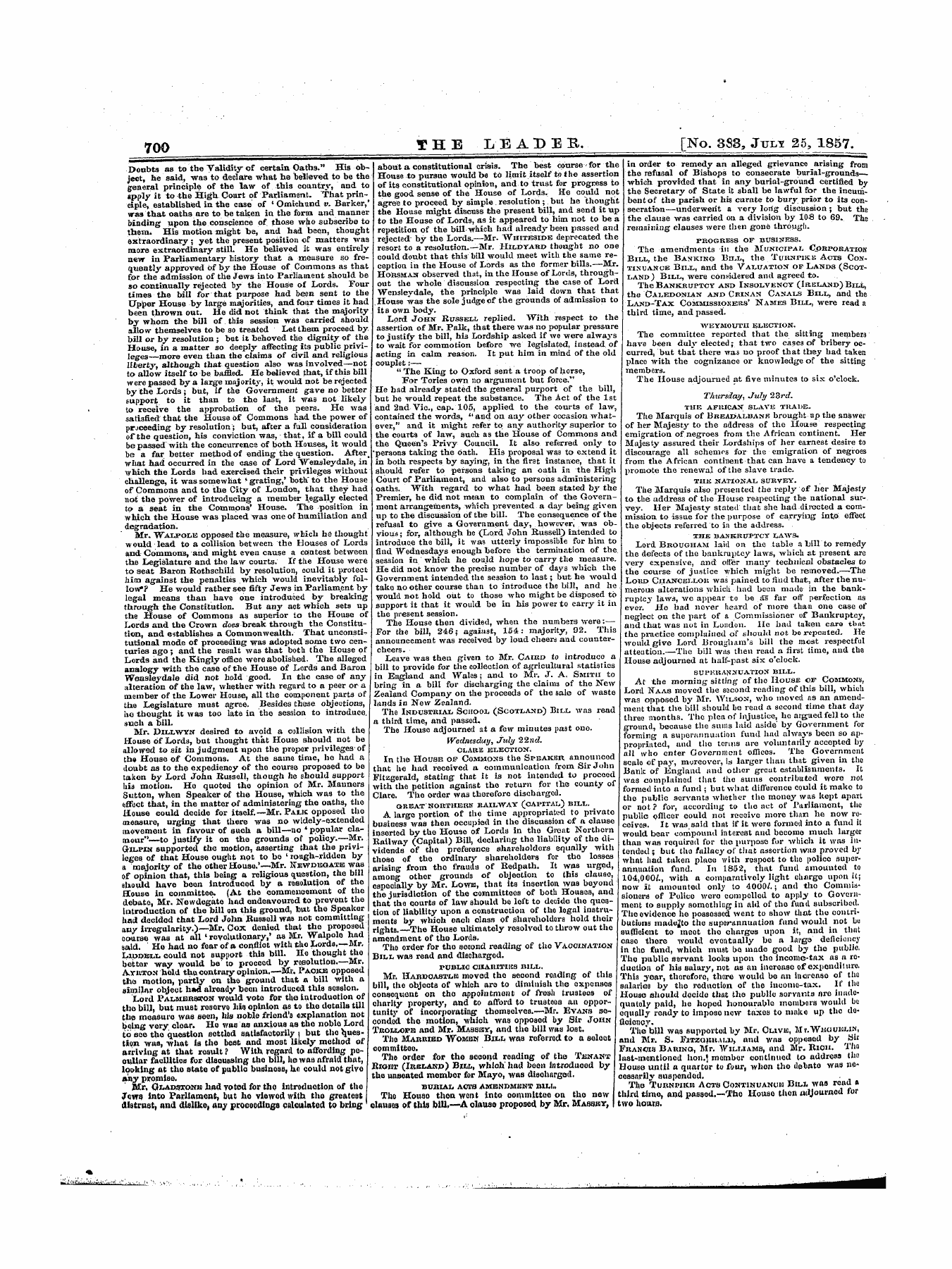
Doubts as to the Validity of certain Oaths . " His object , he said , was to declare what he believed to be the general principle of the law of this country , and to apply it to the High Court of Parliament . "That principle , established in the case of ' Omichund v . Barker , ' was that oaths are to betaken in the form and manner binding upon the conscience of . those who subscribe to them . His motion might be , and had been , thought extraordinary ; yet the present position of matters was more extraordinary still . He believed it was entirely new in Parliamentary history that a measure so frequently approved of by the House of Commons as that for the admission of the Jews into Parliament should be so continually rejected by the House of Lords . Four
times the bill for that purpose had been sent to the Upper House by large majorities , and four times it had been thrown out . He did not think that the majority by whom the bUl of this session was carried should allow themselves to be so treated Let them proceed by bill or by resolution ; but it behoved the dignity of the House , in a matter so deeply affecting its public privileges—more even than the claims of civil and religious liberty , although that question also was involved—not to allow itself to be baffled . He believed that , if this bill were passed by a large majority , it would not be rejected by the Lords ; but , if the Government gave no better support to it than to the last , it -was not likely the
to receive the approbation of peers . He was satisfied that the House of Commons had the power of prjceeding by resolution ; but , after a full consideration of the question , his conviction was , that , if a bill could be passed with the concurrence of both Houses , it would be a far better method of ending the question . After wliat had occurred in the case of Lord Wensleydale , in which the Lords bad exercised their privileges without challenge , it was somewhat f grating , ' both' to the House of Commons and to the City of London , that they had not the power of introducing a member legally elected to a seat in the Commons' House . The position in which , the House wa 3 placed was one of humiliation and degradation .
Mr . Walpolb opposed the measure , which he thought would lead to a collision between the Houses of Lords and Commons , and might even cause a contest between the Legislature and the law courts . If the House were to seat Baron Rothschild by resolution , could it protect him against the penalties which would inevitably follow ? He would rather see fifty Jews in Parliament by legal means thaii have one introduced by breaking through the Constitution . But any act which sets up the House of Commons as superior to the House of Lords and the Crown does break through the
Constitution , and establishes a Commonwealth . That unconsti ^ tutional mode of proceeding was adopted some two centuries ago ; and the result was that both the House of Lords and the Kingly office were abolished . The alleged analogy with the case of the House of Lords and Baron Wensleydale did not hold good . In the case of any alteration of the law , whether with regard to a peer or a member of the Lower House , all the component parts of the Legislature must agree . Besides these objections , he thought it was too late in the session to introduce , such a bill .
Mr . Pillwyn desired to avoid a collision with the House of Lords , but thought that House should not be allowed to sit in judgment upon the proper privileges of the House of Commons . At the saino time , he had a doubt as to the expediency of the course proposed to be taken by Lord John Russell , though he should support his motion . He quoted the opinion of Mr . Manners Sutton , when Speaker of the House , which was to the effect that , in the matter of administering the oaths , the House could decide for itself . —Mr . Pajuc opposed the measure , urging that there was no widely-extended movement in favour of such a bill—no * popular clamour " ' —to justify it on the grounds of policy . —Mr . G-IL . PXN supported the motion , asserting that the privileges of that House ought npt to be ' rouglwiddon by
a majority of the other House . '—Mr . Newdegatk was of opinion that , thia being a religious question , the bill should have been introduced by a resolution of the House in committee . ( At the commencement of the debate , Mr . Newdegate had endeavoured to prevent the Introduction of the bill on this ground , but the Speaker had decided that Lord John Russell was not committing any irregularity . )—Mr . Cox denied that the proposed oourae was at all * revolutionary , ' as Mr . Walpole had said . Ho had no fear of a . conflict with the Lorda , —Mr . Liddkll could not support thia bill . Ho thought the better way would be to proceed by resolution . —Mr . A . YKXON hold tho . contrary opinion . —Mr . Paoiuo opposed the motion , partly on tho erownd tuat a bil 1 witlx a aimllnr object h * & already been introduced thia session .
Lord Paumersocon would vote for the introduction of tho bill , but muat roaervo liia opinion as to tho details till tup measure was seen , his noble friend ' s explanation not being very clear . Ho woe as anxious as the noble Lord to see the , question eottlod satisfactorily i but tho Question wua , what ia the best and moat likely method of arriving at that reault ? With regard to affording pooiiliar facllltioa for diaouaalng the bill , ho waa afraid that , looking at tho state of public buaineaa , ho could not give » ny promise . Mr . Gladstone had voted for tho introduction of tho Jews into Parliament , but he viewed with tho greatest distrust , and dlallko , any proceedings calculated to bring
about a constitutional crisis . The best course for the House to pursue Would be to limit itself to the assertion of its constitutional opinion , and to trust for progress to the good sense of the House of Lords . He could not agree to proceed by simple resolution ; but he thought the House might discuss the present bill , and send it up to the House of Lords , as it appeared to him not to be a repetition of the bill which had already been passed and rejected by the Lords . —Mr . "Whiteside deprecated the resort to a resolution . —Mr . Hildyakd thought no one could doubt that this bill would meet with the same reception in the House of Lords as the former bills . —Mr . Horsm an observed that , in the House of Lords , throughout the whole discussion respecting the case of Lord Wensleydale , the principle was laid down that that House was the sole judge of the grounds of admission to its own body .
Lord John Russell replied . With respect to the assertion of Mr . Palk , that there was no popular pressure to justify the bill , his Lordship asked if we were alwaj-s to wait for commotion before we legislated , instead , of acting in calm reason . It put him in mind of the old couplet : — " The King to Oxford sent a troop of horse , For Tories own no argument but force . " He had already stated the general purport of the bill , but he would repeat the substance . The Act of the 1 st and 2 nd Vic , cap . 105 , applied to the courts of law , contained the words , " and on any other occasion whatever , " and it might refer to ; any authority superior to the courta of law , such as the House of Commons and the Queen ' s Privy Council . It also referred only to persons taking the oath . His proposal was to extend it in both respects by saying , in the first instance , that it
should refer to persons taking an oath in the High Court of Parliament , and also to persons administering oaths . With regard to what had been stated by the Premier , he did not mean to complain of the Government arrangementSj which prevented a day being given up to the discussion of the bill . The consequence of the refusal to give a Government day , however , was obvious ; for , although he ( Lord John Russell ) intended to introduce the bill , it was utterly impossible for him to find Wednesdays enough before the termination of the session in which he could hope to carry the measure . He did not know the precise number of days which the Government intended the session to last ; but he would take no other course than to introduce the bill , and he would not hold out to those who might be disposed to support it that it would be in his power to carry it in the present session .
The House then divided , when the numbers were : — For the bill , 246 ; against , 154 : majority , 92 . This announcement was received by loud cheers and counteroheers-Leave was then given to Mr . Cairo to introduce a bill to provide for the collection of agricultural statistics in England and Wales ; and to Mr . J . A . Smith to bring in a bill for discharging the claims of the New Zealand Company on the proceeds of the sale of waste lands in New Zealand . The Industrial . School ( Scotland ) Bill , was read a third time , and passed . The House adjourned at a few minutes past one .
Wednesday , JtUy 22 nd . CLARE ELECTION . In the House op Commons the Speaker announced that he had received a communication from Sir John Fitzgerald , stating that it is not intended to proceed with , tho petition against the return for the county of Clare . Tho order was therefore discharged . GREAT NORTHERN KAILWAY ( CAPITAL . ) BILL . A largo portion of tho time appropriated to private business was then occupied in tho discussion of a clause inserted by the House of Lords in tho Groat Northern the of tho di
Railway ( Capital ) Bill , declaring liability - vidends of tho preference shareholders equally with those of the ordinary shareholders for tho losses arising from tho frauds of Redputh . It was urged , among other grounds of objection to this clause , especially by Mr . Lown , that ita insertion waa beyond the jurisdiction of tho committooa of both HouaeB , and that tho qourta of law should be left to decide tho quos-: ion of liability upon n conatruction of the legal instruments by which each class pf shareholders hold their rights . —The House ultimately roaolvod to throw out tho amendment of tho Lords .
Tho order for tho second reading of the Vaccination Bill waa read and discharged .
PUBLIC CIIARITIICS BILL . Mr . Hakdoastlb ! moved tho second reading of thia bill , tlio object a of which are to diminish tlie oxponsoa consequent on the appointment of fresh trustees of charity property , and to afford to truatoos an opportunity of incorporating thomsolvoa . —Mr . Evans booonded the motion , which waa oppoaod by Sir John T « OLLoriB and Mr . Massbv , and tho bill w » a loat . Tho Married Wombm Biuju waa roforrod to a aoloot committee . Tho order for tho Beeond reading of tho Tenant Right ( Irbjcanp ) Bx * l , which had boon introduced by tho unsoated member for Mayo , waa diaohnrgod .
BURIAL ACTS AMENDMENT DILI .. Tho House then wont into committee on tho now clauses pf this bill , —A clause propoaod by Mr . Massby
in order to remedy an alleged grievance arising from the refusal of Bishops to consecrate burial-groundswhich provided that in any burial-ground certified by the Secretary of State it shall be lawful for the incumbent of the parish or his curate to bury prior to its consecration—underwent a very long discussion ; but the the clause was carried on a division by 10 S to 69 . The remaining clauses were then gone through . PROGRESS OF BUSINESS . The amendments in the Municipal Corporation Bill , the Banking Bill , the Turnpike Acts Continuance Bill , and the Valuation op Lands ( Scotland ) Bill , were considered and agreed to . The Bankruptc y and Insolvency ( Ireland ) Bill , the Caledonian and Ckinan Canals Bill , and the Land-Tax Commissioners' Names Bill , were read a third time , and passed .
WEYMOUTU ELECTION . The committee reported that the sitting members have been duly elected ; that two cases of bribery occurred , but that there was no proof that they had taken place with the cognizance or knowledge of the sitting members . The House adjourned at five minutes to six o ' clock . Thursday , July 23 rd . THE AFRICAN SLAVE TRADE . The Marquis of Breadalbase brought up the answer of her Majesty to the address of the House respecting emigration of negroes from the African continent . Her Majesty assured their Lordships of her earnest desire to discourage all schemos for the emigration of negroes from the African continent that can have a tendency to promote the renewal of the slave trade .
THE NATIONAL SURVEY . The Marquis also presented the reply of her Majesty to the address of the House respecting the national survey . Her Majesty stated that she had directed a commission , to issue for the purpose of carrying into effect the objects referred to in the address .
THE BANKRUPTCY LAWS . Lord . Brougham laid on the table a bill to remedy the defects of the bankruptcy laws , which at present are very expensive , and offer many technical obstacles to the course of justice which might be removed . —The Lord Chancellor was pained to find that , after the numerous alterations which ¦ had been made in the bankruptcy laws , we appear to be as far off perfection as ever . He had never heard of more than one case of neglect on the part of a Commissioner of Bankruptcy , and that was not in London . He bad taken caro that the practice complained of should not bo repeated . He would give Lord Brougham ' s bill the most respectful attention . —The bill was then read a first time , and the House adjourned at half-past six o ' clock .
SUPERANNUATION BILL . At the morning sitting of tho House of Commons , Lord ETaas moved the second reading of this bill , which was opposed by Mr . Wilson , who moved as an amendment tliat the bill should he read a second lime that day three months . The plea of injustice , he argued fell to the ground , because the sums laid aside' by Government for forming a superannuation fund had always been so appropriated , and the terms are voluntarily accepted by all who enter Government offices . The Government scale of pay , moreover , is larger than thnt given in the Bank of England and other great establisnments . It was complained that the sums contributed were not formed into a fund ; but what difference could it make to
tho public servants whether tho money was kept apart or not ? for , according to tho act of Parliament , the public officer could not receive more than he now roceivos . It was said that if it were formed into a fund it would bear compound interest and become much larger than -was required for tho purpose for which it was intended ; but tho fallacy of that assertion vvus proved by what had taken place with respoct to tho police superannuation fund . In 1852 , that fund amounted to 104 , 00 OJ ., with a comparatively light charge upon it ; now it amounted only to 4000 / . ; and tho Commissioners of Police were compelled to apply to Governsubscribed
ment to supply something in aid of tho fund . Tho evidence ho poaaoaaod went to show that tho contributions mado ^ to tho superannuation fund would not bu aufllolcnt to meot tho cliargos upon it , and in that case thoro would eventually be a largo deficiency in tho fund , which must l > o made good by tho public . Tho public servant looks upon tho income-tax aan roduction of hia sulary , not aa ftn incroaao of expenditure This year , therefore , thoro would bo an incroaao of tho salaries by tho reduction of tho income-tax . It' thu House should decido that tho public sorvnnta ore inudoquatoly paid , ho hoped honourable inombors would be equally rondy to impose now taxes to ninlto up the
deficiency . The bill wab supported l > y Mr . Olive , Mv . Wmciunlin , and Mr . S . Fitzgerald , and waa oppoaod by Wn Francis Baring , Mr . Williams , and Mr- Rich . 1 { " > luat-montionod lion . ! member continued to addroaa tun House until a quarter to four , when tho delate waa nocoaaarily suspended . Tho Turnpike Acts Continuanuio Bill waa road ft third time , and pttaaod . —Tho Houao then ailjournod for two hours .
Untitled Article
700 THE LB ADE B [ No . 3 S 3 , Jui / g 25 , 1857 .
-
-
Citation
-
Leader (1850-1860), July 25, 1857, page 700, in the Nineteenth-Century Serials Edition (2008; 2018) ncse.ac.uk/periodicals/l/issues/vm2-ncseproduct2202/page/4/
-