On this page
-
Text (3)
-

Untitled Article
-
Untitled Article
-

Untitled Article
Note: This text has been automatically extracted via Optical Character Recognition (OCR) software. The text has not been manually corrected and should not be relied on to be an accurate representation of the item.
-
-
Transcript
-
Note: This text has been automatically extracted via Optical Character Recognition (OCR) software. The text has not been manually corrected and should not be relied on to be an accurate representation of the item.
Additionally, when viewing full transcripts, extracted text may not be in the same order as the original document.
Untitled Article
have to ascertain by what influences , while thirty-five millions of the population have . remained tranquil , if not content , seventy-eight regiments , within thirty-six days , melted away from under the British flag . The mutiny can be no accident . Some mortal offence must have been given to that army , which is the chief in India , being more costly and upon a grander scale than the united establishments of Bombay and Madras . We will lay aside the ass umption of foreign influences . There is more than one power interested in undermining our Eastern dominion ; Russian agencies have frequently been detected to the south of the Afghan mountains ; moreover ,
there has been at times a sudden influx of * old among the Sepoys , who have been ^ ob-3 erved to communicate with those mysterious ; raders in money , whose written dialect is less ntelligible than the Koiuv onvpax o £ EleUSIs ; jossibly the stamped cakes and the Jotus lowers indicate more than a local conspiracy ; > ut the evidence is vague , and we do not care ; o exaggerate its importance . Why , then , have he troops of the Bengal provinces revolted , ind not revolted only , but breathed the Moodiest vengeance against their English soinmanders , violating women and young f irls , and then subjecting them to cruelties nore atrocious and unnatural thau ever were
nvented by Roman emperors , Tartar conluerors , or Spanish priests , and carrying their erocity to such a pitch as even to strip chil-Iren , flog and torture them , cut off their lands and feet , and prick them to death with > ayonets and tulwars ? We need not go far or an explanation of these hideous
outages . The Asiatic , in a state of desperation , j a remorseless fatalist , and his propensities empthimto run a muck of slaughter until yertaken by the doom which he . sullenly ntieipates . The crew of a sinking ship have een known , when all . hope was lost , to ravish very woman on board and murder every child ; heir frenzy took that bestial form as to their errified fancies the moment of annihilation
revv near . So , in India , the garrison of Jelhi , with no prospect before it except an iterval of unlimited' lust and rapine , has ^ terally grovelled in human blood , and njoyed a licentious satiety of violence . fiThen and wherever iu history armies have urst into revolt or lost the spirit of subrdination , they have signalized themselves v similar ebullitions of fury , which an ob-** _ _ _ - < w » - ¦ "I - « ¦ T understand \\
_ . crver finds it difficult to . e o not think that auy special reason is to be raced to account for such acts as cutting ofi young girl ' s breasts and a child ' s feet near ) elhi , the scourging of a lady to death at hahjehanpore , or the reported tragedy iu he Raj of the spectral Mogul , who is said 0 have ordered an English girl to he stripped 1 his presence and slowly divided limb from nib .
But there must have been deep-seated and widely-spread causes , resulting in the mutiny . Jnhappily our military administration in Jen gal has been so rot ' tcn that few persons ave been astonished at its collapse . We ave raised a vast and powerful army from ho proudest population in the Bast , conaining one European to every twenty-four atiyes ; we have confided this tremendous rgnhisafcion principally to the care of
sublfcerns ; we have placed striplings who ride fc the head of infantry companies , and andies who disdain the service , iu comland of magnificent battalions of grenaiers , of whom every one was a giant and a tailunin , physically and morally far the supeior of any Addiscombe youngster or spider'aisted loiterer from Pay-mall . We have llowed these soldiers , while their captains , Lionels , and lieutenant-generals were doing erioal duty , to imbibe the teachings of
libellous and ribald native prints , inspired in some cases by abandoned Europeans , paid and pensioned for calumniating the British Government in the interest of the dethroned princes . Worse than all , we have preserved the false titular . distinctions of conquered dvnasties ; we had a Mogul in Delhi ready to become the puppet of an insurrection , and should a storm ever arise among the Mahrattas , they still have their Holkar and their Sindiah to proclaim . The Indian troops
have had facilities for comparing " their own low rank and humble allowances with those of their European officers ; they have measured their relative strength ; the Parsee priests have absolutely instigated them to revolt ; they know that Bengal never contained so much opulence as now . Ever since 1792 , anonymous letters have been disseminated by unknown hands through the Bengal cantonments , urging the men to kill their officers and resume their independence . Those were the seeds : in 1857 we reap the
harvest . Without denying the defects of the general police system in Bengal , the danger of interfering with old and almost sacred tenures , and the pernicious influences of ignorant missionary zeal , we ai-e convinced that the military outbreak has a distinctly military origin . If not , why are the great cities-peaceof the
ful , the villages loyal , the masses population undisturbed ? It is true that the retired and pensioned Sepoy almost invariably retreats to the place of his birth , and forms a link between the army iand the people ; but after losing seventy-eight regiments , we have not lost the allegiance of a single province ; even in Delhi , it is believed , the inhabitants will gladly welcome the entrance of the
besieging army . If it eanibe shown that the discipline of a great army has been radically vitiated , that it has been weakly officered , that disaffection has been allowed to ripen unchecked , and that a . Bengal mutiny has long been predicted by men whose observations have been purely military , we think that ¦ more will be gained by a close inspection of our military system iii India , than by wandering among , the exaggerations of Mr . Malcolm Lewin , or believing that a rebel King has been enthroned at Delhi because we put an end some time ago to the crapulous despotism of Oude .
Untitled Article
FRANCE ON THE DANUBE . The new Eastern question is of a somewhat complex nature . The Treaty of Paris contained a clause by which it was agreed that the authorities in Moldavia and Wallachia should convene a Divan ad hoc to express the wishes of the people with reference to their future institutions . The elections have taken place under every circumstance of injustice , exclusion , and corruption , and the immediate result is favourable to the policy of England , Austria , and the Ottoman Porte . France , Russia , Prussia , and Sardinia refuse to recognize the vote , and insist upon a new election . They threaten to withdraw their representatives from Constantinople should the Porte reject their demands ; and this violent diplomacy , although it has not yet led to concessions , has produced a modification of the Sultan ' s Cabinet . AustriaEngland , and Turkey are opposed
, to the political union of the Principalities under one government ; l ^ ranco , Russia , Prussia , and Sardinia tiro in favour of it . The three Powers objoct that the union , would be injurious to the Ottoman Empire ; the four Powers deny this . But of what value ia the Austrian objection ? Has not . Austria , under the signature of the Treaty of Paris , secretly proposed to Russia a joint occupation of Moldavia and Wallachia , a challenge in
the face of all Europe , a rupture of the Paris Convention ? And did not Russia betray this proposal to the participating Cabinets ? We may suspect the policy of Russia , but it does not . follow that we should confide in Austrian integrity . We believe that the union of the provinces is desired by the inhabitants themselves , chiefly upon the ground that it would erect them into a free and independent state , with a capacity for self-defence , but connect- ? ing itself with the public law of Europe , by acknowledging the modified sovereignty ot
the Porte . Ho doubt the Assemblies elected last month are hostile to this project ; but they are the mere mouthpieces of Prince Togobides , an agent of the Porte , who is known to have expressed his contempt for popular suffrages , and to have said that as the Emperor of the French nominated Jiis candidates to seats in the Assembly , and manipulated the elections , lie , as Kaimakan , was justified by precedent and by example . Public opinion , in truth , has not been allowed to act , and the returns took place amid the protests of the majority . Of
course we are bound to congratulate the French Government upon its devotion to electoral purity , a sentiment which , stifled at home , breaks out upon the Danube , and proves that although Lotris Napoleon despises the people of France , he respects the people of Moldavia , and will not countenance in a " Voqosides that which is divine in a Bonapakte . In a general sense , perhaps , it is well for mankind that , although the French are treated as infants , the Eouraans find their rights defended by no less a , person than M . r > is TiiOTTVENEL . But if we were Frenchmen
we might feel disparaged . Bucharest , under these influences , has been converted into a Babel of intrigues , with the agents of the several powers carrying on a contest of crinoline diplomacy , in which , up to the present moment , France has been signally successful . Not that Prince Vogorijdes has deferred to her ; but that she has taken up the popular policy , and is making manifest advances , while ground is proportionately lost by England , a Power ,
we are sorry to say , very indifferently represented throughout the Principalities . Neither the French , Russian , Prussian , and Sardinian league , nor the British , Austrian , and Turkish , appears inclined to give way ; but the can series , of Osborne may prove too many for M . be Thouvenel ; we have , at all events , the materials of a new and instructive commentary upon the preamble to the Treaty of Paris , " There shall be perpetual peace and amity , " &c .
Untitled Article
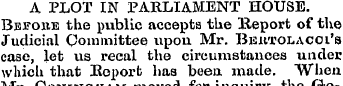
A PLOT IN PARLIAMENT HOUSE . Before the public accepts the Report of the Judicial Committee upon Mr . Beutolacoi ' s case , let us recal the circumstances under which that Report lias been , made . When Mr . Coninguam moved fop inquiry , the Government acquiesced , and five gentlemen , some of them mutual friends , were nominated
by the Committee of Selection to investigate the charges in the petition . The members named were not only in some instances mutual friends , but generally personal friends of the two Earls and the Baron implicated . They received evidonce , and they framed a report ; the report is before the public , but where is the evidence ? Kept buck for three
weeksprobably until Parliament hns risen—and we beg to hint to our contemporary , the Times , that it has , with excusable precip itation , founded an article upon threo or four pages ot oflicial whitewashing without waiting for the blue-book ,, which would have enabled it to judge between the decision of Mr . Sothjjiian JEsrcouttT and his colleagues , and the testi * mony of Mr . Bubtolacci and his colleagues .
Untitled Article
x * MB Attest 8 . 1857 . 1 THE LEADER . 757
-
-
Citation
-
Leader (1850-1860), Aug. 8, 1857, page 757, in the Nineteenth-Century Serials Edition (2008; 2018) ncse.ac.uk/periodicals/l/issues/vm2-ncseproduct2204/page/13/
-