
On this page
-
Text (2)
-
Untitled Article
-

Untitled Article
Note: This text has been automatically extracted via Optical Character Recognition (OCR) software. The text has not been manually corrected and should not be relied on to be an accurate representation of the item.
-
-
Transcript
-
Note: This text has been automatically extracted via Optical Character Recognition (OCR) software. The text has not been manually corrected and should not be relied on to be an accurate representation of the item.
Additionally, when viewing full transcripts, extracted text may not be in the same order as the original document.
Untitled Article
was professedly created to check and punish With what . dignity , weight , and authority , can a judge stand up and enlarge upon the virtues of careful expenditure , moderate discounts , prudent credits , thoughtful provision for the interests of creditors , and all the rare but shining virtues of theoretical and moral trade , in a Court whose charges amount to the old usurious abomination of ' sixty per cent . ?'
When such utterances come from the mouth of a Commissioner , the buzz in and about the Court is a sign of the derision which such hollow virtue excites . A discourse upon honesty is all very well , but we do not take it kindly from men who fatten upon the sacking of bankrupt estates , and who may be merely grumbling that there are not more assets thrown down to be scrambled for . Why should a man—who is not restrained by any higher considerations than mere self-interest—rest contented with the slow profits of
legitimate trade , when he can realize a large fortune in a few months by abusing his credit —that life-blood of commerce—and escaping with impunity because of the expensive , tardy , and uncertain operation of the Court of Bankruptcy ? How many creditors consent to take what we should call a judicious dividend , even when they see a palpable reservation of property on the part of the respectably fraudulent debtor , because the justice required to punish the robbery costs more than the robbery itself ? Nor should the high moralist , arguing upon abstract grounds , assert that trade will never be purified until the creditor class consent to sacrifices for the sake of
making examples of the dishonest debtors . The creditor , while he is a creditor in relation to one man , is a debtor in relation to another , and his only duty is the seemingly narrow one of making the most of a bad debt . He is not the custodian and preserver of the morality of our national trade , and to ask him to make a sacrifice for the public good , is to ask him to do something that it is the function and duty of the State to perform . How well the State—with all its commissions of inquiry , blue-books , and acts of Parliament —performs that duty , the present condition of the Court of Bankruptcy will bear a melancholy witness . The gross amount which the Court absorbs in salaries , compensations , &c , according to the Report of the Bankruptcy Commission , 1854 , is shown by this Summary Account , paid out of the Court fees : — Salaries £ 59 , 759 15 9 Compensations 21 , 565 4 7 Retiring Annuities ... 2 , 900 0 0 Court and other expenses 4 , 366 4 0 Bank Remuneration ... 1 , 799 17 8 £ 90 , 391 2 0 To this we have to add the diminution of the value of assets under a forced sale , or a very low valuation under which the bankrupt , by the assistance of his friends , frequently becomes again the possessor of his forfeited property . Then come the various charges that depend upon ' per-centage . ' First stands the Official Assignee , who claims 8 £ per cent . ; then the Messenger , who takes 6 per cent . ; then the Broker , who withdraws 5 per cent . ; and finally the Trade Assignee and Sundries , absorb another \ . \ per cent . Then another clmvge , arising out of the Court and its peculiar organization , is that of the Solicitor to jfrhe estate , whojuaually gets no less than 26 percent . Then there areTeTTtT ^ paid about 6 £ per cent ., and the bankrupt's allowance and wages , amounting ? to 4 t \ per cent ., so that the balance remaining for the creditors by way of dividend after all these payments and a considerable lapse of time is about 88 £ per cent , of the whole of the , aasetis taken into , realized , and collected by the
Court ! Is it to be wondered at that such a clumsy , expensive , and tardy piece of legal machinery should have thrown to it to be torn to pieces no more than about eight hundred small estates of unreburned value during the whole year ? Is it to be wondered at that bankruptcies , When likely to be profitable to the Court , are regarded as a godsend by the hungry officials ; and when small and unpromising are sent away , if possible , or taken up with unconcealed signs of disgust ? worked with
Of course , no Court can be - out a certain expense , and it is a question whether much of this expense—such as the salaries of the commissioners , 10 , 000 ? . per annum—should not , as in the case of the other law judges , be thrown upon the Consolidated Fund . The amount itself , wherever it may fall , is disgracefully out of proportion to the labour it procures . Close upon it comes an item for registrars of 57501 ., flanked by a chief registrar with 1200 J . per annum , and supported by a staff of clerks who cost 1479 / . 15 s . 9 d . per annum . The ushers are put down at 830 / . ; a very moderate amount , when we look at the
superfluous office of the accountant and his clerks , which inflicts an annual charge of 6710 ? . Then there is the taxing master and clerks at 1650 ? ., and all this for the dirty , insignificant Court in Basinghall-street . The country commissioners cost 21 , 600 Z . ; the registrars , 9600 ? . ; and the ushers , 9407 . Amongst the compensations , are the late London commissioners , 1000 ? . ; the Clerk of the Hanaper and other officers of the Lord Chancellor , 716 ? . 19 s . lid . ; and that wonderful office of Patentee of Bankrupts , which costs each year 7352 ? . 14 s . 6 d . ! The late country commissioners wind up this list with 12 , 495 ? . 10 s . 2 d .
Then there are retiring annuities , 2900 ? . per annum ; Court and other expenses , rent of country courts , travelling , stationery , &c , 4366 ? . 4 s . ; and a sum to the Bank of England , paid each year as remuneration for keeping the banking account of the Court , 1799 ? . 17 s . 8 d . These are some of the details of the expenses of this mercantile Court , which help to explain how it is that any trader who is not too greedy or imprudent to be unwilling or unable to offer five shillingswe say it again , exactly five shillings—in the pound may commit each and all of the crimes that are covered by the protecting shield of trade , and yet escape with impunity from a legal investigation .
Untitled Article
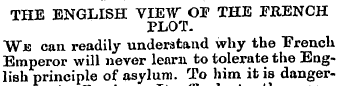
THE ENGLISH VIEW OF THE FRENCH PLOT . Wjs can readily understand why the French Emperor will never learn to tolerate the English principle of asylum . To him it is dangerous and offensive . It affords to the unappeasable enemies of hia throne a ground on which they can safely plan their operations . This , perhaps , is an evil ; but it is an evil inseparable from our laws and institutions . We should not only injure the exiles , but impair our own political basis by expelling such refugees as may be named in the requisition of the French Minister . Every man , alien or subject , within the British realm is entitled to hia liberty until he commits an illegal act . In that case only one course is open to the authorities . They must indict him and procure his conviction by a jury : —Otherwise—he-ie—iudependent ~ of-the Secretary of State , for , oven if the Alien Act were brought into strict ; operation , it would only compel the exiles to register themselves and obtain certificates . These , however , they would be necessitated , under a penalty , to give up on quitting the country , bo that foreign governments would , in that case , be thus xar
informed of their movements . But such precautions would be practically of little value . Nor can the Emperor hope to root out the conspiracies radicating in the English soil . As a French ruler he can only apply for the extradition of Frenchmen , which would leave the Italian dagger in its Birmingham sheath ; or does the communication to Lord Clabendon include a demand that France may hereafter be empowered to nominate the refugees who are to enjoy British hospitality ? The embarrassment is serious , but it is of Louis Napoleon ' s creating .
" Whatever may be said , the worst example ia his own . He conspired , and by conspiring gained an empire . What lesson more seductive to the promoters of a republic ? Louis Napoleon plotted in England , prepared his expedition in England , started from England , shot a harmless man at Boulogne , and , after endeavouring to subvert a Government founded on the national will , escaped to England for
safety . Like his present enemies , he refused ; o abandon his idea . He became a conspirator , he discharged a shower of grape-shot in Paris ; the prototype of Pieri and Ohsint , he slew and wounded many with whom he had no cause of quarrel , and his splendid triumph is , we repeat , a perpetual temptation to conspirators . All declamation on this subject is unnecessary . The facts are known to the world . Louis Napoleon ' s
Government arose out of a successful plot ; it may be the best Government on the earth , but the record of the plot is indelible . This victorious conspiracy , then , naturally desires to suppress all other conspiracies , finds the task difficult , and is therefore irritated . The irritation is excusable . The French people , in a large degree , have accepted the Empire . It gives them that which they desire- —quietude and material
prosperity . " Unhappily , however , the men of thought and intelligence are universally in opposition ; and while this state of things ia permitted to exist , the semblance of content will cover a secret agitation , finding occasional vent in a fulmination of grey gunpowder . For the moment , the incident of the Rue Lepelletier may be left out of sight . It was Italian in its origin and character , although the French Emperor Belects it as an excuse for fresh measures to bridle the
nation of France . We wish to interpret the purely English view of this matter . In Great Britain the principle of assassination is detested . We have not even a Cantillon on our pension list . The attempt to blow Louis Napoleon and the Empress out of their carriage is regarded as an act of reckless brutality , and all classes rejoice not only that the consummation of such a crime was prevented , but that France was saved from the transient period of anarchy rendered inevitable by the
principles of the Empire . But there are two points in connexion with this affair on which the English people do not concur witli Louis Napoleon . They will not surrender the character of their country as one in which every man not a criminal is free ; and they remark with anxiety the departure of the French Government from its habitual tone of reticence and moderation . It is not for the first time that we witness the
brandishing of a menace against Belgium ; we have already heard of remonstrances concerning our privilege of asylum ; but it is something now-to , JboJpJl ^ Mt aft 2 F el ^ y ^ i ^^ f Imperialism , public opinion iuFranco is formiclaDie , and must therefore be gagged . The Empire unconsciously compares itself with the dyke of Haarlem ; a tepid protest trickles through the columns of two opposition journals ; but that may become a flood , according to M : Billaulx , and not a moment must be lost in
Untitled Article
No . 409 , January 23 , 1858 . j THE LEADER . 85
-
-
Citation
-
Leader (1850-1860), Jan. 23, 1858, page 85, in the Nineteenth-Century Serials Edition (2008; 2018) ncse.ac.uk/periodicals/l/issues/vm2-ncseproduct2227/page/13/
-