On this page
-
Text (2)
-
Untitled Article
-

Untitled Article
Note: This text has been automatically extracted via Optical Character Recognition (OCR) software. The text has not been manually corrected and should not be relied on to be an accurate representation of the item.
-
-
Transcript
-
Note: This text has been automatically extracted via Optical Character Recognition (OCR) software. The text has not been manually corrected and should not be relied on to be an accurate representation of the item.
Additionally, when viewing full transcripts, extracted text may not be in the same order as the original document.
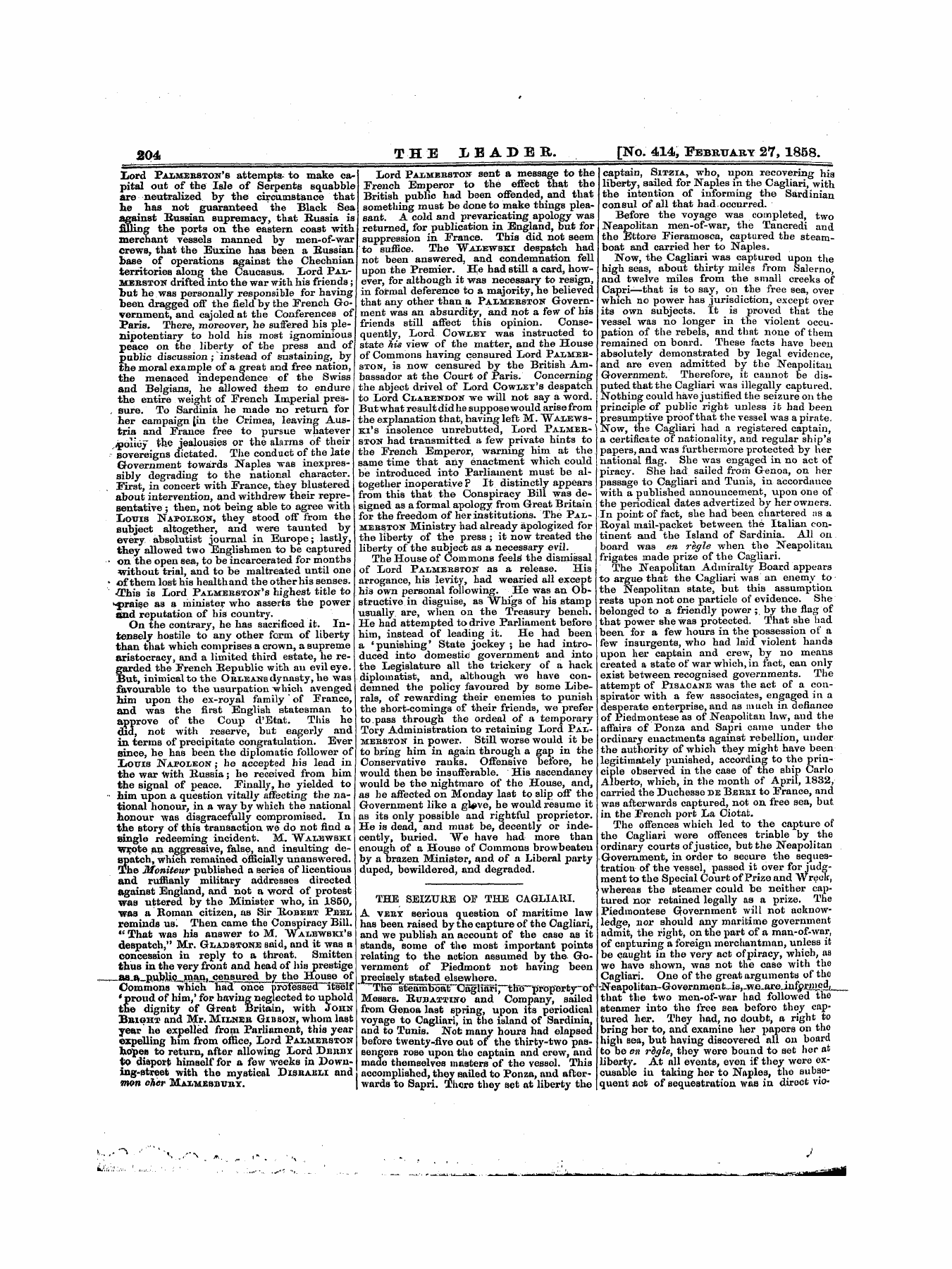
Untitled Article
Lord Pj ^ lmebston ' s attempts- to make capital out of the Isle of Serpents squabble are neutralized by the circumstance that he has not guaranteed the Black Sea against Russian supremacy , that Russia is filling the ports on the eastern coast with merchant vessels manned by men-of-war crews , that the Euxine has been a Russian base of operations against the Chechnian territories along the Caucasus . Lord Pal-Merston drifted into the war with his friends ;
T > ut he was personally responsible for having been dragged off the field by the French Government , and cajoled at the Conferences of Paris . There , moreover , he suffered his plenipotentiary to hold his most ignominious peace on the liberty of the press and of public discussion ; instead of sustaining , by the moral example of a great and free nation , the menaced independence of the Swiss and Belgians , he allowed them to endure the entire weight of French Imperial pressure . To Sardinia he made no return for
her campaign [ in the Crimea , leaving Austria and France free to pursue whatever / poiMsjf the jealousies or the alarms of their sovereigns dictated . The conduct of the late G-overnment towards Naples was inexpressibly degrading to the national character . First , in concert with France , they blustered about intervention , and withdrew their representative ; then , not being able to agree with
Louis Napoxeon , they stood off from the subject altogether , and were taunted by every absolutist journal in Europe ; lastly , they allowed two Englishmen to be captured on the open sea , to be incarcerated for months without trial , and to be maltreated until one of them lost his health and the other his senses . -This is Lord Palmerston ' s highest title to praise as a minister who asserts the power and reputation of his country .
On the contrary , he has sacrificed it . Intensely hostile to any other form of liberty than that which comprises a crown , a supreme aristocracy , and a limited third estate , he regarded the French Republic with an evil eye . But , inimical to the Orleans dynasty , he was favourable to the usurpation -winch avenged him upon the ex-royal family of France , and was the first English statesman to approve of the Coup d'Etat . This he did , not with reserve , but eagerly and in terms of precipitate congratulation . Ever since , he has been the diplomatic follower of Louis Napoleon ; he accepted his lead in
the war with Russia ; he received from him the signal of peace . Finally , he yielded to him upon a question vitally affecting the national honour , in a way by which the national honour was disgracefully compromised . In the story of this transaction we do not find a single redeeming incident . M . Waibwski wr . ote an aggressive , false , and insulting despatch , which remained officially unanswered . The Moniteur published a series of licentious and ruffianly military addresses directed against England , and not a word of protest was uttered by the Minister who , in 185 0 , was a Roman citizen , as Sir Robert Peel reminds us . Then came the Conspiracy Bill . " Thftt was his answer to M . w ALBWSKl ' s
despatch , " Mr . Gladstone said , and it was a concession in reply to a threat . Smitten thus in the very front and head of his prestige _ asja _ puJ ^ Uc ^^^ Commons which had once professed Itself ' proud of him , ' for having neglected to uphold the dignity of Great Britain , with John Bright and Mr . Miuneb Gibson , whom last year he expelled from Parliament , this year expelling him from office , Lord Palmerston hopes to return , after allowing Lord Djbwby to disport himself for a few weeks in Downing-street with the mystical Disraeli and mon oher Malmebbuiiy .
Lord Palmerstoit sent a message to the French Emperor to the effect that the British public had been offended , and that something must be done to make things pleasant . A cold and prevaricating apology was returned , for publication in England , but for suppression in France . This did not seem to suffice . The Waiewski despatch had not been answered , and condemnation fell upon the Premier . He had still a card , however , for although it was necessary to resign , in formal deference to a majority , he believed
that any other than a Paxmerston Government was an absurdity , and not a few of his friends still affect this opinion . Consequently , Lord CowxjEY was instructed to state his view of the matter , and the House of Commons having censured Lord Palmeeston , is now censured by the British Ambassador at the Court of Paris . Concerning the abject drivel of Lord Cowley ' s despatch to Lord Clarendon we will not say a word . But what result did he suppose would arise from the explanation that , having left M . "
Walewski ' s insolence unrebutted , Lord Palmerston had transmitted a few private hints to the French Emperor , warning him at the same time that any enactment which could be introduced into Parliament must be altogether inoperative ? It distinctly appears from this that the Conspiracy Bill was designed as a formal apology from Great Britain for the freedom of her institutions . The Palmerston Ministry had already apologized for the liberty of the press ; it now treated the liberty of the subject as a neeessary evil .
The House of Commons feels' the dismissal of Lord Palmerston as a release . His arrogance , his levity , had wearied all except his own personal following . He was an Obstructive in disguise , as Whigs of his stamp usually are , when on the Treasury bench . He had attempted to drive Parliament before him , instead of leading it . He had been a ' punishing' State jockey ; he had introduced into domestic government and into the Legislature all the trickery of a hack diplomatist , and , although we have condemned the policy favoured by some Liberals , of rewarding their enemies to punish
the short-comings of their friends , we prefer to pass through the ordeal of a temporary Tory Administration to retaining Lord Palmerston in power . Still worse would it be to bring him in again through a gap in the Conservative ranks . Offensive before , he would then be insufferable . His ascendancy would be the nightmare of the House , and , as he affected on Monday last to slip off the Government like a gl ^ ve , he would resume it as its only possible and rightful proprietor . He is dead , and must be , decently or indecently , buried . We have had more than enough of a House of Commons browbeaten by a brazen Minister , and of a Liberal party duped , bewildered , and degraded .
Untitled Article
THE SEIZUiUL OP THE OAGLIAltl . A very serious question of maritime law has been raised by the capture of the Cagliari , and we publish an account of the case as it stands , some of the most important points relating to the action assumed by the Government of Piedmont not having been P £ eoiaely Jjtated elsewhere . The steamboat ^ Oagliari 7 ~ thir *" pfop'ert 3 r" ~ of Messrs . Rub att tiro and Company , sailed from Genoa last spring , upon its periodical voyage to Cagliari , in the island of Sardinia , and to Tunis . Not many hours had elapsed before twenty-five out of the thirty-two passengers rose upon the captain and crew , and made themselves musters of the vessel . This accomplished , they sailed to Ponza , and afterwards to Sapri . There they set at liberty the
captain , Sitzia , who , upon recovering his liberty , sailed for Naples in the Cagliari , with the intention of informing the Sardinian consul of all that had -occurred . Before the voyage was completed , two Neapolitan men-of-war , the Tancredi and the Ettore Fieramosca , captured the steamboat and carried her to Naples . Now , the Cagliari was captured upon the high seas , about thirty miles from Salerno , and twelve miles from the small creeks of
Capri—that is to say , on the free sea , over which no power has jurisdiction , except over its own subjects . It is proved that the vessel was no longer in the violent occupation of the rebels , and that none of them remained on board . These facts have been absolutely demonstrated by legal evidence , and are even admitted by the Neapolitan Government . Therefore , it cannot be
disputed that the Cagliari was illegally captured . Nothing could have justified the seizure on the principle of public right unless ib bad been presumptive proof that the vessel was a pirate . Now , the Cagliari had a registered captain , a certificate of nationality , and regular ship's papers , and was furthermore protected by her national flag . She was engaged in no act of
piracy . She had sailed from Genoa , on her passage to Cagliari and Tunis , in accordance with a published announcement , upon one of the periodical dates advertized by her owners . In point of fact , she had been chartered as a Royal mail-packet between the Italian continent and the Island of Sardinia . All on board was en regie when the Neapolitan frigates made prize of the Cagliari .
The Neapolitan Admiralty Board appears to argue that the Cagliari was an enemy to the Neapolitan state , but this assumption rests upon not one particle of evidence . She belonged to a friendly power ; , by the flag of that power she was protected . That she had been for a few hours in the possession of a few insurgents , who had laid violent hands upon her captain and crew , by no means created a state of war which , in fact , can only exist between recognised governments . The attempt of Pisaoane was the act of a
conspirator with a few associates , engaged in a desperate enterprise , and as much in defiance of Piedmontese as of Neapolitan law , and the affairs of Ponza and Sapri came under the ordinary enactments against rebellion , under the authority of which they might have been legitimately punished , according to the princi ple observed in the case of the ship Carlo Alberto , which , in the month of April , 1832 , carried the Duchesse de Berhi to France , and was afterwards captured , not on free sea , but in the French port La Ciotafc . The offences which led to the capture of the Cagliari were offences triable by the
ordinary courts of justice , but the Neapolitan . Government , in order to secure the sequestration of the vessel , passed it over for judgment to the Special Court of Prize and Wreck , whereas the Bteamer could be neither captured nor retained legally as a prize . The Piedmontese Government will not acknowledge , nor should any maritime government admit , the right , on the part of a man-of-war , of capturing a foreign merchantman , unless it be caught in the yery act of piracy , which , as we have shown , was not the case with the Cagliari . One of the great arguments of the ¦ Neapolitan ~ Government ^ is , Jvv © . ar . e , iuforiyed , __ that the two men-of-war had followed the
steamer into the free sea before they captured her . They had , no doubt , a right to bring her to , and examine her papers on the high Be * , but having discovered all on board to be en rbgle , they were bound to set her at liberty . At all events , even if they were excusable iu , taking her to Naples , the subsequent act of sequestration was in direct \ io-
Untitled Article
204 T H E XBADER . [ No . 414 , February 27 , 1858 .
-
-
Citation
-
Leader (1850-1860), Feb. 27, 1858, page 204, in the Nineteenth-Century Serials Edition (2008; 2018) ncse.ac.uk/periodicals/l/issues/vm2-ncseproduct2232/page/12/
-