On this page
-
Text (3)
-
Untitled Article
-

Untitled Article
-
Untitled Article
Note: This text has been automatically extracted via Optical Character Recognition (OCR) software. The text has not been manually corrected and should not be relied on to be an accurate representation of the item.
-
-
Transcript
-
Note: This text has been automatically extracted via Optical Character Recognition (OCR) software. The text has not been manually corrected and should not be relied on to be an accurate representation of the item.
Additionally, when viewing full transcripts, extracted text may not be in the same order as the original document.
Untitled Article
that a Creole lady -with whom he was m correspondence was surpassingly beautiful , invited her from Spain to act as his mistress , promising to adopt her son as a reward . Ou her arrival , lie found her to be hideous , and kicked her into the streets . Being left utterly helpless in a strange country , she committed suicide . AH these circumstances have been freely commented on . For a long time the presence of a soldier in any society has been considered a disgrace .
This feeling was expressed in . a very light and easy and general manner some weeks ago in the Fiaaro , by M . de Pene , under the signature of " Nemo . " He jeered at the eternal sub-lieutenant who was always tearing ladies' dresses with his spurs in the saloons of Paris . The joke -was not new . It had been made by M . Scribe . De " chirez leurs tendres cosurs , Mais ne de " chirez pas leurs robes .
But that was in other times . In this Praetorian period thirty or forty officers took offence at once , and the most insulting 1 letters poured in upon Nemo . To one of these he replied publicly . The consequences are now known . He was under the necessity of accepting a challenge , and went to the Wood of Vezinet to fight . The unfortunate , man did not know , however , that he was engaged in a duel a la martingale . It -was resolved to knl or disable him . Forty or fifty furious officers were ready in tlie neighbourhood to take up the quarrel . They had not time to come up , however , soon enough
after M . de Pene wounded Ins adversary . That adversary ' s second , a notorious drinker of absinthe , Hysena by name , advanced towards him as he stood breathless , insulted and struck Mm in the face . A new conflict was necessary . It now came on . as it was commenced , in the most irregular manner . Hyene , who had been a fencing-master in his day , ran his opponent through the body , and not satisfied with that , as he span roundj again transfixed Mm through and through . What were the seconds about ? They suffered this murder to be committed . In a civilized country Hyene would be hanged , and all other parties present sent to the galleys . 3 n France it is difficult to say what will be the
result of the trial that is to take place . Will the jury of Versailles dare to take up the cause of the civilians against the brutal violence of the soldiery ? Some say they will be overawed . Meanwhile the bourgeoisie , by its conduct , does not countenance this view . In France there is an absence of what is called civil courage , but there is no absence of personal audacity . The black coat , too , has shown that it knows how to fight . Great prudence will he required to prevent the skirmish between the civil and military which has begun from leading to the most serious consequences .
There is a point of view which seems to be neglected by those who make comments on . this deplorable incident- —we allude to its bearings on the liberty of the press . French journalism is surely sufficiently gagged by the laws and the police . Every week almost we hear of fresh prosecutions and suppressions of journals . The Revue du Nord , a literary organ , was put down the other day for making some remarks on political economy . Yet here we have a new kind of censorship established . All the idle , dissolute oificers of the French army set themselves up as judges of what may or may
not be published . In the article of M . de Pene there was no allusion to an individual . The sting was in the consciousness of the army ., that its arrogance has at last become insupportable to well-bred society . Perhaps the sub-lieutenants in question had pursued a less conquering career this season than usual . Their conversation is never remarkable for its quality . The ladies may be tired of it . Besides , Paris beauties have husbands and brothers like other women , and cannot fail to be i n fluenced by the ton -which has now become almost universal . Swords and spurs are at a discount . This may account for a good deal of bitterness . ~ ko sublieutenant is capable of answering a witty attack
he therefore retorts with cold steel . Literary men are accordingly placed in this dilemma : they must fight , or they must lay down the pen . Most of them scorn ready to fight against this new attack on the press ; and we doubt much whether they will not carry the day . Meanwhile , it is reported tlmt there is an unusual affluence of writers to tlio various salles d ' ar / ncs of Paris . No one feels certain of not having an aflair . The action of the Government in such a case must be limited . It is afraid to show partiality to one side or the other . It is a great charge for a military despotism to have wie armfe qui s ennuie .
Untitled Article
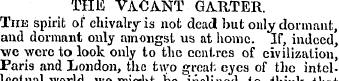
THIS VACANT GARTER . The spirit of chivalry is not dead but only dormant , and dormant only amongst us at home . If , indeed , we were to look only to the centres of civilization , Paris and London , the two great " , eyes of the intellectual world , we might be inclined to think that chivalry was dead and buried—that it had become an antiquity , a tradition—a memory as antiquated as the Lord Mayor ' s Show , and almost as foolish . A gentleman no longer wears a sword , imil one consequence is , that m assemblies where gentlemen meet , language is used , taunts arc uttered , which would , in better days , have been kept m check . Good taste can always restrain the real gentleman ; hut now that society has adopted a general uniform without the sword , tlierc is no distinction hetwemi
the gentleman and the bully . The sword is left entirely to the soldier , which in England moans cither a man of high birth who can purchase rank m the avniy , or a professional man who is liable to ho sent abroad in order to serve as police for colonies . In France the soldier has become a caste , and so completely has the spirit of chivalry died out there under the futnl breath of despotism , that forty soldiers can form a conspi mcy to light successive duels with one man until he shall be killed . His faithful quittnncc in tho first battle , his apology , his bravery , his manly candour , go for
nothing . In England , we say a gentleman and officer ; in France , the phrase has oeen translated an officer and a butcher . France and England have adopted widely different forms of the anti-chivalric—1 ranee the brutal England the effeminate . In France , the soldier ' who is pampered with wines , trained to run , drilled to trample on his own country , takes the brutal form of the anti-chivalric . In England , the march of in . tellect has put down our national sports . The police forbid boxing in the streets , or elsewhere in public . If men still go to look at liorse-races , it is no longer to see the finest types of horseflesh trying the wind of the men that ride them , but it is to see
swindling bets settled in a few seconds by gallo . ways trained to run short distances , the very men who go down to witness the sport wearing Teils against tho sun and dust , as women alone used to do . If we look into the mirror which Art holds up to Nature at the present moment in England , -what anti-chivalric forms fill its dull plain!—but how extolled is the truthfulness of the painting . No picture has ever been so crowded by siglit-seers as Frith ' s Epsom Race-course . A policeman is stationed to prevent the picture being destroyed by its admirers . And what , is therein it ? A crowd , a heap of faces moved by small and superficial emotions ; - —amusement , the comedy of life ; jiot a particle of interest , not a shadow of feeling .
At every step the anti chivalrie meets us . We come upon it in high places as in low . We go into Parliament and find the authenticated statesmen of the day fighting to maintain the principles of their quondam opponents , because Tones can keep pace only so long as they uphold Liberal principles . We find leading Liberals . making the agonized empire of India mere pretext for recovering place . If Mr . "Vernon Smith commits the equivocal mistake of suppressing- a letter , his censors are nioic at fault : he stumbles , and then there is a competition to kick him , becemse he is down . We look for the patriots in Committee-room NoV 11 , and find
that they cannot hold together even , to the number of a score , for want of anything like patriotic object , national purpose , or fixed purpose of any kind . The fact is , that each man is thinking of "what lie can do best for himself , or how he can best display himself . We go to still higher places . The Queen is holding . a Chapter of the Garter . Around her stand some old gentlemen who have never drawn a sword , admitting another old gentleman to be one of the order whose motto is Ho / ii soil' qui mal ij poise , because , he has been a sharp-tongucd partisan , and adds to that chivalrous quality high rank not earned by himself , and great wealth .
Philosophers tell us that the day of chivalry is gone , because the time is passed when the sword decided anything . Oh ! blind that they are ! ' Why , at this moment-, Europe is governed by the sword , held by men who are death to ideas , who hate the very name of ideas , who will send their police after any single idea , if they hear that one is lurking in the purlieus of their capitals . Civilization has not suppressed chivalry , it has shrunk away from it ; and by withdrawing nobility and intellect from those who lield the sword , it has divorced understanding and heart from the brute strength which rules tlic world -. and that is the result of modem
political philosophy . Tlic sword is held by lladetsky or Hyene , while a Gladstone preaches ideas enough to stimulate insurrection , or to lead ou a Sardinia —for a British Grand Cross of the Bath to abandon . But tho spirit of chivalry is not dead , it is only abroad . In our own day wo sec Yicfor Emmanuel surrounded by great ; powers , abandoned by great powers , and not quailing for an instant , we sec ii Camillo Cavour generously proclaiming bis predecessor , Massimo d'Azcglio , whose ideas lie has adopted and so magnificently carried forth . We sec a James Outram , waiving hi , s rank , serving" under Havclock and afterwards , when he has received , his command , forgetting his own exploits to expatiate on
the help which he has had from others . \\ c see a llavelock , marching through hordes of the enemy , braving death , misconstruction , defeat , apparent hopelessness , not ; only to fulfil the cause of duty , but to prove , that , hope and cll ' ort ; never leave the heart of a gontleiuan . And there is the chivalry , too , of womanhood faithful unto death , we see Heleno d'Orleans preserving patiently , through a whole life , tho mission bequeathed to her b y her husband ; maintaining , single-handed , the dignity of a dynasty unabated for her son : a patrimony which the successful despot ; could not confiscate . No ; the order of the Garter , by - \ vhich _ the world should be ruled , is not extinguished , —it ia only vncant .
Untitled Article
496 THE : LEaDER . [ Ko . 426 , May 22 , 1858 .
Untitled Article
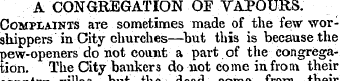
A CONGREGATION OF VAPOURS . Complaints are sometimes made of the few worshippers in City churches—but this is because the pew-openers do not count a part of the congregation . The City bankers do not come in from . their country villas—but the dead come from their graves . There are , it is calculated , about " sixteen thousand corpses beneath the pews occupied in the City churches by Sunday congregations . " The vaults are so badl y secured that the dead burst their cerements and join the congregation . How ? not to the sight ? Very nearly so , but at least to the smell . " It is generally noticed at . night when the church is lighted up with gas , and the warm rarefied air rises out of the church and draws from the
graves and vaults the mephitic gases , which have accumulated during the week . " What an idea to preside over evening prayer ? the gases from the corpses of old parishioners stealing out to the accustomed pew , hovering over the old prayer-book , perhaps coining with a kind of memory , making sick and faint to the orphan daughter , or the bereft widow . " Here is fine revolution , ail we had the trick to see it : " a City vampire coming from the grave to stiflle his own children . But fancies and fictions are pale beside the simple fact told by Dr . Letheby , in his Sanitary Report , published this week
•"In some cases the effluvium from the vaults is most offensive , for although it is the general practice to confine the body in a lead coffin , yet the metal gives way after a longer or a shorter time , and there oozes out a dark treacle-like liquid , TV-liich stinks abominably , and which is , I believe , a most deadly poison . I lave seen tills escaping from a lead coffin that bad been deposited in the vault for more , than a hundred years—so that there is no saying for how long a time the mischief of decay and slow corruption may be carried on . "
A hundred years ! Poisoned by a great-grandfather , to whose portrait in the dress of tie period we look with veneration ! In one of her pleasing letters , Miss Anna Seaward ( a blue-stocking of the last century , whose name all our readers may not have heard ) gives a story of the plague renewed in a country village by digging up clothes over a hundred years buried in a plague graveyard : so immortal are some essences of poison . But the City congregations have only themselves to blame .
" In many cases the vaults are entered by imperfectly closed traps or doors from the general area of the church , and the vaults are either not ventilated at all , or they are ventilated into the public way , so that there streams out incessantly a poisonous vapour . " In most cases , " Precaution is taken to shut in the vapours by means of stone and cement ; but so powerful in its action is the diffusive law of gases , that , with all our precautions of wood , and lead , arid stone , the vapours ' will find an outlet , and will mix with tlie surroundi ng atmosphere . The remedy , therefore , for the evil is to divert the gases from tlie vaults into a proper channel , and by conveying them through a shaft to a high level they may he safely disposed of . "
We have neglected the dead , and they have made a . terrible retaliation . May we not in imagination trace the dust of an energetic vestryman until we find it stiflinpr a churchwarden ? ¦ .
-
-
Citation
-
Leader (1850-1860), May 22, 1858, page 496, in the Nineteenth-Century Serials Edition (2008; 2018) ncse.ac.uk/periodicals/l/issues/vm2-ncseproduct2243/page/16/
-